
Guide to Your Half Crown 1967 Value
Posted by: Ian Stainton • 12 May 2026
You open a drawer, a tin, or an old coin jar and spot a large British coin dated 1967. It looks important. It feels older than decimal coins. Then the obvious questions follow. Is it rare? Can you still spend it? Is it worth keeping, selling, or exchanging with other leftover currency?
For many people, the half crown 1967 sits in an awkward middle ground. It's old enough to be interesting, but common enough that most examples aren't high-value collector pieces. That doesn't make it worthless. It means you need the right route.
Your 1967 Half Crown What Is It and Can You Exchange It

A 1967 half crown is a pre-decimal British coin from the final circulation year of the denomination. It can't be spent in shops today, but it can still hold exchange or collector value depending on condition.
Quick answer: The half crown 1967 was the last circulation issue of the denomination, and circulated examples are usually modest in value rather than rare. If you have one, it's no longer legal tender, so a bank won't treat it like current money. A specialist exchange route is usually the practical option, especially if it's part of a mixed bundle of old or leftover coins. For coin-specific guidance, see this half a crown exchange page.
That's where many people get stuck. They assume an old British coin must be accepted somewhere over the counter. In practice, old coins often fall into the same category as leftover foreign currency. They're real money from another time, but not usable in day-to-day spending.
Why people get confused
The half crown looks official because it was official. It was struck by the Royal Mint, used in circulation, and formed part of everyday spending for years. So it feels like a bank should accept it.
Banks and ordinary exchange counters tend to focus on current, spendable money. Old denominations, withdrawn notes, and coins no longer used in shops usually need a more specialist process.
The simple version
If you've got a single coin, you may want to check whether it's collectable. If you've got a jar, folder, charity bag, or mixed lot of old UK and overseas money, the goal is usually more practical:
- Confirm what it is
- Check whether it has collector appeal
- Exchange it if you don't want to keep it
That same approach works whether you want to exchange foreign coins, convert old British money, or deal with mixed holiday change and withdrawn currency in one go.
The History and Context of the Last Half Crown
You find a broad old coin in a drawer, recognise the Queen, and assume it must be either valuable or still redeemable somewhere. The 1967 half crown sits in that awkward middle ground. It is historically important, widely kept, and very often worth more as something to exchange than as a rare collector piece.
Its importance comes from closing a chapter in British money. The 1967 issue was the last half crown struck for circulation before decimalisation reshaped everyday cash use in Britain. That gives the coin a clear historical role. It was part of ordinary spending right at the end of the old pounds, shillings, and pence system.
That point often causes confusion. People hear "last issue" and assume scarcity. In coin collecting, final-year status can add interest, but it does not automatically turn a common circulated coin into a high-value rarity.
What was a half crown worth
A half crown was worth 2 shillings and 6 pence, or 12.5p in decimal terms. In 1967, that was a useful everyday amount, not a token coin that people ignored at the bottom of a pocket. It had the kind of spending power that made it feel substantial in hand and meaningful in use.
A good comparison is a decent modern pocketful of change rather than a tiny denomination. That is why so many surviving examples show honest wear. These coins were used, passed from shop to shop, and handled as normal money.
The 1967 half crown is best understood as a working coin from the final moments of pre-decimal Britain.
Why 1967 marked the end
Decimalisation simplified the currency system. Instead of counting in shillings and pence under the old structure, Britain moved to a base-100 system in 1971. Coins such as the half crown belonged to the earlier method, so their place in daily life was coming to an end even before decimal day arrived.
That history explains why the coin still appears so often in family collections, charity donations, house clearances, and jars of mixed old money. People put these coins aside during the changeover, much as travellers put leftover foreign coins in a kitchen tin after a trip. Years later, the coins remain real pieces of monetary history, but they no longer function as current cash.
Historic, yes. Rare, usually no.
For collectors, the last circulating half crown has genuine appeal. For non-collectors, the more practical question is usually simpler: is this something to keep, or something to turn into cash?
In many cases, circulated 1967 half crowns are common enough that banks will not help and collector-to-collector selling is often not worth the effort for a single worn coin. That is where a specialist exchange service becomes useful, especially if the half crown is only one part of a larger bundle of obsolete British coins or mixed foreign change. The coin carries history, but for many people its best use is as exchangeable value rather than as a long-term collectible.
Identifying Your Coin Specifications and Design Details
A 1967 half crown is easy to misread at first glance. In mixed tins of old money, it often gets mistaken for a crown, a florin, or just "one of the big old British coins." Getting the identification right matters, because the right route for exchange depends on knowing exactly what you have.

For practical purposes, start with the features you can check in seconds. The 1967 half crown is a broad, solid-feeling pre-decimal coin in cupro-nickel, with a reeded edge and a formal heraldic design that looks very different from modern change. If you are sorting a larger batch, our guide to pre-decimal coin values can help you separate half crowns from other obsolete British coins before you decide what to send in.
What to check first
Use this quick identification checklist:
- Date. The reverse should show 1967.
- Diameter. A genuine half crown measures 32 mm across.
- Weight. It should weigh about 14.2 grams.
- Metal. The coin is cupro-nickel, not silver.
- Edge. The edge is reeded, with fine milled lines.
If your coin feels noticeably smaller or lighter, or the edge is plain, pause before assuming it is a half crown. Old British coins can look similar in photographs, but in the hand they differ a lot in size and finish.
What the front should show
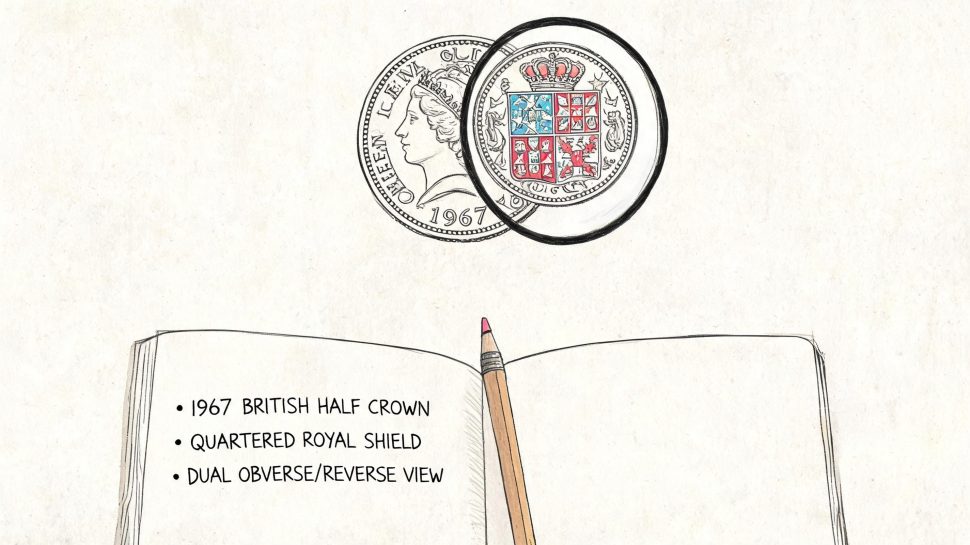
The obverse carries the young laureate portrait of Queen Elizabeth II, facing right. The portrait was designed by Mary Gillick.
Around the portrait, you should see the inscription ELIZABETH II DEI GRATIA REGINA. If that wording seems unfamiliar, it helps to read it as part of the coin's older style rather than as a sign that something is wrong. Pre-decimal coins often use abbreviated Latin inscriptions, much like older documents use formal wording that modern versions no longer keep.
What the back should show
The reverse features a quartered Royal Shield with a crown above it, plus E and R on either side. The design is associated with Edgar Fuller and Cecil Thomas.
Check for these details:
- Royal Shield in the centre
- Crown above the shield
- E on one side and R on the other
- HALF CROWN and 1967 below
This combination is the clearest visual marker. A large old coin with a shield is not automatically a half crown, but a 1967 coin with this exact layout usually is.
Why these details matter if your goal is cash
Collectors look closely at design details because small differences can affect desirability. Non-collectors need the same details for a different reason. Accurate identification prevents wasted time, rejected listings, and trips to banks that do not exchange obsolete coins.
That matters even more if the half crown came in with foreign coins, old banknotes, or a charity collection. Once you confirm the date, size, metal, and design, you can treat it for what it is: an obsolete British coin that may have modest collector interest in high grade, but is more often part of a practical exchange job. For circulated examples, that practical route is usually the useful one.
Grading and Valuing Your 1967 Half Crown
The value of a half crown 1967 comes down to two things. First, it's a common coin. Second, condition is key.
According to the Hackney Museum collection entry on the 1967 half crown, the coin is made from 75% copper and 25% nickel, which makes it more resistant to wear than earlier silver versions. That durability helps explain why many surviving examples still look decent, but it also means ordinary worn pieces remain common.
Why grade matters more than age
People often think age alone drives coin prices. With this coin, that's not enough. A well-worn example and a bright uncirculated one can sit in very different parts of the market.
Here's a practical guide.
1967 Half Crown Condition and Value Guide 2026
| Grade | Description | Estimated Value |
|---|---|---|
| VG | Clear date and main design visible, but obvious wear across portrait and shield | Around £0.20 |
| Fine | More detail remains, but circulation wear is still noticeable | Modest collector value |
| Uncirculated | No circulation wear, with full original lustre | £1.50 or more |
Those figures reflect the broad pattern confirmed by the museum source. Very worn pieces are usually low-value retail coins. Sharper examples with original brightness attract more interest.
What the grades mean in plain English
VG and Fine
A VG or worn Fine half crown has done its job in circulation. The date is readable. The portrait is still identifiable. The shield is present, but softer in places.
That's the kind of coin many people find in old jars or inherited collections. It still has value, but usually not enough to justify the effort of trying to market it individually as a collector item.
Uncirculated
An uncirculated example hasn't picked up the usual wear from pockets, tills, and handling. That means stronger detail and original lustre.
That's where collector premiums begin to appear. Even then, this is still a common final-year coin rather than a major rarity.
A useful rule is this. If the coin looks bright, sharp, and untouched, check it more carefully. If it looks clearly spent, think in practical exchange terms rather than jackpot terms.
When exchange makes more sense than selling one by one
If you have a single attractive coin, a collector route may be worth considering. If you have several circulated half crowns, or a mixed group of old British and overseas money, the exchange route is often simpler.
That's especially true when your coins form part of a broader pile of:
- leftover foreign currency
- old UK denominations
- withdrawn banknotes
- tourist change
- charity collections
If your aim is to exchange foreign coins and notes in one batch, the half crown fits naturally into that process.
For more context on old UK coin pricing, this pre-decimal coin values guide is a useful reference point.
How to Exchange Your Half Crown and Other Old Currency
You empty an old tin, spot a 1967 half crown, and wonder whether it is spending money, collector money, or just a curiosity. For many people, the answer is simpler than it first appears. A circulated 1967 half crown is usually not a coin a bank will take, and it is often too common to make a one-by-one collector sale worthwhile.
The practical reason is straightforward. The half crown was officially demonetised on 1 January 1970, before Decimal Day. As explained on this 1967 UK half crown value page, it no longer has legal tender status. That puts it in the same category as many old foreign coins and withdrawn notes. Interesting to own, but outside normal banking channels.

Why banks and bureaux usually say no
Banks and high street exchange counters are built for current money. They process notes and coins they can send back into circulation or balance through standard cash systems. A demonetised half crown does neither.
That creates a practical dead end for ordinary counter services. They often:
- cannot recirculate the coin
- do not price obsolete coins individually
- decline mixed coin deposits, especially foreign coins
- exclude withdrawn currency from everyday counter procedures
Collector markets can also disappoint people with circulated examples. If your coin is common, worn, and part of a larger pile of old cash, listing it on its own can feel like trying to sell a single book from a box of paperbacks. The item has some value, but the time and effort can outweigh the return.
How a specialist exchange process works
A specialist exchange process is designed for this situation. Instead of treating the half crown as a standalone collectible, it treats it as part of a wider conversion job. That is often the better fit for households, charities, schools, visitor attractions, and small businesses holding mixed old or foreign money.
1. Gather everything together
Start by pulling the half crown together with any other currency you no longer use. Common examples include:
- old British pre-decimal coins
- foreign coins left from holidays
- withdrawn banknotes
- charity tins with mixed change
- coins set aside from tills or cash drawers
This step matters because small, awkward amounts become more worthwhile when handled as one batch.
2. Choose the right exchange route
The key question is not only "what is this half crown worth?" It is also "who will process it?" Banks usually will not. Many collector buyers want better-grade coins or more specialist material. A service that handles obsolete and mixed currency solves the problem those routes leave behind.
If you want to exchange foreign coins and notes, the same route can usually cover the half crown as well, which saves you from splitting one old-money problem into several smaller ones.
3. Send the currency for checking
Once you have chosen the service, pack the coins and notes securely and send them for verification. That is much closer to a currency conversion process than a collector sale. You do not need to photograph every coin, write individual listings, or negotiate with buyers over a circulated common piece.
For non-collectors, this is often the point. The goal is cash conversion with less friction, not turning a worn half crown into a specialist auction project.
4. Receive payment, or donate the value
After verification, you can usually receive payment or send the value to charity, depending on the service. That option is especially useful for organisations that collect low-denomination or mixed currency over time and need a realistic way to turn dormant money into usable funds.
A circulated 1967 half crown often makes more sense as part of an exchange batch than as a solo collector listing.
Comparison of your main options
| Option | Best for | Limits |
|---|---|---|
| Bank or Post Office | Current, standard money | Usually not suitable for demonetised pre-decimal coins |
| Collector sale | Strong individual coins in high grade | Slow and often unrewarding for common circulated pieces |
| Specialist exchange service | Mixed coins, notes, withdrawn currency, bulk lots | Best for people who want practical conversion rather than item-by-item selling |
For many readers, that last route is the only one that matches the actual situation. The 1967 half crown has history behind it, but many surviving examples are ordinary circulated coins found in drawers, jars, donation pots, and inherited boxes. If your aim is to turn that kind of old money into usable cash, a specialist exchange service is usually the most workable answer.
Common Mistakes to Avoid With Old and Foreign Coins
Most errors happen before anyone even checks value. A little care saves time and avoids disappointment.
The mistakes that come up most often
- Cleaning the coin hard. Scrubbing, polishing, or using metal cleaner can reduce collector appeal. If you think a coin might be collectable, leave it alone.
- Assuming old means rare. The half crown 1967 is historically interesting, but many examples are common. Don't build your expectations around age alone.
- Assuming common means worthless. A modest individual coin can still be worth including in a mixed exchange. Small amounts add up, especially in bulk.
- Sorting everything too aggressively. If you've got bags of mixed coins and banknotes, spending hours making perfect categories often isn't necessary for a specialist exchange route.
- Taking old currency to the wrong place. Banks, ordinary bureaux, and retail counters often aren't set up for obsolete coins or mixed foreign change.
- Overlooking donation options. If the amount is small or the currency is mixed, directing the value to charity can be more satisfying than leaving it in a drawer.
A better approach
Handle old coins gently. Keep like items together if that's easy. Separate anything that looks especially sharp or unusual. Then treat the rest as a practical exchange job.
If a coin is common and circulated, convenience matters. If a coin looks exceptional, pause before exchanging it and assess it properly.
That one habit prevents most avoidable mistakes.
Frequently Asked Questions About Exchanging Old Coins
A common situation looks like this. You find a 1967 half crown in a drawer, then notice it is sitting beside old holiday change, a few foreign notes, and coins no shop or bank counter seems interested in. At that point, the question is usually less about history and more about what can still be turned into money.
Can I exchange foreign coins at a UK bank
Usually, not in any practical way. UK banks often limit what they accept, and foreign coins, mixed currency, and withdrawn issues are commonly outside that service. If you want to exchange foreign coins and notes, a specialist service is often a better fit for this purpose.
Can I still spend a 1967 half crown in shops
No. A 1967 half crown is a pre-decimal coin that no longer circulates, so ordinary tills and retailers will not accept it as spending money.
Do old withdrawn coins still have value
Sometimes, yes. The value can come from collector interest, metal-free exchange value through a specialist service, or from being included with a mixed batch of old and foreign money. In simple terms, an obsolete coin can still be useful even when it is no longer spendable.
Is the half crown 1967 rare
Usually not. It is better understood as a common coin with historical interest because 1967 was the final year of issue before decimal change. That makes it a good conversation piece, but circulated examples often have practical exchange value rather than strong collector value.
What if I have mixed coins and banknotes from different countries
That is very common, especially after travel, house clearances, fundraising collections, or sorting family belongings. People rarely end up with one neat group of identical coins. They usually have a mixed jar. A specialist service can process that kind of bundle more efficiently than trying to solve each item one by one, so it can be a sensible way to convert foreign coins and banknotes together.
Can I exchange leftover currency without sorting every coin
Often, yes. Some services accept unsorted or lightly sorted currency, which saves time if you are dealing with a tin, charity bag, travel wallet, or office collection. It works a bit like taking mixed recycling to the right centre. The service does the detailed separation so you do not have to do all the preparation yourself.
Can I donate foreign coins to charity instead of cashing them in
Yes. That can suit individuals, schools, churches, clubs, and charities that collect small amounts of unwanted currency. If you would rather donate foreign coins to charity than receive the proceeds yourself, some exchange services let you direct the value to a charity partner.
Who uses specialist currency exchange services
Collectors are only one group. Private individuals use them after trips abroad or when clearing out old drawers. Charities use them because donors often give mixed foreign coins that banks will not handle. Businesses, visitor attractions, and travel-related organisations also use them when they receive coins and notes that fall outside normal banking channels.
How long does payment take
That depends on the provider and the method used. Postal exchange services usually need to receive the currency, check it, and confirm what qualifies before payment is issued. If speed matters, check the stated process before you send anything.
What if I'm unhappy with the valuation
Look for a provider that explains its rates and return policy clearly before you post your currency. Transparency is what turns a confusing pile of old money into a simple transaction. That matters especially with mixed or withdrawn items, where the primary benefit is clarity, convenience, and a realistic route to cash when banks and collector buyers are unlikely to help with ordinary circulated pieces.
If your 1967 half crown is one of many common old coins rather than a collector-grade example, a specialist exchange service can be the practical answer. The same applies if you are holding mixed holiday change, obsolete UK coins, or donation pots full of foreign currency that no bank wants to process.