
How Much Does a UK Penny Weigh in 2026?
Posted by: Ian Stainton • 16 Jul 2026
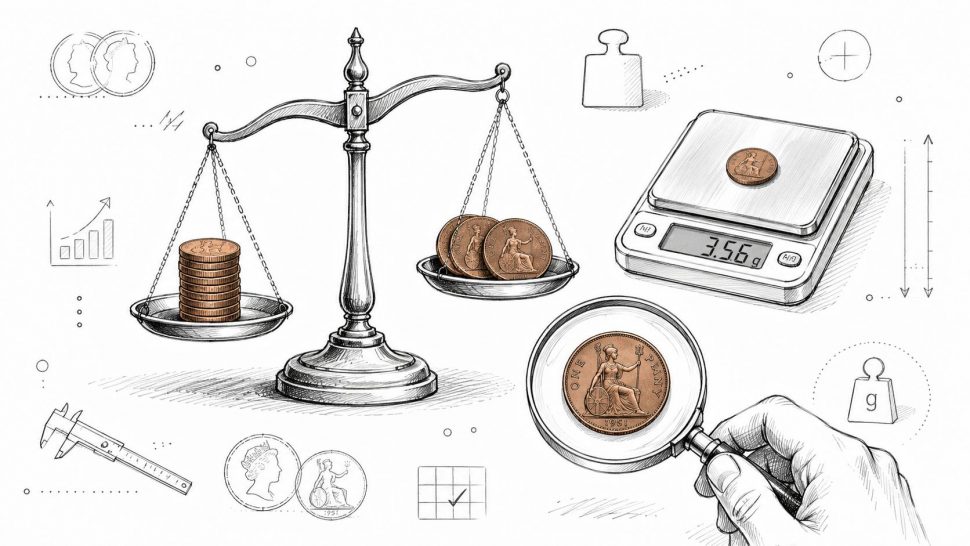
A modern UK decimal penny weighs 3.56g, and the older pre-decimal penny weighs 9.4g. In practical terms, that means a 1p coin from the decimal era introduced in 1971 is far lighter than a pre-decimal penny used from 1860 to 1970.
That sounds like a pub quiz fact until you find a jar of coins in a drawer, a box of old change after a house clear-out, or a mixed pile of British and foreign money left back from travel. At that point, weight stops being trivia and starts becoming useful. If you want to know how much does a UK penny weigh, you probably also want to know whether that pile can be counted, identified, donated, or turned into cash without spending an evening sorting it by hand.
How Much a UK Penny Really Weighs
A lot of people ask this after lifting something heavier than expected. It might be a biscuit tin full of 1p coins, a charity collection tub, or an old money box that clearly contains more metal than value at first glance.
The short answer is simple. A modern decimal 1p is light. An old penny is not. That difference matters because mixed coin collections often include both, especially in homes that still have old British coins alongside leftover foreign currency.
What the answer means in real life
One modern penny on its own doesn't change much. A large quantity does. Coin exchange services, charities, businesses, airports, and retailers all run into the same practical issue. Loose coins build up, they aren't sorted, and nobody wants to count them one by one.
Practical rule: When coins arrive in bulk, weight is often the fastest starting point for working out what you've actually got.
That is especially true when the collection isn't neat. A jar may contain decimal pennies, older British coins, and foreign change from years of travel. In those cases, people usually need a realistic route to exchange leftover currency, not another basic definition.
Why so many people search this in the first place
The search usually starts with curiosity and ends with a bigger question:
- Found money from a clear-out: Old drawers, loft boxes, and inherited tins often contain mixed coins.
- Leftover holiday money: Small denominations are the hardest to spend and the least likely to be accepted by banks.
- Charity collections: Unsorted donations often include UK pennies, foreign coins, and withdrawn notes.
- Business tills and counters: Shops and attractions sometimes receive foreign change in error and it accumulates.
That is why the useful answer isn't just the weight. It's what the weight helps you do next.
UK Penny Weights and How to Identify Them
If you're comparing coins from a jar or money box, the easiest mistake is assuming every copper-coloured British penny is the same. It isn't. The UK has two main penny types that people commonly confuse in old collections.

The modern decimal penny
The modern British decimal one penny coin has a mandated weight of exactly 3.564 grams, with a tolerance of ±0.0750 grams under Royal Mint specifications, and that standard supports reliable use in automated sorting and vending systems according to the Royal Mint one pence coin designs and specifications.
It was introduced during decimalisation. The decimal version is the coin people recognise from current circulation and recent decades of everyday use. It is made from copper-plated steel, which is one reason it feels different from older bronze pennies. If you want more background on materials, this guide on what UK pennies are made of is a useful companion.
The pre-decimal penny
The pre-decimal penny is much heavier. It weighed 9.4 grams and circulated from 1860 to 1970, as outlined in the history and specifications of the British pre-decimal penny).
These older coins are usually larger and more substantial in the hand. They were minted across multiple monarchs, so the portrait changes, but the overall impression is consistent. They look older, feel heavier, and stand out quickly once you've handled both types side by side.
Quick ways to tell them apart
If you're sorting a mixed batch, these checks are the most practical:
- Check the date: Coins from the decimal era are the modern 1p. Older pieces dated before decimalisation may be pre-decimal pennies.
- Feel the weight: The older penny is noticeably heavier.
- Look at the size: Pre-decimal pennies are generally broader and more imposing.
- Notice the finish: Modern 1p coins have the look of copper-plated steel, while older pennies have the appearance associated with bronze coinage.
| Feature | Modern Decimal Penny (1p) | Pre-Decimal Penny (1d) |
|---|---|---|
| Name | One penny, 1p | Penny, 1d |
| Era | Decimal era, introduced in 1971 | Used from 1860 to 1970 |
| Standard weight | 3.564g | 9.4g |
| Tolerance | ±0.0750g | Not needed for most household identification |
| Composition | Copper-plated steel | Bronze alloy |
| First impression | Smaller, lighter, familiar | Larger, heavier, historic |
| Best household identifier | Date and lighter feel | Size, date, and heavier feel |
If a coin feels surprisingly heavy for a penny, stop and check it before treating it as ordinary loose change.
Why Your Penny's Weight Actually Matters
A single penny tells you very little. A jar, carrier bag, charity tub, or office clear-out full of pennies tells you you have a handling job on your hands, and weight is the quickest way to size it up.

Bulk coins create practical decisions
Once coins build up, the question stops being "what does one penny weigh?" and becomes "is this worth counting, carrying, posting, or exchanging?" Weight helps answer that fast. It gives you a rough sense of quantity, the likely postage band, and whether a mixed batch is small enough to deal with at home or better sent to a specialist.
That matters because loose change often arrives in bulk and out of order. We see jars mixed with coppers, silver-coloured coins, foreign pieces, old UK coins, arcade tokens, and the odd banknote folded in with them. Counting every piece by hand is possible. It is rarely the best use of time.
Weight gives you a realistic first estimate
For household savers, charities, schools, pubs, and small businesses, weight is often the first useful checkpoint. It helps you avoid spending an evening sorting low-value coins just to discover the collection is awkward to bank and expensive to carry.
A practical reference helps here. If you need a rough guide before packing or sending coins, this UK coin weight guide makes planning easier.
Low-value coins become a packing, storage, and processing problem long before they become a counting problem.
Why services use weight-based handling
Banks and high street counters usually prefer current, sorted money in tidy quantities. Mixed coin lots are different. They take time to verify, take space to store, and often include coins that are no longer in circulation or were never spendable in the UK to begin with.
Weight-based exchange services solve the problem from the practical end. Instead of expecting perfect sorting, they are built to receive bulk coin collections, assess them efficiently, and turn neglected change into real cash value where possible.
| Situation | Why weight matters | Better approach |
|---|---|---|
| Household penny jar | Shows whether the total is worth posting or combining with other coins | Weigh the jar first, then decide how to exchange it |
| Charity or school collection | Helps with packing, courier planning, and volunteer time | Keep mixed donations together and process in bulk |
| Business or till clear-out | Reveals how much metal is involved before staff start counting | Use a service that accepts mixed coin volumes |
The key trade-off is simple. Hand-sorting may save a service fee in some cases, but it costs time and increases the chance of mistakes. For large, unsorted coin collections, weight is often the faster route to getting value out of money that would otherwise sit untouched.
How to Exchange Coins by Weight Step by Step
The easiest process is the one that removes manual sorting. If you've got coins, notes, old UK money, or leftover foreign currency, the practical route is simple.

Start with what you already have
Don't overprepare. Time is often lost by trying to make the collection perfect before doing anything with it.
Gather everything together
Put coins, banknotes, old holiday money, and withdrawn currency in one place. Check drawers, travel wallets, charity tins, glove boxes, and storage jars.Separate only if it's obvious
If modern coins, old coins, and notes are already grouped, keep them that way. If not, don't spend hours forcing order onto a mixed lot unless a service specifically requires it.Get a rough weight if you can
A kitchen scale is usually enough for household planning. For charities and businesses, a parcel scale can be more practical.
Use a specialist service, not a high street guess
Most high street banks and exchange bureaux are built around current banknotes, not tubs of low denomination coins or discontinued money. They usually don't want the counting time, storage, transport, or verification work that comes with mixed coin deposits.
A specialist process is usually closer to this:
- Check accepted currencies: Make sure the service handles coins, notes, and withdrawn currency.
- Use the online tool: A proper wizard or calculator should let you estimate or submit without unnecessary fuss.
- Send securely by post: Pack tightly, avoid damaged packaging, and follow the provider's instructions.
- Receive payment after verification: Good services keep the process straightforward and transparent.
For people with mixed travel money, it's much easier to exchange foreign coins and notes in one process than to try separate routes for each type.
What works and what doesn't
Trade-off: Sorting everything perfectly can feel organised, but it often wastes time if the exchange service already handles mixed submissions.
What works:
- keeping everything together
- using a service that accepts coins and withdrawn currency
- packing securely
- checking rates and process before posting
What doesn't work:
- assuming your bank will take foreign coins
- spending hours hand-counting very low denominations
- throwing old or withdrawn currency away because it looks unusable
Common Mistakes to Avoid With Old Coins
The biggest mistake is assuming old coins are worthless because you can't spend them in a shop. Spendable and exchangeable aren't the same thing. Plenty of old or unusual coins still have value when handled by a specialist.
Mistake one is treating them like junk
People clear a drawer, see old pennies or leftover foreign change, and either leave it there for another year or throw it out. That is usually the wrong call. Old money often needs the right route, not a local till.
Mistake two is taking them to the wrong place
Banks and travel money counters tend to focus on current notes and standard retail-friendly transactions. Coins are bulky, expensive to handle, awkward to count, and often outside their process if they're foreign, mixed, or withdrawn.
That is why many people hit a dead end with normal banking channels even when the money still has exchange value.
Mistake three is over-sorting
You don't need to turn a kitchen table into a coin room. If the goal is to exchange foreign coins, exchange leftover currency, or process a mixed charity collection, over-sorting can waste hours.
A better approach is:
- Keep obvious groups together: Notes with notes, loose coins with loose coins.
- Avoid cleaning old coins: Rubbing or polishing can create problems, especially for anything older.
- Use labelled packaging: If you're posting multiple bags, basic labels help.
- Choose a specialist: That matters most when coins, banknotes, and withdrawn currency are all mixed together.
A lot of value gets stranded simply because people try the wrong route first.
Frequently Asked Questions About Exchanging Coins
Can I exchange foreign coins in the UK
Yes, but a specialist is usually the practical route. Ordinary banks and standard travel money counters often focus on current banknotes, while mixed foreign coins from holidays, charity collections, and business tills need a service set up to sort, value, and process bulk coin submissions efficiently.
Do banks accept foreign coins
Often, they do not. Foreign coins are costly to handle, awkward to count, and harder to return into the banking system than notes. That is why people with jars, bags, or boxes of overseas change regularly find that a bank can help with notes but not with the coins that make up a large share of the total.
Can I exchange old UK pennies
Yes, in many cases. Old UK pennies, including pre-decimal pieces, may still be accepted by a specialist service even though they are no longer spendable in everyday retail settings.
The practical point is not only what one penny weighs. It is what that weight helps you do when you have a large quantity of old coins. Weight can help identify coin types, separate older pieces from newer ones, and speed up the process of turning a mixed lot into a real valuation.
Does withdrawn currency still have value
Often, yes. A withdrawn coin or note can still hold exchange value through a specialist service, even after shops, banks, or bureaux stop handling it.
That matters for people clearing inherited money, old savings tins, shop back offices, or charity collections. Currency does not need to be current to be worth checking.
What if my coins and notes are all mixed together
That is normal. Coins and notes often arrive mixed by country, denomination, and age, especially after years in storage.
You do not need to make everything perfect before sending it to a specialist. Basic separation helps, but a key advantage of a weight-based coin service is that it can handle volume without expecting you to count every penny by hand.
Can I donate foreign coins to charity instead of taking payment
Yes. Donating foreign coins is a common option for leftover travel money, retail fundraising, airport collections, and community campaigns.
It is a practical choice when the amount is modest or when the goal is fundraising rather than personal payout. If the amount is larger, it is worth checking the exchange value first so you can decide whether donation or payment makes more sense.
How long does payment usually take
It depends on the provider and on what you send. Cleanly packed, straightforward submissions are usually quicker to process than mixed lots containing older coins, withdrawn currency, or items that need extra checking.
Good services explain the process in advance. You should be able to see how they assess the coins, how payment is made, and what happens if the contents differ from the original description.
Who uses these services
Travellers use them. So do charities, retailers, airports, attractions, police forces, and businesses that end up with coin volumes a normal counter service does not want to handle.
In practice, the bigger the pile, the less useful a simple answer like "a UK penny weighs this much" becomes on its own. The useful question is how to turn unsorted coins into cash without spending hours counting them manually.
If you've got loose change, old coins, banknotes from past trips, or mixed currency sitting unused, We Buy All Currency offers a straightforward way to exchange foreign coins, exchange leftover currency, or convert foreign coins and banknotes without the usual hassle. It accepts coins, notes, and withdrawn currency, and it's built for the situations where banks and exchange bureaux usually fall short.