
Discover how much is a 10 shillings note worth: Rarity, Condition & Selling Tips
Posted by: Ian Stainton • 2 Feb 2026
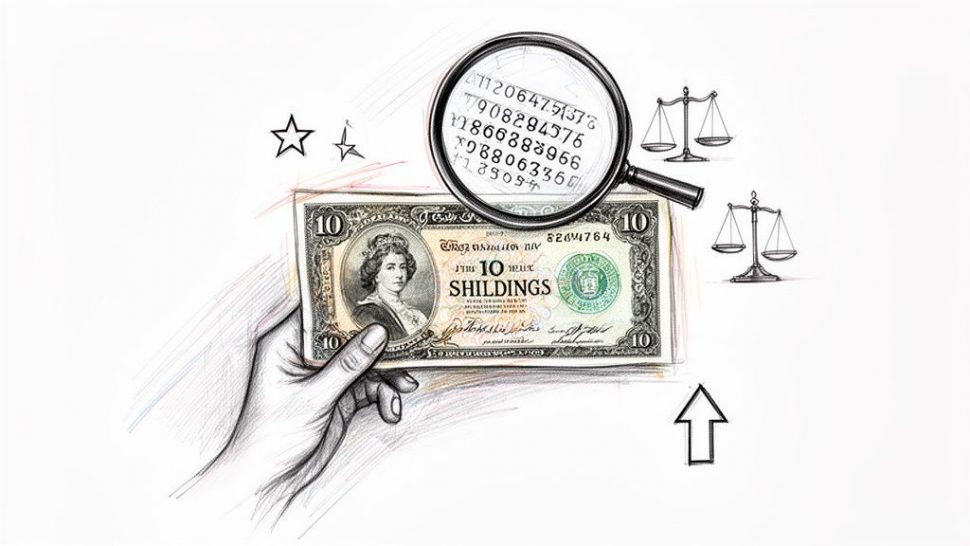
So, how much is a 10 shillings note actually worth? While its direct decimal equivalent is only 50p, its real value to a collector is often much higher. In today's market, these notes typically sell for anything from a few pounds to over £50 for the more sought-after examples. The final price really comes down to its age, condition, and rarity.
Unlocking the True Value of Your Ten Bob Note
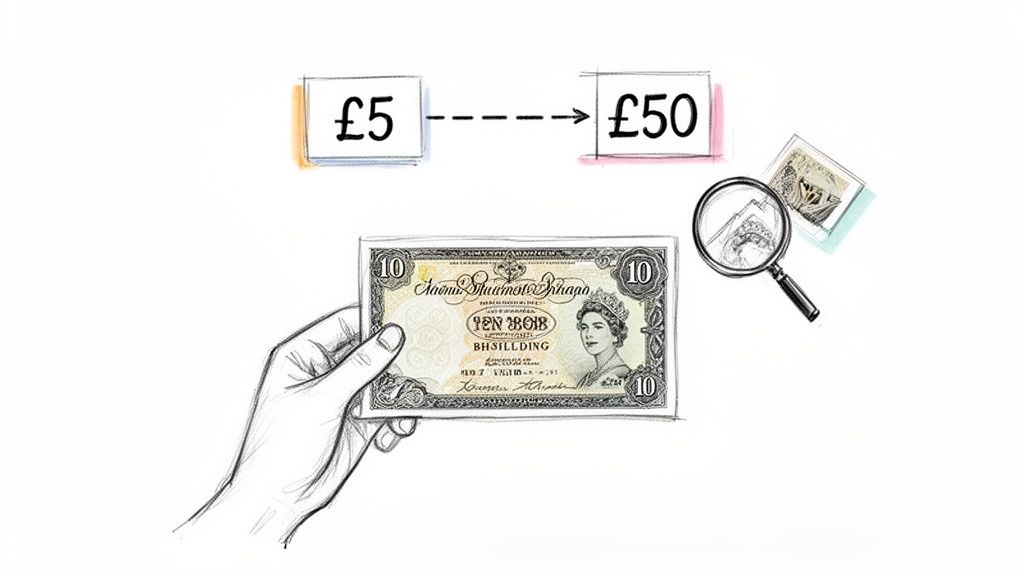
Have you found an old 'ten bob' note tucked away in a book or a forgotten drawer? It’s easy to assume it’s worth little more than its 50p face value, but that couldn’t be further from the truth. That bit of paper is a direct link to Britain's past, and its value is now driven by collectors, not its old spending power.
The Bank of England 10 shilling note, affectionately known as the 'ten bob', first appeared on 2nd April 1928. It was a staple of British life for decades until it was withdrawn from circulation on 22nd November 1970, making way for the 50 pence coin as the country switched to decimal currency.
While you could once pop into the Bank of England to exchange them, their collector value today is almost always much higher. To give you a quick idea, here's a simple breakdown of what you might expect.
10 Shilling Note Value at a Glance
This table offers a snapshot of potential values for different 10 shilling notes, depending on their era and general condition. Keep in mind, these are typical ranges and a particularly rare or pristine note could fetch much more.
| Note Type / Era | Condition | Typical Collector Value Range | Face Value (Decimal Equivalent) |
|---|---|---|---|
| Early Issues (1928-1930s) | Good to Very Fine | £15 – £60+ | 50p |
| Wartime Emergency Issue | Very Fine to Uncirculated | £10 – £40 | 50p |
| Post-War Issues (1948-1960s) | Worn / Circulated | £1 – £5 | 50p |
| Post-War Issues (1948-1960s) | Crisp / Uncirculated | £5 – £25 | 50p |
As you can see, the difference in value can be quite significant. It really pays to understand what you're holding.
From Pocket Money to Prized Collectable
So, what exactly turns a simple banknote into a valuable item? It’s really a mix of a few key things:
- Condition is King: A crisp, unfolded note that looks like it just came from the bank is worth far more than a worn, creased one that’s seen better days.
- Age and Rarity Matter: Earlier issues or those signed by less common Chief Cashiers are always in high demand with collectors.
- Unique Serial Numbers: Keep an eye out for special serial numbers. Very low digits, like 000001, or interesting patterns can boost the price dramatically.
Understanding these details is the first step in figuring out if you're holding onto pocket money or a genuine piece of history.
At We Buy All Currency, we make it simple. Our process is fast, easy, and completely hassle-free, letting you convert foreign coins and banknotes without needing to sort through them first. It’s a service trusted by major UK brands, including airports, police forces, supermarkets, and leading charities.
Whether you're looking to sell an old 10 shilling note or convert leftover foreign currency from a trip, we offer a 100% guaranteed service to give you cash for your currency. You can find out more in our detailed guide on where to sell old banknotes.
The Five Factors That Define Your Note's Value
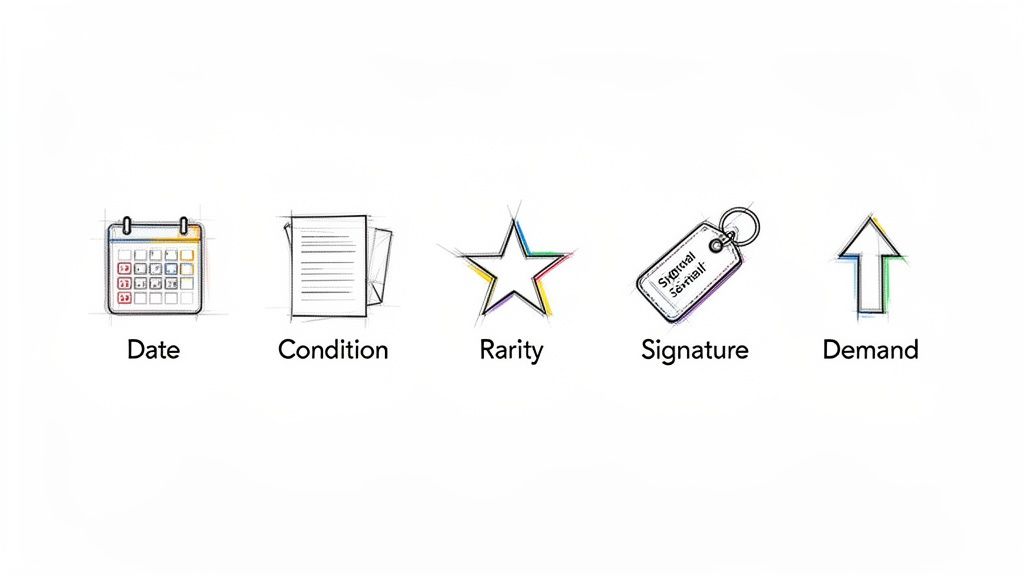
Figuring out what a 10 shillings note is worth is about more than its old face value of 50p. Think of it like a classic car; the model is a starting point, but its history, mileage, and condition are what really drive the price. The very same logic applies to your ‘ten bob’ note, where five key factors can separate a common piece of history from a collector’s dream.
Getting to grips with these elements helps you see your note through a professional's eyes. Each factor connects to the others, building a complete picture of its potential worth. By breaking them down, you can start to understand the story your note tells—and why collectors are willing to pay for it.
1. Date and Issuing Authority
The first clue to any note's value lies in its origin story: when was it printed, and who issued it? The very first 10 shilling notes weren't even printed by the Bank of England. During the First World War, the government issued emergency Treasury notes, often nicknamed 'Bradburys' after the Treasury Secretary, John Bradbury, whose signature they carried. These are genuinely rare and highly prized.
It wasn't until 1928 that the Bank of England officially took over, issuing its own series of notes. Identifying the series—from the early Britannia designs to the later portraits of Queen Elizabeth II—is a critical first step. Each design and era comes with a different level of scarcity and collector appeal.
2. Physical Condition and Grade
Condition is king. It's probably the single biggest factor influencing a note's value, and its grade can cause the price to soar or plummet, even for two notes from the same print run. While collectors use a detailed grading scale, you can think of it in simpler terms:
- Uncirculated (UNC): This is a perfect, flawless note. It’s crisp, with razor-sharp corners and vibrant colours, looking exactly as it did the day it left the press. It has absolutely zero folds or blemishes.
- Extremely Fine (EF): An almost-perfect note that might have one or two barely noticeable, light folds but otherwise looks brand new.
- Very Fine (VF): The paper still has its crispness, but you can see a few folds from light circulation. It's clean and has clearly been well looked after.
- Fine (F) to Poor (P): These notes have been through the wars. They might feel soft or limp, with heavy creases, small tears, stains, or even bits missing.
The value gap between a VF and an UNC note can be massive. A common note worth £5 in circulated condition could fetch over £50 if it’s in pristine, uncirculated shape.
The smallest details matter. A single, sharp centre fold can be the only thing separating an Extremely Fine note from a much more valuable Uncirculated one. This is why professional assessment is so important.
Handling your old notes and any leftover foreign currency with care is crucial for preserving their condition and, ultimately, their value.
3. Rarity and Series
Rarity isn’t just about age; it’s about supply and demand. How many notes of a particular type were printed, and more importantly, how many have actually survived? Some series had much smaller print runs, making them naturally harder to find today. For instance, the mauve-coloured wartime issue from the 1940s is a favourite among collectors, not just for its history but for the introduction of a metal security thread to foil counterfeiters.
Likewise, notes issued during the brief tenure of a specific Bank of England Chief Cashier are much scarcer than those from a cashier who had a long career. A little research into your note's specific series and issue date can reveal a lot about its original production numbers and how common it is today.
4. Signatures and Serial Numbers
The fine print on the note itself can hide real value. The signature of the Chief Cashier is a key identifier. Notes signed by cashiers with shorter terms, like J.Q. Hollom (1962-1966), are often rarer than those signed by longer-serving figures such as J.S. Fforde (1966-1970).
The serial number is another treasure map for collectors. Keep an eye out for special numbers, including:
- Low Numbers: A prefix like 'AA01' followed by a very low number (e.g., 000007) is extremely desirable.
- Replacement Notes: If a note was damaged during printing, it was replaced with a special one. These often have a distinct prefix, like 'M', and are much rarer than standard notes.
5. Market Demand
At the end of the day, a note is only worth what someone is willing to pay for it. The collectors' market is always moving, with trends shifting over time. A note series that’s popular today might be less so in a few years, and vice versa. Current demand, influenced by forums, auction results, and even historical anniversaries, plays a huge part in setting the final price.
This is where turning to a trusted expert makes all the difference. At We Buy All Currency, we handle everything for you. Our service is fast, easy, and hassle-free. There’s no need to sort your coins or notes; just send them to us for a 100% guaranteed valuation and payment. We are trusted by major brands, including supermarkets, airports, charities, and police forces, to exchange foreign coins and notes efficiently.
To get started, simply visit our homepage and see how easy it is to turn your old currency into cash.
A Collector's Guide to 10 Shilling Note Designs
The design on a 10 shilling note is much more than just a pretty picture; it's a window into British history. Every series tells its own story, from wartime emergencies to leaps in technology, and knowing these stories is the key to understanding a note's true value. This trip back in time isn't just a history lesson—it’s a practical guide to figuring out how much is a 10 shillings note worth.
This visual history is what gives any old UK currency or leftover foreign currency its unique identity and, ultimately, its value to a collector.
The Emergency Treasury Notes of WWI
It’s hard to imagine now, but before 1914, the smallest banknote you could get from the Bank of England was a £5 note—a huge sum for the average person. When the First World War broke out, it created a financial panic, forcing the government to step in and issue its own emergency Treasury notes for ten shillings.
These first notes, nicknamed 'Bradburys' after the Treasury Secretary who signed them, were a game-changer. Their simple design was a radical departure from the norm, marking a massive shift in British money. Because of their age and what they represent, they're highly prized by collectors, and even well-used examples can be surprisingly valuable.
The Famous Wartime Mauve Issue
The mauve-coloured note issued during the Second World War is probably the most famous design of all. Its real claim to fame was the introduction of the world's first metal security thread, a clever and direct response to Operation Bernhard—the Nazi plot to flood Britain with high-quality fakes and crash the economy.
This single feature made the 'mauve' note a landmark in banknote technology. Collectors are naturally drawn to its incredible story of wartime ingenuity, which is why it remains such a popular and valuable piece. The design was later reissued in brown in 1948 and stayed in circulation for over a decade.
In terms of collector value, a slightly worn standard Bank of England 10 shilling note typically trades well above its original face value equivalent of 50p, with prices ranging from £5 to £20 or higher depending on series, condition, and rarity. For instance, Series A wartime issues from 1940, featuring the innovative metal security thread in mauve and grey, or the 1948 brown reissues, appeal to history buffs for their role in thwarting WWII counterfeits. You can discover more insights about the value of these historic notes on JustAnswer.
The Final Series Queen Elizabeth II Portrait
The last and most familiar design arrived in 1961. This 'Series C' note was groundbreaking because it was the first 10 shilling note to feature a portrait of the reigning monarch, Queen Elizabeth II. With its modern, brown-coloured design and Sir Walter Raleigh on the back, it’s the version most people picture when they think of a "ten bob note."
Millions of these were printed right up until decimalisation in 1970, so they are the most common type you'll come across. Their value, however, still comes down to their condition.
Here's a quick breakdown of what you might expect for this final QEII series:
- Common, Circulated Condition: A note that's obviously been through a few hands, with folds and soft paper, could be worth between £5 and £20.
- Crisp, Uncirculated Condition: A pristine example that looks like it just came from the bank can fetch a much higher price, often in the £30 to £50 range, especially if it has an early serial number.
To help you compare the key issues at a glance, we've put together this quick reference table. It highlights what makes each series distinct and gives you a realistic idea of what collectors are looking for.
Comparing Key 10 Shilling Note Issues
| Series / Year | Key Features | Rarity Factor | Estimated Value (Very Fine Condition) |
|---|---|---|---|
| Treasury (1914-28) | Known as 'Bradburys'. Simple design, signed by Treasury Secretary. | High – Oldest series, fewer survive. | £30 – £100+ |
| Series A (1940-48) | Mauve/grey. First note with a metal security thread. WWII historical link. | Medium-High – Historically significant. | £20 – £60 |
| Series A (1948-61) | Brown reissue of the wartime design. | Medium – Circulated for over a decade. | £15 – £40 |
| Series C (1961-70) | First to feature Queen Elizabeth II. Sir Walter Raleigh on reverse. | Low – Printed in huge numbers, very common. | £10 – £30 |
As you can see, the story behind the note is just as important as its condition. The older and more historically significant the note, the more likely it is to command a higher price.
No matter the design, if you have old ten bob notes or want to exchange foreign coins and notes, the whole process can feel a bit daunting. We make it simple. Our service is designed to be fast, easy, and completely hassle-free.
You don't even need to sort through your currency; just send your collection to us. We’re trusted by major organisations, including police forces, national charities, and supermarkets, to handle currency exchanges with total professionalism. Our 100% service guarantee ensures you get a fair and clear valuation for everything you send, from common holiday change to rare banknotes. Whether you want to cash in or donate foreign coins to charity, we provide a solution you can rely on.
Ready to turn your old currency into cash? Visit our homepage to get started.
What Ten Bob Could Actually Buy Back in the Day
To really get a feel for what a 10 shillings note is worth, you have to imagine yourself stepping back in time. Today, we see it as a collector's piece, but for decades, this note was a workhorse of the British economy. Its value wasn't in its rarity, but in what you could actually stick in your shopping basket.
Understanding its historical purchasing power paints a much richer picture. It’s one thing to know what a collector might pay for it now; it's another thing entirely to grasp what that note meant to someone bringing home their weekly wage. This context is key to seeing how "ten bob" went from a simple tool for daily life to a treasured piece of history.
This timeline shows the main design changes of the 10 shilling note, from its emergency wartime origins right through to its final issue featuring Queen Elizabeth II.
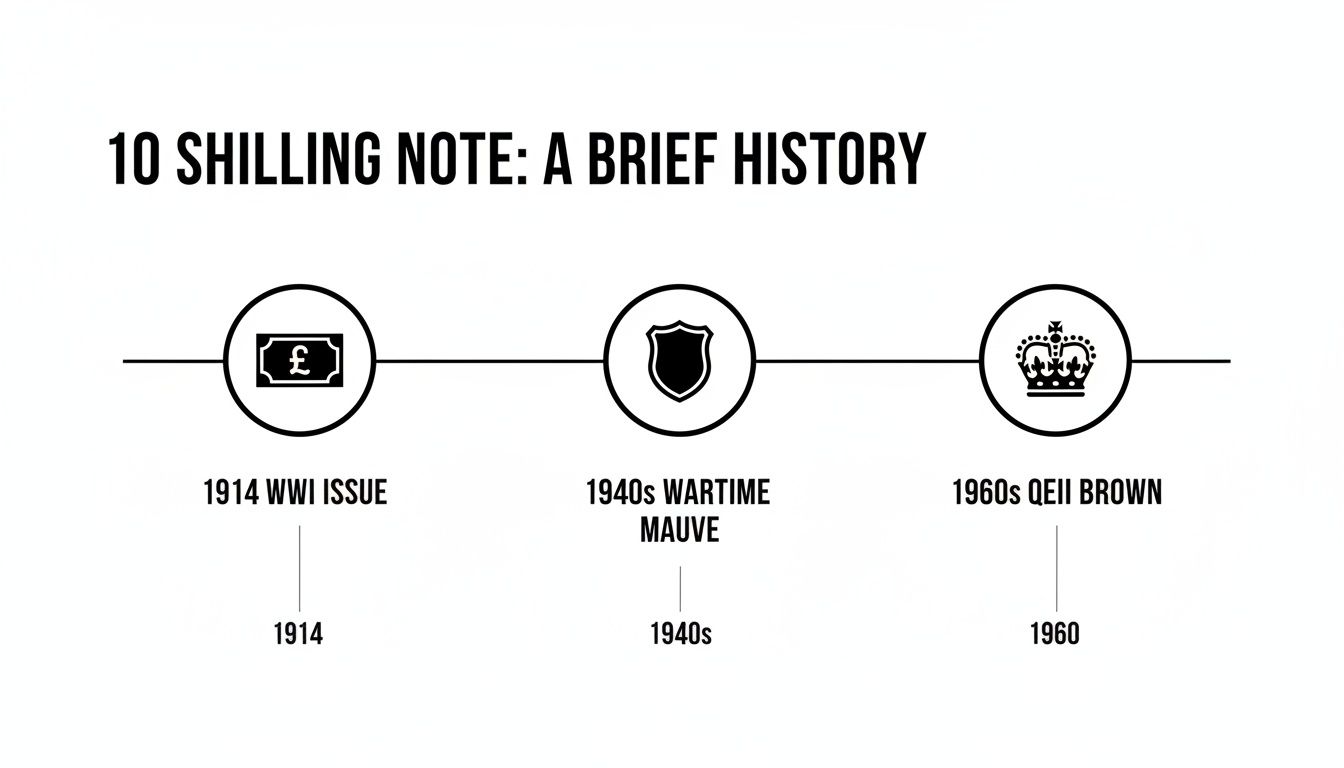
As you can see, the design evolved quite a bit, marking key shifts like the introduction of the mauve wartime note and the iconic brown QEII design that many still remember.
The Spending Power of Ten Shillings
When the Bank of England first introduced the 10 shilling note in 1928, it was a serious amount of money. Back then, "ten bob" could make up a hefty chunk of the average worker's weekly pay packet.
The note's journey is really a story of inflation. In 1928, ten shillings (which became 50 new pence in 1971) could buy you roughly what £45-£50 gets you today. Fast forward to its final year of issue in 1969, and relentless inflation had chopped that power in half, bringing its modern equivalent down to about £25. This sharp decline was a big reason it was eventually replaced by the much more durable 50p coin. You can play around with the numbers yourself using the Bank of England's inflation calculator.
From Shopping Trips to Collector's Item
To put its value in real-world terms, think about what ten shillings could buy in the mid-20th century. In the 1960s, for example, you could get:
- Ten loaves of bread
- Six pints of beer down the local pub
- A ticket to the cinema, with a bit of change left over
- Around seventeen pints of milk
This everyday buying power is a world away from its value today. While its 50p face value, adjusted for inflation since 1970, would be worth around £8-£10, the collector market tells a different story. A note in decent condition can easily fetch five to ten times that amount, driven not by its original spending power but by its scarcity and historical appeal.
This shift from utility to collectability is what makes old currency so fascinating. An item once used for everyday transactions is now a prized possession, its worth defined by the story it tells and the history it represents.
This is true for all sorts of obsolete currency, including any leftover foreign currency you might have tucked away from holidays. Often, these forgotten coins and notes have a hidden value just waiting to be unlocked.
Whether you have a single 10 shilling note or a bag of unsorted foreign coins, turning them into cash doesn't have to be complicated. Our service is designed to be fast, easy, and completely hassle-free. Trusted by major UK brands like supermarkets, airports, and police forces, we offer a 100% guaranteed way to convert foreign coins and banknotes without any need to sort them yourself. Simply send us your collection, and we’ll handle the rest, turning forgotten currency into real money.
How to Exchange Your Old Currency for Cash
Once you've figured out what your ten bob note might be worth to a collector, the next question is how to turn that piece of history into actual cash. You could try navigating private sales or auction houses, but that often means a lot of time, research, and uncertainty. For anyone holding a 10 shilling note, or a drawer full of leftover foreign currency, there’s a much simpler way.
Our service is designed to be the most straightforward solution you'll find. We offer a fast, easy, and completely hassle-free way to exchange not just your 'ten bob' note but any obsolete or foreign currency you might have. It's a system built on trust and efficiency, relied upon by major UK brands, including well-known charities, supermarkets, airports, and even police forces.
A Simple, Secure, and Guaranteed Process
We believe that getting value from old money shouldn't be complicated. Forget the stress of dealing with auction fees, trying to find reliable private buyers, or spending hours sorting through piles of unfamiliar coins. Our process is transparent and designed with your peace of mind as the top priority.
It works in three simple steps:
- Get an Instant Valuation: Use our online calculator to get an immediate estimate for your currency. You'll see our transparent rates right upfront, with absolutely no hidden fees.
- Send Us Your Currency: Package up your 10 shilling note along with any other foreign coins and banknotes you have. The best part? No need to sort anything. Just put it all in a secure envelope or box and post it to us.
- Get Paid Quickly: Once we receive and verify your currency, we process your payment. You can choose to be paid via bank transfer or PayPal, and the funds will be with you within five working days.
This streamlined approach removes all the usual headaches, making it easy to convert foreign coins and banknotes into money you can actually use.
Our 100% Satisfaction Guarantee
We stand behind our service with a 100% satisfaction guarantee. We’re committed to providing a fair, clear, and trustworthy exchange experience. If for any reason you aren't completely happy with the valuation we provide, we will return your currency to you free of charge. This commitment ensures you can send us your currency with total confidence.
Our service is the ideal solution for anyone looking to exchange foreign coins, leftover holiday money, or obsolete currency. Trusted by leading organisations, we ensure a secure and reliable process from start to finish, giving you complete peace of mind.
Whether you're looking to cash in a single valuable banknote or clear out a drawer full of mixed foreign change, we make the entire process effortless. The goal is to provide a reliable service that helps you unlock the hidden value in currency that would otherwise sit forgotten.
If you want a more detailed walkthrough of our system, you can learn more about how to exchange foreign currency with our comprehensive guide. It covers everything you need to know to get started. Don't let that old money gather dust—turn it into something useful today.
Turn Your Leftover Currency into a Charitable Gift
That old ‘ten bob’ note tucked away in a book, or the jar of forgotten holiday coins sitting on your shelf—did you know they could support a great cause? For many people, the simplest and most rewarding thing to do with old currency is to turn its value into a charitable donation. It’s a fantastic way to transform something gathering dust into a gift that makes a real difference.
We make it easy to support one of our trusted charity partners. We handle absolutely everything from start to finish, making the experience straightforward, transparent, and genuinely impactful. It’s a secure way to exchange foreign coins for yourself or donate foreign coins to charity.
Make a Real Difference Without the Hassle
Donating the value of your currency couldn’t be easier. You don’t need to spend hours sorting through different coins or trying to identify old banknotes. Our process is fast, easy, and hassle-free, which means you can simply pop your entire collection of unsorted foreign and obsolete currency in the post and send it to us in one go.
We take care of the entire valuation and exchange from there. The full value is then passed directly to the charity you’ve chosen from our list of partners. It’s a 100% guaranteed service trusted by major UK brands, including airports, supermarkets, and even police forces, who all rely on us for secure and efficient currency handling.
Turning forgotten money into a charitable gift is one of the most effective ways to make a positive impact. Every coin and note, no matter how small, adds up to provide crucial support for vital causes across the UK.
How It Works: A Simple Guide
Getting started is simple. We’ve designed the process to be as convenient as possible, ensuring your goodwill gesture is easy to complete.
- Gather Your Currency: Just collect all your leftover currency, including your 10 shilling note and any other foreign coins and banknotes you have.
- Choose a Charity: Pick a charity you’d like to support from our list of vetted partners.
- Send It To Us: Post the currency to us using our simple instructions. We’ll handle the rest.
If you're thinking about turning old currency into a charitable gift, it can be interesting to see how these contributions fit into the wider picture for non-profits. You can explore the essential sources of funding for nonprofits to understand how individual donations play a crucial role.
By choosing to donate foreign coins to charity, you’re not just clearing out a drawer; you’re giving tangible support to organisations doing incredible work. Find out more about how you can donate your foreign currency on our dedicated page and make a difference today.
Got Questions About Your 10 Shilling Notes?
After digging into the history and design of the old 'ten bob' note, you probably have a few practical questions. It's one thing to know the history, but another to know what to do with the note in your hand. Let's clear up some of the most common queries we get.
Can I Still Pop into a Bank and Exchange a 10 Shilling Note?
The short answer is no, I'm afraid. High street banks stopped accepting 10 shilling notes a long, long time ago. They officially ceased to be legal tender back on 22nd November 1970.
While the Bank of England used to let you exchange old notes for their face value (a modest 50p), that service has long been discontinued for this particular note. To get any real value, you'll need to go to a specialist currency exchange service or a collector, as your note is almost certainly worth far more than 50p.
How Do I Know If My 10 Shilling Note Is a Rare One?
Rarity is often hiding in plain sight, right there in the small details. The three things to check immediately are the signature of the Chief Cashier, the serial number, and the issue date.
Notes signed by a Chief Cashier who had a short run, like P.S. Beale (1949-1955), tend to be harder to find than later ones. The serial number is another huge clue. Keep an eye out for very early prefixes like 'A01' or what's known as a replacement note, which you can often spot by an 'M' prefix. Collectors absolutely love finding these.
Is a Folded or Creased Note Still Worth Anything?
Yes, absolutely! It's one of the biggest myths that a note that's been folded or passed around is worthless. Even a note with a few creases, some folds, or a bit of discolouration is worth more than its original 50p face value.
Of course, a pristine 'Uncirculated' note will always fetch the top price, but a 'Very Fine' or 'Fine' note is still a fantastic collectible with real monetary value. Many sell for several pounds. Every note has a story, and even the well-loved ones are of great interest to the right buyer.
The most important thing to remember is that your old currency has value. It doesn't matter if it's a single 10 shilling note or a bag full of forgotten foreign coins from your holidays. The trick is finding a simple, trustworthy way to unlock that value.
What’s the Quickest Way to Sell My Old Notes and Foreign Coins?
Our service was created from the ground up to be the fastest and easiest way to do just that. You can forget about the hassle of complex auction sites or the time-consuming effort of finding private buyers for every single item.
With us, you get an instant online quote, pop all your unsorted currency into a single package, and get paid straight into your bank or PayPal account. It’s a secure and completely hassle-free process.
Our 100% guarantee means you get a fair price for your collection. It’s a promise trusted by major UK brands, including national charities, supermarkets, airports, and even police forces. So, whether you want to exchange foreign coins and notes or donate foreign coins to charity, we've got you covered.
At We Buy All Currency, we turn your forgotten money into real cash, quickly and easily. Our fast, easy, and hassle-free service is 100% guaranteed, trusted by major brands across the UK. Visit our homepage to see how simple it is to get started and convert your old and foreign currency today.