
How Much Is a Half a Penny Worth Today’s Value Explained
Posted by: Ian Stainton • 22 Jan 2026
So, you've stumbled across an old halfpenny. Have you just found a hidden treasure, or is it just another bit of shrapnel? The honest answer is, it could be either. The value of a halfpenny can swing wildly from virtually nothing to a figure that might have you doing a double-take.
Most common UK halfpennies found rattling around in old tins are worth very little, often just a few pence. But, get a specific year, a coin in exceptional condition, or one with a rare minting error, and that humble piece of bronze can suddenly become a serious collector's item.
What Is Your Halfpenny Really Worth?
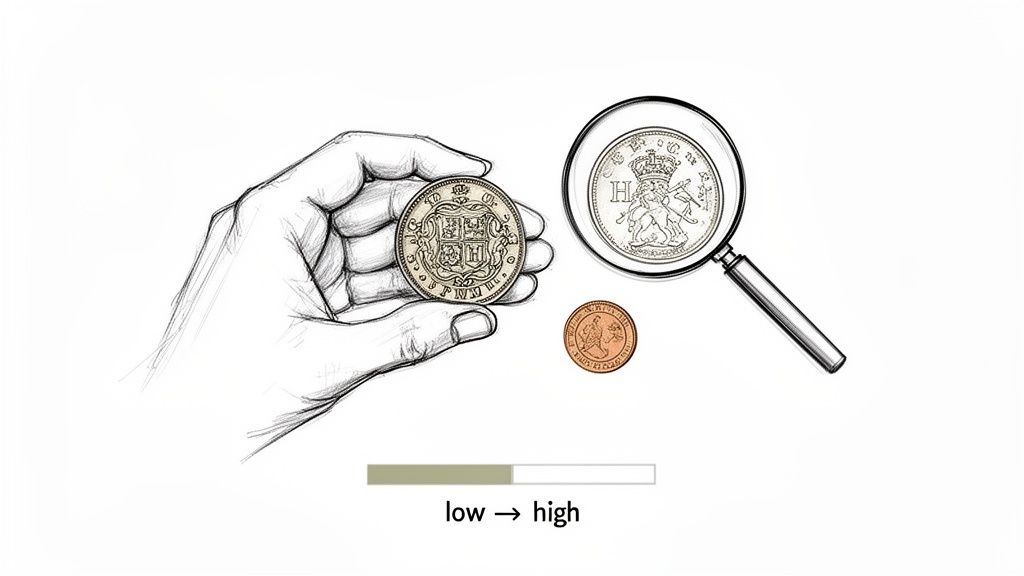
Finding a jar of old coins always feels a bit like uncovering a secret stash. As you sift through old holiday money and forgotten change, you’ll likely spot a few halfpennies. But to get a real sense of their worth, you need to look past what’s written on the coin. The first step is figuring out which of two very different eras your coin belongs to.
-
Decimal Halfpennies (1971–1984): These are the small, modern bronze coins that were part of the UK's currency system until the mid-80s. Because they were minted in huge numbers and were in circulation so recently, they are incredibly common. They typically have very little value unless they're in absolutely perfect, untouched condition.
-
Pre-Decimal Halfpennies (pre-1971): Now, this is where it gets interesting. These are the older, larger coins that were part of British life for centuries. Their value is a mix of age, rarity, and of course, their condition. Certain years are incredibly sought-after by collectors and can fetch a pretty penny.
Halfpenny Value at a Glance
To give you a clearer picture, here’s a quick breakdown of what you can generally expect from each type of halfpenny.
| Coin Type | Era | Typical Circulated Value | Potential High Value (Rare/Uncirculated) |
|---|---|---|---|
| Pre-Decimal Halfpenny | Pre-1971 | £0.10 – £5 | £50 – £1,500+ |
| Decimal Halfpenny | 1971-1984 | Less than £0.05 | £1 – £10 |
This table is just a rough guide, of course. The real value is always in the details – the specific date, the monarch, and how well the coin has survived the years.
Getting a Clear Valuation
Figuring out what an old coin is worth takes more than a quick online search. It requires a good eye for the small details, much like spotting what makes any collectible special. If you're curious about the principles that apply across the board, it's worth reading a guide to knowing if an antique is valuable.
This first step—identifying your coin—is crucial for getting a proper valuation. But don't feel like you have to become an expert overnight.
Our service is built to be fast, easy, and completely hassle-free. We specialise in assessing mixed bags of leftover foreign currency and obsolete coins, making sure you get a fair and accurate price for everything you send in. We're trusted by major organisations like charities, police forces, supermarkets, and airports, and we offer a 100% guaranteed service to turn that forgotten money into cash. And the best part? There is absolutely no need to sort your coins.
The Journey from Pocket Change to Prized Collectible
When you’re trying to figure out how much a half a penny is worth, you’ll find its story is just as important as the date stamped on its face. It’s a tale of two completely different coins.
First, you have the old, pre-decimal halfpenny. Known as 1/2d, this coin was a real workhorse in its day, making up 1/480th of a pound. It was part of the everyday fabric of British commerce for centuries.
Then came the big switch in 1971. Decimalisation introduced a new, much smaller halfpenny, the 1/2p. Suddenly, its value was 1/200th of a pound. But its life was short-lived; the tiny 1/2p was demonetised in 1984 because it was just too small to be practical.
This evolution is like watching a marathon runner shorten their stride over time. The robust bronze halfpennies from Queen Victoria’s reign eventually gave way to more delicate coins under later monarchs, with changing alloys and mintages creating all the varieties collectors hunt for today.
“Coins carry more than metal—they carry generations of stories,” notes a leading numismatist.
Understanding the Decimal Shift
After decimalisation, most people found the new halfpenny impractically tiny. It just wasn't worth the pocket space. This simple fact is why some decimal halfpennies are just common change, while many of their pre-decimal ancestors can fetch a real premium.
The designs also tell a clear story, making it easy to spot which era your coin is from.
- Victorian halfpennies typically featured the classic seated Britannia figure on the reverse.
- Edwardian issues often had a simplified crown and scrollwork.
- Decimal coins displayed the heraldic portcullis, a symbol of Parliament.
These aren't just cosmetic changes; they're vital clues that directly affect a coin's rarity and value. A quick look at their physical differences makes it obvious.
| Coin Type | Era | Size | Composition |
|---|---|---|---|
| Pre-Decimal 1/2d | Pre-1971 | 25.4 mm | Bronze |
| Decimal 1/2p | 1971–1984 | 17.14 mm | Bronze alloy |
The table above shows exactly why a worn-out pre-decimal halfpenny might be worth more than a pristine decimal one. Its history, size, and scarcity all play a part. For example, historians know that mintages dropped dramatically during wartime, making any surviving examples much harder to find.
So, next time you look at a jar of old coins, think of it as reading a time-lapse photograph. Each piece tells you something about the world it came from.
For a bit more context on how currencies change over time, you can check out our guide on Former Currencies of Europe.
Keeping this journey in mind helps you spot the small details that can signal a hidden gem. Whether you have a mixed collection or just some leftover holiday coins, our service is fast, easy, and hassle-free. There's no need to sort your coins yourself.
We are trusted by major brands, including charities, supermarkets, airports, and police forces, to turn unsorted currency into cash. Turn that jar of neglected coins into a window on history—each halfpenny holds clues to its era. It’s time to embrace the past and uncover its hidden value.
The Three Factors That Drive a Halfpenny's Value
Ever wonder why two halfpennies from the same year can be miles apart in value? One 1887 halfpenny might be worth just £4, while another from the exact same year could sell for £220. It’s not magic; it’s down to three key factors that professional coin dealers look at to figure out what a coin is really worth.
Getting to grips with these factors—the coin's grade, its rarity, and its history—is how you unlock the hidden value in your own collection. Think of it like a vintage car. A perfectly preserved, low-mileage classic will always fetch a higher price than the same model that's been driven into the ground for decades. Coins are exactly the same.
This flowchart maps out the halfpenny's journey through Britain's two major currency systems.
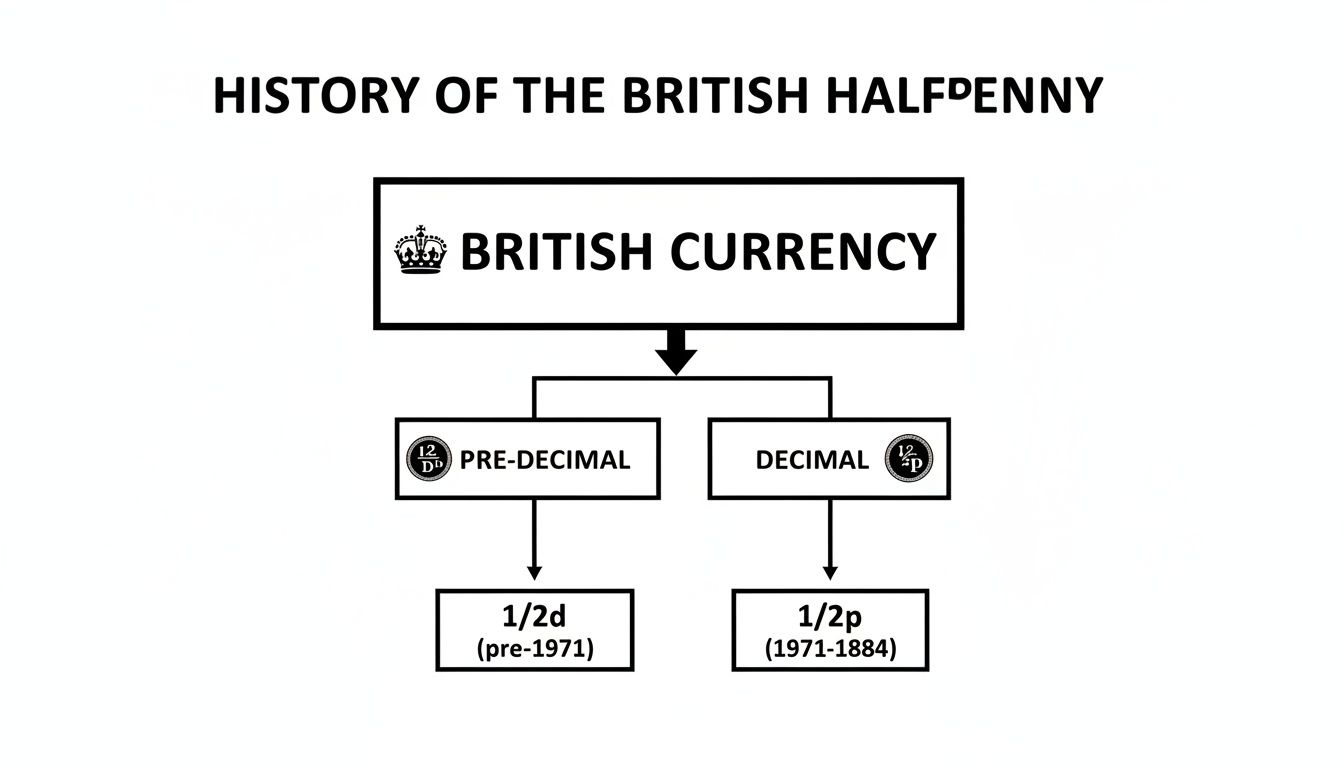
As you can see, telling the difference between the old, large pre-decimal coins and the smaller, modern decimal ones is the very first step in working out what you have.
Grade: The Condition of Your Coin
First and foremost, the most critical factor is the coin’s grade. In simple terms, this is its physical condition. A coin that looks like it just rolled off the minting press, with crisp details and its original shine, is graded as 'Uncirculated' (UNC). At the other end of the spectrum, a coin that’s been worn smooth from years of rattling around in pockets is classed as 'Poor' or 'Fair'.
The difference this makes to the value is massive. For instance, an 1887 halfpenny in 'Fine' condition is typically valued at around £4. But find an 'Uncirculated' example, and the price can rocket to £220—that’s a staggering 5,400% increase. It just goes to show why condition is king in the coin world. You can see for yourself how dramatically grading impacts UK halfpenny values.
Rarity: How Many Were Made?
Next on the list is rarity. This usually comes down to mintage—the total number of coins that were produced in a certain year. Some years saw millions of coins minted, making them incredibly common. In other years, production was very low, making those coins much harder to find today.
A few things contribute to rarity:
- Low Mintage Years: Coins from years with small production runs are naturally scarce.
- Errors and Varieties: Sometimes, a slip-up during the minting process creates a unique and valuable error coin.
- Survival Rate: Even if millions were made, very few might have survived in decent condition, making well-preserved examples rare.
A low mintage figure is often the first clue you’ve found something special.
Provenance: A Coin's Life Story
Finally, there’s provenance, which is the coin’s documented history of ownership. While this is less of a factor for common coins like halfpennies, a noteworthy backstory can definitely add value. If a coin was once part of a famous collection or has a really interesting story attached to it, collectors will often pay more for it.
Trying to figure all this out for a big box of leftover foreign currency can be a real headache. That's why our service is designed to be fast, simple, and completely hassle-free. You don't need to sort or grade anything; our experts do all the hard work for you. We’re trusted by major UK brands, including charities, supermarkets, airports, and police forces, and we provide a 100% guaranteed service to turn your foreign coins and notes into cash.
How to Spot a Rare and Valuable Halfpenny
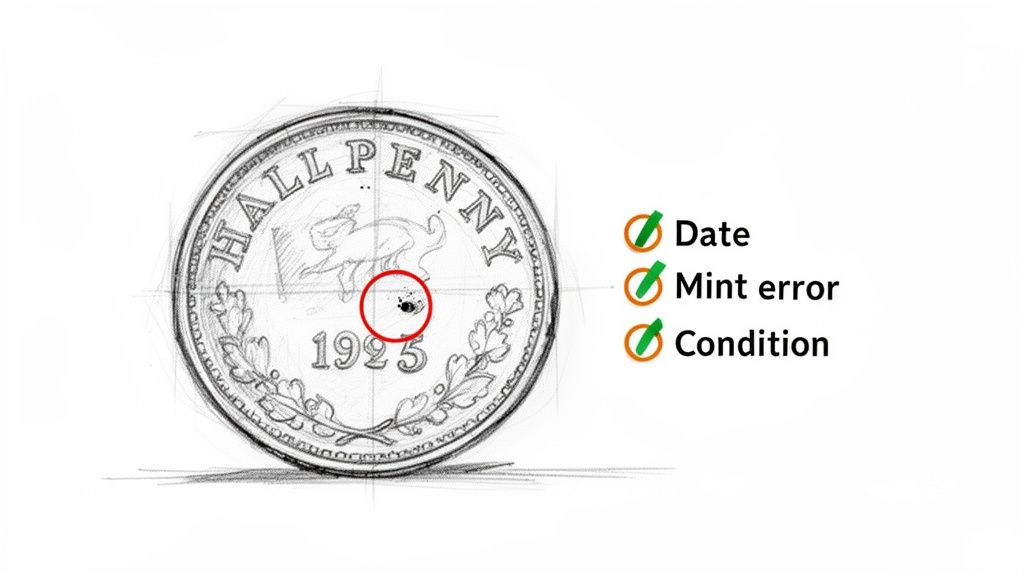
While most halfpennies you'll come across are common and hold modest value, a select few can be genuine collector's items. These are the jackpot coins everyone hopes to find buried in an old tin of forgotten change. Knowing what to look for transforms the search from a random sift into a focused treasure hunt.
So, what makes a simple halfpenny special? Often, it's about scarcity. A low mintage figure—meaning very few coins were struck in a particular year—is the first big clue. Unique minting errors, like a misaligned strike or a doubled date, can also turn an ordinary halfpenny into a valuable prize.
Key Dates to Watch Out For
Certain years have earned almost legendary status in the coin-collecting world. Their rarity usually comes down to a mix of low production numbers and unique historical circumstances, making them highly sought after by collectors.
The market for rare British halfpennies has seen some incredible prices at auction, with specific dates fetching huge premiums. For instance, a 1947 large date halfpenny in fine condition has achieved bids around £886,000, while a 1941 halfpenny in circulated condition can command roughly £177,000. It's not just older coins, either; a 1956 halfpenny has sold for approximately $28,000, showing just how strong the global demand is for these scarce pieces.
To give you an idea of what to look for, here are a few of the most well-known rare halfpennies.
High-Value Halfpenny Watchlist
| Year/Variety | Reason for Rarity | Potential Value Range (Fine to Uncirculated) |
|---|---|---|
| 1862 | Some coins were minted with an inverted '2' in the date. | £50 – £1,500+ |
| 1902 (Low Tide) | The sea level on the Britannia design is noticeably lower. | £20 – £500+ |
| 1925 (Modified Effigy) | A subtle alteration to the King's portrait makes it scarce. | £10 – £400+ |
| 1946 (Altered Date) | The '6' in the date was often punched over a '4'. | £30 – £800+ |
| 1953 | Only minted for ceremonial sets, not general circulation. | £40 – £1,000+ |
This is just a small sample, but it shows how a tiny detail can make a massive difference in value.
Spotting these differences requires a keen eye. As you start to understand your halfpenny's potential, learning how to identify valuable antiques is a brilliant skill that applies to much more than just coins.
Why Expert Evaluation Matters
Identifying a key date is a great start, but it's only half the story. Factors like the coin's grade (its level of wear and tear) and subtle variations can drastically alter its value. This is where a professional appraisal becomes so important. A single rare coin could easily elevate the worth of your entire collection.
For a deeper dive, you can explore our guide on pre-decimal coin values.
Our service is designed to take all the complexity and guesswork out of the equation for you. We provide a fast, easy, and hassle-free way to get an expert valuation for your leftover foreign currency, obsolete coins, and unsorted collections. You don’t need to sort through anything yourself—our team does all the hard work.
We are trusted by major brands, including charities, supermarkets, airports, and even police forces, to identify and fairly value important finds. With our 100% guaranteed service, you can confidently convert foreign coins and banknotes into cash, knowing you’re getting the best possible price.
How to Exchange Your Old Coins for Cash
So, you’ve sorted through your jar of coins, figured out which halfpennies you’ve got, and maybe even found a few other old foreign notes and coins along the way. Now for the big question: what’s the best way to turn all this old metal into actual, spendable money?
You could go the old-fashioned route, of course. That often means traipsing around local coin dealers or jewellers, trying to find someone who’s not only interested but also willing to give you a fair price. It’s a lot of legwork, research, and haggling, especially if you just have a mixed bag of currency. Frankly, it can be a real headache.
A Faster, Simpler Way to Exchange Foreign Coins
We’ve designed a much easier alternative. Instead of you having to become a numismatist overnight, our service does all the heavy lifting for you. The secret is our unique weight-based valuation process, which is a game-changer for anyone with a jumble of unsorted coins.
The real beauty of this approach is its simplicity. There is absolutely no need to sort your coins. Just tip all your leftover holiday money, obsolete currency, and inherited collections into one box and send it to us. We’ll take care of the rest.
Think of the time and effort this saves. You don’t need to separate your halfpennies from your old Spanish pesetas or French francs. Whether you want to exchange foreign coins and notes or donate foreign coins to charity, our platform gives you a single, trusted way to get the best possible value.
If you want to read more about dealing with older currency, you might find this guide helpful: the easy way to exchange old British coins and notes.
Trust and Credibility You Can Count On
We get it—sending your money off to someone requires a lot of trust. That’s why we’ve built our entire reputation on being transparent and reliable, earning the confidence of some of the UK’s biggest organisations.
Our trusted partners include:
- Major Charities: Who count on us to process public donations of foreign currency quickly and efficiently.
- National Supermarkets: That use our service for their in-store collection points.
- Airports and Police Forces: Who trust us to handle found and confiscated currency with total integrity.
Our service is 100% guaranteed. From the moment your currency arrives, our experts handle it with care, making sure you get a fair and accurate price. This commitment to a hassle-free and credible experience makes us the ideal choice to convert foreign coins and banknotes. We take all the guesswork out of turning your forgotten change into cash.
Ready to Turn Your Old Coins into Cash?
So, you've sifted through that old coin jar and now have a much better idea of what makes a halfpenny valuable. But what about the rest of that collection? The leftover holiday money, the obsolete notes, the jumble of coins you're not even sure about? Don't let them gather dust on a shelf.
Every coin has a story, and some have a surprising monetary value. The next step is the easiest one of all.
We offer a fast, transparent, and completely secure way to convert your entire collection into cash. Our process is designed to be hassle-free from start to finish. There is absolutely no need to sort or identify anything. Just send us all your mixed coins and notes, and let our experts handle the rest.
A Service Built on Trust
Choosing where to send your currency requires confidence, and we've built our reputation on it. We're trusted by major UK brands—including national charities, supermarkets, airports, and even police forces—to process their currency with integrity.
Our 100% satisfaction guarantee means you can send your collection with complete peace of mind. We provide a fair, clear valuation, and if you’re not happy for any reason, we’ll return your currency to you, free of charge.
This commitment makes it simple to exchange foreign coins or even donate foreign coins to charity. We manage everything, from common holiday change to obscure, obsolete banknotes, making sure you receive the best possible value for the whole lot.
Whether you want to exchange foreign coins and notes for yourself or find a new purpose for them through donation, our fast and easy service is the perfect solution. Stop wondering what your old currency is worth and start unlocking its value today.
Ready to get started? Visit our homepage to see just how simple it is to turn that forgotten currency into real money.
Common Questions Answered
We get a lot of questions about exchanging old coins like halfpennies. Here are some of the most common ones we hear, with straightforward answers to help you out.
Do I Need to Sort All My Coins Before Sending Them?
Absolutely not! One of the biggest headaches with leftover currency is figuring out what’s what. We designed our service to take all that hassle away.
Just gather up all your foreign and obsolete coins and banknotes and send them to us mixed together. Our team of experts and our unique weight-based system handles all the sorting and identification for you. It’s perfect for those big, jumbled collections and saves you hours of tedious work.
What if My Halfpenny Isn’t a Rare One?
That’s perfectly fine! Most halfpennies aren't going to be the ultra-rare jackpot finds, but even the common ones have value. When you include them as part of a larger collection of foreign currency, their metal content and collective value really start to add up.
We give you a fair price for all the currency you send, whether it’s still in circulation or long obsolete. This way, you don't have to spend your time trying to pick out only the ‘valuable’ ones. It’s a fast, simple way to cash in on the whole lot.
How Can I Be Sure I’m Getting a Fair Price?
Trust is everything to us, and we’ve built our reputation on it. We’re the trusted currency exchange partner for some of the UK’s biggest names, including major charities, national supermarkets, airports, and even police forces.
We’re always upfront with our exchange rates, and our 100% satisfaction guarantee is our promise to you. If you’re not completely happy with our valuation for any reason, we’ll send your currency straight back to you, free of charge. You can send your coins to us with total peace of mind.
It’s this commitment to a credible, no-fuss experience that has made us the go-to service for so many organisations looking to exchange foreign coins and banknotes.
Ready to unlock the value in your forgotten coins? At We Buy All Currency, our process is fast, easy, and 100% guaranteed. There's no need to sort your coins—just send us your leftover foreign currency, and we'll handle the rest. Visit our homepage to get started today!