
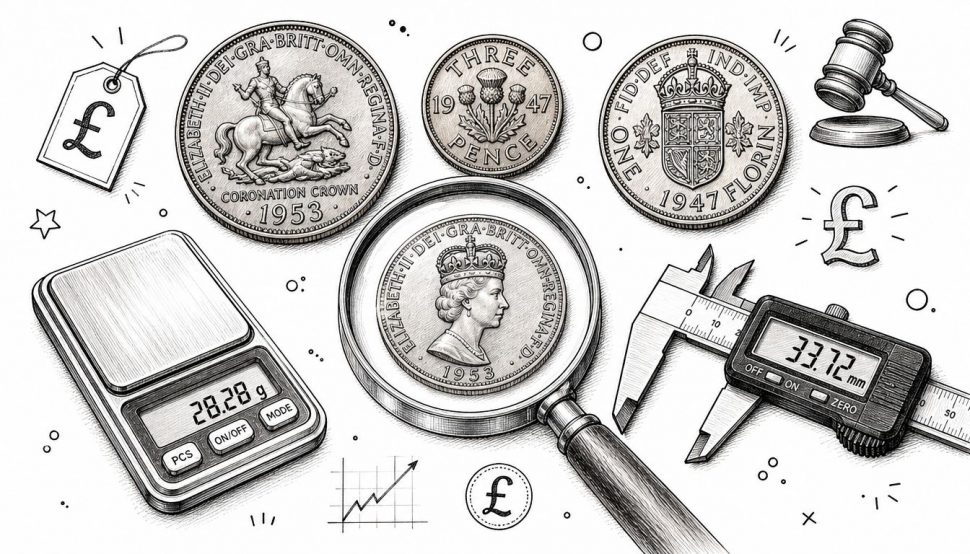
If you've got a jar of old coins, start with date and denomination. Then check the monarch, any mint mark, and whether the coin sits before or after 1971, because that date is a clean dividing line for British coinage and can change what you're holding.
A handful of worn pieces can be worth nothing more than face value, scrap, or a modest collector premium, but the right identifier, variety, and condition can move a coin into a very different bracket. The practical job is to sort fast, avoid cleaning, and decide whether each coin should be sold individually, sold in bulk, or set aside for specialist review.
The Quick Answer for Valuing Old Coins
A coin's value usually comes down to date, denomination, monarch, mint mark, weight, condition, and any variety or error, then checking the exact coin against recent realised auction sales, not asking prices. If you are sorting inherited coins or a mixed jar, that first pass is usually enough to separate the common pieces from the ones worth a closer look.

The quickest working method is direct. Pick up one coin, read the date and denomination, note the monarch or issuing authority, and look for a mint mark or variety letter such as H or KN on older British pieces, because small letters can change value in a real way Cavalier Coins. If the coin is pre-decimal, treat 1971 as the main sorting line, because British denominations changed across that transition.
After that, compare the coin's condition with standard grade descriptions, then check sold prices, not what sellers are asking Pratt Library. That matters because a listing can sit online without selling, while a realised price shows what a buyer paid. For mixed holdings, the honest answer is often that most coins are ordinary, a few deserve individual attention, and the rest are better cleared in bulk or converted through a specialist currency service when no single piece justifies a collector sale Reference.com.
Practical rule: if you cannot identify the coin cleanly, do not guess the value. Sort it, label it, and move on to the next piece.
Identify the Coin Before You Try to Price It
A mixed tray of old coins looks manageable until you try to price the lot without naming each piece properly. At the desk, the first pass is simple, date, denomination, monarch or issuing authority, and any mint mark or variety letter. Without that set of identifiers, any price check turns into guesswork.
Read the coin like a dealer would
Start with the face value and the date. Then confirm who issued it, because a 1953 Coronation crown is not the same coin as a 1951 Festival of Britain crown, even though both are crowns and both sit in the same broad run of British collecting.
Small details matter more than beginners expect. On older British coinage, little letters such as H for Heaton or KN for King's Norton can shift the value sharply, because those marks separate common circulation pieces from scarcer mint varieties Cavalier Coins. That is the point where a specialist starts paying attention and a casual seller usually stops too soon.
Write the coin down in a plain string, such as “1953, Crown, Elizabeth II, no mint mark”. That is enough to search, compare, or hand to a dealer without relying on memory. It also stops mixed coins from becoming an unlabelled pile of assumptions.
Sort British holdings by the 1971 line
For UK material, 1971 is the dividing line because it marks decimalisation. Anything before it belongs to the pre-decimal system, so a bag of “old British coins” often contains far more categories than the owner first thinks.
That is why the first job is triage, not pricing. Put clearly pre-decimal pieces in one group, decimal circulation coins in another, and anything odd, worn, or obviously foreign in a separate tray. That keeps the work honest and tells you what deserves an individual sale, what may only justify a bulk or by-weight route, and what is better left out of the market altogether.
If you are working through a larger mixed lot, a quick UK coin weight guide can help you separate likely keepers from common filler before you spend time on closer checks. Use it as a sorting aid, not as a final verdict.
If the coin still is not identified after date, denomination, monarch, and mint mark, it does not belong in the pricing step yet. It belongs back in the sorting tray.
Check Weight, Diameter and Metal Against the Specification
A coin can look right at a glance and still fail the basic checks. On a mixed tray, that is often the point where you separate a saleable piece from something that only deserves a closer look.
Start with the official specification for the issue, then compare the coin's weight, diameter, and thickness against it. A digital scale accurate to 0.01 g and a simple calliper are enough for the first pass, and using a UK coin weight guide helps you sort likely keepers from filler before you spend time on anything more expensive.
Use measurements as an authenticity screen
A measurement check is a filter, not a price on its own. If the coin is too light, too thick, or badly out of spec, the cause may be wear, cleaning, corrosion, damage, or a forgery risk rather than a coin with strong market value. Antique Identifier makes the same basic point, and it is the right way to approach a pile of uncertain pieces.
That matters most with older British coins, because metal content changed over time and the same denomination can behave very differently from one issue to the next. Spec is part of the value question, not a side note.
In practice, I use the measurements to decide whether a coin is worth selling individually, worth putting aside for a specialist opinion, or better treated as bulk material. A coin that matches its expected dimensions and weight still needs identification and grading, but a coin that fails those checks usually does not justify chasing a premium.
Weigh first, then decide whether the coin deserves more time
A sensible triage order keeps you from spending money in the wrong place.
- Measure the coin: compare the weight and dimensions with the published specification before you start thinking about price.
- Look for obvious red flags: strange wear patterns, cleaning marks, bends, or corrosion often explain a bad reading better than rarity does.
- Use the result to sort the lot: a coin that still fits its spec may be worth an individual sale, while a poor match may belong in a by-weight group or, if it has no collector interest, in the donation pile.
That approach matters in inherited mixed lots, where one misleading piece can waste time across the whole tray. It also keeps people from paying grading or auction fees on coins that were never likely to cover the cost, which is where a practical UK coin weight guide earns its place.
Grade the Coin Honestly Against Standard Descriptions
Condition is the part most sellers overestimate. At a desk, the pattern is predictable, people call a coin “very fine” because it's old, not because it fits the grade.
UK grading bands are broad, but the market still responds to them. Fine (F) means the main design is visible but worn. Very Fine (VF) still shows clear detail with moderate wear. Extremely Fine (EF) keeps most details sharp, Uncirculated (UNC) shows no circulation wear, and FDC or Fleur de Coin is the top end for pieces that look as struck.
UK Coin Grading Bands at a Glance
| Grade | Plain-English Description | Typical Realised Price Impact |
|---|---|---|
| Fine (F) | Heavy wear, basic detail remains | Usually the lower end of the market |
| Very Fine (VF) | Moderate wear, major details still clear | Often a step up from common circulated pieces |
| Extremely Fine (EF) | Light wear, most design elements remain sharp | Can move a coin into a noticeably better band |
| Uncirculated (UNC) | No circulation wear, only handling marks possible | Often the point where collector demand rises |
| FDC | Exceptional preservation, top presentation | Can carry the strongest premium where the issue is desirable |
A worked comparison makes the point better than theory. Two identical 1953 Coronation crowns can sit in very different price bands if one is EF and the other is UNC. For common pieces, that can mean the difference between a modest sum and a much better one, and for scarcer issues the spread widens much faster. Condition doesn't create rarity, but it absolutely changes what the market will pay for rarity.
If in doubt, grade down. It protects you from optimistic pricing, and it costs nothing.
That rule is worth following because over-grading destroys credibility fast. A buyer who sees a worn coin described as UNC doesn't just discount that one coin, they start discounting the seller's whole pile.
Compare Realised Auction Prices Rather Than Asking Prices
Asking price is only what someone hopes to get. Realised price is what a buyer paid, and that is the figure that matters at the desk.
For mixed UK coin groups, that distinction saves time and bad decisions. A dealer listing can stay unsold because the price is optimistic, while an auction archive shows the level the market accepted for the same type of coin. For a quick valuation, the sold result is the defensible number, not the asking figure Pratt Library.

Build a price band from sold examples
Start with the same identifiers you used to sort the coin, then add grade. Search by date, denomination, monarch, mint mark, and condition, and compare sold examples from auction archives, dealer catalogues, and price databases. One result is a clue. Several matching results from different venues give you a much firmer estimate.
That approach matters with UK material that gets distorted by overseas pricing. US-centric guides can still help you spot obvious outliers, but they often quote values in dollars for coins that are common in Britain and only thinly traded abroad. If you use those guide prices without checking local sold results, you can end up pricing a box of inherited coins as if every piece were a specialist item.
Mixed lots need triage, not optimism. A silver coin with collector interest may deserve an individual sale, a low-grade common piece may be better sold by weight or as part of a bulk lot, and a worn duplicate may be better donated if the selling friction outweighs the return.
Ask three questions of every price you see
- Was it sold or merely listed? Sold means market behaviour, listed means hope.
- Does it match the exact coin? Small changes in mint mark or variety can matter.
- Is the grade comparable? An UNC coin and a VF coin are not the same product.
A useful estimate in pounds sterling usually comes from several real sales, not from a polished catalogue entry with no sale behind it. That standard holds up when you are deciding whether a coin belongs in the individually sellable pile, the bulk pile, or the donation tray.
When Not to Pay for Grading or Auction Fees
A worn common coin from a family tin does not need a slab. A specialist exchange desk sees this mistake all the time, a seller spends on grading, postage, insurance, lot fees, and commission, then finds the net return is thinner than the original coin value.
The break-even point is the first question. If a coin is only worth a modest amount, grading fees and auction costs can swallow the margin before the coin ever reaches a buyer. AARP points out that auction selling costs can also remove much of the gain on lower-value pieces. For borderline coins, that means you are paying to find out they were not worth that route in the first place.
A practical collector rule is simple. Grading usually makes sense only when the coin sits in the upper-value band, and a working threshold often used by sellers is around £200 or more in estimated value. Below that, the fee tends to outrun the upside. The same logic applies to auction submission. If the likely realised price will not comfortably clear the commission and related charges, the market is telling you to keep the process simple.
Choose the route that matches the coin
A coin that might be special still has to clear its costs. A specialist auction or grading submission only works when the upper realised estimate leaves room after fees, postage, insurance, and any lotting charges. If the upside is uncertain, the sale route should be conservative.
For modest pieces, a local dealer quote or a specialist currency exchange route is usually cleaner. The best place to sell old coins depends on what the coin is, not on what the owner hopes it might be. That matters most in mixed inherited lots, where one or two coins may deserve individual attention but the rest are better handled in bulk or not sold at all. I see the same pattern repeatedly, a single better coin can justify effort, while the rest of the tray should be treated as ordinary material.
The decision rule that saves money
- High-value coins: consider grading or specialist auction only if the figures still work after all costs.
- Middle-value coins: sell through a reputable dealer or specialist marketplace.
- Low-value coins: keep them, gift them, donate them, or move them in bulk rather than paying premium fees.
That rule keeps sentiment from overruling arithmetic. Collectors attach stories to old objects, but the market does not add value because a coin came from a family tin or an estate drawer.
Rule of thumb: if the likely sale price does not beat the total cost of selling, do not consign it.
Decide What to Do with Each Coin After Valuation
A mixed tin on the desk usually needs triage, not sentiment. Once the coin is identified, measured, graded, and compared, the choice is clear: sell individually, sell in bulk, or let it go another way. In inherited lots, the value usually sits in a small cluster of better pieces, while the rest belongs in a simple, practical route.
Use the value band to choose the route
High-end coins should go to specialist buyers or auction houses, where strong examples can draw competitive bidding. Mid-range pieces usually suit a dealer or a specialist listing, especially if the coin is desirable but not rare enough to justify heavy fees. Low-value or damaged coins are often better handled by weight, included in a bulk exchange, or donated if that fits the owner's aim.
Cleaning is the move that causes the most avoidable damage. It strips originality, leaves hairlines or surface disturbance, and can turn a promising coin into an ordinary one. It also makes honest grading harder, which is the last thing you want before trying to sell.
Three common mistakes to avoid
- Cleaning the surface: This usually hurts value, even when the coin looks brighter afterwards.
- Assuming age equals value: Plenty of old coins are common.
- Forgetting withdrawn pieces: Old or withdrawn currency can still matter to the right buyer, even if it no longer circulates.
A mixed batch of foreign coins, old British pieces, and withdrawn notes should be split quickly into keepers and clear-outs. That avoids wasting time on item-by-item scrutiny for material that is only worth moving by weight or passing on. For a broader guide to sale routes, see the options in best places to sell old coins. If you are clearing notes or a mixed travel stash as well, the same logic applies to exchange foreign coins and notes.
If you still have leftover foreign coins, old UK pieces, withdrawn currency, or a mixed jar you do not want to sort yourself, visit We Buy All Currency for a direct route into cash. The service handles coins, banknotes, and awkward mixed holdings, with exact quotes before you send and payment after verification, so you can clear the lot without the usual hassle.