
New 10 Pound Note Guide: Features, Security & Cash Exchange
Posted by: Ian Stainton • 27 Mar 2026
If you’ve stumbled upon an older £10 note featuring Charles Darwin in a forgotten wallet or the back of a drawer, it's worth knowing it’s no longer accepted in shops. But don't worry, that old note still holds its full face value, and we offer a fast, easy, and 100% guaranteed way to exchange it for cash.
The Story of the Modern Ten Pound Note

The ten-pound note you see today has come a long way. The journey started with the familiar paper £10 note, which celebrated the famous naturalist Charles Darwin, and moved towards a more modern and secure polymer design. This wasn't just a simple facelift; it was a major leap forward in currency technology.
From Paper to Polymer with Jane Austen
The first polymer new 10 pound note was released in 2017, and it celebrated the brilliant literary giant Jane Austen. The switch to polymer was all about making our money stronger and safer. Unlike the old paper versions, these polymer notes can handle a bit of rough and tumble—they’re resistant to tearing, dirt, and moisture, which means they last a lot longer.
These new notes also came packed with advanced security features, making them incredibly difficult to counterfeit. If you have a Jane Austen polymer £10 note, you can still spend it anywhere, as it remains legal tender. It circulates right alongside the newest version, making for a smooth and simple transition.
Welcoming the King Charles III Design
More recently, the Bank of England rolled out an updated polymer £10 note that features a portrait of King Charles III. While it keeps the same durable polymer material and clever security features as the Jane Austen version, it also signals a new chapter for British currency. It's important to know that both the Jane Austen and King Charles III polymer notes are current legal tender.
So, what should you do if you come across an old paper Charles Darwin £10 note? Since these notes have been officially taken out of circulation, shops won't accept them. That's where we can help. We provide a fast, easy, and 100% guaranteed service to exchange your obsolete currency.
We are a trusted partner for major UK brands, including well-known charities, supermarkets, airports, and even police forces who rely on our credibility. Our process makes it incredibly simple and hassle-free to turn your old notes into cash. You don’t even need to sort your money—just send us a mix of old British notes, leftover foreign currency, and foreign coins all in one go. Have a look at our homepage to see how it works.
The Story Behind the Tenner: A Quick Trip Through Time
The humble £10 note has been a part of British life for a lot longer than you might think. Its story isn't just about fancy designs; it's a fascinating look at why our money is always changing. It all started out of pure necessity. The Bank of England first issued a £10 note way back in 1759, right in the middle of the Seven Years' War, when gold was in short supply.
These first tenners looked nothing like the ones in our wallets today. They were simple, one-sided notes handwritten on white paper and were only issued to specific people when needed. The whole point was to give people a trustworthy paper alternative to gold, helping to protect the country's reserves. This style of banknote, issued when the economy was under pressure, actually stuck around for almost 200 years before production stopped in 1943. You can dive into the detailed history of these early banknotes to see how economic events shaped them.
From Simple Paper to Modern Security
After a 19-year break, the tenner made a comeback in 1964. This "Series C" note was a game-changer – it was the first £10 banknote to feature a portrait of Queen Elizabeth II, which became the new normal for our currency. This brown note, designed by Reynolds Stone, had a lion on the back and was used until 1975.
This return marked a real shift. Banknotes weren't just for spending anymore; they were becoming symbols of national identity, and more importantly, they needed to be secure. As criminals got smarter, the Bank of England had to get smarter too. Events like "Operation Bernhard" during WWII, a German plot to wreck the British economy with forged notes, were a wake-up call. This ongoing cat-and-mouse game between counterfeiters and the Bank has driven all the security upgrades we see, from watermarks and metal threads to today's high-tech polymer notes.
Why Do Old Notes Get Withdrawn?
This history lesson explains exactly why our banknotes get updated and taken out of circulation. Every new version, like the polymer new 10 pound note, is a major step up in making our money safer and more durable. It's a vital process for keeping the economy stable, but it often leaves people holding onto old cash they can no longer spend.
And that’s where our helpful advice comes in. If you've found a stash of old paper £10 notes, or even have leftover foreign currency from holidays, we offer a fast, easy, and 100% guaranteed service to exchange them. You don't even need to sort through it – just gather up all your old money.
We are trusted by some of the biggest names in the country, including national charities, supermarkets, airports, and even police forces, to exchange foreign coins and notes for them. Our simple, hassle-free process means you can turn that obsolete currency into real, usable cash without any fuss.
Whether you want to convert foreign coins and banknotes for your own pocket or donate foreign coins to charity, we provide a reliable and straightforward way to do it. Just pop over to our homepage to see how easy it is to get started.
How to Spot a Genuine Polymer £10 Note
Whenever a new note enters circulation, it’s natural to wonder about spotting fakes. The good news is, the Bank of England packed the new polymer £10 note with advanced security features that make it incredibly tough to copy.
Once you know what to look for, checking your cash becomes second nature. It only takes a few seconds to feel confident you’re holding the real deal.
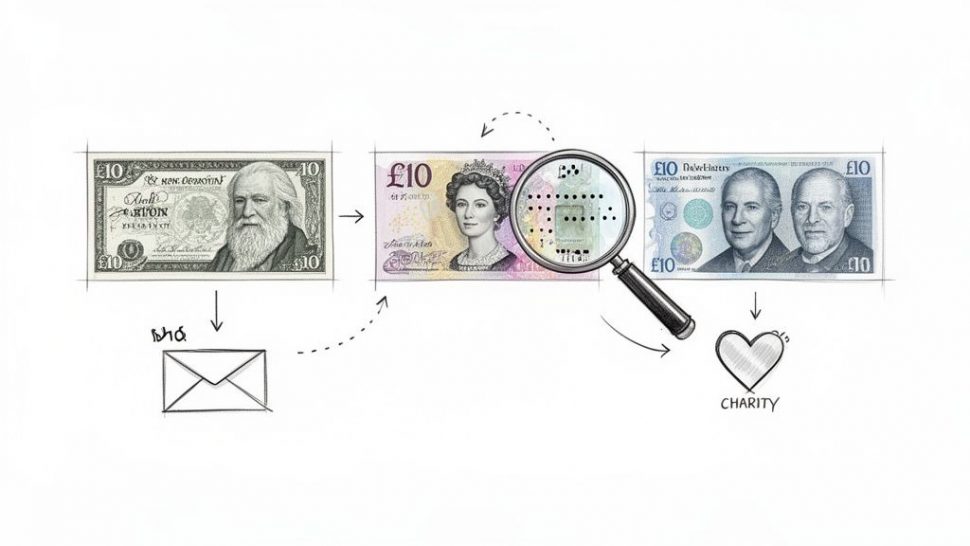
The tenner has certainly come a long way. This visual shows just how much our banknotes have changed over the years, moving from simple handwritten notes to the high-tech polymer we use today.

You can see the journey was all about making our money more durable and, most importantly, more secure.
Check the Look and Feel
Your first checks are the simplest ones—just use your eyes and hands. A genuine polymer note feels distinctly different from paper. It’s smoother, but it has some specific textures you can feel for.
- Raised Print: Run your finger across the words "Bank of England" on the front. You should be able to feel the ink is slightly raised.
- Print Quality: Look closely at the details. The lines and colours on a genuine note are sharp and clear, with no smudging or blurry edges. Forgeries often look flat and lack that crisp, professional finish.
Honestly, these two simple checks are often enough to spot a dodgy note straight away. But for a definitive answer, the advanced features are foolproof.
Inspect the Advanced Security Features
Think of these next features as the note's secret handshake. They are incredibly difficult for counterfeiters to replicate because they are built into the note itself, not just printed on top.
This quick guide below breaks down exactly what to look for.
Quick Guide to the £10 Note Security Features
| Security Feature | How to Check It |
|---|---|
| See-Through Window | The large, clear window has a portrait of the Queen. The metallic image of Winchester Cathedral is gold on the front and silver on the back. |
| Colour-Changing Quill | Find the quill next to the window. As you tilt the note, it should change colour from purple to orange. |
| Holographic Patch | Look for the silver foil patch. When you tilt it, the word should switch between ‘Ten’ and ‘Pounds’. |
| Micro-lettering | Below the Queen's portrait, you’ll find tiny letters and numbers. You'll need a magnifying glass, but they spell out the value of the note. |
Getting familiar with these features is the best way to protect yourself. Once you've checked them a few times, you'll be able to spot a real tenner in an instant.
What to Do With Your Old Paper £10 Notes
Ever been clearing out an old jacket or a dusty drawer and stumbled upon a paper £10 note with Charles Darwin on it? It's a familiar find for many of us. While that note was a common sight for years, it's now been officially withdrawn, which means you can no longer pop to the shops and spend it.
But don't be disappointed—that old tenner still holds its full face value. The real question is how to swap it for a new polymer new 10 pound note. You've got a few options, but they aren't all created equal when it comes to convenience.
Traditional Exchange Options
The most official route is taking your old paper notes directly to the Bank of England in London. They have a policy to always exchange their own withdrawn notes. The catch? For most people, a trip to Threadneedle Street just isn't practical, especially if you live outside the capital.
You might also try your luck at a local high street bank or Post Office branch. However, their policies can be quite restrictive. Often, they'll only offer this service to their own customers, and even then, there might be a limit on how much you can exchange at once. It can quickly become a bit of a hassle trying to find a branch that will help.
The Fast and Easy Way to Exchange Obsolete Currency
This is where our service really comes into its own. We offer a fast, easy, and hassle-free way to exchange your old currency without you ever needing to leave the house. Our whole process is designed to be simple, secure, and give you complete peace of mind.
Instead of trying to navigate tricky bank rules or planning a day trip to London, you can use our online service to convert foreign coins and banknotes, including those old paper £10 notes, directly into cash.
Our service is 100% guaranteed. We're trusted by major UK brands—including national charities, supermarkets, airports, and even police forces—to handle their currency exchange needs. That trust and credibility are built on a foundation of reliability, transparency, and top-notch customer service.
One of the biggest perks is that you don’t need to sort coins or separate all the different types of currency you have. Just gather everything together:
- Old paper £10 notes
- Any other obsolete British currency you’ve found
- Leftover foreign currency from past holidays
- Mixed bags of foreign coins and notes
We handle the entire sorting process for you. Our goal is to make it as straightforward as possible to exchange foreign coins and notes. Whether you have a single old note or a big collection of mixed currency, our system is built to manage it all efficiently. For anyone looking for more helpful advice, our guide on exchanging old British coins and notes offers even more real-world insights.
If you’re ready to get started, just pop over to our homepage to see just how easy it is to turn your forgotten currency into usable cash today.
A Simple Guide to Exchanging Your Old Currency With Us

Found some old currency lying around? Maybe it’s a few of the old paper Charles Darwin £10 notes, some leftover holiday money, or even a jar full of foreign coins. Turning that forgotten cash into money you can actually spend shouldn't be a chore. We’ve designed our service to be fast, easy, and completely hassle-free.
We know the feeling. You have this odd collection of notes and coins, and you just want it sorted. Forget spending hours separating different currencies or trying to figure out what's what. Just send it all to us in one go, and we'll handle the rest.
Our Fast and Easy Exchange Process
We’ve cut out all the complicated steps to get your money back to you with as little fuss as possible. Here is some practical advice on our three simple stages.
- Get Your Free Online Quote: Jump onto our online currency calculator. Just tell us what currency you have and its weight, and you'll get an instant quote. No surprises, no hidden fees.
- Pack and Send Your Currency: Gather up all your old banknotes and leftover foreign currency. You don't need to sort coins or separate different types of money—our team does all that for you. Just pack it up securely and pop it in the post.
- Verification and Payment: As soon as we receive your package, our experts get to work verifying everything. We'll confirm the final value and send your payment via bank transfer or PayPal, usually within just five working days.
It’s that simple. We take care of the details so you don't have to. For more helpful advice, take a look at our full guide on how to exchange old Bank of England notes.
Trust and Credibility You Can Count On
Sending money to any service requires trust. You need to know it’s in safe hands. We've built our reputation on being completely reliable, which is why we’re the go-to partner for some of the UK's most respected organisations.
Our service is trusted by major brands, including national charities, supermarkets, airports, and even police forces, to exchange foreign coins and notes. This trust and credibility are earned through our commitment to transparency and our 100% guaranteed service.
What does that mean for you? If for any reason you aren’t completely happy with our valuation, we will return your currency to you, free of charge. It’s a completely risk-free way to see what your old money is worth.
The introduction of the polymer new 10 pound note on 14 September 2017 was a big step forward. But for anyone still holding onto the old paper Darwin notes after they were withdrawn in 2018, our service offers a straightforward way to convert foreign coins and banknotes into cash.
If you’re ready to unlock the value in that old money, we’re here to help. See just how easy it is to turn your obsolete currency into cash.
Your Questions About Currency Exchange Answered
It's easy to get confused about which notes are still in use and what to do with the old ones. Whether you've stumbled upon a paper Charles Darwin £10 note or have a jar of mixed holiday money, knowing your options is the first step.
We get asked a lot of questions, so we've put together the most common ones here to give you clear, straightforward answers. Our entire process is designed to be fast, easy, and completely hassle-free, so you can feel confident from start to finish.
Are the Jane Austen Polymer £10 Notes Still Valid?
Yes, absolutely. The polymer £10 note featuring Jane Austen is still legal tender and is being used all over the country, right alongside the newer King Charles III version. You can carry on spending them as normal.
The only tenner that's been taken out of circulation is the old paper £10 note with Charles Darwin on it. If you happen to find one of these, you'll need a specialist service like ours to get it exchanged for cash.
Can I Exchange a Mix of Old UK Notes and Foreign Coins?
Definitely! This is exactly what our service is designed for. One of the best things about using us is that there’s no need to sort your coins or separate out all the different currencies.
Just gather up all that leftover money—whether it's an old £10 note, foreign banknotes from past holidays, or a big jar of random coins. Our hassle-free process lets you convert foreign coins and banknotes from that whole mixed collection into cash, making it the simplest way to clear out that currency drawer.
How Do I Donate Old Currency to Charity?
We make it incredibly simple to support a good cause. Many of our customers use our service to donate foreign coins to charity, and you can easily do the same with your old British currency.
When you go through our online exchange process, you’ll see an option to send the payment for your old currency directly to one of our UK charity partners. It’s a fast, simple way to make sure your old £10 notes and leftover foreign money make a real difference. This is the same trusted method our airport and retail partners use for their public collection boxes.
Our commitment to being trustworthy and credible is why we're the chosen partner for major brands across the UK, including charities, supermarkets, airports, and even police forces. They all rely on our transparent and efficient service to exchange foreign coins and notes.
What if I Am Not Happy With My Valuation?
Your satisfaction is our absolute priority, which is why we offer a 100% guaranteed service. We believe in being completely transparent and want you to feel totally confident when using our service.
If you aren't satisfied with the final valuation after we've checked your currency, just let us know. We will return all of your currency to you at no cost whatsoever. This commitment to a risk-free, trustworthy experience is why so many major UK organisations count on us.
Ready to turn that old currency into new cash? At We Buy All Currency, our service is fast, easy, and hassle-free. Get an instant quote and see how simple it is to exchange your old notes and leftover foreign currency today by visiting our homepage at https://www.webuyallcurrency.com.