
New US Dollars: Spot Fakes & Exchange in UK 2026
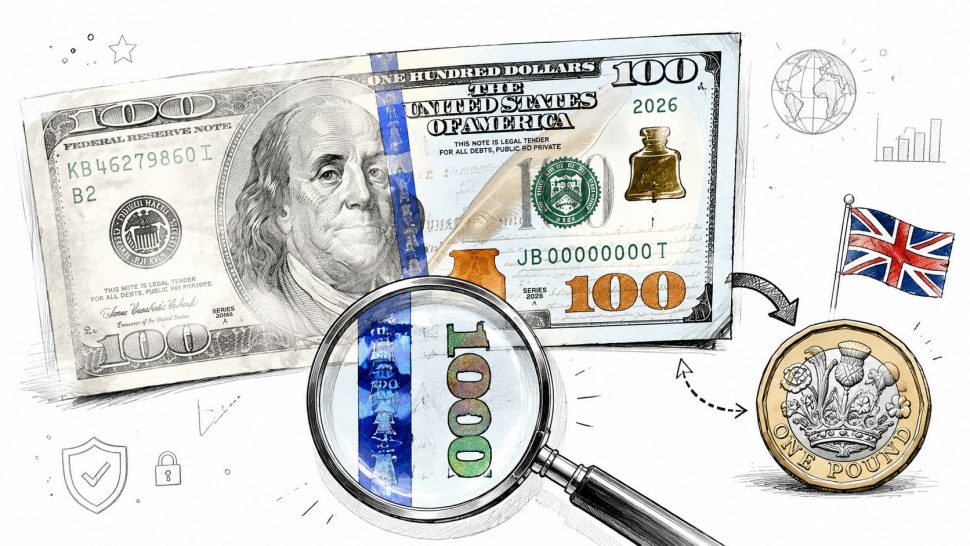
Posted by: Ian Stainton • 8 Jun 2026
There were $2,322.9 billion in U.S. currency in circulation on December 31, 2024, across 55.4 billion notes, and all designs of U.S. currency remain legal tender, including older-looking notes. In practice, new US dollars means recently redesigned banknotes, not a separate or more valid type of money, so if you're in the UK with a mix of old and new U.S. cash, both still have exchange value.
You see this all the time after a trip. A few crisp newer notes sit next to older bills that look dated, plus some quarters, dimes, and pennies that nobody on the high street wants to handle. That mix makes people wonder whether the older notes are still usable, whether the newer ones are safer, and whether any service in the UK will take all of it.
The most important point is simple. Old US notes haven't been cancelled just because newer designs exist. The common issue isn't validity. It's finding a straightforward way to exchange foreign coins and notes without being told that coins aren't accepted, older designs are awkward, or the amount is too small to bother with.
Your Guide to New and Old US Dollars
You get home from the U.S., empty your wallet, and find a familiar mix. A newer-looking $100 note, an older $20, a few $1 bills, and some coins sitting in the side pocket. For UK holders, that usually raises the same practical question. Can all of this still be exchanged without hassle?
In most cases, yes. The point that matters is simple. A newer design does not cancel an older genuine U.S. note. If you are holding a mix of old and new dollars, that is normal, and both can still carry exchange value in the UK.
What people usually mean by new US dollars
Inquiries about new US dollars typically refer to redesigned banknotes with newer security features, not a different currency and not a more valid version of the dollar.
That distinction matters because older notes often worry people more than they should. An older design can still be legal tender and still be worth exchanging, provided the note is genuine and in reasonable condition. Official U.S. guidance confirms that all denominations of U.S. currency remain legal tender regardless of when they were issued (U.S. denominations guidance).
For a UK traveller or small business, the actual issue is rarely validity. It is whether the exchange provider will accept the mix you have.
What this means in practice in the UK
High street banks and standard exchange counters often prefer current-looking notes in tidy amounts. They may refuse coins outright, hesitate over older designs, or make small mixed bundles feel like more trouble than they are worth.
That is why it helps to sort your cash by type before you try to exchange it.
- Newer notes are standard U.S. banknotes and are usually the easiest to place.
- Older notes are often still fine to exchange if they are genuine and not badly damaged.
- Coins still have face value, even though many mainstream services will not handle them.
- Mixed bundles are common after travel, events, charity collections, and cash takings.
We see this regularly with families back from Florida, charities counting overseas donations, and UK businesses that have accepted U.S. cash from visitors. The notes are usually fine. The friction comes from finding a service willing to handle the full bundle sensibly, especially when old and new notes are mixed together.
If that is your position, do not assume the older notes are a lost cause. Check that they are genuine, separate coins from notes, and use a provider that deals with mixed foreign currency rather than only the easiest notes to resell.
Understanding the US Dollar Redesign Schedule
The U.S. doesn't replace every banknote at once. It updates denominations in stages, mainly to improve anti-counterfeiting features and keep cash handling workable while old and new notes circulate together.

The redesign timetable that matters
The public roadmap is staggered. The redesigned $10 note is scheduled for 2026, followed by the $50 in 2028, the $20 in 2030, the $5 in 2032, and the $100 in 2034 (U.S. dollar redesign roadmap).
For UK holders, the key takeaway isn't memorising the years. It's understanding what those dates mean in practice. There won't be one clean switchover where everything old disappears and everything new arrives overnight.
Why mixed designs are normal
When redesigns happen by denomination, several versions of U.S. notes remain in circulation at the same time. That's why one traveller can come home with a modern-looking $100 bill and an older-style $20 in the same wallet, both perfectly valid.
A significant amount of confusion arises. People tend to assume a note that looks older must be near the end of its life. In reality, redesigns create a long period of overlap.
UK holders usually don't have a currency validity problem. They have an identification and acceptance problem.
That distinction matters. If you're a charity sorting donation tins, or a retailer that occasionally gets paid in U.S. cash by mistake, trying to judge a note by age alone isn't reliable. A specialist exchange process is more useful than trying to second-guess design generations yourself.
What works better than waiting
Waiting for all your U.S. notes to become the same design doesn't help, because that may never happen in the cash you've collected. Travel money, donation streams, and till finds are almost always mixed.
A better approach is to separate your concerns:
- Is the note genuine?
- Is it legal tender?
- Can a service process mixed notes and coins without fuss?
If the answer to the second question is yes, and with U.S. notes it generally is, the job becomes operational rather than historical. That's why people who need to exchange foreign coins and notes should think in terms of acceptance and processing, not whether a note looks old-fashioned.
How to Spot a Genuine US Banknote
You don't need forensic training to do a sensible first check. For those handling new US dollars, the right approach is basic note handling: feel it, look at it in normal light, and tilt it.
Start with the simple checks
The redesigned $100 note was introduced to add multiple security features because the highest-value U.S. note is the one most likely to attract advanced counterfeiting attempts (U.S. Treasury note on the redesigned $100 bill).
That doesn't mean every older-looking or unfamiliar note is suspicious. It means the $100 deserves a bit more attention than lower denominations.
Use this order:
- Feel the paper. Genuine U.S. notes have a distinct currency-paper feel that doesn't resemble standard printer paper.
- Look for embedded features. Hold the note up to light and check for security elements that are built into the paper rather than printed flat on top.
- Tilt the note. Modern U.S. notes use movement and colour-shift effects that are harder to fake convincingly.
Key Security Features on New US Banknotes
| Feature | New $20 Note | New $100 Note |
|---|---|---|
| Portrait watermark | Check for a watermark visible when held to light | Check for a watermark visible when held to light |
| Security thread | Look for an embedded thread, not surface printing | Look for an embedded thread, plus other layered features |
| Colour-shifting ink | Tilt and check for colour change in printed elements | Tilt and check for colour change, including the bell in the inkwell |
| Advanced motion feature | Not the main feature most people rely on | Includes the 3D security ribbon, which is a key visual check |
What not to do
Don't rely on just one sign. A note that "looks about right" isn't enough, and a note that looks older isn't automatically bad.
Working rule for mixed cash: check the note's features, not its apparent age.
If you're a traveller checking change from your last U.S. trip, a quick feel-look-tilt check is usually enough to decide whether a note seems normal. If you're a charity or business receiving foreign cash regularly, don't build your process around staff trying to become amateur counterfeit specialists. Build it around secure verification and consistent acceptance rules.
Face Value vs Collector Value What You Should Know
People often find an older U.S. note in a drawer and wonder if it's a rare collectible. Usually, it isn't. For most leftover holiday cash, face value is what matters. That's the value printed on the note or coin, and that's the value people are trying to recover when they convert foreign coins and banknotes into pounds.

Why most old-looking notes aren't collectibles
Collector value depends on scarcity, condition, demand, and very specific issue details. The average U.S. notes people bring back from travel don't fall into that category. They were printed for circulation, used in circulation, and are best treated as ordinary cash.
That matters because people can lose time chasing a collector premium that was never realistic. If your aim is to get value back from mixed travel money, a straightforward currency buy back for dollars is usually more practical than trying to sell common notes as specialist collectibles.
A better way to think about value
Ask one question first. Did this come from normal spending, change, donations, or a cash drawer?
If yes, treat it as exchangeable currency unless a genuine specialist has already identified it as unusual. That saves time and avoids the common mistake of letting usable money sit untouched for years because it "might be worth more someday".
How to Exchange US Dollars Coins and Notes in the UK
The U.S. remains one of the world's largest cash systems. On December 31, 2024, there were $2,322.9 billion in circulation across 55.4 billion notes, and $100 bills accounted for 19.2 billion notes, the largest denomination by volume. The note count also rose from 54.6 billion in 2023 to 55.4 billion in 2024 (U.S. currency in circulation data). For UK travellers, charities, and businesses, that scale explains why mixed U.S. cash turns up so often.

The practical route that usually works best
If you're trying to exchange foreign coins, banks and traditional bureaux often fall short for very ordinary reasons. Coins are expensive to handle. Mixed foreign cash takes time to process. Older notes can trigger manual checks. Small amounts don't fit their business model.
A specialist currency service is usually built for exactly those awkward cases. That includes leftover foreign currency, unsorted holiday money, mixed denomination notes, and coins that high street outlets don't want.
For example, if you're specifically checking a denomination before sending it in, this guide to the US $50 bill is the kind of practical reference people often need when handling mixed notes.
How the process works
The cleanest process is simple:
Gather everything together
Put all your U.S. coins and notes in one place. Don't worry if they're mixed, older, newer, or leftover from several trips.Get a quote before sending
A proper online exchange service should show you the rate up front so you know what you're sending and why.Pack and post securely
Use the provider's instructions. The point isn't to make the process complicated. It's to make sure mixed currency arrives safely and can be checked properly.Verification happens after receipt
Genuine note checking, denomination handling, and sorting are appropriate for this stage. Not in your kitchen, and not at your local bank counter.Receive payment
Specialist online services typically pay by bank transfer or PayPal after verification.
The easiest way to exchange leftover currency is to stop treating coins, old notes, and mixed designs as separate problems.
Why this beats the usual alternatives
This works well for three groups in particular:
- Travellers who want to exchange foreign coins and notes from a recent trip
- Charities that receive assorted overseas donations and need a practical way to process them
- Businesses that end up with foreign cash through tills, tourism, or customer mistakes
The biggest advantage isn't novelty. It's that a specialist process is designed for the messy reality of foreign cash, including coins, mixed notes, and withdrawn currency that standard channels often reject.
Common Mistakes to Avoid When Exchanging Currency
Most value is lost through bad assumptions, not bad luck. People either assume their U.S. cash is too awkward to bother with, or they hand it over to the first place that looks convenient.

Mistakes that cost people money
The first mistake is assuming your bank will take everything. Many won't handle foreign coins, and older or unusual notes can also be awkward.
The second is treating airport exchange as the default answer. Convenience has a price, and if you're not in a rush, it's rarely the best environment for careful decisions.
The third is throwing old-looking U.S. notes into a drawer forever because you're unsure if they're still valid.
Public guides often focus heavily on counterfeit detection, but for UK users the bigger issue is confusion caused by multiple coexisting note designs, not widespread counterfeiting. U.S. guidance confirms that all designs remain legal tender, which is why acceptance across note types matters so much in practice (practical guide to new $100 bill confusion and mixed designs).
Better habits instead
- Check acceptance, not just exchange rate. A provider that won't take coins or awkward notes may not solve your real problem.
- Don't sort obsessively unless asked. Many specialist services are set up for mixed currency.
- Keep coins with the notes. People often forget the coins, even though they still form part of the leftover value.
- Think about donation as well as exchange. If the amount is small, some people prefer to donate foreign coins to charity rather than leave them unused.
A note that looks older is often still valid. A coin that a bank won't touch still isn't worthless.
One more trap to avoid
Don't let fear of getting it wrong stop you from acting at all. The worst outcome for many people isn't a fake note. It's years of perfectly good foreign currency sitting unused because the exchange process seemed annoying.
Real World Scenarios for Exchanging US Currency
The holiday family
A family comes back from Orlando with a handful of $1 notes, a couple of newer $20s, an older $50, and a pouch full of quarters and dimes. The notes don't match, the coins feel like dead weight, and the bank says no to the loose change.
This is the classic exchange foreign coins and notes problem. The money is valid. It's just inconvenient for mainstream exchange channels.
The local charity
A charity receives foreign cash in donation pots after fundraising events. U.S. dollars appear regularly, but they're mixed with coins and notes from other countries, and volunteers don't have time to sort every item by denomination and design.
For this type of organisation, the useful solution isn't a travel-money counter. It's a process built for bulk, mixed, leftover foreign currency that can also support the choice to donate foreign coins to charity instead of leaving them unused.
The small business owner
A retailer near a tourist area occasionally finds U.S. banknotes in the till. Some are newer. Some are older. Staff aren't sure what they are, and nobody wants the hassle of debating authenticity and exchangeability note by note.
In this case, the practical answer is operational. Gather the foreign cash, treat it as a recoverable asset, and use a specialist route to exchange leftover currency rather than letting it pile up in the office safe.
Frequently Asked Questions About US Dollars
Can I exchange foreign coins in the UK if they're U.S. coins
Yes, but usually through a specialist rather than a high street bank or standard travel-money counter. U.S. coins are a common leftover from holidays, yet many mainstream providers will not take them because counting, checking, and processing coins is less efficient for them.
Do banks accept old or new US dollars
Sometimes, but policies vary a lot. A bank may accept current U.S. notes at one branch and refuse older designs, mixed notes, or any foreign coins at another. For UK customers holding a mix of old and new dollars, a specialist currency service is usually the more reliable route.
Are old US dollar notes still valid
Yes. Older U.S. banknotes do not become worthless just because a newer design exists. For many in the UK, the primary issue is exchange acceptance, not legal validity.
What denominations of U.S. paper money are there
U.S. paper money is issued in $1, $2, $5, $10, $20, $50, and $100 notes. If you also have cents, dimes, quarters, or other coins alongside them, it makes sense to use a service that can handle both notes and coins together.
Can I exchange leftover foreign currency without sorting it
Often, yes. That is especially useful for families returning from the U.S., charities emptying donation pots, or businesses clearing foreign cash from a till. A specialist service may let you send mixed currency for checking instead of asking you to separate every item first.
What if I have both old and new US dollars together
That is very common, and it usually does not cause a problem. New notes do not cancel old ones. If you have a mixed bundle, keep everything flat and dry, avoid writing on the notes, and send them through a provider that checks both designs properly.
Can I convert foreign coins and banknotes from a small amount
Yes. Small balances are one of the main reasons people use postal exchange services. A few notes and coins may not feel worth a bank trip, but they can still be exchanged if the provider accepts low-value submissions.
How long does payment usually take
It depends on the provider and the condition of the currency sent in. In most postal exchange cases, payment is made after the notes and coins have been received, counted, and checked.
If you've got mixed new and old US dollars, loose American coins, or leftover travel money that banks won't handle, We Buy All Currency offers a simple way to exchange foreign coins and notes, convert withdrawn currency, or turn unused cash into something useful. You can check the rate, send your currency by post, and get paid without the usual hassle of sorting everything yourself.