
Old 10p Coin: Your Guide to Value & Exchange (2026)
Posted by: Ian Stainton • 28 Apr 2026
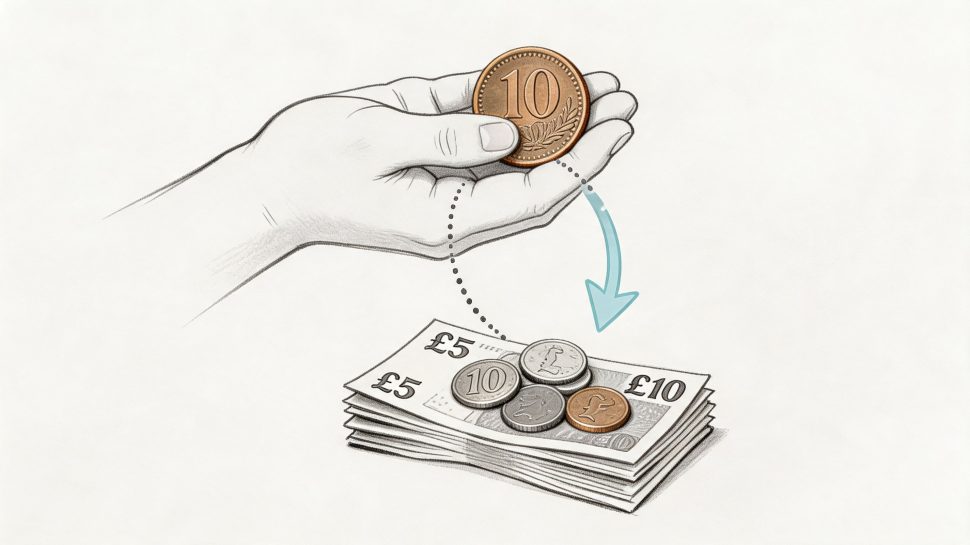
The old large 10p coin was withdrawn on 30 June 1993 and isn’t legal tender anymore, but you can still turn it into cash through a specialist service that accepts withdrawn currency. If you’ve found a tin, drawer, or jar full of old 10ps, they’re usually not rare enough to sell one by one, yet they still have practical exchange value when handled the right way.
A lot of people find these coins by accident. They clear a house, empty a holiday money pot, sort through charity donations, or count the loose change from a business till and suddenly notice some 10p coins look much bigger than the ones in circulation today. That’s where the confusion starts.
Some people assume an old 10p coin must be valuable because it’s old. Others assume it’s worthless because shops won’t take it. The truth sits in the middle. Most old 10p coins are common, but that doesn’t mean they’re useless. And while a few unusual versions attract collectors, many want to know what they’ve got and how to exchange it without wasting time.
Your Quick Guide to the Old 10p Coin
The phrase old 10p coin usually means the larger ten pence piece used before the size change in the early 1990s. It’s the coin that feels noticeably broader and heavier than the modern 10p.
What most people mean by an old 10p coin
There are really two ways people use the term:
- The withdrawn large 10p. This is the older, bigger version that is no longer legal tender.
- Older circulating 10ps. Some people also use the phrase for earlier small 10p coins still recognisable from before later metal changes.
If you’ve found a pile of big 10p pieces, you’re almost certainly dealing with the withdrawn type. These are the ones that often turn up in inherited collections, old money jars, charity tins, and mixed bags of British coins.
Practical rule: If the 10p looks unusually large beside a modern one, treat it as an old withdrawn coin first and a collector item second.
The short answer on value
For most readers, the answer is simple:
- Common old large 10p coins usually aren’t individually rare
- A few unusual issues and transition errors can be worth more
- Bulk exchange is often the easiest route for ordinary finds
That matters because many websites focus on the exciting exceptions. They talk about scarce pieces, proof issues, or specialist errors. Many individuals don’t have those. They have everyday coins and want a straightforward way to exchange leftover currency, old coins, or mixed banknotes and coins without sorting every item into separate piles.
Where people get stuck
Three questions come up again and again:
- Is this coin still spendable?
- Is it a collector coin or just old change?
- Where can I get cash for it?
Those are the practical questions that matter when you’re holding real coins in your hand, not reading a collector’s catalogue.
The Story Behind the Old 10p Coin
The old 10p coin didn’t begin as a quirky collector piece. It was created to solve a national problem. Britain was preparing for decimalisation, and people needed a coin that would feel familiar during a major money change.
Why the old 10p was introduced before Decimal Day
The original large-size UK 10p coin was introduced on 23 April 1968, three years before Decimal Day, as a direct replacement for the pre-decimal florin. It matched the florin in size at 28.5 mm and weight at 11.3 grams, which let both coins circulate interchangeably. The reverse first used NEW PENCE until 1982, and the larger version stayed legal tender until 30 June 1993, as noted by Check Your Change’s guide to old-size 10p coins.
That decision was clever. Instead of asking the public to learn an entirely unfamiliar coin overnight, the authorities used a piece that already felt normal in the hand. The old florin had paved the way.
The florin connection
The florin matters because it explains why the old 10p coin looks the way it does. The florin was first issued on 12 December 1849 and was worth one-tenth of a pound, which made it Britain’s first decimal denomination long before full decimalisation arrived. It shared the same 28.5 mm diameter later used for the 1968 10p, according to Change Checker’s history of the florin as the first 10p.
That’s why older generations often treated florins and early 10ps almost as cousins. In practical use, they formed a bridge between two currency systems.
Design details people notice
Collectors may focus on portraits and inscriptions, but even non-collectors tend to spot a few obvious details:
- Portrait of Queen Elizabeth II on the obverse
- Crowned lion design on the reverse
- NEW PENCE on earlier pieces
- TEN PENCE on later ones
Those wording changes don’t automatically make a coin rare, but they do help place it in the right period.
The old 10p coin was built for familiarity, not rarity. That’s why so many examples still turn up in ordinary household change.
For everyday readers, the main takeaway is simple. The old 10p coin isn’t just an outdated coin. It’s part of the handover from pre-decimal Britain to the money system we use now.
How to Identify and Grade Your Old 10p Coins
If you’ve got a handful of mixed 10p coins, identification is easier than many people think. You don’t need specialist tools to make a first pass. Most of the time, size, weight, and appearance tell you what you need to know.
The easiest way to tell the different 10p coins apart
The biggest change came in 1992, when the large 10p was replaced by a smaller one. The original measured 28.5 mm and weighed 11.31 g. The replacement measured 24.5 mm and weighed 6.5 g, which reduced material use by over 42%. A later change to nickel-plated steel came in 2012 to cut costs and improve vending-machine compatibility, according to the Royal Mint’s ten pence coin specifications.
Here’s the simplest comparison:
| Specification | Large 10p (1968-1992) | Small 10p (1992-2011) | Modern 10p (2012-Present) |
|---|---|---|---|
| Diameter | 28.5 mm | 24.5 mm | 24.5 mm |
| Weight | 11.31 g | 6.5 g | 6.5 g |
| Metal | Cupro-nickel | Cupro-nickel | Nickel-plated steel |
| Status | Withdrawn | Circulating type from earlier period | Current metal type |
If you want a broader reference point for British coin values while sorting older denominations, this guide to pounds coins value is useful for checking what else may be sitting in the same container.
A practical home check
Try this in your kitchen or at a desk:
- Compare the size. The old withdrawn coin looks clearly wider than a modern 10p.
- Feel the weight. The large coin feels heavier straight away.
- Look at the date and wording. Older inscriptions can help place the coin in the right era.
- Separate obvious groups. Put large withdrawn 10ps in one pile and modern spendable 10ps in another.
You don’t need to go further unless you think you’ve found something unusual.
A simple guide to condition
Condition matters most when you’re dealing with collector interest, not routine bulk exchange. For a beginner, these broad categories are enough:
- Worn. Details are flattened and the lettering may be softer.
- Average circulated. The design is clear but shows ordinary use.
- Better condition. Sharper detail, less rubbing, cleaner surfaces.
- Uncirculated-looking. Strong detail with little sign of use.
If you’re exchanging mixed coins in bulk, don’t spend hours grading ordinary pieces. Save the close inspection for coins that already look unusual.
That’s where many people waste time. They think every old coin must be carefully classified before it can be exchanged. In reality, if your aim is to exchange foreign coins and notes, convert foreign coins and banknotes, or cash in withdrawn UK coins, specialist bulk services are designed for exactly that kind of mixed, unsorted lot.
Understanding the Value of Your Old 10p Coins
Most old 10p coins are worth far less to collectors than people expect. That’s not bad news. It just means you need a realistic plan.

Why most old 10p coins are common
The old large 10p was made in huge numbers during its circulation life. That’s why so many still appear in jars and drawers today. Age alone doesn’t create a premium. A coin also needs scarcity, strong condition, or some feature collectors actively want.
Readers often get misled. They search for “old 10p coin value” and land on pages about rare pieces, then assume every old 10p in their possession might be a windfall. Usually, it won’t be.
Which 10p coins can be worth more
There are exceptions. Some low-mintage variants and transition-period pieces attract stronger demand. For example, some A-Z 10p coins such as the 2019 Robin, with 284,000 minted, can sell for £15 to £25. Transitional errors from the 1992 switch to the smaller coin can also reach £50 or more for good examples, according to Change Checker’s coverage of A-Z 10p coins and sought-after variants.
That tells you what drives value:
- Low mintage
- Transition errors
- Strong condition
- Collector demand
How to think about your own coins
A useful rule is to split your find into two groups.
| Type of coin | Typical next step |
|---|---|
| Common old large 10p coins | Bulk exchange or cash conversion |
| Unusual dates, odd strikes, scarce collector pieces | Check individually before exchanging |
If you’ve got dozens or hundreds of ordinary large 10ps, selling them one by one usually isn’t worth the effort. If you spot a coin that seems different from the rest, that single coin may deserve a closer look before you bundle everything together.
Most people do best with a two-minute check, not a two-week research project.
That same logic applies beyond British decimal coins. People trying to exchange foreign coins, exchange leftover currency, or convert foreign coins and banknotes often hold a mixture of ordinary spendable money, obsolete notes, and the occasional collectable item. The smart approach is to identify obvious standouts, then use a practical exchange route for the rest.
Your Practical Options for Cashing In Old 10p Coins
Once you know you’re holding withdrawn large 10p coins, the next question is simple. Where can you turn them into money?
Why banks and ordinary exchange counters usually aren’t the answer
Banks and standard currency counters tend to focus on current money. They may accept selected banknotes, but coins are much more limited, especially if they’re old, foreign, mixed, or withdrawn. That’s why people often walk away frustrated.
The same problem affects more than household savers. Charities, airports, retailers, and businesses can end up with containers full of mixed coins and notes that ordinary channels won’t handle efficiently.
Comparing your main options
Here’s a practical comparison:
| Option | Best for | Main drawback |
|---|---|---|
| Selling to a collector | One rare or unusual coin | Poor fit for common bulk coins |
| Auction sites | Scarcer items with clear buyer demand | Time, listing effort, packing, and uncertainty |
| Specialist exchange service | Mixed, common, old, foreign, or withdrawn currency | Best results depend on using a service built for these items |
A key challenge for people with old coins is the lack of a simple bulk disposal option. Most guides concentrate on collectables, but specialist weight-based exchange services offer a straightforward route for unsorted, obsolete UK coins at face value or more without the hassle of sorting or auction fees, as explained in this overview of the easy way to exchange old British coins and notes.
Common mistakes to avoid
People lose time and money in predictable ways:
- Treating every old coin as a rare find. Most aren’t.
- Trying banks first for withdrawn coins. That often leads nowhere.
- Sorting too finely too early. Basic separation is enough for most lots.
- Ignoring mixed currency value. Old UK coins often sit alongside foreign coins and banknotes that can also be exchanged.
- Listing low-value common coins individually. Effort can outweigh return.
The easiest route is usually the one that matches the reality of what you have, not the most exciting story you’ve read online.
For ordinary households, the best solution is often the simplest one. If the coins are common and the goal is cash, use a specialist route designed for old and mixed money. That’s just as true when you need to exchange foreign coins and notes or deal with leftover foreign currency from travel.
A Simple Step-by-Step Guide to Exchanging Your Coins
You open a drawer to look for batteries and find a bag full of old 10p coins, a few foreign notes, and loose change from trips you barely remember. At that point, the question usually is not coin history. It is what to do next, without spending your evening sorting every piece by hand.

A practical exchange process should feel closer to emptying a piggy bank than preparing a museum display. If your aim is cash rather than collecting, keep the job simple and follow a clear order.
Gather everything into one place
Start by bringing all the coins and notes together. Use a table, tray, or clear worktop so you can see what you have at a glance.
You only need a basic sort:
- Old UK coins, including old 10p coins and other withdrawn pieces
- Foreign coins
- Foreign banknotes
- Leftover holiday money
- Any current coins or notes mixed in by mistake
If a bag contains several types of currency, that is normal. Households, charities, and businesses often find that old British coins are mixed with euros, pre-euro coins, or notes from past trips. You are not trying to grade every item here. You are separating the pile into something manageable.
Choose a quote method that matches the pile you have
This is the stage where many people get stuck. Collector websites often expect detailed identification, but a cash-out service for ordinary holders should work with real-life mixed bags.
Look for a service that lets you get a quote in a practical way, such as by denomination, by category, or by weight for unsorted amounts. That approach is especially useful if your old 10p coins are only one part of a larger bundle and you also want to exchange foreign coins and notes.
For non-collectors, this matters a lot. A charity volunteer, shop manager, or family member clearing a relative's home usually needs a straightforward route to value, not a lesson in specialist catalogues.
Pack the coins securely
Once you have your quote, pack the contents so they travel safely and can be checked easily on arrival.
A simple routine works well:
- Put coins and notes into separate bags inside the parcel.
- Stop coins from shifting around so they do not split the packaging.
- Add any reference or order details requested by the service.
- Use a padded envelope or sturdy box based on the weight.
- Seal the parcel carefully and post it using the recommended method.
Heavy coin parcels need extra care. A small box is often better than a thin envelope if the contents are dense.
Wait for checking and payment
After your parcel arrives, the service checks what was sent and confirms the exchange value. According to the publisher information provided for this service, payment is made within five working days by PayPal or bank transfer. Rates are shown before you send your parcel, and if you do not want to proceed, the currency is returned free of charge under a happiness guarantee.
That gives people two things they usually want straight away. They can see how the process works before posting anything, and they know there is a clear outcome at the end.
Who this works well for
This process suits more than one type of customer because mixed coin finds happen in everyday settings, not only in coin albums.
It works well for:
- Households clearing drawers, jars, and inherited tins
- Charities collecting assorted donated coins and notes
- Shops and cafés that receive foreign change over the counter
- Tourist venues and travel-related businesses handling leftover currency
- Offices and organisations that want one simple route for old UK and foreign money
For anyone sitting on a pile of old 10p coins, the main goal is usually simple. Turn awkward money into usable money with as little effort as possible.
Turning Your Old Coins into Charitable Donations
Not everyone wants the payout for themselves. Sometimes the old 10p coin at the bottom of a drawer becomes more useful as a donation than as a keepsake.

Why donation makes sense for leftover coins
People often assume charity donations only work for current notes or online payments. In practice, old coins, foreign coins, and withdrawn banknotes can also be useful if they’re converted through the right channel.
That matters because the awkward money is often the money people never use. It sits in kitchen drawers, car compartments, office boxes, airport collection points, and fundraising buckets. On its own, it feels too messy to deal with. Combined and processed properly, it becomes meaningful.
Good situations for donating old and mixed currency
Donation works particularly well in these situations:
- After a holiday, when you’ve got leftover foreign currency you won’t spend again
- During a house clear-out, when old British coins surface in bulk
- For business collections, where staff and customers drop mixed change into a charity pot
- For charities themselves, when supporters donate coins and notes from many countries
This is one of the strongest reasons specialist exchange services matter. They can accept the kinds of money high street channels usually reject, which means more of the donation gets converted instead of sitting unused.
A bag of unwanted coins may look untidy on a desk. In a charity process, it becomes usable money.
A better alternative to throwing old coins back in a drawer
If you don’t want to spend time identifying every piece, donation gives the collection a clear purpose. That’s especially helpful for mixed lots containing foreign coins, old 10p pieces, obsolete UK currency, and small-value notes.
It also removes the pressure to maximise every single coin as a potential collector item. For many people, the best outcome isn’t chasing a tiny premium. It’s clearing clutter, doing some good, and making sure the currency gets used rather than forgotten again.
Frequently Asked Questions About Old and Foreign Currency
Can you exchange an old 10p coin in the UK
Yes, but not in the same way you’d spend a current coin in a shop. A withdrawn old 10p coin usually needs a specialist exchange route rather than ordinary retail use. That’s the key difference people miss.
Do banks accept old 10p coins
Banks and standard bureaux typically focus on current currency. Old coins, foreign coins, and withdrawn denominations often fall outside what they handle. That’s why specialist services are so useful for people who need to exchange leftover currency or convert foreign coins and banknotes.
Are old 10p coins valuable
Sometimes, but usually not individually. Most common large old 10p coins are ordinary exchange items rather than high-value collectables. A smaller number of unusual pieces, such as certain transition errors or scarcer modern collector-related issues, may be worth checking on their own.
How do I know if my 10p coin is the withdrawn large type
Compare it with a modern 10p. If it looks noticeably larger and heavier, it’s probably the withdrawn version. That first visual check solves the question for many without any specialist equipment.
Should I sort my coins before sending them
Only lightly, if at all. Separate obvious modern spendable money from clearly old or foreign pieces if that helps. Beyond that, many people over-sort. If you’re using a service designed for mixed currency, unsorted holdings are exactly what it’s built to handle.
Can I send foreign coins and UK coins together
In many specialist systems, yes. That’s one of the main advantages compared with banks or travel money desks. If your old 10p coins are mixed with euros, pre-euro money, old Irish currency, or leftover holiday notes, a specialist route can process the lot much more efficiently.
What about old notes and withdrawn banknotes
They may still have exchange value through a service that accepts obsolete currency. That’s why it’s worth checking everything in the same drawer or tin, not just the coins. Many people focus on one old 10p coin and overlook the foreign notes and withdrawn banknotes sitting right beside it.
Is it safe to post coins and notes
It can be, as long as you package them properly and follow the service instructions. Use sturdy packaging, keep the contents contained, and choose the recommended postal option. The main risk usually comes from poor packing, not from the idea of postal exchange itself.
How long does payment take
For the publisher service behind this article, payment is issued within five working days after verification, with PayPal or bank transfer available. That’s helpful for people who want a clear, predictable process rather than an open-ended wait.
Can charities and businesses use this kind of service too
Yes. This type of service isn’t only for travellers or coin collectors. It’s useful for charities receiving public donations, retailers handed foreign change in error, airports collecting travel leftovers, and organisations that need one route to exchange foreign coins and notes in bulk.
What if I’m not sure whether my coins are worth more individually
Use common sense and a quick triage. Pull out anything that looks obviously different, especially unusual designs, dates, or striking oddities. If the rest is ordinary mixed change, the simplest approach is usually to exchange it as bulk currency rather than spend hours researching every piece.
Can I donate foreign coins to charity instead of taking cash
Yes, many people do exactly that. It’s a practical option for leftover foreign currency and old British coins that would otherwise sit unused. For families, it clears clutter. For businesses and charities, it turns awkward money into funds that can be used.
If you’ve found old 10p coins, foreign coins, banknotes, or mixed withdrawn currency, We Buy All Currency gives you a simple way to turn it into cash or donate the value to charity. You can exchange foreign coins, exchange leftover currency, or convert foreign coins and banknotes through one specialist service that accepts the awkward money banks and bureaux usually won’t handle.