
Old 5p Coin Value What Your Collection Is Really Worth
Posted by: Ian Stainton • 5 Jan 2026
Ever stumbled across one of those big, old 5p coins in a change jar and wondered if you’ve found a little piece of treasure? It’s a common question, and the short answer is that while most are just worth their face value, some rare versions can be a nice find for collectors.
This guide will walk you through exactly what you've got and show you the simplest, most hassle-free way to get some cash from them.
Your Guide to the Old 5p Coin
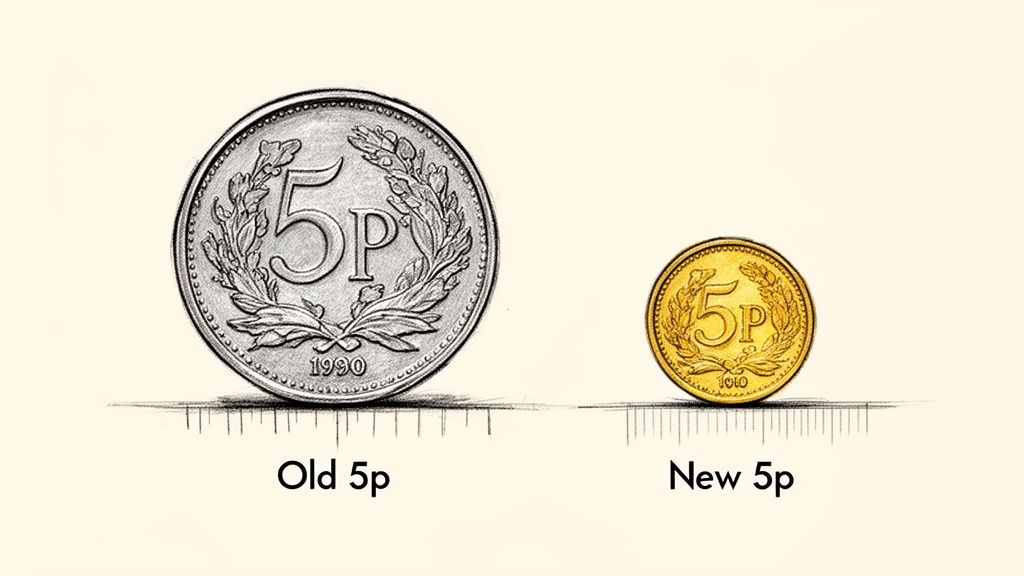
We've all got a pot or tin somewhere filled with old coins, and this larger 5p piece is usually in the mix. They first appeared back in 1968, a few years before the UK went fully decimal in 1971.
Cleverly, they were made to be the exact same size and weight as the old shilling. This was a smart move to help everyone get used to the new system without much fuss. This bigger version served us well until 1990, when it was replaced by the smaller, lighter 5p coin we all know today.
Old 5p Coin At a Glance
Here’s a simple comparison to help you quickly identify the old 5p coin versus the one in your pocket today.
| Feature | Old 5p Coin (1968-1990) | Current 5p Coin (1990-Present) |
|---|---|---|
| Diameter | 23.59mm | 18.00mm |
| Weight | 5.65g | 3.25g |
| Metal | Cupro-nickel | Nickel-plated steel |
| Legal Tender? | No | Yes |
As you can see, the main giveaway is the size. The old coin is noticeably bigger and heavier than its modern replacement.
Because millions upon millions of these were minted for over two decades, they aren’t considered rare. Still, they’re a fascinating part of Britain’s monetary history.
For most people, the real value of these coins isn't in finding a rare collector's item, but in the collective total of a large, unsorted collection. The challenge is turning that bulky metal into actual money you can use.
That’s where our simple, hassle-free exchange service really comes in handy. Instead of spending hours sifting through your coins one by one, you can get a guaranteed value for the entire lot.
The Easiest Way to Exchange Your Coins
If you have a bag of old 5p coins, maybe jumbled up with leftover holiday money or other obsolete British coins, the thought of exchanging them can feel like a chore. It really doesn't have to be.
Our service is designed to be fast, easy, and completely hassle-free.
Here’s what makes us the perfect solution:
- No Sorting Needed: Just gather up all your unwanted coins and notes. It doesn’t matter if they’re all mixed together – we handle all of that for you.
- A 100% Guaranteed Service: We give you a clear, transparent quote from the start. What you see is what you get, with no hidden fees.
- Trusted by Major Brands: We’re the go-to currency exchange partner for major UK charities, supermarkets, airports, and even police forces. You can be confident you’re in safe hands.
Our mission is to help you easily convert foreign coins and banknotes and other old currency into cash. Whether you want to exchange foreign coins and notes from a trip abroad or donate foreign coins to charity, we make it simple.
Find out how to turn that jar of old 5p coins and other currency into cash by visiting our homepage.
The Shilling's Successor: Britain's Smart Move to Decimal Money
Every coin jingling in your pocket has a story, and the old 5p coin tells a particularly interesting one. It’s a key chapter in Britain's dramatic shift from the old system of pounds, shillings, and pence to the decimal currency we use today. To really get what this coin is all about, you have to picture a time when money was a completely different language – a system that had worked for centuries but was on the brink of a massive overhaul. The government knew this change had to be as painless as possible, and the old 5p was their secret weapon.
This coin wasn't just a new piece of metal; it was a brilliant bit of strategic planning. It was released years before the official switchover, designed to build a bridge between the old world and the new. By making it look and feel exactly like a coin people already knew and trusted, it became a familiar face in a sea of change, helping the public get used to the idea of decimal money long before it became official.
A Clever Bridge to Decimalisation
Switching an entire country to a new currency system was a monumental task. To ease everyone into this new way of thinking, The Royal Mint cleverly started rolling out new coins that had a direct link to the old money. The old 5p coin is the perfect example of this strategy in action.
It first appeared on 23 April 1968, well ahead of Decimal Day. Its mission? To directly replace the much-loved shilling. By making it the exact same size and value, the transition felt natural in everyday shopping. This chunky cupro-nickel coin weighed 5.65 grams and measured 23.59mm across. On the front, it featured Queen Elizabeth II’s second portrait by Arnold Machin, while the back showed off Christopher Ironside’s crowned thistle design.
Crucially, the old shilling wasn't taken out of circulation until 31 December 1990. This meant both coins were used side-by-side for over two decades, giving people plenty of time to get comfortable with the new system, which officially launched on 15 February 1971. You can find more fascinating details about the 5p's history over on The Royal Mint's website.
This dual circulation was a masterstroke. For over twenty years, you could get a shilling in your change and spend it as 5p, or the other way around. This seamless interchangeability built a slow, natural understanding of the new system, avoiding the chaos a sudden switch might have caused.
Thanks to this long overlap, by the time "Decimal Day" finally arrived, a big chunk of the new currency already felt completely normal to everyone. To learn more about the coin it replaced, why not check out our guide on what shilling coins are worth?
Iconic Designs for a New Era
The old 5p coin wasn't just a practical tool; its design was symbolic of a modernising Britain. Every detail was carefully chosen to represent a blend of continuity and progress.
The portrait of Queen Elizabeth II was the second official one used on UK coins, designed by the artist Arnold Machin. It took over from the younger-looking portrait by Mary Gillick seen on pre-decimal coins. The Machin portrait, which showed the Queen wearing the famous "Girls of Great Britain and Ireland" tiara, presented a more mature, regal image that would become an icon on coins and stamps for years to come.
The design on the back, created by Christopher Ironside, was just as meaningful. It featured the crowned thistle of Scotland.
- The Crowned Thistle: As the national flower of Scotland, this emblem has been a royal symbol for centuries.
- A Symbol of Unity: Including it on the coin was a nod to the unity of the nations within the UK during a period of huge national change.
Together, these designs gave the coin a feeling of being both traditional and fresh. It paid respect to the past while clearly signalling the dawn of a new monetary age.
While most of these coins are quite common today, their historical importance is what makes them special. If you have a collection of them, along with other leftover foreign currency, our service offers a fast and simple way to exchange foreign coins and notes. As a company trusted by major UK brands, including charities, supermarkets, airports, and police forces, we provide a 100% guaranteed process to convert your old currency into cash, with no need for you to sort anything.
How to Identify Key 5p Coin Varieties
Spotting the subtle differences between old 5p coins can feel like a small treasure hunt. While most of these coins are very common, knowing which variety you have is the first step to understanding its story and potential. Armed with a little knowledge, you can easily sort through a pile of change and identify exactly what you're holding.
The most important distinction is the wording on the coin itself. This simple detail tells you which era your coin belongs to and is the primary way collectors categorise them. Think of it as the coin's birth certificate, pinpointing its place in history.
The New Pence Era: 1968 to 1981
When the large 5p coin first arrived in 1968, it carried the inscription “NEW PENCE” on the reverse side, just above the crowned thistle. This wording was a deliberate choice by The Royal Mint to help the public tell these new decimal coins apart from the old pre-decimal currency that was still circulating.
These "NEW PENCE" coins were minted every year from 1968 to 1981, with a few exceptions. None were produced for general circulation in 1972, 1973, and 1974. If you find a coin from this period, you’re holding a piece of the original decimalisation story.
The Five Pence Era: 1982 to 1990
By the early 1980s, the British public was completely used to the decimal system. The "NEW" prefix was no longer needed, as the currency was just… well, the currency.
So, in 1982, The Royal Mint updated the inscription to read “FIVE PENCE”. This change marked the coin's transition from a new-fangled piece of money to a familiar part of everyday life. This second variety was minted every year from 1982 until 1990, the final year of production for the large 5p coin before it was replaced by the smaller version.
This simple decision tree helps visualise the coin's journey from its pre-decimal roots as the shilling to its final form as the large five pence piece.
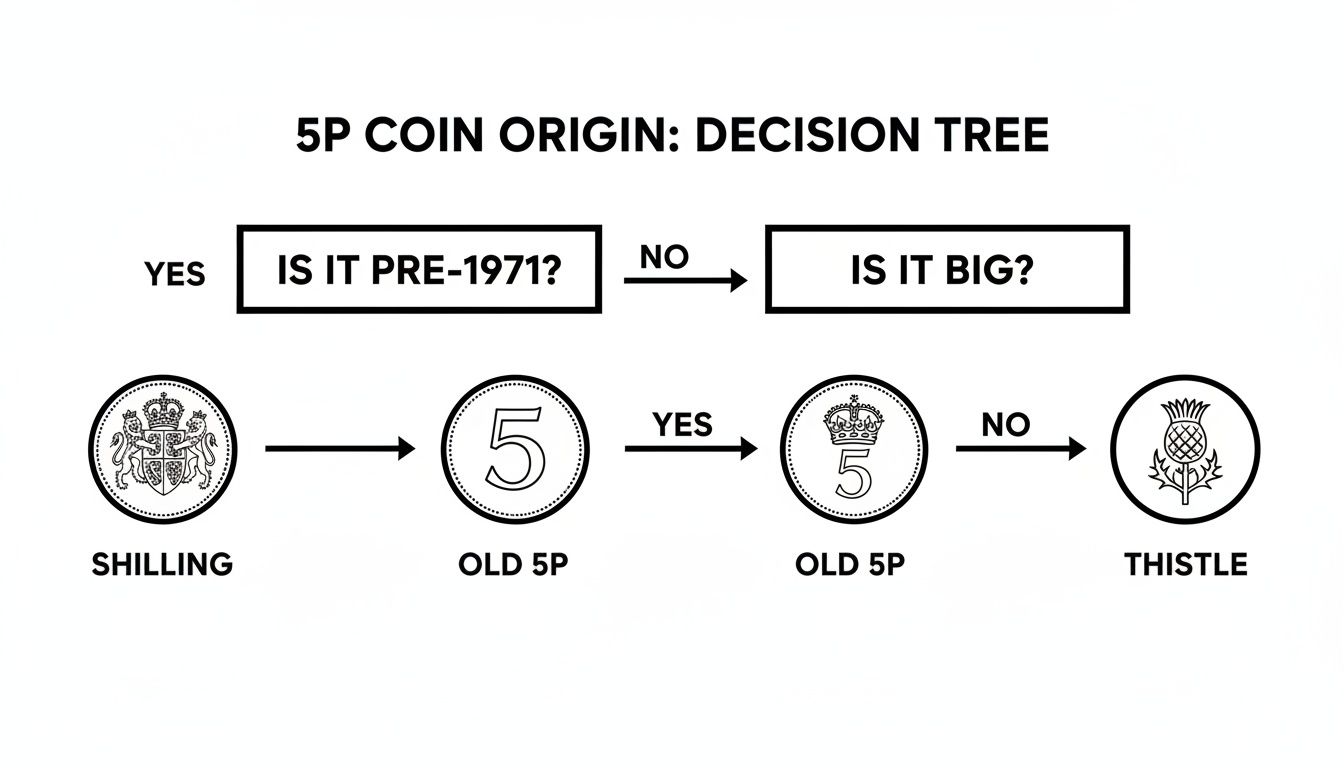
As you can see, the large 5p directly evolved from the shilling, keeping its size to create a smooth transition for the public during decimalisation. It was a clever bit of planning.
To make identifying your coins even easier, here's a quick breakdown of the different issues.
Key Dates and Varieties of the Old Large 5p Coin
| Years of Issue | Key Identifying Feature | Designer (Obverse/Reverse) | Notes for Collectors |
|---|---|---|---|
| 1968–1981 | Inscription reads “NEW PENCE”. | Arnold Machin / Christopher Ironside | This was the first decimal 5p, designed to ease the transition from shillings. |
| 1982–1984 | Inscription changed to “FIVE PENCE”. | Arnold Machin / Christopher Ironside | Same Machin portrait of the Queen, just with the updated wording on the back. |
| 1985–1990 | Queen's portrait updated. | Raphael Maklouf / Christopher Ironside | The final version before the coin was shrunk. Features the more mature Maklouf portrait. |
This table should help you quickly sort your large 5p coins into their correct categories based on the year and the design features you see.
Proof Coins and Special Collector Sets
Beyond the coins you'd find in your change, The Royal Mint also produced special versions for collectors. These are known as proof coins and were never intended for general circulation.
You can spot a proof coin by its distinct, premium appearance:
- Mirror-Like Finish: The background is highly polished and reflective, almost like a mirror.
- Frosted Details: The designs, like the Queen's portrait and the thistle, have a matte or frosted look that contrasts sharply with the shiny background.
- Exceptional Quality: They are struck multiple times with specially prepared dies, resulting in a much sharper and more detailed image.
These proof coins were usually sold as part of annual collector sets. While they are visually stunning, it's important to remember that even proof versions of the old 5p are generally not rare, as a high number of sets were produced over the years.
While sorting your coins is an interesting exercise, remember that the vast majority are extremely common. For large, mixed collections of old currency, the most practical solution is often the simplest.
At We Buy All Currency, we offer a fast, easy, and hassle-free service to exchange your old coins. There’s no need to sort anything; just send us your mixed collection of old 5p coins, leftover foreign currency, and any other obsolete money. Our 100% guaranteed process is trusted by major UK brands, including charities, supermarkets, airports, and police forces. We make it simple to convert foreign coins and banknotes into cash.
Ready to clear out that coin jar? Visit our homepage to see how easy it is to get started.
What Are My Old 5p Coins Actually Worth?
So, you’ve dug out your old 5p coins and separated them into the ‘NEW PENCE’ and ‘FIVE PENCE’ piles. But what’s the difference between a common old coin and something a collector would genuinely want? Getting to grips with this is key to understanding why, for most people, a simple bulk exchange is the smartest move.
The honest truth is that the overwhelming majority of old 5p coins are incredibly common. With hundreds of millions minted over two decades, they are about as far from rare as you can get. Their real value, if any, boils down to three key things every collector looks at: mintage, condition, and rarity.
Mintage Numbers Explained
First up is mintage. It’s just a simple term for how many coins The Royal Mint produced in a specific year. As you’d expect, a lower mintage figure often means a coin is harder to find, which can make it more desirable.
For the old, large 5p coin, the mintage numbers were almost always sky-high. In its very first year, 1968, over 98 million were struck. By 1975, that number ballooned to over 141 million.
While some years saw smaller production runs (like 1977, with just over 24 million), these are still enormous numbers in the world of coin collecting. This is the main reason why most old 5p coins are only worth their metal value, not a hefty collector’s premium.
It's important to be realistic about this. It helps you understand why our weight-based exchange service is often the most practical and rewarding way to handle a big jar of common coins.
Why Coin Condition is Crucial
Next, let's talk about condition, or what collectors call the "grade." Think of it like a second-hand car – a pristine one with low mileage will always be worth more than a battered one that’s been around the block a few times. Coins are exactly the same. One that’s been rattling around in pockets and tills for years will have scratches, faded details, and a dull finish.
Coin grading is a formal system, but here are the basics you need to know:
- Uncirculated (UNC): A perfect coin, straight from the mint. It’s never been spent and still has that original shine.
- Fine (F): This coin has been used. The main design is still clear, but you’ll see obvious wear on the high points, like the Queen's hair or the thistle’s leaves.
- Good (G): This means it's seen a lot of action. The coin is often smooth, and much of the delicate detail has worn away, though you can still make out the main design.
Most old 5p coins you find in a change jar will fall into the "Fine" or "Good" categories. An Uncirculated version, especially from a year with lower mintage, is what collectors look for, but these are usually only found in special collector sets, not in everyday change.
The Hunt for Rarity and Errors
The final factor is true rarity, which usually comes from minting errors—mistakes made when the coin was being produced. These create unique oddities that can be valuable, like a coin struck on the wrong type of metal or with a wonky design.
But finding a genuine error coin is like finding a needle in a haystack. For anyone interested in learning more about valuing old currency in general, our detailed guide on how to sell old coins is a great place to start.
For the average person with a stash of old 5p coins, the best way to get value from them isn't by checking each one individually. It’s through a simple, guaranteed exchange. Our fast, easy, and hassle-free service was designed for exactly this. You can convert foreign coins and banknotes or any other obsolete currency without even needing to sort them first—a process trusted by everyone from major UK charities and supermarkets to police forces.
The Easiest Way to Exchange Your Old Coins for Cash
After digging into the history of the old 5p coin, you might be feeling the thrill of the hunt for a rare collectible. But for most of us, the reality is a heavy jar full of very common, now obsolete, currency. Instead of letting that old money gather dust, there’s a dead simple way to turn it into cash you can actually spend.
We get it – your time is precious. That’s why we’ve built a service that’s fast, easy, and completely hassle-free. It’s designed to unlock the value in your old coins without any of the usual fuss.
A Radically Simple Weight-Based System
The secret to our straightforward service? We work by weight. Forget the tedious chore of sifting through mountains of shrapnel, trying to separate coins by size or country. With us, there’s absolutely no need to sort your coins.
Just gather up all your unwanted currency—those old 5p pieces, leftover holiday money, and any other old notes you have lying around—and we’ll handle the rest. It’s the perfect solution for those big, mixed collections that feel too overwhelming to tackle on your own.
Our 100% guaranteed service means the quote you see is the payment you get. We believe in being completely upfront, so you know exactly what to expect from start to finish.
This simple system lets us process your collection quickly, which means you get paid faster. It’s the ideal way to exchange foreign coins and notes without the headache.
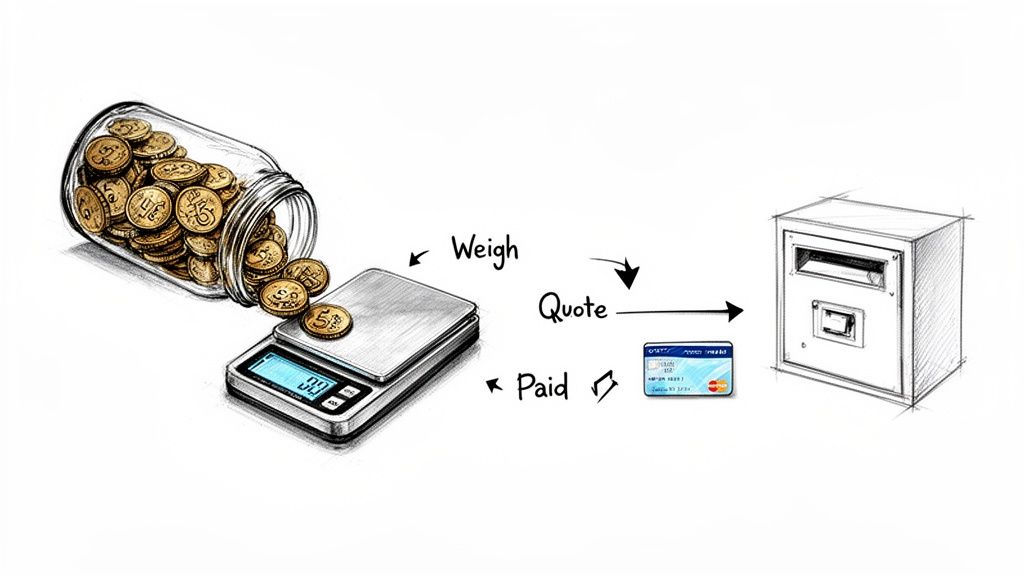
How Our Hassle-Free Process Works
We’ve boiled our exchange process down to three simple steps. Our goal is to put cash back in your pocket with as little effort from you as possible.
- Get a Free Online Quote: Use our easy online currency wizard to get an instant quote. It’s quick, free, and gives you a clear idea of what your collection is worth.
- Post Your Currency: Pack your unsorted coins and notes securely and pop them in the post. We give you clear instructions to make sure it’s simple and safe.
- Get Paid Quickly: As soon as we receive your currency, we get your payment processed. You can choose to be paid straight into your bank account or via PayPal.
The whole thing is designed to turn a chore into a quick and satisfying win.
A Service Built on Trust and Credibility
Sending your money away requires complete confidence in the company you’re dealing with. We’re proud to have built a solid reputation for reliability, becoming the trusted currency exchange partner for some of the UK’s most recognised organisations.
Our credibility is reflected in our strong relationships with:
- Major UK Charities: We help them turn donated foreign and old currency into vital funds.
- National Supermarkets: They rely on us to handle obsolete and foreign currency efficiently.
- Airports and Police Forces: We’re the go-to service for managing currency from various sources.
This trust has been earned by providing a dependable, transparent, and 100% guaranteed service for years. Whether you want to convert foreign coins and banknotes for yourself or donate foreign coins to charity, you can be sure you’re in safe hands.
If you have a mix of currencies, including other old British money, our guide on how to exchange old British coins and notes has more helpful advice.
Ready to see how much your collection is worth? Head to our homepage to start your fast and easy exchange today.
Turn All Your Unwanted Currency Into Cash
Finding a few old 5p coins is often just the start. If you’re like most people, you probably have a drawer, a jar, or an old travel wallet stuffed with odd coins and notes. Think leftover holiday money, old round pound coins, or even pre-decimal treasures like shillings and sixpences.
Instead of letting that jumble of forgotten currency gather dust, you can turn all of it into useful cash in one simple, hassle-free go. Our service is designed to handle much more than just the old 5p coin—we’re experts in dealing with a massive variety of obsolete and foreign currency. Think of us as your one-stop shop for unlocking the value in all that forgotten money.
Beyond the 5p: What Else Can You Exchange?
That heavy bag of mixed coins is where our service really shines. There’s absolutely no need to sort your coins or notes before sending them to us. Our fast and easy system is built to handle it all together.
We regularly help customers exchange foreign coins and notes from all corners of the globe, including:
- Old European Currencies: Still got Spanish Pesetas, German Deutsche Marks, or French Francs from trips taken years ago? We can convert them for you.
- Other Obsolete British Money: We accept old round pound coins, the larger 10p coins, and even pre-decimal currency like shillings and half-crowns.
- Leftover Holiday Money: From US dollars to Australian cents, you can include any leftover travel money in your package.
Our service is 100% guaranteed, offering a transparent and credible way to convert all your unwanted currency at once. We’re trusted by major brands, including UK charities, supermarkets, airports, and police forces, to provide a reliable exchange.
Make a Difference: Donate Your Currency to Charity
Sometimes, the value of old currency isn’t just about what it can do for you, but how it can help others. Many people find that donating the value of their forgotten coins is a wonderfully simple way to support a good cause, and we make this incredibly straightforward.
When you use our service, you have the option to donate foreign coins to charity. Instead of receiving a payment yourself, you can direct the full value of your currency to one of our trusted UK charity partners. It’s a fast, easy, and impactful way to ensure that money you can no longer spend makes a genuine difference to those in need.
Whether you choose to cash in or donate, we provide a seamless way to convert foreign coins and banknotes into something meaningful.
Ready to clear out all your old currency? Head over to our homepage to start your easy, hassle-free exchange.
Still Have Questions? Here Are Some Quick Answers
To wrap things up, let's go over a few of the most common questions we get about the old 5p coin. Getting clear answers is the first step to making a smart decision about what to do with them.
Are the Old, Large 5p Coins Still Legal Tender?
In short, no. The original large-sized 5p coins were officially taken out of circulation on 31st December 1990. So, you can’t pop down to the shops and spend them, but that doesn't mean they're worthless. You can still unlock their value right here with our fast and easy exchange service.
Do I Need to Sort My Coins Before Sending Them?
Absolutely not. We designed our service to be completely hassle-free. It’s based on a simple and efficient weight system, which means you can just chuck all your mixed, unsorted coins into a box and send them over. Whether it's old 5p pieces, leftover holiday money, or other old British coins, we'll do all the hard work for you.
What if I Have a Mix of Other Old British or Foreign Coins?
That’s perfect! We specialise in exchanging all sorts of obsolete and foreign currency. You can pop everything into the same package, from leftover foreign currency from your travels to pre-decimal British coins you found in a drawer. Our 100% guaranteed service is trusted by major UK charities and supermarkets, so you can be sure you're getting a fair value for the whole lot.
Our mission is to make it easy for you to convert foreign coins and banknotes into cash. We provide a credible, transparent process from start to finish.
Can I Donate the Value of My Old Coins to Charity?
Yes, and we've made it incredibly simple to do so. As you go through our online exchange wizard, you'll see a clear option to donate foreign coins to charity. You can choose to send the payment directly to one of our trusted UK charity partners, making it an easy way to ensure your old currency makes a real difference.
Ready to turn that old coin collection into cash or a meaningful donation? At We Buy All Currency, our fast, easy, and 100% guaranteed service is the perfect solution for your unsorted currency. Why not head over to our homepage and get started today?