
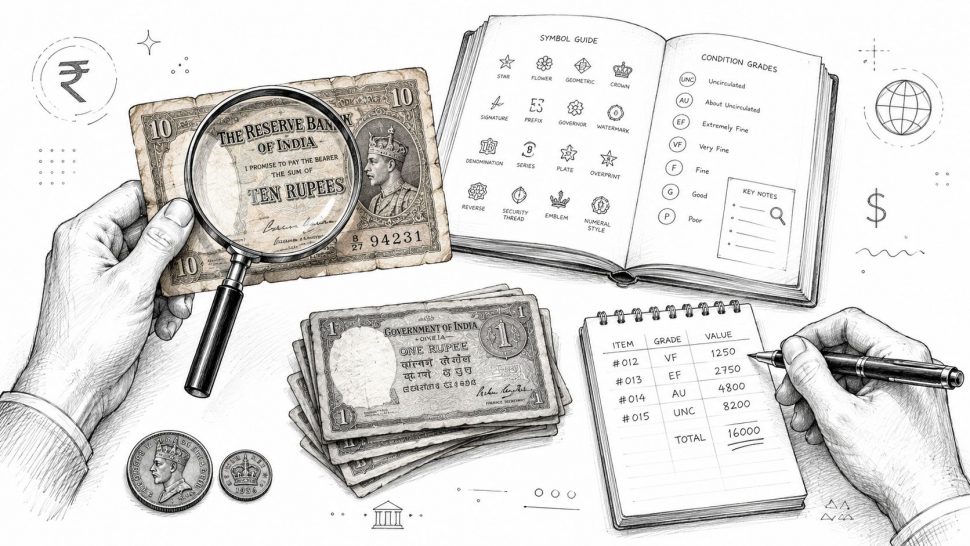
You've just come back from a trip, tipped a few notes into a drawer, and forgotten about the loose change in your coat pocket. Months later, you find a mix of banknotes, coins, and maybe a few older slips that don't look like they belong in circulation anymore. That's when old currency notes value stops being an abstract phrase and turns into a real question: what's worth exchanging, what's collectible, and what should be sent for conversion?
Quick answer: start by identifying the issuing country, series, and condition of each note, then check whether it's current legal tender or withdrawn. If the note is old, scarce, or in strong condition, it may be worth more than face value, especially when collector demand is involved. A specialist service such as We Buy All Currency accepts coins, banknotes, withdrawn currency, and mixed leftover currency, so you don't need to sort everything first, and payment is issued after verification within five working days. There are no hidden charges, and if you're unsure, the quote gives you a practical starting point before you send anything away.
Introduction and Quick Answer
A lot of people only think about leftover money when they're clearing a holiday bag or emptying an old envelope from a suitcase. At that point, the obvious choice is often a bank counter or a local exchange bureau, but those routes can fall short once the mix includes foreign coins, old notes, or withdrawn currency.
The main mistake is treating every note as if it has the same value. Some are only worth their face amount, some have a modest premium, and some are collectible because of era, rarity, or condition. That's why a practical valuation process matters before you decide whether to exchange foreign coins, exchange foreign coins and notes, or donate foreign coins to charity.
Practical rule: if a note is old, clean, and from a clearly identified series, don't assume it's worthless just because it's no longer current.
The fastest route is usually simple. Identify the note, check whether it's legal tender or withdrawn, compare condition, and then use a specialist buyer that handles unsorted collections and older paper money. If you want the money out of the drawer and into your account without a lot of friction, that approach usually beats trying to force it through a bank that won't take coins or obsolete notes.
Understanding Old Currency Notes Value
Old currency notes value usually comes down to three questions, who issued it, when it was printed, and whether it still functions as money. A note from a current series behaves differently from a withdrawn one, and a withdrawn note can still have genuine collector value even when it's no longer legal tender. That's why face value and market value often point in completely different directions.
Era matters more than denomination
In the UK, the key historical turning point was decimalisation on 15 February 1971, when the pound was redefined and the old £1/–/d system was replaced by 100 new pence to the pound, a change that helped create a long-term collector market for pre-decimal notes and made era a bigger factor than face value alone, as noted in the historical record. The Bank of England's later withdrawal timetable also drew clearer lines between note generations, with older £1 notes withdrawn on 11 March 1988 and the last paper £5 note with Queen Elizabeth II and George Stephenson withdrawn on 11 May 1990.
Those dates matter because they separate ordinary spending money from collectible paper. Once a note has crossed into the withdrawn category, its value depends much more on scarcity, condition, and demand than on the number printed on the front. That's why some old notes can sell above face value while others sit close to it.
Legal tender is only part of the story
A note no longer being legal tender doesn't make it useless. It just changes the market it belongs to. Collectors focus on era, series, and survival rate, while exchange specialists focus on whether the note can still be processed, resold, or sent on to the right channel.
A withdrawn note can still have a real price tag, but the right benchmark is the market, not the face value printed on the paper.
That distinction is especially useful if you've found an old holiday stash or inherited a mixed envelope of foreign cash. The note may be obsolete for spending, but it can still have value as an artefact, a collectible, or currency that a specialist exchange service is set up to handle.

Assessing Condition and Rarity
A note's price can shift fast once condition changes. A crisp example can sit in a different bracket from a worn one, because collectors pay for survival as much as for type. For UK paper money, crisp uncirculated notes command exponentially higher prices than circulated ones, and even small defects such as edge nicks or pinholes can materially reduce what a collector will pay, according to specialist grading guidance.
What to look for first
Condition is usually the first filter because it shows how much of the original note survives in collector terms. Before you think about pricing, check for folds, stains, pinholes, tears, writing, fading, and any obvious repair. A note that looks merely old to you may already sit in a much lower grade than a collector would want.
Use a simple checklist:
- Surface quality: look for stains, discolouration, or heavy handling marks.
- Edges and corners: check for nicks, soft corners, or fraying.
- Folds and creases: repeated folding usually cuts appeal.
- Paper integrity: pinholes, tears, and repairs lower grade fast.
- Overall eye appeal: a scarce note still needs to look presentable.
A clean note from an ordinary issue can still be more saleable than a scarcer example that has been badly handled. In practice, buyers often make the call in seconds, especially if they are choosing between several similar notes.
Why scarcity still matters
Rarity can lift a note's value, but it rarely works alone. Limited print runs, withdrawn series, and unusual errors can all help, yet the market still prices heavily on condition. Two notes from the same series can end up in very different brackets once wear, centring, and paper quality are taken into account.
A useful comparison comes from Spanish banknotes issued between 1906 and 1992, where common examples may be worth as little as €0.60, while scarcer high-grade issues can reach €25, as shown in a specialist catalogue. It shows how quickly value changes when scarcity meets better preservation, and it also helps explain why exchange sites often miss the collector premium unless they are checking the right grade. For Bank of England pieces, a practical starting point is this Bank of England old notes exchange guide.

Finding Price Guides Valuations and Sending Notes
The safest way to value old notes is to compare them with actual sold examples, not wishful listings. A practical valuation guide recommends checking completed eBay sales, then filtering by year, denomination, and condition to benchmark true market value rather than relying on asking prices, which are often misleading. That matters because a note advertised at one price can sit unsold for weeks, while a similar note with the right grade changes hands at a much lower figure.
Use the right evidence
Catalogue prices are useful as a starting point, but they don't always reflect what a buyer will really pay today. In some markets, specialist directories are more helpful because they narrow down the likely value by issue and condition. The point isn't to chase the highest number, it's to find the most defensible one.
A sensible process looks like this:
- Identify the note precisely. Check country, date, denomination, and series details.
- Confirm status. Current legal tender, withdrawn, or obsolete.
- Compare sold listings. Look for completed sales that match the same type.
- Judge condition. Don't price a circulated note as if it were uncirculated.
- Choose the right route. Sell, exchange, or hold for collection if the premium looks real.
For users who want a specialist route for Bank of England pieces, a practical starting point is this Bank of England old notes exchange resource, which sits alongside valuation checks and helps separate collectible notes from ordinary leftovers.
Pack notes properly before posting
Once you've decided to send notes away, treat them like documents, not loose change. Flat packing reduces fold damage, and a rigid envelope or card support helps protect corners. Keep similar notes together, label the bundle if needed, and avoid taping directly onto the paper.
Practical rule: if a note is worth more because of condition, don't let the packaging destroy that value on the way in.
Postal tracking is worth using for anything you'd be unhappy to lose. For mixed currency, the goal is safe arrival and clear identification, not making the envelope look impressive. A neat package, a clear note list, and visible contact details make the whole process smoother.
Comparing Selling Options with Fees and Tax
Different selling routes work for different kinds of old currency. A high-street counter may be fine for current notes, but once coins, withdrawn issues, or mixed foreign leftovers enter the picture, the fit becomes poor fast. Specialist services exist precisely because ordinary outlets often don't want the operational hassle of sorting, grading, or reselling unusual currency.
| Provider Type | Accepts Coins & Old Notes | Fees | Processing Time |
|---|---|---|---|
| High street bank | Usually limited, often poor for coins and withdrawn currency | Often no explicit exchange fee, but acceptance is restricted | Can be slow or refused at the counter |
| Auction house | Usually focuses on collectible lots, not mixed leftovers | Commission and seller costs may apply | Slower, depends on catalogue and sale date |
| Specialist online service | Typically accepts coins, banknotes, and withdrawn currency | Transparent quote-based pricing is common | Usually faster once received and verified |
| Private collector sale | Can work for rare items only | Negotiated, no standard fee structure | Unpredictable, depends on finding a buyer |
For most circulated modern notes, market data show they trade close to face value or only a modest premium, while rare, high-grade issues can command substantially higher prices, which is why the selling channel matters so much, as noted in market guidance. If you send ordinary material to a collector channel, you may wait longer than necessary. If you send a scarce note to a generic exchange desk, you may undersell it.
Where tax and fees fit in
Tax treatment depends on the nature of the item and the transaction, so the right answer is to keep records and check the sale context if the lot is sizeable or clearly collectible. Fees matter too, because a flashy headline rate means little if deductions eat the gain. A transparent quote, a clear payment timetable, and a simple return policy are often more valuable than a marginally higher advertised rate.
A dedicated route such as exchange foreign coins and notes can be useful when the collection is mixed, unsorted, or includes withdrawn pieces that a general bureau won't want. That's especially true for travellers, charities, airports, and businesses that accumulate foreign currency in bulk and need a clean operational process rather than a one-off coin-by-coin check.
Maximising Payout with Tips Scenarios and Avoiding Mistakes
The strongest returns usually come from staying organised enough to protect value, while avoiding so much sorting that you waste time on items that do not need it. Mixed lots often perform well when they are presented clearly, especially if the notes are grouped by country or era and the photos are sharp enough for a proper appraisal. Old notes do not need to look pristine to be worth submitting, but they do need careful handling.

A few practical wins
A mixed collection from a charity or local business often contains items that are individually small but together still worth processing. A specialist exchange route can turn leftover currency into usable value without forcing manual sorting, which matters when the lot is broad and the goal is speed as well as fairness. If the aim is to exchange leftover currency quickly, the simpler route usually makes more sense than separating every coin first.
- Photograph clearly: use good light and show both sides of each notable note.
- Keep notes flat: creasing can reduce value, especially on collectible pieces.
- Don't clean aggressively: wiping, ironing, or over-handling can do more harm than good.
- Set aside obvious rarities: old, withdrawn, or unusual notes deserve a closer look.
- Consider donation routes: if the proceeds are better used for good causes, some services let you donate foreign coins to charity.
Common mistakes that cost money
Over-grading is the most common one. A note that looks “near perfect” to an owner may still be only an average circulated example, and that gap affects the price a collector will pay. Ignoring small denomination lots is another mistake, because they can still add up once processed together.
A pattern I see in practice is simple. A charity or club receives a mixed envelope, assumes it is too messy to deal with, and leaves value untouched. Better-run cases follow a different path, the lot is packed, sent to a specialist, and the proceeds are redirected into a donation pot or project fund. For Spanish notes, the condition spread from €0.60 to €25 shows why that extra effort can matter, as illustrated by the specialist guide, even when the starting lot looks modest.
FAQ
Can foreign coins be exchanged in the UK?
Yes, but not every counter will accept them. The easiest route is usually a specialist service that handles foreign coins and notes, especially if the lot is mixed, old, or unsorted.
Do banks accept old or withdrawn currency?
Sometimes, but it's inconsistent and often limited to specific notes or current issues. Withdrawn notes are more likely to be rejected at a general counter than accepted for their collectible or conversion value.
Are old banknotes ever worth more than face value?
Yes, especially if they're withdrawn, scarce, or in strong condition. The market price can be well above face value when collectors want the note and the grade is strong enough.
How do I check whether my note has value?
Start with country, series, and condition, then compare sold listings rather than asking prices. Realised sales are the more reliable benchmark.
How long does payment usually take?
With a specialist mail-in service, payment is typically made after verification, and the publisher's process states that this happens within five working days.
Can I send coins without sorting them?
Yes, specialist exchange services often accept unsorted currency, which is one reason they're useful for travellers, charities, and businesses with mixed leftovers.
Is it better to sell rare notes at auction?
Sometimes, but only if the note is clearly collectible and likely to attract serious interest. For ordinary leftovers, a direct specialist exchange is usually simpler and faster.
Can leftover currency be donated instead of exchanged?
Yes, and that can be a sensible option for charities, businesses, or individuals who'd rather turn unused foreign money into a contribution than keep it in a drawer.
If you've got leftover foreign coins, old notes, or a mixed pile of withdrawn currency, send them for valuation instead of letting them sit unused. Use We Buy All Currency to exchange foreign coins, exchange foreign coins and notes, or exchange leftover currency quickly, with a simple mail-in process and no need to sort first.