
Old European Gold Coins: A UK Guide to Value & Exchange
Posted by: Ian Stainton • 28 May 2026
Old European gold coins can hold significant value, and many can be exchanged for cash through specialist online services in the UK even if they're common pieces or not in perfect condition. Their value usually comes from a mix of gold content, rarity, and condition, which means a coin can be worth more than simple scrap gold.
A lot of people arrive here in the same situation. They've found a small envelope of coins in a drawer, inherited a few pieces from a relative, or uncovered mixed foreign money during a house clear-out. Some coins look obviously old. A few feel heavier than modern coins. One or two may be gold coloured, but you're not sure whether they're gold, gold-plated, or just old foreign currency.
That uncertainty is normal. The practical questions are usually simple: is it real, is it valuable, and what's the safest way to sell it without getting it wrong?
Quick answer: If you own old European gold coins, start by identifying the country, denomination, date, and visible design. Most common examples found in the UK are from the early 1800s to the 1950s, and many trade on a combination of bullion value and collector interest rather than melt value alone.
Your Guide to Old European Gold Coins
Old European gold coins sit in an awkward middle ground that most guides ignore. At one end, you have museum-level rarities that belong in specialist auctions. At the other, you have plain scrap gold sold only for metal value. Between these extremes lie recognisable coins such as a Sovereign, a Helvetia, or a French piece that may be common, but still deserve a proper assessment.
That difference matters because the wrong selling route can cost you money. A scrap buyer may focus only on metal. A general pawnbroker may not recognise a foreign coin properly. A specialist coin buyer may value its market familiarity, condition, and resale demand.
The practical checklist
Before you do anything else, check these basics:
- Look at both sides carefully. Portraits, shields, eagles, wreaths, and female allegorical figures often identify the country quickly.
- Read the wording. Terms like Franc, Mark, Lire, Sovereign, or Latin inscriptions usually narrow it down.
- Note the date. Older doesn't always mean rarer, but the date still matters.
- Don't clean it. Dirt and toning are less harmful than scratches from polishing.
- Separate obvious gold coins from mixed leftover foreign currency. If you also have ordinary coins and notes, keep them together in a separate bag for later exchange.
Many owners also have bags of non-gold foreign money alongside the coins they're trying to identify. That's common. A specialist service that can exchange foreign coins and deal with coins, notes, and withdrawn currency is often far more useful than a high street bureau that only wants current banknotes.
Why ordinary owners need a different approach
Collectors often talk in catalogue numbers and grades. Bullion dealers often talk only about metal. Most sellers need something simpler.
You need to know:
- what you've got,
- whether it's mainly a bullion coin or a numismatic coin,
- and where to sell it safely.
A coin doesn't need to be rare to be worth handling properly. Common gold coins still have real resale value, and poor handling is one of the easiest ways to reduce it.
The Enduring Appeal of European Gold
Gold coins have lasted in people's minds for one simple reason. They combine money, history, and portable value in one small object. That's why people still keep them in jewellery boxes, old cash tins, and family envelopes long after they stopped circulating.
The roots of European gold coinage go back much further than the coins most UK owners find. Gold coinage in Europe is usually traced back to the first coins struck under King Croesus of Lydia around 550 BCE, a milestone that helped establish coin-based gold money and influenced later Greek and Roman systems, as noted in this history of gold coins in currency.

Why that history still matters
That ancient beginning still shapes the modern market. Gold became something people trusted across borders and generations. Even when empires changed, coin designs changed, and monetary systems moved away from precious metals, gold retained a special status.
For an ordinary owner, that explains an important point. A gold coin isn't just a decorative object. It comes from a tradition in which people used gold as a store of value for centuries. Buyers still see it that way today.
From circulation to collecting
The coins most often seen in the UK aren't ancient. They're usually much later pieces that survived because families kept them, investors stored them, or travellers brought them home. Coins that once circulated later became collected, gifted, or held as a compact way to preserve value.
That shift changes how they're sold. A worn coin may still appeal as a tradable gold piece. A sharper example may attract stronger interest because it combines gold content with collectability.
Some owners assume a coin must be extremely old to matter. In practice, recognisable later European gold often proves easier to sell because buyers know exactly what it is.
Identifying Common European Gold Coins
Most UK sellers don't need a full numismatic handbook. They need a short list of coins they're most likely to encounter and a way to rule out obvious mistakes.
Many of the most common old European gold coins found in the UK, such as the gold Sovereign, were minted between the early 1800s and the 1950s, with most ceasing to be regular circulating currency after World War I, which is one reason these pieces appear so often in modern holdings of European gold Sovereigns.

Coins UK owners often find
These are the types that come up repeatedly in mixed family collections, inherited holdings, and old travel savings.
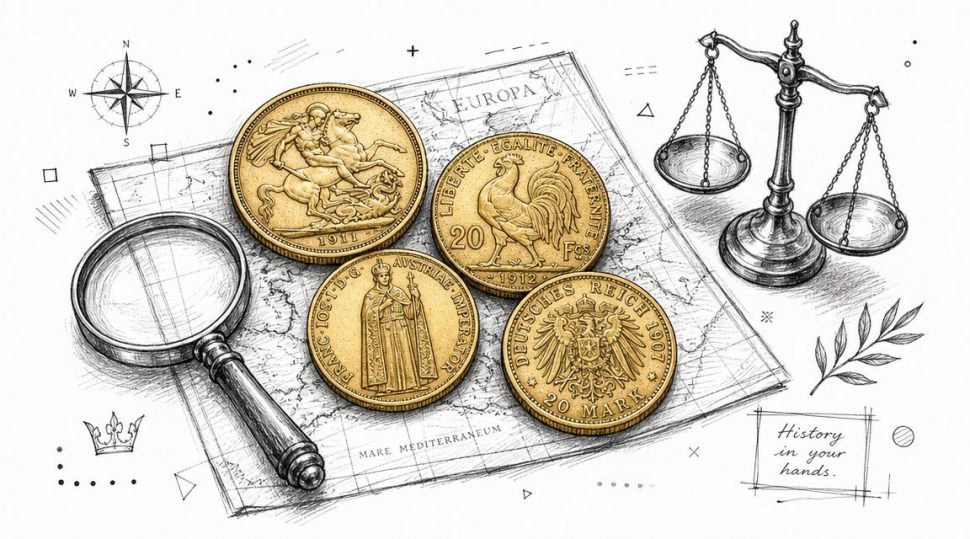
British Sovereigns
Usually show a monarch's portrait on one side. Many examples show St George slaying the dragon on the reverse. These are among the most familiar gold coins in the UK and are often easier to identify than continental pieces.Swiss Helvetias
Often feature the female figure Helvetia. If the coin says Helvetia or Confederatio Helvetica, that's a strong clue. These are widely recognised and commonly traded.French gold francs
Look for wording such as Francs and French national imagery, including heads of state, wreaths, or the well-known rooster design on some issues. French coins are regularly mistaken for medals by non-specialists, so reading the denomination matters.Austrian ducats
These often have formal imperial designs and can look thinner or broader than British coins. Double-headed eagles are a common visual cue.German marks
Imperial eagles, royal portraits, and the word Mark can help with identification. These often appear in old continental collections.Belgian francs
Typically show royal portraits or national emblems. If the wording is in French or Dutch and the style looks continental rather than British, Belgium is worth checking.
What to look for on the coin itself
Start with the obvious physical clues before you worry about specialist grading:
Country name or Latin form
Helvetia, Österreich, Belgique, Deutsches Reich, or similar wording can reveal the issuing country.Denomination
Franc, Mark, Lire, Ducat, and Sovereign usually appear somewhere on the coin.Portrait style
Monarch busts usually suggest formal coinage rather than tokens or souvenirs.Reverse symbols
Eagles, shields, saints, wreaths, and heraldic arms often identify a specific series.
If your coin doesn't match any of those categories, don't guess too hard. Mixed collections often contain medals, commemoratives, brass tokens, and modern replicas alongside genuine gold.
For broader reference on old continental money, this guide to old currencies of Europe is useful when inscriptions or denominations point to a country you don't immediately recognise.
A simple authenticity check at home
You can do a few safe checks without damaging anything:
- Use a magnet carefully. Gold is not magnetic.
- Check colour consistency. If worn edges show a different base metal underneath, it may be plated.
- Compare the strike quality. Genuine coins usually have sharper, more consistent detail than tourist copies.
- Listen to your doubts. If the coin looks unusually bright, crude, or soft in detail, treat it cautiously until a specialist checks it.
How to Value Your Old European Gold Coins
Most old European gold coins are valued in two layers. First comes the bullion value, which is the underlying gold worth. Then comes any numismatic value, which is the extra amount a buyer may pay because the coin is scarce, desirable, or especially well preserved.
That distinction is the biggest source of confusion for sellers. People either assume every old gold coin is a rare treasure, or they assume it should be weighed and treated as scrap. Both approaches can be wrong.
Bullion value and collector value are not the same
Common European pieces often sell as familiar, fractional-gold coins rather than anonymous melted metal. That's especially true for recognisable types such as Sovereigns and Helvetias, where value is influenced by gold content, grade, and market familiarity, not just melt value, as discussed in this overview of why investors buy European gold coins.
Here's the simplest way to understand it:
| Value Driver | Bullion Value (Melt Value) | Numismatic Value (Collector Value) |
|---|---|---|
| What it means | The value of the gold in the coin | Extra value because the coin is collectible |
| What affects it | Gold content and current gold market level | Rarity, condition, popularity, survival rate |
| Who focuses on it | Bullion buyers and scrap dealers | Coin dealers and numismatic buyers |
| Typical result for common coins | Sets the baseline | May add a premium if the coin is desirable |
| Typical risk for sellers | Being offered only metal value | Overestimating rarity without evidence |
What usually increases value
A coin is more likely to attract value beyond bullion when one or more of these apply:
- It's a recognisable series. Buyers know what it is and can resell it easily.
- It has stronger detail. Wear matters. Cleaner devices and lettering usually help.
- It's less commonly seen. Scarcer dates or types can attract stronger interest.
- It hasn't been damaged. Holes, mounting marks, filing, and harsh cleaning reduce appeal.
What usually doesn't help
Some assumptions sound sensible but often mislead sellers:
- “It's old, so it must be rare.” Age alone doesn't create a premium.
- “It was my grandfather's, so it's special.” Family history matters emotionally, but buyers need market reasons.
- “It's gold coloured, so it's valuable.” Colour is not proof of gold.
- “A jeweller weighed it, so that's the full value.” Weight gives only part of the picture.
Practical rule: Get a coin assessed as a coin first, not as scrap metal. Once a coin is reduced to melt logic, any collector premium is gone.
How to Exchange Your Gold Coins The Simple Way
Selling old gold coins doesn't need to involve shop visits, guesswork, or awkward counter conversations. The smoothest route is a specialist online process that handles identification, assessment, and payment without requiring you to become a coin expert first.
That matters even more if your gold coins are only part of the story. Many sellers also have ordinary foreign cash, withdrawn notes, old pre-euro coins, and leftover holiday money mixed in with the better items. Banks and exchange bureaus usually fall short there. They may accept some current notes, but they typically don't want foreign coins, obsolete currencies, or mixed unsorted holdings.

A practical step by step process
Step 1
Start with an online valuation route that lets you describe or submit the coins without pressure. If you've got mixed items, choose a service that can handle unsorted holdings rather than forcing you to separate every denomination first.
This is also where specialist services stand apart from high street options. They're built to handle coins and notes together, including items that standard bureaux reject.
Step 2
Pack the coins securely. Use small bags, coin flips, or wrapped bundles so they don't rub against each other in transit. Put those inside a padded envelope or small box.
If you're sending gold, use a tracked and insured postal method where available. Keep a list or photos of what you've sent before posting it.
Step 3
After receipt, the coins should be checked by someone who understands both bullion and coin value. That's the stage where common, recognisable pieces can be separated from anything scarcer or unusual.
If you're ready to exchange foreign coins and notes, this specialist route is usually much simpler than trying a bank first and then discovering they won't take coins or older issues.
Step 4
Once the items are verified, payment is normally made by bank transfer or another chosen method. A good service also explains what happens if you don't want to proceed after the assessment.
Why specialist exchange services work better than banks
Here's the practical trade-off:
| Option | Best for | Main limitation |
|---|---|---|
| Bank | Current account services and some current notes | Usually poor for coins, mixed lots, and old currency |
| Travel exchange bureau | Holiday cash and current banknotes | Often won't handle coins or withdrawn issues |
| General gold buyer | Plain metal selling | May ignore collector value |
| Specialist online currency buyer | Mixed coins, banknotes, withdrawn currency, recognisable gold coins | Requires posting items securely |
This is why many people use specialist services for more than gold. They can also exchange leftover currency, convert mixed foreign coins and banknotes, and even deal with withdrawn money in one process.
Common Mistakes When Selling Old Gold Coins
The easiest money to lose is the money lost through avoidable handling errors. Most of them happen before a buyer even sees the coin.

Mistakes that reduce value quickly
Cleaning the coin
This is the classic mistake. Rubbing, dipping, or polishing can leave hairlines and remove original surface character. Even common coins can suffer when they've been harshly cleaned.Taking the first offer
A fast cash offer can be tempting, especially if you're unsure what you have. But a quick offer from a pawnbroker or non-specialist buyer may reflect only metal value.Assuming every gold-coloured coin is gold
Many replicas, fantasy pieces, medals, and plated items look convincing at first glance.Posting loose coins badly packed
Coins rubbing together in transit can pick up fresh marks. Gold is softer than many people realise.
What to do instead
Use a slower, cleaner process:
- Leave the coin exactly as found.
- Make a basic note of date, wording, and design.
- Check magnetism without scraping or testing aggressively.
- Seek a specialist opinion before agreeing to sell.
If you're unsure whether a piece is a coin, token, or replica, treat uncertainty as useful information. It means you should pause before selling, not push ahead faster.
A few real-world situations
These come up often:
Inherited envelope with mixed European coins
One or two pieces may be gold while the rest are ordinary currency. Don't assume the whole lot should be sold as bullion or ignored as junk.Jewellery box coin on a chain mount
Mounted coins can still have value, but the mount may affect numismatic appeal.Holiday money tin with old notes and one gold coin
Specialist services are helpful, because you can often convert foreign coins and banknotes in the same overall transaction.
For people with mixed holdings, it also helps to choose a route that can exchange foreign coins and notes rather than forcing separate solutions for gold coins, leftover cash, and obsolete currency. Some owners also prefer to donate foreign coins to charity when the non-valuable remainder isn't worth keeping.
Frequently Asked Questions About Old Gold Coins
Can I exchange old European gold coins in the UK?
Yes. Specialist online buyers can assess and buy old European gold coins for cash. This is often the most practical route if the coins are foreign, older, mixed with other currency, or outside the narrow scope of what a bank or travel exchange counter will accept.
Do banks accept foreign gold coins?
Usually, banks are not the best route for this. Banks tend to focus on account services and, in some cases, current banknotes. They generally aren't set up to assess foreign gold coins, collector value, or mixed lots that include coins and withdrawn currency.
Do I need to identify every coin before sending it?
No. A basic idea of what you have is helpful, but you don't need to become an expert first. Good specialist services can handle mixed submissions, which is useful if you also want to convert foreign coins and banknotes from the same household collection.
What if my gold coin is worn or damaged?
Worn coins can still have solid value because the gold content remains relevant. Damage can reduce collector appeal, but it doesn't automatically make the coin worthless. The key question is whether the piece still has bullion-only value or whether it also retains some numismatic interest.
Is it safe to send gold coins in the post?
It can be, provided you pack them properly and use a tracked, suitable postal method. Wrap coins individually, avoid movement inside the parcel, and keep a record of what you've sent. Don't write anything on the outer packaging that advertises valuable contents.
Can I send other currency at the same time?
In many cases, yes. That's one of the main advantages of using a specialist platform rather than a standard exchange bureau. You can often send old gold coins alongside leftover foreign currency, ordinary foreign coins, banknotes, and even withdrawn issues.
What happens if I also have obsolete notes or pre-euro coins?
Those can still be exchangeable through specialist services even when banks and bureaux refuse them. That's particularly useful after house clearances, estate sorting, or charity collections where current and obsolete currency has been mixed together.
How is the value worked out?
The final value usually depends on the coin's gold content first, then any added market premium based on recognisability, condition, and saleability. A common coin may trade close to bullion. A scarcer or better-preserved example may attract more.
How long does payment usually take?
Payment timing depends on the service, but specialist online currency buyers typically explain the process clearly before you send anything. Look for transparent rates, a clear assessment process, and a stated payment window after verification.
If you've got old European gold coins sitting alongside holiday cash, obsolete notes, or mixed foreign change, it often makes sense to deal with everything in one go. That saves time, avoids multiple buyers, and gives you a cleaner view of what's worth selling, what can be exchanged, and what you may want to donate.
If you're ready to turn coins, notes, or withdrawn currency into cash without the usual hassle, We Buy All Currency offers a simple specialist route. You can exchange foreign coins, sort out leftover foreign currency, or use a straightforward currency buy back service for mixed collections that banks and bureaux usually won't handle.