
Old Penny Value by Year: A Complete UK Collector’s Guide
Posted by: Ian Stainton • 9 Jul 2026
An old British penny can be worth anything from a little over face-level collector interest to thousands of pounds, depending on its year, monarch and condition. In the most dramatic cases, the 1933 George V penny has reached over £156,000, while many ordinary circulated pennies are far more modest and are often best handled as part of a bulk exchange rather than as individual rarities.
That's why so many people get stuck. You open a tin, jam jar or inherited box of old coins, spot dates from Victoria or George V, and immediately wonder if you've found something special. Sometimes you have. Often you've found a mix of common pieces, a few better dates, and a lot of uncertainty.
Old penny value by year is a useful starting point, but it only tells part of the story. A date matters. The ruler on the coin matters. Wear matters even more than most beginners expect. And if your pennies aren't collector-grade rarities, you still need a practical answer to the question most guides ignore. What do you do with them now?
What Are Your Old British Pennies Worth
If you've found a handful of dark bronze pennies in a drawer, the short version is simple. Not every old penny is rare, but some are worth far more than people expect.
A British pre-decimal penny was a real unit of the old money system, not just a novelty. It sat within the historic £sd structure, where the pound was divided into 20 shillings and each shilling into 12 pence, making the penny worth 1/240 of £1 before decimalisation according to the history of the British pre-decimal penny).
What usually determines value
Most old penny values come down to four things:
- The date: Some years are much scarcer than others.
- The monarch: Victoria, Edward VII, George V and later issues attract different collector demand.
- The grade: A worn example and a sharp uncirculated example can sit worlds apart in value.
- The type of market: A collector may pay for rarity, while a mixed bulk lot may be better treated as exchangeable old currency.
Practical rule: First identify the date. Then judge the condition. Only after that should you think about price.
A realistic way to think about old penny value by year
Many people search for one exact figure, but old penny value by year is really a range. A common year in worn condition may bring very little as a single coin. A scarcer year in strong grade can be much more desirable. Even then, there's a big difference between what a collector pays for a certified coin and what a casual mixed lot is worth.
That's where this guide helps. You'll learn how to identify the era, spot the key dates, understand grading, and decide whether your coins belong in a collector's tray or in a simple process to exchange leftover currency, convert foreign coins and banknotes, or clear out a mixed hoard of old and obsolete money.
Understanding the Basics of Pre-Decimal Pennies
Before looking up old penny value by year, it helps to know exactly what kind of penny you're holding.
The British pre-decimal penny was worth 1/240 of a pound sterling and was minted in bronze from 1860. It was officially demonetised on 1 September 1971, six months after Decimal Day, when the old system gave way to decimal currency, as outlined in this pre-decimal penny reference.
The old £sd system in plain English
The old money system often confuses people because it wasn't decimal.
Here's the basic structure:
- £1 = 20 shillings
- 1 shilling = 12 pence
- 1 penny = 1/240 of a pound
The penny was written as d, a symbol that came from the Roman denarius. If you've ever seen prices written in old books or on auction tickets as something like 2/6, that means two shillings and sixpence.
Which monarch is on your penny
For bronze pennies, the monarch portrait gives you a quick first clue.
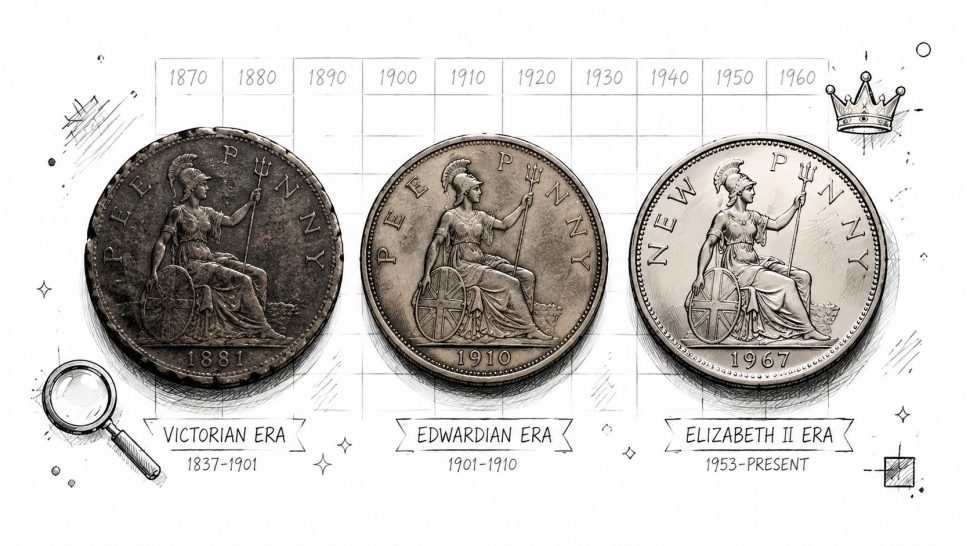
Queen Victoria
Victorian pennies are common in old family collections. Her portrait changes across the long reign, so the image may look younger on earlier pieces and older on later ones. These are the pennies many people first notice because they look the oldest and often have dark, rich surfaces.
Edward VII
Edward VII pennies have a short reign appeal. His portrait is distinct and easy to separate from Victoria once you compare them side by side. Collectors pay attention to this era because some dates and varieties are much tougher than others.
George V
George V pennies are especially important for value hunters because this reign includes one of the most famous British rarities. Many ordinary George V pennies are not rare, but this is still an era worth checking carefully.
George VI and Elizabeth II
Later pre-decimal pennies often turn up in larger numbers. They may look less dramatic than Victorian coins, but they still matter. Some are collected by date, some by grade, and some end up in mixed lots people want to exchange foreign coins and notes alongside old UK and overseas currency.
If a coin is old but no longer in circulation, you're no longer dealing with a spending coin. You're dealing with either a collector item or an obsolete exchange item.
Why this background matters
Beginners often jump straight to the date and miss the bigger picture. But the monarch helps confirm the period, the metal and style tell you whether you have a pre-decimal bronze penny, and the old system explains why these coins are now valued as historical objects rather than spendable change.
How to Grade the Condition of Your Pennies
Most mistakes in old penny value by year come from one issue. People identify the date correctly, then overestimate the condition.
A penny that looks “pretty good for its age” may still count as circulated and heavily worn in collector terms. That matters because the value difference caused by condition is substantial. A common circulated 1963 penny might sell for only a few pounds, while a certified MS65 example can fetch over £100, as noted in this grading-focused 1963 penny discussion.

The simple grading ladder
You don't need to become a professional grader overnight. You do need a sensible framework.
Poor to Good
These coins have seen a lot of use. The portrait may be flat, Britannia may be weak, and some lettering might be hard to read. The date is often still visible, but detail is limited.
Fine
A Fine coin is worn, but still clear. Main design elements remain visible. The portrait outline is stronger, and the reverse is easier to read without strain.
Very Fine to Extremely Fine
These grades show much more detail. Hair, facial features and finer reverse elements remain sharper. Wear is present, but it's lighter and mostly on the highest points.
Uncirculated
An Uncirculated coin shows no wear from circulation. It may still have small marks from handling or storage, but it keeps the fresh look collectors want. In this condition, values can rise sharply, even for dates that are not especially rare in lower grades.
What to examine on the coin
Use a good light and take your time. Focus on these areas:
- The date: It must be clear and not guessed.
- The monarch's portrait: Look at hair, cheek, ear and crown detail where relevant.
- Britannia on the reverse: Check the trident, shield and the overall sharpness.
- The rims and lettering: Weak rims and blurred legends often signal heavier wear.
Don't grade by age. Grade by detail. A very old coin can still be low grade, and a later coin can be valuable if it's unusually well preserved.
Why inherited coins often disappoint people
Most inherited pennies spent years in circulation before they were saved. That means many are worn. They still hold interest, and some can still be exchanged in bulk with other obsolete or leftover foreign currency, but they usually won't match the top figures seen in headline-grabbing rarity stories.
That isn't bad news. It just means you should separate collector-grade possibilities from ordinary old coinage before deciding whether to sell, keep or exchange foreign coins as part of a larger mixed group.
Key Dates and Rare Pennies Worth Looking For

A small pile of old pennies can look ordinary until one date changes the whole picture. That is why collectors start with the date and type first. It is the fastest way to spot a coin that deserves closer attention before you decide whether to keep it, sell it to a specialist, or include it with a wider coin exchange.
The best-known example is the 1933 George V penny. It is one of the classic rarities in British coin collecting, and any genuine example needs expert handling. Another date that deserves real attention is the 1869 Victoria penny, a reminder that Victorian pennies are not all cut from the same cloth. Some are common survivors. Some are scarce enough to attract strong collector demand.
The famous dates collectors chase
1933 George V penny
This is the date that draws headlines and phone calls. Very few were made for circulation, so a British penny dated 1933 should never be treated like an ordinary old coin. Set it aside carefully and get it checked.
1869 Victoria penny
This is a true key date from the bronze penny series. If you are sorting Victorian pennies by year, 1869 belongs in the "look twice" group. Even worn examples can attract interest because scarcity starts the conversation.
1901 Queen Victoria penny
This date shows how mintage can affect value in a way that is easy to miss at first glance. A 1901 penny does not look dramatically different from a 1900 penny to a non-collector, but collectors often rate the scarcer year more highly, especially in better condition. It is a good example of why sorting by date before anything else saves time.
1902 Edward VII high relief and 1910 penny
Some pennies matter because of a specific variety or a lower-output year rather than a famous headline rarity. The 1902 high relief issue is one to watch, and 1910 is another date collectors often check with care. These coins sit in the area where small design details or lower availability can separate an ordinary coin from a more desirable one.
Why rare dates are only half the story
A rare date is the starting point, not the finish line. Coin value works like property value. The address matters, but so does the condition of the house.
A key date in heavily worn condition can still be collectable, but it does not trade in the same way as a sharp, problem-free example. The reverse is also true. A more common year in unusually nice condition can surprise people because collectors pay for quality as well as scarcity.
Authenticity matters too, especially for famous dates. If something seems unusually valuable, avoid cleaning it, avoid polishing it, and avoid guessing from online photos alone. A proper opinion can protect you from underselling a good coin or overestimating an altered one.
Coins that are old, but not necessarily rare
Many pennies from George V, George VI and Elizabeth II have historical interest without being major rarities. They are often collected as part of date runs or monarch sets, and that gives them a market, but usually a modest one unless the coin is especially well preserved.
That practical distinction helps with the next step. If you have one or two coins that appear to be better dates, those may justify individual attention. If you have a tin full of ordinary old pennies mixed with obsolete British coins, tokens, or leftover foreign money, a bulk exchange route may make more sense. Collectors want the standouts. Non-collectors usually want a clear path to cash.
A rare penny can be exciting. A common penny can still be worth checking. And a mixed group of older coins can still be worth converting instead of leaving it in a drawer.
Old Penny Value Quick Reference Table 1860-1967
You tip a small jar of old pennies onto the table and want a fast answer. Which ones deserve a closer look, and which are usually modest-value coins? A quick reference table helps you sort that first pass.
Use these figures as guideposts, not final prices. Coin value works a lot like house prices in the same street. The date gives you the location, but condition decides whether you are looking at an ordinary example or one that stands out. If a penny looks unusually sharp, has strong detail, or matches a known better date, it may deserve an individual opinion. If it is part of a larger mixed group, a practical exchange service may be the simpler route.
A few examples show how wide the range can be. Some common dates have modest collector value even in nice condition, while scarcer dates can rise sharply. Famous rarities sit in a category of their own.
Sample British penny values by year and condition
| Year | Monarch | Value (G) | Value (F) | Value (UNC) |
|---|---|---|---|---|
| 1869 | Victoria | Scarce and strongly collected | Much stronger than common dates | Over £4,900 |
| 1890 | Victoria | £0.15 | Higher than Good | £3.50 |
| 1900 | Victoria | Modest for a common year | Moderate | £2.00 |
| 1901 | Victoria | Stronger than 1900 | Stronger than 1900 | £15.00 |
| 1933 | George V | Famous rarity | Famous rarity | Over £156,000 |
| 1963 | Elizabeth II | A few pounds in circulated condition | Stronger if well preserved | Over £100 at certified MS65 |
How to read the table without misjudging your coin
Read across the row for your coin rather than focusing on the year alone.
- Start with the date on the coin
- Check the monarch to make sure you have the right issue
- Choose an honest grade based on wear and detail
- Compare within that grade, because a Fine coin and an Uncirculated coin from the same year can sit in very different value ranges
One more practical point matters here. A penny that is not rare enough for a specialist sale can still be worth including in a larger exchange of old British coins, obsolete currency, or mixed inherited pieces. That is often the gap in value guides. They tell you what collectors may pay, but not what to do next if your coins are ordinary. This table helps with both jobs. It highlights dates worth pausing over, and it helps you separate those from coins that may be better handled through a straightforward cash exchange route.
Common Mistakes to Avoid With Old Pennies
The fastest way to lose value is to handle an old coin like an ordinary object. Collectors don't just care about the date. They care about surfaces, originality and whether the coin has been altered.
That's why a cautious approach is almost always the right one, especially if you're unsure whether you have a collector piece or just old bronze coinage to sort into a larger batch.

Mistakes that regularly cost people money
Cleaning the coin
This is the classic error. Rubbing, polishing or washing a coin can strip away the natural surface collectors expect to see. Even when the coin looks “better” to an untrained eye, the market often sees damage.
Assuming every Victorian penny is valuable
Age alone doesn't make a coin rare. Some Victorian dates are desirable, but many ordinary pieces survive in large numbers and only command modest values unless they are unusually well preserved.
Ignoring condition
A date lookup without a grade estimate is incomplete. This is why inherited coins are often misunderstood. The owner sees age and history. A buyer sees wear level first.
Storage and identification problems
A few practical habits make a big difference:
- Don't store coins loose: Contact marks and rubbing can lower appeal.
- Don't use poor-quality plastic: Problem materials can affect surfaces over time.
- Don't rely on one quick search result: Similar years and varieties can be confused.
- Don't mix possible rarities with bulk coins: Separate anything that looks better or scarcer.
Keep uncertain coins dry, separate and untouched until you've identified them properly.
When online values create false expectations
Online lists often show the best-case figure because that catches attention. They may mention an outstanding rare date or a premium grade without making clear that most examples don't look like that.
That doesn't mean online guides are useless. They're excellent for triage. But they work best when you use them to sort coins into groups:
- Potential key dates
- Ordinary but collectable dates
- Bulk old coinage
- Mixed obsolete or overseas currency for exchange or charity
If you also have travel money, old banknotes or miscellaneous foreign change, it often makes sense to think beyond the penny jar and look at the whole bundle of leftover foreign currency you've built up over time.
How to Exchange Your Old Pennies and Other Coins
Once you know roughly what you have, the next question is practical. Where do old pennies go?
For collector-grade rarities, the answer may be a specialist dealer or auction route. For ordinary old pennies, mixed pre-decimal coins, and bundles of overseas change or withdrawn notes, the answer is different. Banks and standard exchange counters usually focus on current, spendable money. They often don't deal with obsolete coinage, loose foreign coins, or mixed small-value collections.
That divide matters because once a currency is withdrawn from circulation, its value no longer follows normal foreign exchange logic. It moves into a collector or specialist handling market based on rarity and survival, as explained in this guide to withdrawn currency and collector value.

Why banks and bureaus usually won't help
High street banks and travel money counters are built for current notes, not bags of old bronze pennies or jars of mixed international coins.
They often won't accept:
- Foreign coins
- Withdrawn banknotes
- Pre-decimal British currency
- Mixed unsorted coin batches
- Low-value leftover holiday money
That's why people searching to exchange foreign coins and notes often hit a dead end with ordinary channels.
A practical way to handle mixed old money
If your pennies are not rare enough to justify individual sale, think in terms of categories:
Collector candidates
Separate anything with a standout date, better detail or unusual appearance. These deserve a second look before going anywhere else.
Bulk old British coins
Common pre-decimal pennies, halfpennies and similar pieces can often be grouped together for specialist handling rather than researched one by one.
Leftover travel money
This includes the foreign cash people bring home and forget about. If you want to exchange foreign coins, convert miscellaneous notes, or exchange leftover currency without sorting every coin by country, a specialist process is usually far easier than a bank visit.
How the process usually works
A straightforward service for obsolete and mixed currency tends to follow a simple pattern:
Identify the broad type of money
Separate obvious key-date coins from ordinary mixed pieces.Get a quote or estimate
This is especially useful for mixed lots of old UK coins, foreign change and withdrawn notes.Pack and send the currency
Good specialist services accept coins, banknotes and obsolete issues together.Verification happens after receipt
The contents are checked so the final value reflects what was received.Payment follows once processing is complete
For many people, this is the easiest route when they want to convert old or unused money into cash or even donate foreign coins to charity.
The biggest advantage of a specialist service is simplicity. You don't need the bank to want the coins, and you often don't need to sort every piece in advance.
When exchange makes more sense than collecting
If you enjoy the history, keep a few examples by monarch or era. If you've got bags of ordinary coins and no interest in building a collection, exchanging them is often the more sensible choice.
That's especially true if your old pennies are sitting alongside holiday change, foreign coppers, obsolete notes or banknotes from countries you no longer visit. In that situation, the goal isn't auction drama. It's a clear, hassle-free way to convert foreign coins and banknotes that would otherwise remain unused.
Frequently Asked Questions About Old Penny Values
A lot of readers reach this point with the same practical question in mind. You have a few old pennies in a tin, a jar, or a mixed bag of coins, and you want to know whether you are holding a collectable, a small exchange value, or just an interesting piece of British history. These answers are here to make that decision simpler.
Can I exchange old British pennies at a UK bank?
Usually not. High street banks tend to deal with current money, not pre-decimal bronze pennies or other withdrawn coins. For old pennies, the realistic route is usually a specialist coin or currency exchange service.
Are all Queen Victoria pennies valuable?
No. A Victorian penny is not automatically rare.
Date, condition, and demand are primary factors here. A common Victorian penny with heavy wear may only have modest value, while a scarcer year in better condition can attract much stronger interest from collectors.
How do I tell if my penny is pre-decimal?
Start with the date and design. Pre-decimal pennies were part of the old pounds, shillings and pence system used before decimalisation, and they were issued with monarch portraits from Victoria through Elizabeth II.
A simple way to picture it is this. Pre-decimal pennies belong to an older money system, much like an old railway ticket belongs to a route that no longer runs. They still have collector or exchange value, but they are no longer spendable in everyday shops.
What makes one old penny worth much more than another?
Three factors usually matter most. Scarcity, condition, and collector demand.
That combination works a bit like the value of a second-hand book. A common title with torn pages is easy to find and worth little. A harder-to-find edition in clean condition can be worth far more.
Can foreign coins be exchanged in the UK?
Yes, but usually not through ordinary banks or travel money counters, especially for low-value coins, mixed countries, or withdrawn issues. Specialist services are often the practical answer for people who want to exchange foreign coins and notes without sorting every piece into neat collector categories first.
Do I need to sort mixed coins before sending them for exchange?
Not always. Some specialist services accept unsorted or partly sorted currency, which is helpful when old British pennies are mixed in with foreign coins, tokens, and old notes.
That matters for non-collectors. A collector may enjoy identifying every date. Someone clearing a house, emptying a drawer, or handling a charity collection usually wants a clear route to cash instead.
Is an old penny still worth anything if it is not rare?
Often, yes. A single common penny may not be especially valuable on its own, but groups of old coins can still carry exchange value.
The distinction between collecting and cashing in is evident. Collector guides focus on standout pieces. In real life, many people have ordinary coins in quantity, and exchanging a bulk lot can make more sense than chasing a rare-coin premium that is not there.
What about silver old British coins?
Silver content matters more for denominations such as shillings, florins, and sixpences than for bronze pennies. Old pennies were bronze, so their value usually comes from collectability, date, condition, and quantity rather than precious metal content.
How long does payment usually take with a specialist currency exchange service?
It depends on the provider and on how quickly the coins can be checked after arrival. In general, the process includes receipt, verification, valuation, and payment.
For many people, the main benefit is clarity. You know the coins have gone to a service that handles obsolete and mixed currency regularly, rather than trying to persuade a bank counter to accept something it does not process.
Can I donate old or foreign coins instead of cashing them in?
Yes. Some services let you donate foreign coins to charity by converting them on your behalf. That can be a good option for small mixed amounts that you do not want to keep but would still like to put to good use.
If you've got old British pennies, mixed pre-decimal coins, withdrawn notes or leftover holiday money tucked away at home, We Buy All Currency gives you a straightforward way to turn it into cash. You can use the service to exchange foreign coins and notes, handle unsorted currency without the hassle, or choose to exchange leftover currency from travel, collections or charity drives. It accepts coins, banknotes and obsolete currency, offers transparent rates before you send, and is trusted by individuals, charities and businesses, including major organisations such as charities, supermarkets, airports and police forces. If you're ready to stop guessing and start converting unused money, it's a practical next step.