
Your Guide to One Penny Coin Value and History
Posted by: Ian Stainton • 19 Feb 2026
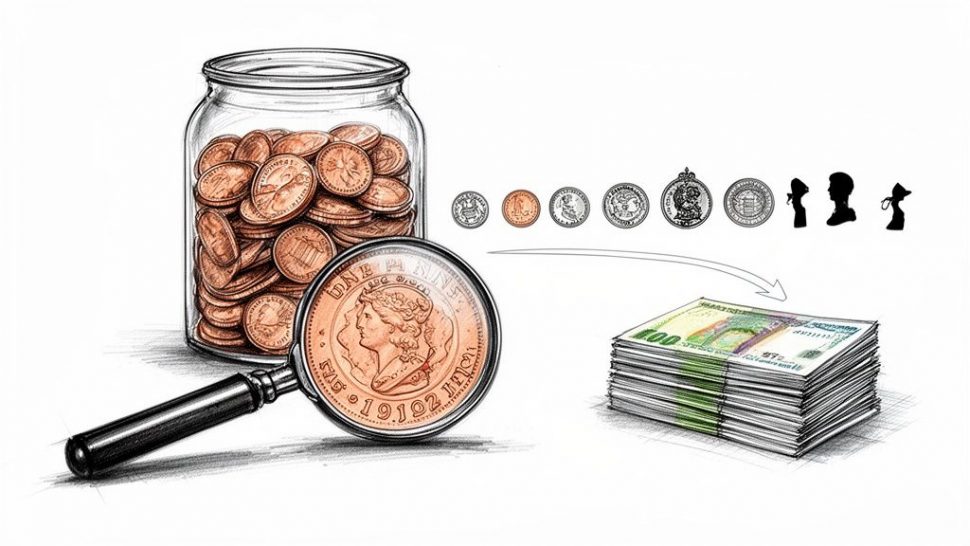
That forgotten jar of one penny coins could be more than just loose change. This guide will walk you through the fascinating story behind the British penny, from rare dates to valuable designs. More importantly, we'll show you how to turn your old coins, leftover holiday money, and obsolete currency into cash, completely hassle-free.
Unlocking the Hidden Value in Your Penny Collection
Have you ever looked at that growing collection of coins gathering dust on a shelf and wondered what to do with it? So many of us have jars, bags, or even old biscuit tins filled with pennies and other leftover foreign currency, but the thought of sorting through it all feels like too much effort.
The good news is, you don’t have to. Our service is designed to be fast, easy, and completely hands-off for you.
We offer a 100% guaranteed way to exchange foreign coins and notes without you needing to sort a single one. Just gather up your currency—whether it’s old British pennies, pre-decimal coins, or leftover holiday money from all over the world—and we’ll handle the rest. It's a simple, hassle-free process trusted by major UK brands, including national charities, supermarkets, airports, and even police forces who rely on us for secure and efficient currency conversion.
Turning Clutter Into Cash or Charity
The value in your collection isn't just about money; it can also make a real difference. Our platform gives you a straightforward option to donate foreign coins to charity. Imagine turning a forgotten pile of change into a meaningful contribution for a cause you truly care about. This is a practical and helpful way to put unwanted money to good use.
Of course, if you're holding onto your collection for a while, making sure it stays in good condition is key. You can learn more about how to store collectibles to keep them safe and preserve their value.
Whether you want to convert foreign coins and banknotes for yourself or for a good cause, the process should be simple.
Our mission is to take the complexity out of currency exchange. We believe that unlocking the value in old money should be a transparent and rewarding experience, not a chore.
Forget the tedious job of sorting and identifying every single coin. We make it easy to exchange foreign coins and notes all at once. Start by gathering your collection, and let us show you just how simple it is to get paid for your old currency. Visit our homepage to begin your hassle-free exchange today.
Quick Guide to Exchanging Your Penny Coins
Here's a quick look at how our fast and easy service helps you turn those old penny coins into cash, and why each step is designed with you in mind.
| Feature | Why It Matters for You |
|---|---|
| No Sorting Required | Saves you hours of tedious work. Just bag it up and send it. |
| All Currencies Accepted | We take everything—old pennies, foreign coins, and even obsolete currency. |
| Fast, Secure Payments | Get your money quickly and safely, directly to your account. |
| Trusted by Major Brands | Our reliability is proven by charities, police forces, and airports. |
| Charity Donation Option | Easily turn your old coins into a meaningful donation for a good cause. |
With our straightforward process, you can finally clear out that clutter and unlock the cash sitting in those old coin jars. Ready to get started? We’re here to help.
The Penny Through Time: A Rich History
That humble one penny coin rattling around in a forgotten jar is more than just loose change; it’s a small piece of British history you can hold in your hand. Its story stretches back centuries, starting with the hefty copper ‘cartwheel’ pennies of the late 18th century and evolving into the classic bronze designs that became a familiar sight for generations.
Each era left its mark. The portraits of monarchs tell a story of succession from one reign to the next, while shifts in the metal composition reflect the nation's economic ups and downs. Understanding this journey helps you see what you really have—not just old coins, but tiny historical artefacts.
A Coin Shaped by History
Big events like the World Wars had a direct impact on the penny's production, leading to unique varieties and periods of scarcity that collectors now hunt for. The coin’s journey through times of conflict and peace is what gives us the clues to identify potentially valuable pieces today.
For example, economic pressures often decided just how many pennies were made. Mintages were high between 1936 and 1940, but production dropped sharply during and after World War II, with only 42.28 million coins struck in 1940. By 1949, demand had fallen so much that a mere 14.3 million were produced. Later, as inflation eroded its buying power, the Royal Mint even started pulling surplus pennies out of circulation.
Understanding the story behind each design and date transforms simple currency into a tangible link to the past, turning a pile of old money into a story worth telling.
Getting to know the different eras of the one penny coin is the first step in unlocking its potential. For a deeper dive, you might find our guide on pre-decimal coin values useful.
The Simple Path from Pennies to Pounds
This timeline shows just how easy it is to turn your old pennies and other leftover currency into cash with our straightforward service.

The whole process is designed for your convenience. Just gather up your unsorted coins, send them to us, and get paid quickly and securely.
Our fast, easy, and 100% guaranteed service is trusted by major brands, from national charities and supermarkets to airports and police forces. You don’t need to sort a thing; just send us your collection, and we handle the rest. Ready to turn your old coins into cash? Let's get started.
The Decimalisation Revolution That Changed British Coins
Back in 1971, Britain’s pockets went through a seismic shift. The entire country switched over to a decimal currency system, waving goodbye to the pounds, shillings, and pence that had been the norm for centuries. For the humble one penny coin, this wasn't the end—it was a moment of survival and total reinvention.
Before this big change, life was a bit more complicated. One pound was made up of 240 pence, a system with a long and storied history. Moving to a simpler, decimal-based currency was a massive national project, announced years ahead of time to get everyone ready. The old, larger penny was heading for retirement, and a modern replacement was waiting in the wings.
The Birth of the New Penny
The "new penny" that emerged was a different beast altogether. It was smaller, lighter, and now represented one-hundredth of a pound. This wasn't just a minor tweak; it was essential for the new system to work, but it also meant parting ways with an iconic piece of British history.
The seated figure of Britannia, a powerful symbol that had graced British pennies since the 18th century, was gone. Her replacement? A crowned portcullis, the symbol of Parliament, signalling a fresh start for the nation's smallest coin. This design change is one of the easiest ways to tell pre- and post-decimal coins apart when you're sorting through a collection of leftover foreign currency.
This wasn't just a symbolic gesture; it was a huge logistical challenge. The Royal Mint started churning out the new decimal pennies back in December 1968. By the end of 1971, they had minted over 1.5 billion of them to keep up with demand. Despite all the changes, the penny proved to be the "great survivor" of British coinage, adapting to its new role and sticking around. You can dive deeper into this transition and the enduring legacy of the decimal penny on Wikipedia).
From Old Money to New Opportunities
Knowing this bit of history is incredibly useful if you've got a jar of mixed coins sitting at home. It helps you separate the old from the new and gives you a real appreciation for the story behind what you're holding. Whether it's pre-decimal pennies, leftover holiday money, or other obsolete currency, every single coin has a past.
But you don’t need to be a historian to unlock its value. That’s what we’re here for. Our service is designed to be fast, easy, and completely hassle-free. Forget about sorting through pre- and post-decimal coins—just send us the whole lot, and we’ll handle the rest.
Our 100% guaranteed process is trusted by major UK brands, from national charities and supermarkets to airports and police forces. We make it simple to exchange foreign coins and notes, turning that historical clutter into ready cash. Why not visit our homepage to start your easy exchange and see what value is hiding in your old currency?
How To Spot Valuable One Penny Coins
Not every one penny coin is worth just a penny. Hiding away in old change jars and forgotten wallets, you might just find rare dates, specific portraits, or even minting errors that have collectors buzzing. Learning what to look for can turn a rummage through old coins into a proper treasure hunt.
The first thing to check is always the date. Some years had surprisingly low mintage numbers, meaning fewer coins were ever made, making them much scarcer today. For example, the 1933 George V penny is the stuff of legend, but other dates—especially from certain wartime periods—can also command a premium. At the end of the day, it's all about rarity.
Next, have a closer look at the monarch’s portrait and the tiny details around it. Sometimes, subtle differences in the design or lettering can signal a valuable variety that most people would overlook.

Key Features to Look For
So, what should you keep an eye out for? Certain features instantly make a coin more appealing to collectors.
Here’s a quick reference guide to help you spot a penny that might be worth more than its face value.
Key Features of Valuable One Penny Coins
| Feature to Check | What to Look For | Why It's Important |
|---|---|---|
| Date & Mintage | Look for years with low production numbers (e.g., 1933, 1950, 1951). | Low mintage means fewer coins are in circulation, making them rarer and more desirable. |
| Monarch's Portrait | Check for specific portraits like a young Queen Victoria or King George V. | Early portraits are often scarcer, especially if they are in good condition. |
| Minting Errors | Look for off-centre strikes, misaligned text, or double-stamped features. | These are one-of-a-kind mistakes from the minting process that collectors love. |
| Condition | Examine the coin for sharp, clear details and minimal signs of wear and tear. | A coin in "uncirculated" or excellent condition is always worth more than a worn one. |
This table should give you a solid starting point, but remember, the condition is just as important as the date. A coin that looks like it just left the mint will always fetch a better price.
The real secret to finding value isn't just about spotting one rare coin; it's about understanding that even common coins, when gathered together, have worth. Every piece of leftover foreign currency adds up.
Turning Your Findings into Cash
Once you have an idea of what might be valuable, what’s next? While hunting for rare pennies is a great hobby, sifting through hundreds or thousands of them can be a huge time-sink.
This is where our fast, easy, and completely hassle-free service comes in. There’s absolutely no need for you to sort anything. Just gather all your leftover foreign currency—rare finds, common pennies, and old banknotes—and send them to us. Our process is 100% guaranteed, so you can be sure you’re getting a fair value for your entire collection.
We are trusted by major UK brands, including national charities, supermarkets, airports, and police forces, to convert foreign coins and banknotes securely and efficiently. For more details on specific coins like the first decimal penny, you can learn more about the British 1 New Penny Coin from 1971 in our dedicated guide.
Ultimately, whether you uncover a rare gem or have a mountain of common coins, our service makes it simple to unlock their value. Just visit our homepage to start your easy exchange and turn that old money into cash today.
How a Penny's Metal Tells Its Story
That humble one penny coin in your hand is more than just loose change; its very metal tells a powerful story about Britain's economic history. The journey started with hefty, pure copper back in the 18th century, a material that was both tough and easy to get hold of at the time.
As Britain's industrial power surged, the recipe changed. The classic bronze penny—a mix of copper, tin, and zinc—became the new standard. This wasn't just for looks; it created a much harder, more resilient coin that could survive the rough and tumble of daily life.
Adapting to Economic Realities
The materials used to mint a penny have always mirrored the nation's economic health. Soaring metal costs or the immense demands of wartime often forced the Royal Mint to get creative with its formula. Every single change marks a specific moment in time, turning the coin you're holding into a tiny piece of history.
This is particularly true in the modern era. The most significant shift happened in 1992 when, due to the climbing price of copper, the Royal Mint switched from solid bronze to copper-plated steel. It was the first major change to the penny's makeup since 1860, proving just how much economic pressures continue to shape the coins we use every day. You can find more fascinating details about this monetary evolution on coins-of-the-uk.co.uk.
From Bronze to Steel
The switch to copper-plated steel in the 1990s was a purely practical decision. As the price of raw copper crept up, it simply no longer made sense to produce a bronze coin worth only one penny. The new steel-core pennies looked almost identical, but they were a whole lot cheaper to make.
This change also gave the penny a brand-new party trick: magnetism.
- Bronze Pennies (pre-1992): Made from a copper alloy, these coins are non-magnetic.
- Copper-Plated Steel Pennies (post-1992): These are magnetic, which is a dead giveaway for telling them apart from their older cousins.
Knowing what your coin is made of not only helps you date it but also unlocks the economic story behind its creation. If you're curious, you can check out our guide on UK coin weight, which dives deeper into how these material changes affect different coins.
Knowing what your coins are made of adds another fascinating layer to your collection, connecting a simple piece of metal to major historical and economic events.
This knowledge can turn sorting through old holiday money from a chore into a bit of an adventure. But you don't need to be a metallurgist to cash in. Our service is fast, simple, and 100% guaranteed, with no need to sort your coins beforehand. We're trusted by major brands—from charities and supermarkets to police forces—to convert foreign coins and banknotes without any fuss. Visit our homepage to start your hassle-free exchange today.
Turn Your Old Coins Into Cash The Easy Way
So, you've learned a bit about the history and potential value hiding in your jar of one penny coins. That's a great start. Now for the best part—turning that pile of shrapnel into actual cash. Forget the headache of sifting through dates, compositions, and monarchs; we've made the whole process fast, easy, and completely straightforward.
You don't need to be a coin expert to unlock the value in your old money. We’ve designed a system where there’s absolutely no need to sort your coins. Just gather up all your leftover currency—whether it's old British pennies, obsolete European notes, or forgotten holiday money—and send it all to us in one go.

A Process Built on Trust and Simplicity
Our service is 100% guaranteed, which gives you complete peace of mind. We’re proud to be trusted by some of the biggest names in the UK, including national charities, major supermarkets, airports, and even police forces. They all rely on us to securely and efficiently convert foreign coins and banknotes. This trust is the foundation of our service, ensuring you get a fair and transparent exchange every time.
We believe that exchanging old currency should be effortless. Our goal is to remove the barriers, making it simple for anyone to unlock the value sitting in dusty jars and forgotten drawers.
Whether you're looking to sell your coins or give back, our platform makes it easy. You have the option to donate foreign coins to charity, transforming your unwanted currency into a meaningful contribution for a cause you care about.
Of course, if you do decide to go it alone and sell coins individually, it pays to know the market. To get the best results, it's essential to understand how to price items on eBay to make sure you're getting a fair price.
Your Simple Steps to Getting Paid
Ready to clear out the clutter and get paid? Here’s how our fast and easy process works:
- Pack It Up: Gather all your unsorted coins and notes—no need to separate anything.
- Send It To Us: Post your collection to our secure facility.
- Get Paid: We'll verify what you've sent and get your payment out to you quickly.
It really is that simple. Stop letting that old money collect dust and start the easiest exchange process today.
Visit our homepage to begin your hassle-free exchange now
Frequently Asked Questions
When you've got a pile of old one penny coins, it's natural to have a few questions. We get asked a lot about the process, so we've put together some answers to the most common queries to make everything clear and simple.
Are Old One Penny Coins Still Worth Anything?
They certainly are! While their face value is low, many pre-decimal pennies and even some of the more recent ones are sought after by collectors. This gives them a numismatic value far beyond just one pence.
Even if you just have a big jar of common pennies, they still have scrap metal value. Our service is designed to give you a fair rate for the whole lot, saving you the headache of sifting through them one by one. It’s why we’re trusted by major brands, from supermarkets to airports, to handle their unsorted currency.
Do I Need to Sort My Coins Before Sending Them?
Not at all. In fact, that's one of the best parts of our service – there's no need to sort coins.
You can just pop everything into one package. Send us your mixed pennies, old British money that’s no longer in circulation, and any foreign banknotes you have lying around. Our fast, easy, and 100% guaranteed process saves you a huge amount of time and makes it incredibly simple to exchange foreign coins and notes.
How Can I Donate My Foreign Coins to Charity?
We make it really easy to turn that old loose change into something meaningful. When you go through the exchange process on our website, you'll see an option to send the money to one of our UK charity partners.
It’s a quick and simple way to donate foreign coins to charity and make sure your leftover money goes to a brilliant cause. This is the same secure and transparent system used by police forces and major charities who trust us with their donations.
Our goal is to make currency exchange a simple, rewarding, and completely straightforward process, whether you're cashing in for yourself or giving back to the community.
Ready to convert your leftover currency without any fuss?
At We Buy All Currency, our fast, easy, and 100% guaranteed service turns your old coins and notes into cash. We're trusted by major brands to make exchanging leftover foreign currency completely hassle-free. Visit our homepage to start your simple and secure exchange today.