
One Pound Coin Value: Identify, Check Prices, and Exchange Your Old Currency
Posted by: Ian Stainton • 12 Dec 2025
Let's get straight to it. That jar of coins on your shelf or the loose change in your car could be holding more than just spare pounds. While most £1 coins are worth exactly that—one pound—a select few are hidden treasures worth much more to collectors.
Think of it like this: your everyday £1 coin is a standard car that gets you from A to B. But a rare £1 coin? That’s a limited-edition classic model. They both started life in the same factory, but one is now far more sought-after.
Unlocking the True Value of Your One Pound Coins
This is the difference between face value (the £1 stamped on the coin) and collector value (what someone is actually willing to pay for it). While the vast majority of one pound coins are simply worth £1, certain pieces have a collector value that can far exceed this.
To help you get a quick handle on this, here’s a simple breakdown of the two concepts:
Face Value vs Collector Value At a Glance
| Characteristic | Standard £1 Coin (Face Value) | Collectible £1 Coin (Collector Value) |
|---|---|---|
| Primary Worth | £1.00 – its legal tender value for spending. | Determined by rarity, condition, and demand. |
| Circulation | High mintage; millions or billions produced. | Low mintage; often a limited or special issue. |
| Design | Common, everyday design seen frequently. | Unique, commemorative, or error-prone design. |
| Condition | Typically shows signs of wear and tear. | Often in uncirculated or near-perfect condition. |
| Market | Used for daily transactions and commerce. | Bought and sold by coin collectors and enthusiasts. |
As you can see, the journey from pocket change to prized collectible depends entirely on a few special factors. In this guide, we'll explore what those are—from low mintage numbers and quirky design variations to fascinating minting mistakes. Understanding these elements is the first step to spotting those hidden classics in your collection.
From Paper Note to Pocket Change
So, why do we even have a £1 coin? The story of the modern pound coin began out of sheer necessity. Back in the early 1980s, the paper £1 banknote had an average lifespan of just nine months before it became too worn and tatty.
The government needed a more durable solution, and the coin was the answer, expected to last for 40 years or more. To ensure a smooth transition, the Royal Mint produced a staggering 443,053,510 coins in 1983 alone. These early ‘Royal Arms’ coins are therefore among the most common you’ll find today. You can read more about the history of the one pound coin on Wikipedia).
Whether you have rare finds, common round pounds, or a mix of leftover holiday money, our service provides a fast, easy, and hassle-free way to convert it all into cash. There’s no need for you to sort anything.
Our 100% guaranteed service is trusted by major brands, including charities, supermarkets, airports, and even police forces. We specialise in making the process to exchange foreign coins and notes as simple as possible.
You can donate foreign coins to charity or convert foreign coins and banknotes into cash for yourself, all with complete confidence. Just send us your collection, and we’ll handle the rest.
What Makes a One Pound Coin Valuable
So, what’s the difference between a one pound coin you’d use for a shopping trolley and one that a collector would pay a premium for? It’s rarely about just being old. The real value of a £1 coin is a mix of specific factors that create rarity and make it desirable.
Think of it like a recipe—each ingredient has to be there to create something special. Understanding these elements is the first step to spotting a potential treasure in your change jar. It’s not just about luck; it’s about knowing what to look for. Let’s break down the four key ingredients that can make your coin worth more than its face value.
Mintage Figures: Simple Supply and Demand
The most straightforward factor is the mintage figure. This is simply the total number of coins of a particular design that the Royal Mint produced in a specific year. It’s a classic case of supply and demand. The fewer coins made, the rarer they are, and the more a collector might be willing to pay.
A coin with a mintage in the hundreds of thousands is a world away from one minted in the tens of millions. For example, the 1983 Royal Arms £1 coin had a huge mintage of over 443 million, making it incredibly common. The ones collectors really hunt for are those with tiny production runs.
Unique Designs and Scarcity
Beyond pure numbers, a coin's design plays a huge part. Over the years, the Royal Mint has released all sorts of commemorative one pound coins, celebrating everything from the UK's capital cities to iconic floral emblems. Crucially, many of these designs were only minted for a single year.
This limited-time-only production naturally creates scarcity. Once a design is retired, that’s it—no more are ever made. This turns the coins already out there into finite pieces of history. A coin that was common when it first came out can become a genuine rare find decades later as they get lost or damaged.
The idea of scarcity driving value isn't just for modern coins; it's a principle that has shaped coin collecting for centuries. For instance, this same logic is key when working out the value of a five shilling coin from 1953, where its commemorative design and original mintage figures are just as important.
Minting Errors: The Happy Accidents
Sometimes, value is found where things went wrong. Minting errors are mistakes made during the production process, and these "happy accidents" can make a coin surprisingly valuable. The Royal Mint has incredibly high quality control, so coins with errors are exceptionally rare.
Collectors love these oddities. Some of the most common types include:
- Off-centre strikes, where the design hasn’t been stamped in the middle of the coin.
- Mule coins, which happen when the heads (obverse) and tails (reverse) dies don't match up.
- Incorrect lettering or missing details on the edge inscription.
Finding a coin with a genuine minting error is like finding a misprinted stamp—its rarity alone makes it a highly sought-after piece.
Condition and Grade
Finally, the physical state of the coin is vital. A coin that looks like it just came from the mint—bright, with sharp details and no scratches—is graded as 'Brilliant Uncirculated' (BU). It will always command a higher price than the same coin that’s been rattling around in someone's pocket for years.
Scratches, dinks, and general wear and tear from being in circulation will drastically reduce a coin's value to a collector. Even a very rare, low-mintage coin will fetch a much lower price if it's in poor shape. For serious collectors, condition is everything.
How To Spot Rare Pound Coins In Your Change
Right, this is the fun part—the treasure hunt. You don't need a magnifying glass and a deerstalker hat to become a coin detective; a little bit of knowledge is all it takes to start spotting hidden gems in your spare change.
The secret often boils down to one key thing: recognising specific designs from years when the Royal Mint produced very few of them. These coins were rare from day one simply because not many were made. Let's dive into a few of the most sought-after round pounds that could be jangling in your pocket right now.
Top Rare Round £1 Coins To Look For
Some of the most valuable round £1 coins come from the "Capital Cities" series, which celebrated the four capitals of the UK. If you see one of these, take a closer look.
This quick table highlights some of the big ones to keep an eye out for.
| Coin Design | Year Issued | Mintage Figure (Approx.) | Why It's Valuable |
|---|---|---|---|
| Edinburgh City | 2011 | 935,000 | The lowest mintage of any round £1 coin in circulation. |
| Cardiff City | 2011 | 1,615,000 | The second-rarest in the "Capital Cities" series. |
| London City | 2010 | 2,635,000 | The third-rarest city coin and highly collectible. |
| Royal Arms 'Shield' | 2008 | 3,910,000 | An unusually low mintage for a standard Royal Arms design. |
These are the coins that collectors are really chasing. Finding any one of them is a fantastic result. Of course, knowing what makes a coin valuable requires a bit of practice, and it can really help to improve your critical thinking skills when you're weighing up a coin's rarity and condition.
The chart below breaks down the three main things that push a coin's value way beyond £1.
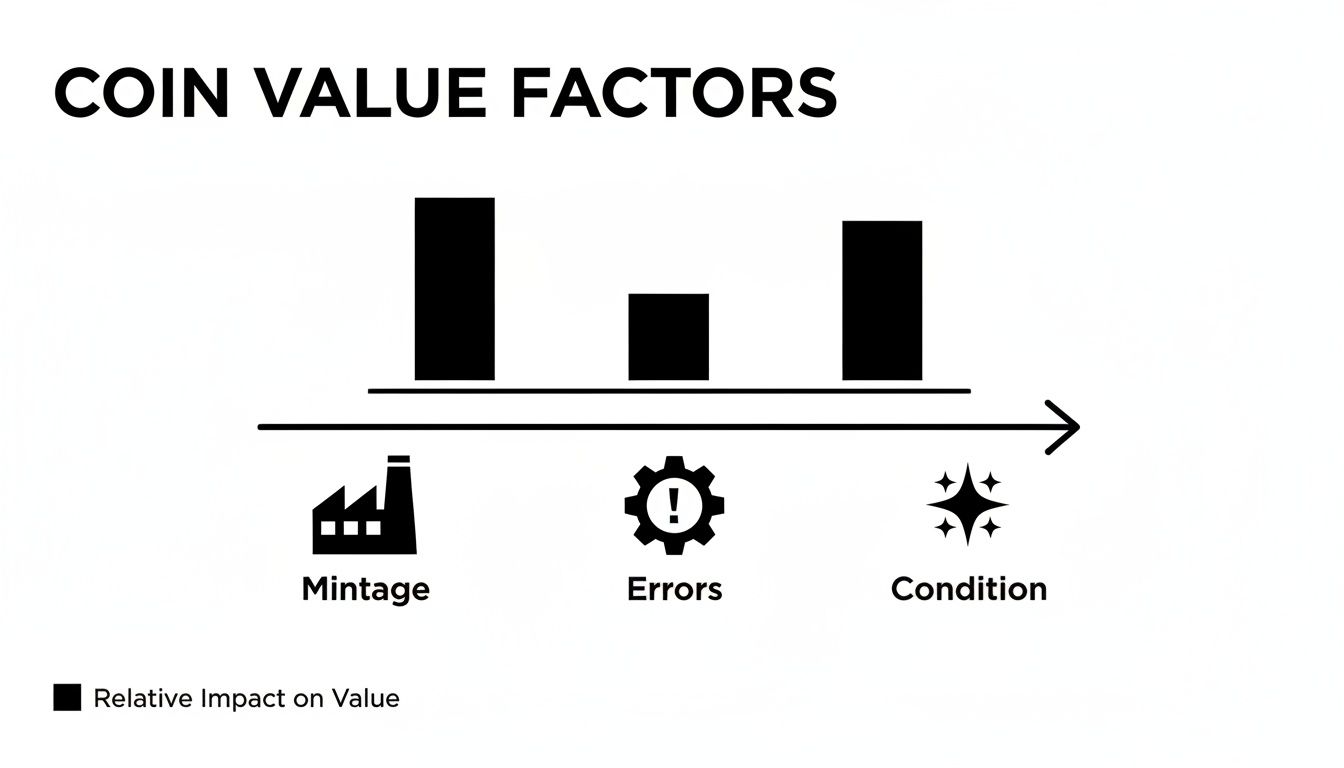
As you can see, a low mintage figure is the biggest driver of value. But a noticeable minting error or keeping the coin in pristine condition can also make a massive difference.
Why Mintage Numbers Matter
Mintage figures tell a story. For example, that 2008 Royal Arms coin is another one to watch for, with a mintage of just 3,910,000. Why so few that year? Production volumes often changed based on the UK's economic needs.
Once the new 12-sided pound coin appeared in 2017, the game changed completely for the old round pounds. If you're interested in the modern coin that replaced them, you can learn all about the new one pound coin from 2017 in our detailed guide.
Remember, even if you don't find a rare collectible, any old round pounds you have can still be exchanged. Our service is fast, easy, and 100% guaranteed, with no need for you to sort anything.
We are trusted by major UK brands, including charities, supermarkets, airports, and police forces, to provide a hassle-free way to exchange foreign coins and notes. Whether you want to donate foreign coins to charity or simply convert foreign coins and banknotes into cash, our process is designed for your convenience.
How to Check the Current Market Value
So, you’ve found a coin that looks a bit special. Maybe it’s the 2011 Edinburgh City design, or you’ve spotted a quirky minting flaw. What now? The next step is to figure out its actual one pound coin value, which means doing a little detective work. At the end of the day, a coin is only worth what someone is willing to pay for it.
Your best friend here is the internet, especially online marketplaces. But there’s a crucial trick to getting a realistic price, and it’s one that many people miss.
Look Beyond Asking Prices
It’s easy to hop onto a site like eBay, type in your coin, and see listings asking for hundreds of pounds. While that initial rush of excitement is great, asking prices are often just wishful thinking. To get a true feel for the market, you need to filter your search to show only "Sold Items" or "Completed Listings."
This one simple click changes everything. It shows you what buyers have actually paid for a coin like yours recently. This is the difference between an optimistic dream and cold, hard market data, and it will give you a much more grounded idea of what your coin is really worth.
Broaden Your Research
While checking sold listings is a brilliant start, it only gives you part of the picture. To get the full story, it’s a good idea to consult a couple of other sources.
- Coin Collector Forums: Communities dedicated to numismatics (the fancy term for coin collecting) are treasure troves of expertise. Post clear photos of your coin on a reputable forum, and you’ll likely get some honest opinions and valuations from people who live and breathe this stuff.
- Official Price Guides: Publications like the Coin Year Book release updated price guides for UK coins every year. These books are put together by experts and give you a dealer’s perspective on value, though what you’d get from a private sale might be different.
By combining these different research methods, you can build a much clearer picture of your coin's potential value. This puts you in the driver's seat, helping you decide whether to sell it to a collector, hang onto it, or simply exchange it for face value.
Of course, if all that research sounds like a bit too much faff, or if your coins turn out to be the common garden variety, there’s a much simpler alternative. Our service offers a fast, easy, and hassle-free way to exchange all your currency. You don’t need to sort through anything; just send us your whole collection of old round pounds, leftover foreign currency, or any obsolete notes you have lying around.
We provide a 100% guaranteed service trusted by major names like charities, supermarkets, airports, and even police forces. We make it simple to exchange foreign coins and get cash back quickly. Visit our homepage to see just how straightforward the process is.
The Easiest Way to Exchange Your Old Coins and Notes
So, after the thrill of the hunt, what do you do with the pile of coins that aren't rare collectibles? It's a common story: you've got a jar of old round pounds, some leftover holiday money, or even obsolete banknotes tucked away. Turning that forgotten currency into actual cash should be simple, and that's exactly where we come in.
We've designed a service that’s fast, straightforward, and completely hassle-free.
Forget all the usual headaches of currency exchange. There's absolutely no need to sort your coins and notes. Just gather everything you have—old UK currency, foreign coins, and withdrawn banknotes from anywhere in the world—and pop it in the post to us.
A Trusted and Guaranteed Service
Trust is everything, and we've worked hard to earn it. We’re proud to be the go-to currency exchange partner for some of the UK’s biggest brands, including major charities, supermarkets, airports, and even police forces. They trust us because our 100% guaranteed service is built on transparency and efficiency.
We are experts in handling your unwanted cash, providing a smooth experience from the moment you send your package to the moment you get paid. Our whole process is designed for your convenience:
- Fast: We get your currency processed quickly, so you aren't left waiting.
- Easy: Just pack up your coins and notes and send them our way.
- Hassle-Free: Don't worry about sorting or identifying anything; we do all the heavy lifting.
Why Old Pounds Needed Exchanging
You might wonder why the old round pound was replaced in the first place. The simple answer? Counterfeits. The original design was plagued by fakes, with forgery rates tripling over a decade. By 2016, a staggering 1 in every 30 coins was a counterfeit, meaning around 45 million fakes were floating around.
In response, the Royal Mint introduced the clever 12-sided bimetallic £1 coin in March 2017 and pulled the old version from circulation by October that year. You can read more about the history of the modern one pound coin from the Royal Mint.
This change left a lot of people holding old coins they could no longer spend. If that's you, our service is the perfect solution.
We specialise in converting currency that high street banks and post offices will no longer accept. Your jar of old round pounds or bag of mixed foreign coins is not worthless—it’s cash waiting to be unlocked.
Whether you want to exchange foreign coins and notes for yourself or donate foreign coins to charity, we offer a reliable and simple way forward. We help you turn that forgotten money into real, usable funds. For more practical advice, check out our guide on the easy way to exchange old British coins and notes.
Ready to finally clear out that currency clutter? Our system to convert foreign coins and banknotes is designed to be as easy as possible. You can start the process today by visiting our homepage and see for yourself how simple it is to get paid for your old money.
Your Top Questions About Pound Coin Value
To help you on your coin-collecting journey, we've answered some of the questions we hear most often about one pound coin value. Hopefully, this will clear up any lingering doubts and pull together everything we've talked about.
Are All Old Round Pound Coins Worth More Than £1?
In short, no. The vast majority of old round pound coins are simply worth their face value of £1. What really gets collectors excited is rarity, which usually comes down to low mintage numbers or those quirky minting errors we mentioned.
Coins from big production years, like 1983 or 1991, are incredibly common. You’d be hard-pressed to find a collector willing to pay more than a quid for one unless it’s in absolutely pristine, uncirculated condition.
How Much Does Condition Affect My One Pound Coin’s Value?
Condition, or 'grade' as it’s known in the collecting world, is everything. A coin that's ‘Brilliant Uncirculated’ (BU)—meaning it has never seen the inside of a pocket or a cash register—will always fetch a much higher price than the same coin that’s scratched, worn, and tarnished from years of changing hands.
Even for the genuinely rare coins, the value plummets once they've been in circulation. The bumps and scrapes from daily life quickly reduce a coin's appeal for any serious buyer.
The key thing to remember is that most of the change in your pocket, even the old stuff, is just worth its face value. The real opportunity is in making that value useful again, especially for obsolete currency that shops and banks have stopped accepting.
What Is the Best Way to Exchange My Old Pound Coins?
Since you can't spend the old round pounds in shops anymore, the simplest way to get your money back is to use a currency exchange service. We happily accept old round pounds, along with any other leftover foreign or obsolete currency you might have lying around. It’s a fast and easy solution.
Our 100% guaranteed service is trusted by major brands, including well-known charities, supermarkets, airports, and even police forces. You don't have to sort a thing—just send it all to us. We offer a completely hassle-free way to convert foreign coins and banknotes into cash.
Ready to turn your old coins and leftover currency into cash? With We Buy All Currency, the process is fast, easy, and completely hassle-free. There's no need to sort your money; simply send it to us and get paid. Visit our homepage to learn more and get started today: https://www.webuyallcurrency.com