
What Is the True One Shilling Value Today?
Posted by: Ian Stainton • 3 Feb 2026
Got an old shilling kicking about in a drawer? You might be sitting on something worth a fair bit more than you’d think. But figuring out its real value isn't as simple as looking up a single price.
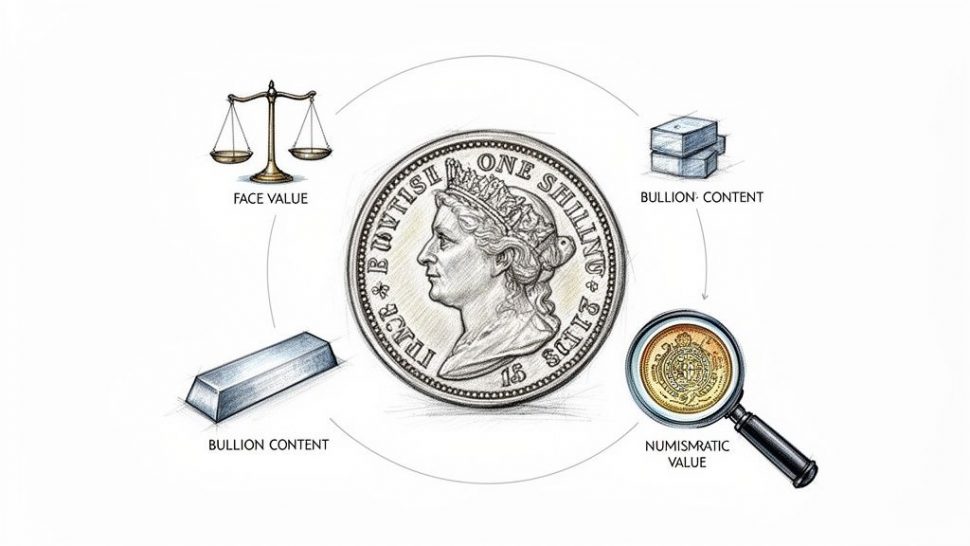
The true one shilling value all comes down to a mix of three things: its long-gone face value, its silver content (what we call bullion value), and whether it’s something collectors are after (its numismatic value). While most common shillings won't pay for your next holiday, some rare dates or coins in mint condition can be a real surprise.
What Is a One Shilling Coin Really Worth?
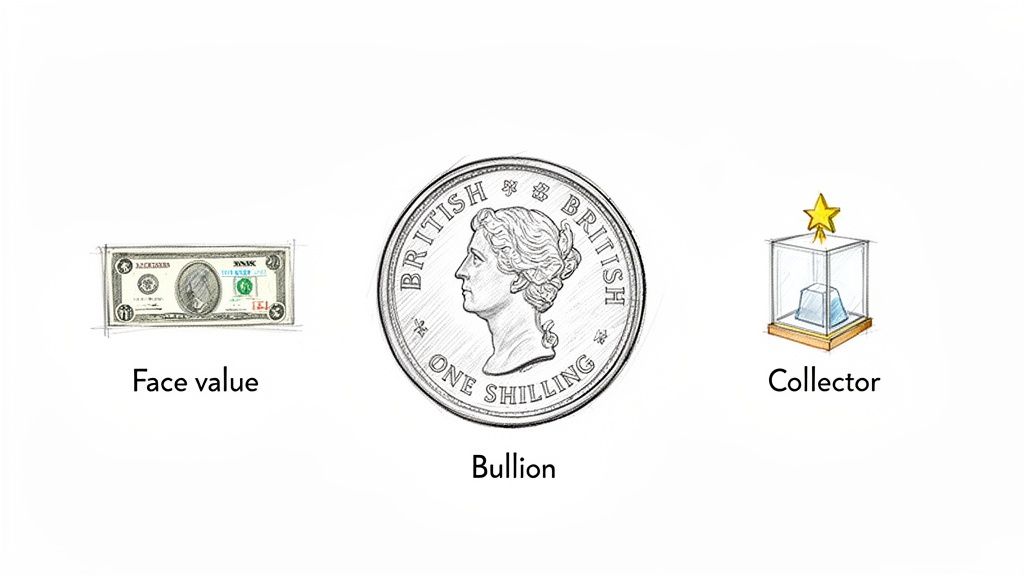
If you've ever found an old shilling in a forgotten tin or amongst leftover travel money, you’ve probably wondered what it’s worth. The answer is more interesting than just a number—a shilling’s value is a blend of history, precious metal, and rarity.
For centuries, the British shilling was a workhorse of the economy, worth a standard 12 pence. First established by the Normans, it was a coin people relied on. Just to give you an idea, in 1915 alone, the Royal Mint churned out over 39 million of them to keep up with demand. You can get a sense of its long history from this detailed overview of the British shilling).
Three Key Factors of Shilling Value
So, how does that history translate into value today? A shilling isn't just a coin; it's an object that can be valued in three completely different ways. It’s crucial to understand these distinctions because they explain why one shilling might be worth a few quid while another could fetch hundreds.
The table below breaks down these three value types to give you a clearer picture.
| Type of Value | What It Means for You | When This Value Applies |
|---|---|---|
| Face Value | This is the value printed on the coin. It’s now purely historical and has no spending power. | Historically, a shilling was worth 12 old pence (or 5 new pence after 1971). Today, it’s no longer legal tender. |
| Bullion Value | This is the value of the precious metal in the coin, determined by the live market price of silver. | This applies to all British shillings minted before 1947, as they contain either 92.5% or 50% silver. |
| Numismatic Value | This is the collector's value, based on rarity, condition (grade), and historical importance. | This is the most variable factor. It applies to all shillings but is highest for rare dates or coins in near-perfect condition. |
As you can see, a coin’s worth isn’t a straightforward matter. Assessing these factors yourself—especially numismatic value—can be tricky and time-consuming without the right expertise. But you don't need to become a coin expert just to find out what you have.
Our service is designed to be fast, easy, and completely hassle-free. We handle the assessment for you, and there's no need to sort your coins. We ensure you get a fair and guaranteed price for all your leftover foreign currency, including old and obsolete coins like the shilling.
We are trusted by major UK brands, including national charities, supermarkets, airports, and even police forces. We provide a credible and secure way to convert foreign coins and banknotes into cash, all backed by our 100% satisfaction guarantee for a totally risk-free process.
Uncovering the Hidden Silver in Your Shillings
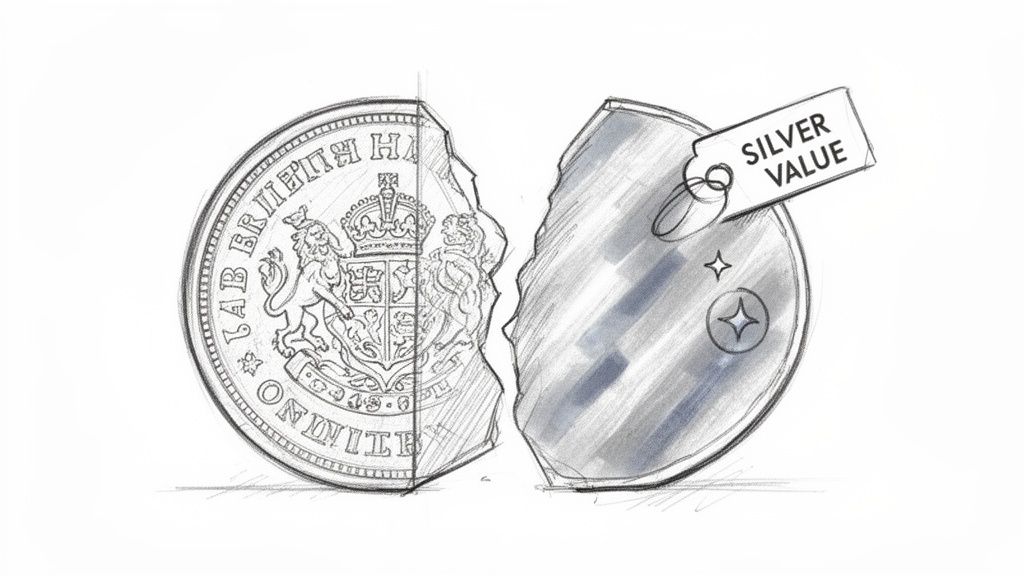
Many people who find old shillings tucked away in a drawer are surprised to learn they might be holding onto something with real, tangible worth—a value that has nothing to do with what it could buy decades ago. This hidden value comes from the precious metal the coin is made from, known as its bullion value.
It's a bit like finding an old piece of silver jewellery. Its true worth isn't its original price tag but the current market value of the silver it contains. The exact same principle applies to a huge number of old British shillings, turning what looks like obsolete pocket change into a genuine asset.
That’s because every single British shilling minted before 1947 was made of silver. If you've got one in your collection of leftover holiday money, you’re holding onto a small amount of precious metal whose value fluctuates every day with the global silver markets.
The Silver Standard: A Quick Guide
Figuring out which shillings contain silver is the first step to unlocking their true value. The silver content actually changed over the years, which directly affects how much a coin is worth today just for its metal. It’s one of the key details our experts look for when you exchange foreign coins and notes.
Here’s a simple breakdown of the key dates to watch out for:
- 1816 – 1919: Shillings from this long stretch are made from 92.5% silver—what you might know as Sterling silver. These are the purest ones, making them the most valuable based on metal content alone.
- 1920 – 1946: The silver content was dropped to 50%. While not as pure, these coins still have a significant bullion value that’s far higher than their old face value.
Any shilling minted from 1947 onwards was made of cupro-nickel and contains no silver, so they have no value based on their metal. It's helpful to know these dates, but don't worry about memorising them. For a deeper look at different shilling types, our guide on the value of a 2 shilling coin has more great info.
Calculating the True Bullion Value
So, what does this actually mean in pounds and pence? A single shilling from the 1920-1946 period, for example, contained 0.0909 ounces of pure silver. Based on today's prices, that gives it an intrinsic value of around £1.20. It’s this silver content that made shillings valuable not just as currency but as real assets.
Our service makes this whole process fast, easy, and completely hassle-free. You don't need to sort through dates, weigh coins, or track silver prices. We handle all the complexities for you.
We are trusted by major national charities, supermarkets, and even police forces to accurately assess and convert foreign coins and banknotes. Our 100% guaranteed service ensures you get a fair and honest price for the hidden silver in your collection, giving you a simple way to turn forgotten currency into real cash. Just send us your coins, and we'll do the rest.
Finding a Collector’s Prize in Your Coin Jar
While the silver content gives many old shillings a solid baseline value, the real excitement comes from something far less predictable: its numismatic value. This is the fancy term for what a collector is willing to pay for a coin, which can often be much, much higher than its simple metal worth.
It’s what turns a common piece of old money into a genuine prize. Think of it like the difference between a standard printed book and a rare first edition signed by the author. Both tell the same story, but one has a unique history and scarcity that gives it a completely different level of value. Several key factors decide whether your shilling is just old pocket change or a collector's item.
What Makes a Shilling Valuable to Collectors?
Identifying a rare coin can feel like a treasure hunt, but the clues are always the same. Collectors are looking for a special combination of rarity, condition, and historical significance. A coin that ticks all these boxes can see its one shilling value shoot up dramatically.
Here’s what they look for:
- Rarity and Mintage: How many were made? The fewer coins produced in a specific year, the rarer they are today. Years with low mintages, like the 1950 English shilling, are always in higher demand.
- Condition (Grade): A coin that looks like it just left the Royal Mint will always be worth more than one that’s been rattling around in pockets for decades. Scratches, dinks, and faded details will drastically reduce its appeal to a collector.
- Mint Marks and Varieties: Sometimes, little mistakes or variations happened during the minting process. These unique quirks—often tiny letters or slight design differences—can create exceptionally rare and sought-after versions of an otherwise common coin.
- Historical Context: Shillings tied to major historical events or monarchs can also attract more interest. For example, coins from the reign of Edward VIII are incredibly rare because he abdicated before they were ever widely circulated.
Key Dates and Realistic Price Ranges
So, what should you be looking for in that jar of leftover foreign currency? While most shillings you find will be common dates, a few stand out from the crowd. A 1905 shilling, for instance, had a very low mintage of just over 600,000 and can be worth over £200 if it’s in excellent condition.
Even a more common King George V shilling from 1926 can fetch £20-£30 if it's in uncirculated, pristine shape. It’s important to be realistic, though. The vast majority of shillings aren't rare and, if heavily worn, will only be worth their silver value. Telling the difference requires a trained eye and specialist knowledge.
That’s where our service simplifies everything. While hunting for rare coins is exciting, it’s also complex and time-consuming. We've designed our process to be fast, easy, and completely hassle-free, so you don’t have to sort or identify anything yourself.
We are trusted by major UK brands—including national charities, supermarkets, airports, and even police forces—to handle their currency. Whether you want to exchange foreign coins and notes or donate foreign coins to charity, we provide a 100% guaranteed service.
Just send us your unsorted collection, and our experts will ensure you get the best possible value for every single coin, rare or not. Ready to see what your collection is worth? Visit our homepage to get started!
How to Judge Your Shilling's Condition
When it comes to old coins, condition is king. It’s easily one of the biggest factors driving the value of a shilling, especially for collectors. You could have two shillings from the exact same year, but if one is crisp and clear while the other is worn smooth, the difference in value could be enormous.
Think of it like buying a second-hand car. A model with low mileage and a pristine body will always fetch a higher price than the same car that’s clearly been through the wars. Coins tell their life story on their surface, and collectors are willing to pay a premium for a story that’s been well-preserved.
This handy infographic breaks down the core elements that determine a coin's overall worth, including rarity, condition, and historical context.
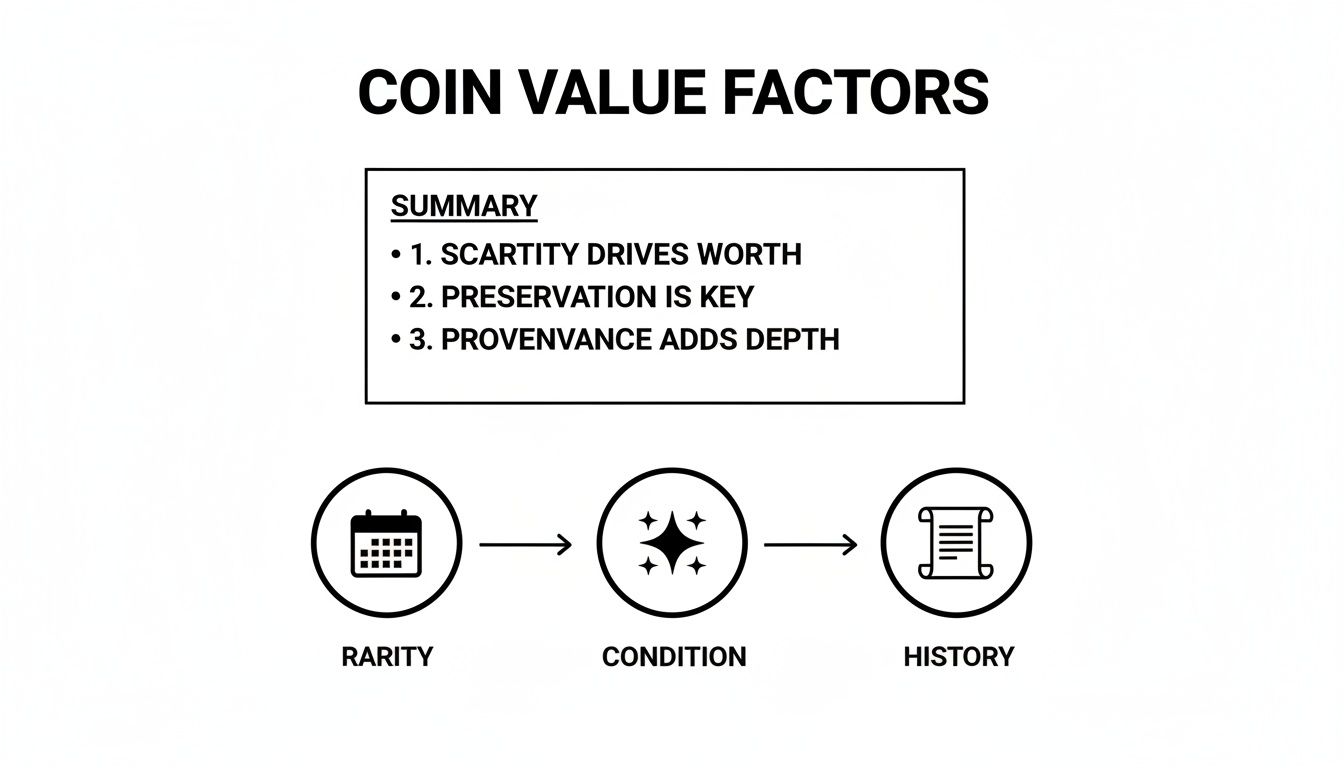
As you can see, the condition works hand-in-hand with rarity and history to build the coin’s final value. It’s a crucial piece of the puzzle.
A Simple Guide to Coin Condition
You don't need to be a professional numismatist to get a rough idea of your shilling's condition. While experts use a very detailed grading scale, you can get a good feel for things by looking for a few key signs of wear.
Use this simplified guide to estimate the condition of your shillings based on visible wear and tear.
| Grade | What to Look For | General Impact on Value |
|---|---|---|
| Uncirculated (UNC) | Looks brand new. Still has its original mint shine (lustre). All details are sharp with no visible signs of wear. | Highest potential value for collectors. |
| Very Fine (VF) | Only light wear on the highest points of the design (like the monarch's cheek or hair). Most details are still sharp and clear. | Still very desirable and commands a strong price. |
| Fine (F) | Details are visible but have noticeable wear from being in circulation. The coin looks a bit flattened. | A common grade for older, circulated coins. Value is moderate. |
| Good (G) | The design is heavily worn but the main outlines, date, and lettering are still legible. Looks faint and well-used. | Usually holds value closer to its silver content, unless it's a very rare date. |
Learning these basic terms is a great first step, and you can find more practical advice in our guide on how to sell old coins. It's a useful skill, but it also shows how subjective and time-consuming it can be to assess a large collection yourself.
The Easiest Way to Exchange Your Old Coins for Cash
So, you now have a better feel for what makes a shilling valuable – whether it's the silver in the coin or its appeal to a collector. But knowing that is one thing; actually turning that old metal into cash is another kettle of fish. This is where we come in, transforming what can be a fiddly, confusing process into a simple, rewarding one.
Forget spending your weekends squinting at coin books or trying to figure out which dates are the rare ones. Our service is designed to be as fast, easy, and hassle-free as possible. You don't need to sort anything at all—just gather up your collection of shillings, any leftover foreign currency from holidays, and any other old notes and coins you've got lying around. We’ll do the rest.
A Simple, Secure, and Guaranteed Process
Our main goal is to make exchanging currency completely straightforward and trustworthy. We’ve done away with all the usual headaches, so you can turn your old coins into cash without any of the stress or guesswork. It’s all built on being clear and efficient, so you know exactly what’s happening every step of the way.
Here’s a quick look at how our fast and easy process works:
- Get a Quick Quote: Use our simple online tool to get an idea of what your collection might be worth.
- Post Your Currency: Pop your unsorted coins and notes into a secure package and send them to us.
- Expert Valuation: Our specialists will carefully check every single coin, looking for any hidden value from silver content or numismatic rarity.
- Guaranteed Payment: You get the full, agreed-upon amount paid directly into your bank or PayPal account. Simple as that.
We're the trusted currency exchange partner for some of the biggest names in the UK. Our credibility is backed by long-standing relationships with major charities, supermarkets, airports, and even police forces who rely on us for a transparent and efficient service.
Why You Can Trust Us Completely
Choosing someone to handle your currency is a big deal, and it requires confidence. We’ve built our reputation on being reliable and fair, which is why we offer a 100% satisfaction guarantee. If for any reason you’re not completely happy with our valuation, we’ll return your currency to you, free of charge. There is absolutely no risk on your part.
This commitment is why so many organisations choose to partner with us when they want to donate foreign coins to charity. They know we provide an honest, secure way of turning forgotten change into meaningful contributions. You can find out more about how it all works in our in-depth guide to exchanging coins for cash.
Whether you have one valuable shilling or a big bag of mixed coins, our service is the simplest and most secure way to unlock its value. Let our experts do the hard work while you get a fast, guaranteed payment. Your peace of mind is our top priority.
Your Shilling Questions Answered
Got a few questions about your old shillings? You're not alone. Here are some straightforward answers to the queries we hear most often, helping you figure out what to do next.
Are All Old Shillings Actually Worth Anything?
It’s a great question, and the honest answer is no, not all of them hold significant value. Most of the common shillings you’ll find, especially the cupro-nickel ones made after 1946, are worth very little on their own.
The ones that get interesting are the silver shillings (minted pre-1947), coins in crisp, uncirculated condition, or those from particularly rare years. Spotting the difference takes a trained eye, which is exactly where we can help.
Do I Have to Sort All My Coins Before Sending Them?
Absolutely not! In fact, that’s one of the best parts of our service. We’ve designed the entire process to be completely fast, easy, and hassle-free.
Just gather up your mixed, unsorted collection of foreign coins and notes and send them our way. Our experts will handle all the tedious sorting and valuation work for you, saving you hours of time while making sure you get a fair, guaranteed price.
It’s why major UK brands—from national charities and supermarkets to airports and even police forces—trust us. They rely on our transparent and efficient service to convert their foreign coins and banknotes.
How Do I Know I'm Getting a Fair Price?
Trust is everything to us. The exchange value we quote you is exactly what you get paid—no hidden fees, no last-minute deductions. Simple as that.
We’re so confident in our valuations that we back them with a 100% satisfaction guarantee. If for any reason you’re not completely happy with our offer, we’ll return your currency to you, free of charge. Your peace of mind is what matters most.
This commitment to fairness is also why so many organisations partner with us to donate foreign coins to charity. They know we provide a secure and honest way to turn forgotten change into valuable contributions for a good cause.
Ready to find out what your old currency is really worth? We Buy All Currency makes it simple. Head over to our homepage to get started on your fast, easy, and guaranteed currency exchange today!