
Sell and Buy Currency: A UK Traveller’s 2026 Guide
Posted by: Ian Stainton • 29 Apr 2026
Specialist online postal services are the most effective way to sell leftover or old currency, including foreign coins and withdrawn notes, because banks and standard bureaux usually won’t take them. For buying travel money, comparing dedicated online currency providers is usually the smartest route, especially if you want to avoid the weak rates commonly found at airport kiosks.
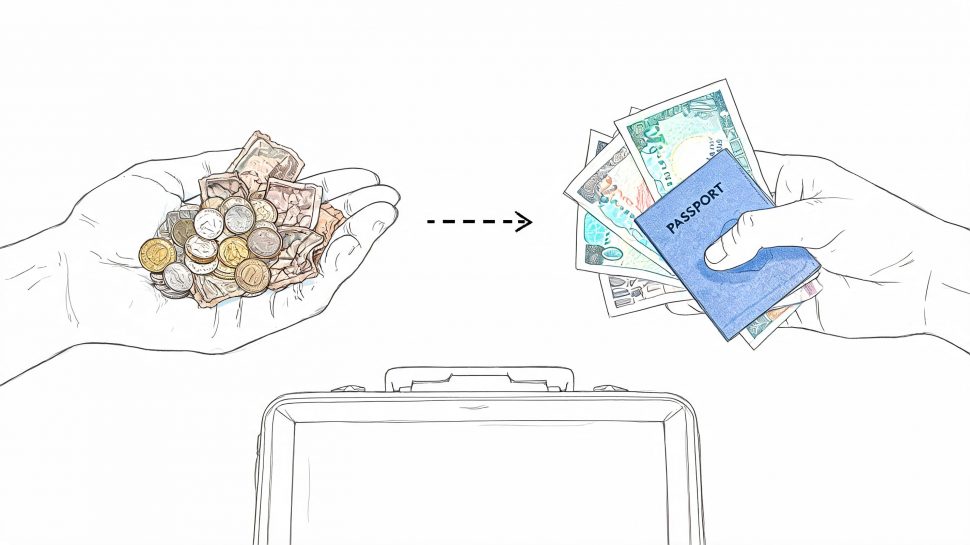
A common scenario arises: A purse full of euros, a jar of random coins from three holidays ago, a few notes that might still be valid, and no clear idea what’s worth exchanging. Then the next trip comes along and the problem flips. You need to buy currency, but you don’t want to overpay.
That’s why it helps to think about sell and buy currency as one practical job, not two separate ones. Clear out what you already have, understand what can still be converted, and use the same disciplined approach when you need travel money again.
Practical rule: If a provider can’t handle coins, mixed bags, or withdrawn notes, it isn’t built for leftover currency. It’s built for standard travel cash only.
Why Your Leftover Foreign Currency is So Hard to Exchange
High street banks and travel money counters aren’t ignoring your old coins out of stubbornness. They’re built for a different kind of market.

The modern foreign exchange system is enormous. The global FX market handles over $2 trillion in daily turnover, and that figure had more than tripled since 1989 in the data cited by the Chicago Fed. In practice, that scale pushes mainstream institutions toward high-volume, electronic transactions in actively traded currencies, not bags of low-value foreign coins or discontinued notes (Chicago Fed on foreign exchange market growth).
Why banks reject coins and old notes
Banks want standardisation. They prefer current banknotes, common currency pairs, and straightforward processing.
Foreign coins create the opposite conditions:
- Low individual value: Counting, checking, storing, and transporting them can cost more than the coins are worth.
- Labour-heavy handling: Mixed coin lots need manual or specialist sorting.
- Limited resale routes: Many institutions have no practical downstream buyer for physical foreign coins.
- Extra compliance checks: Old or withdrawn notes need validation before any value can be assigned.
Withdrawn currency is even harder. If a note is no longer in circulation, a mainstream bureau may have no system for pricing it, no route for bulk processing it, and no appetite for the delay.
The real problem isn’t your money
People often assume they’ve made a mistake by keeping leftover holiday cash. Usually, they haven’t. The issue is that mainstream exchange services were never designed for leftover foreign currency, especially when it’s unsorted, mixed, or old.
That’s also why supermarket coin machines aren’t a fix. They’re built for domestic coins. Foreign metal is outside their rules and calibration.
A bureau that happily sells you euros for a city break may still refuse the same euros later if they come back as small change, mixed denominations, or older series notes.
Why specialist services exist
A specialist postal buyer works because the process is built around what others reject:
- Foreign coins and notes together
- Mixed, unsorted collections
- Older and withdrawn currency
- Postal handling rather than counter service
- Quote-first systems that show value before you send
That last point matters. Leftover currency is frustrating mainly because people don’t know where they stand. Once you can identify what’s accepted, how it’s valued, and what happens if you’re unhappy with the quote, the whole task becomes much simpler.
How to Convert Foreign Coins and Banknotes into Cash
The best approach is the least glamorous one. Gather everything in one place, check what you’ve got, use a specialist valuation tool, and send it by post through a service built for mixed currency.
Start with one full sort
Don’t just pull out the obvious notes and ignore the rest. Small coin piles often look worthless until they’re combined.
A sensible home sort usually means making three groups:
- Current foreign banknotes
- Foreign coins
- Old, pre-euro, pre-decimal, or withdrawn currency
You don’t need museum-level accuracy. You just want enough order to recognise what belongs together. If the collection is too mixed to sort neatly, a weight-based option is often the easiest route for bulk coin exchange.
Why old currency can still be worth sending
People throw away old notes far too often. That’s usually the wrong move.
According to the verified brief, specialist postal buyers can often offer fixed quotes capturing 92-98% of face value for collectable notes, and the same brief notes that many travellers lose money because they don’t realise old or souvenir currency may still have value (background on obsolete currency value and traveller awareness).
That doesn’t mean every old note is valuable. It means you shouldn’t assume it’s worthless just because a bank won’t accept it.
How the process usually works
A specialist postal exchange is simple when it’s done properly:
- Get an online valuation: Enter the currencies you have, or use a weight-based wizard for mixed coins.
- Choose your payout method: Bank transfer or PayPal are common options.
- Pack the currency securely: Keep notes flat where possible and bag coins sensibly.
- Post the parcel: Use a tracked service if you want extra peace of mind.
- Verification takes place on receipt: The currency is checked against the submission.
- Payment follows after verification: For this publisher, payment is issued within five working days by bank transfer or PayPal.
If you want a practical walkthrough of the process, this guide on exchange foreign coins gives a clear example of how specialist postal exchange works in the UK.
Packaging that works
This part matters more than people think. Currency doesn’t need fancy presentation, but it does need sensible handling.
- Use small bags for coins: Mixed coins are easier to manage if they’re contained.
- Keep notes dry and flat: Folded notes are usually fine, but avoid damage in transit.
- Don’t overpack one weak envelope: Heavy coin parcels need stronger packaging.
- Include any requested reference details: That helps match your parcel to your online quote.
If you’re sending a mixed collection, the aim isn’t to make it pretty. The aim is to make it secure, traceable, and easy to verify.
Comparing Your Currency Exchange Options
| Exchange Option | Current Banknotes | Foreign Coins | Old/Withdrawn Currency | Best For |
|---|---|---|---|---|
| High street bank | Sometimes | Rarely | Rarely | Existing customers with standard, current notes |
| Travel money bureau | Usually for common notes | Usually not accepted | Usually not accepted | Buying travel cash and selling recent banknotes |
| Airport kiosk | Usually for common notes | Generally poor for coins | Generally not accepted | Last-minute convenience |
| Specialist postal exchange service | Yes | Yes | Yes | Leftover holiday money, mixed collections, obsolete currency |
What works and what doesn’t
What works:
- Sending all the leftover currency together
- Using a provider that accepts coins and banknotes
- Checking the quote before posting
- Choosing a service with a free return option if you’re unhappy
What doesn’t:
- Drip-feeding small amounts to multiple outlets
- Assuming coins are automatically worthless
- Waiting indefinitely because you hope a local branch might help
- Treating withdrawn notes as junk
A proper specialist service solves the awkward part of the market. It accepts the formats that standard channels avoid, and it removes the need to sort every last coin by hand.
Real-World Scenarios Beyond Holiday Money
Leftover travel money is only one part of this market. Some of the biggest foreign currency headaches come from charities, retailers, transport hubs, and organisations that collect money incidentally rather than by choice.

A strong example is the charity sector. A 2023 survey found UK charities hold over £50 million in unconvertible foreign change, with 42% saying “no viable exchange options” is the main barrier (UK charity foreign change survey reference). That’s exactly the kind of problem mainstream exchange services struggle to solve.
Charity collections
A charity might receive foreign coins through:
- airport collection points
- sponsored travel
- public donation tins
- old holiday money donated by supporters
The amounts are often too mixed, too small, or too awkward for banks. A specialist postal route changes that. Instead of treating the money as unusable, the charity can convert mixed foreign coin and note donations into usable GBP.
That’s also why donation-directed exchange is useful for individuals. If you’ve got a drawer of mixed currency and don’t particularly need the proceeds yourself, sending the value straight to a UK charity is often easier than leaving it untouched for years.
Retailers, attractions, and service businesses
Businesses regularly end up with foreign currency by accident. It appears in tills, tip jars, lost property clear-outs, customer returns, and mixed cash collections.
A retailer doesn’t want staff spending time debating whether an old euro coin is still valid. A specialist route lets the business consolidate odd currency and turn it into recovered value without disrupting normal operations.
Airports, airlines, and public-facing organisations
Airports and airlines are obvious examples because travellers carry spare coins everywhere. But the same issue affects any organisation dealing with international footfall.
Police forces, transport operators, visitor attractions, and large venues can all accumulate foreign cash that standard banking routes don’t process neatly. The practical need is the same in every case: one method for mixed, physical currency that doesn’t require perfect sorting first.
The organisations that handle leftover foreign money best aren’t the ones with the biggest finance team. They’re the ones using a process built for awkward currency from the start.
Common Mistakes to Avoid When You Exchange Currency
People lose value on currency exchange in predictable ways. The mistakes are rarely dramatic. They’re small, ordinary decisions that add up to wasted money or needless delay.

Mistakes when selling leftover currency
- Throwing old notes away: A note being withdrawn doesn’t automatically make it worthless.
- Ignoring small foreign coins: One coin isn’t much. A mixed household collection often is.
- Relying on banks for specialist items: Most aren’t set up for bulk coins or obsolete series.
- Sending without checking the quote process: You want to know how valuation, verification, and return options work before posting anything.
A lot of frustration comes from using the wrong channel for the job. If you try to exchange foreign coins and notes through a standard service, it often feels as though the system is broken. Really, the service is just designed for a different product.
Mistakes when buying travel money
Buying currency badly usually comes down to timing and comparison.
- Leaving it until the airport: Convenience is high. Value usually isn’t.
- Taking the first rate you see: Tourist-facing exchange rates vary.
- Focusing only on headline rate: Fees, collection terms, and minimum order rules matter too.
- Buying in a rush: When you’re hurried, you’re less likely to compare providers properly.
Why specialist execution matters
There’s another mistake that most customers never see directly. It happens on the provider side.
The verified brief notes that professional platforms use hedging to manage exposure, and that over-hedging by 10% can create direct losses if the market moves favourably. The point for customers is simple: a reliable specialist uses hedging instruments carefully so the quoted rate can be honoured (currency hedging and over-hedging risk).
That’s one reason informal, vague, or poorly structured exchange options can be risky. A serious provider has to match quote, timing, and payout process with disciplined risk control behind the scenes.
A good quote isn’t just a number on a screen. It depends on whether the provider can support that rate operationally.
A safer way to think about it
Before you exchange anything, ask four practical questions:
- Does this provider accept the exact type of currency I have?
- Can I see the rate or quote before I send?
- What happens if I’m unhappy after verification?
- How and when do I get paid?
Those four checks prevent most bad decisions.
A Practical Guide to Buying Foreign Currency Cost-Effectively
Selling leftover money is one side of the job. Buying the next batch well is the other.

If you’re buying travel money, the basic rule is simple. Plan early and compare online before you commit. That gives you the best chance of avoiding poor retail rates and rushed decisions.
Why timing affects what you pay
Exchange rates move constantly. The verified data notes that the USD to EUR rate fluctuated by over 2% in a single quarter, which is a good reminder that waiting until the last minute can change what your pounds buy (historical exchange rate volatility and quote transparency).
For travellers, that means two things:
- a rate can move between the day you first check and the day you buy
- a transparent, real-time quote matters more than a generic advertised rate
The best buying options in practice
Specialist online providers are often the strongest starting point. They tend to be easier to compare, and you can review the total cost before you travel.
High street branches can still be useful if you need speed or prefer face-to-face service, but they aren’t always the cheapest. Airport kiosks are mainly a convenience option. If you use them, you’re usually paying for urgency.
If you’re actively comparing providers, this guide to best currency exchange rates online is a sensible place to start.
How to buy travel money without overpaying
Try this sequence:
- Check rates a few days before you need to buy
- Compare more than one dedicated provider
- Look at the full offer, not just the headline
- Avoid buying your entire amount in a panic at the airport
- Keep some flexibility if your trip is still weeks away
This doesn’t mean you need to predict the market perfectly. Most travellers don’t need that. You just need to avoid the worst buying habits.
Understand the difference between a market rate and a customer rate
The rate shown on a financial chart is not always the same as the rate offered to a retail traveller. Providers have operating costs, stock considerations, and margin requirements.
That doesn’t mean every retail rate is unfair. It means you should compare like with like. Check whether the offer includes fees, delivery charges, or collection restrictions. A slightly lower-looking headline can still be the better overall deal if the terms are cleaner.
If you need currency for a trip, don’t aim for the perfect market call. Aim for a transparent provider, a sensible purchase window, and no last-minute panic.
Frequently Asked Questions About Currency Exchange
Can you exchange foreign coins in the UK
Yes, but usually not through normal banks or standard travel money counters. If you want to exchange foreign coins, especially loose holiday change or mixed coin lots, specialist postal services are typically the practical option.
Do UK banks accept foreign coins and notes
They may accept some current foreign banknotes in limited circumstances, but foreign coins are commonly refused. Old, withdrawn, and mixed currency is where banks are least helpful, because their systems are usually geared toward current, standardised notes rather than awkward physical currency.
Can I exchange old or withdrawn currency
Often, yes. Old currency can still have value, especially where a specialist service accepts discontinued notes, pre-euro money, or older coinage. The key point is not to assume that “not accepted by a bank” means “worthless”.
Is it worth exchanging small amounts of leftover foreign currency
Usually, yes, if you combine everything and use a service that accepts coins as well as notes. A few coins from one trip may not feel significant, but mixed leftovers from several trips often justify sending together. That’s particularly true when you can include notes and older currency in the same exchange.
Do I need to sort all my foreign coins first
Not always. Some specialist services provide a weight-based wizard for unsorted collections, which is useful if you’ve got a jar or bag of mixed coins. That can save a lot of time compared with trying to separate every denomination by hand.
How do I know if the quote is fair
Look for a provider that gives transparent rates before you send your parcel. A fair process is one where you can review the expected value, understand what’s accepted, and check what happens after verification. Clarity matters more than flashy advertising.
What happens if I’m not happy with the valuation
A strong specialist service should explain this upfront. In this publisher’s case, there’s a happiness guarantee, which means the currency is returned free of charge if the customer isn’t satisfied with the quote after verification. That’s a useful trust signal because it reduces the risk of sending awkward currency items by post.
How long does payment take
For this publisher, once the currency has been received and verified, payment is issued within five working days by bank transfer or PayPal. Always check the provider’s stated verification and payout times before sending.
Can I donate foreign coins to charity instead of taking the money myself
Yes. Some specialist services let you direct the proceeds to a partnered UK charity. That’s a practical option if you want to donate foreign coins to charity or turn leftover foreign currency into a simple donation without dealing with sorting or bank refusals yourself.
Can businesses and charities use the same process as travellers
Yes. The same specialist model can work for individuals, charities, retailers, airports, and other organisations that collect mixed foreign cash. The advantage is consistency. One process can handle current notes, coins, and withdrawn currency without forcing staff or volunteers to find separate routes for each type.
What’s the best way to buy travel money
For most UK travellers, comparing dedicated online providers before departure is the best starting point. It’s usually more cost-effective than leaving it until the airport, and it gives you time to compare the actual offer rather than buying under pressure.
Should I keep old holiday money for my next trip
Sometimes that makes sense if you know you’ll use the same currency soon and the notes are current. It makes less sense when you’re holding mixed coins, old series notes, or currency from trips you’re unlikely to repeat. In those cases, it’s often better to exchange leftover currency while it’s still easy to identify and process.
If you’ve got coins, banknotes, or withdrawn currency sitting unused at home or in your organisation, We Buy All Currency offers a straightforward way to convert it. You can check your quote online, send mixed currency by post without needing to sort every coin, and choose payment by bank transfer or PayPal, with the option to donate the proceeds to charity if that suits you better.