
Sell Old Coins for Cash: Your 2026 UK Guide
Posted by: Ian Stainton • 3 Jul 2026
A travel wallet from Spain. A jar of odd coins from family holidays. Old Irish punts, shillings, francs, and a few notes tucked into a drawer because you meant to “deal with them later”. A tidy coin collection is rare. What's more common is a mixed pile of money that banks won't touch and high street exchange counters usually don't want.
That frustration is common, and it's one reason so much value gets ignored. The average UK household holds approximately £50 to £70 in unused foreign or obsolete currency according to Warwick & Warwick's guide to selling rare coins. For families, charities, and businesses, the total can be much higher once everything is pooled together.
If you want to sell old coins for cash, the main question isn't just what the rarest coin might be worth. It's how to turn all that leftover currency into money without wasting time, overpaying in fees, or accidentally giving away something valuable.
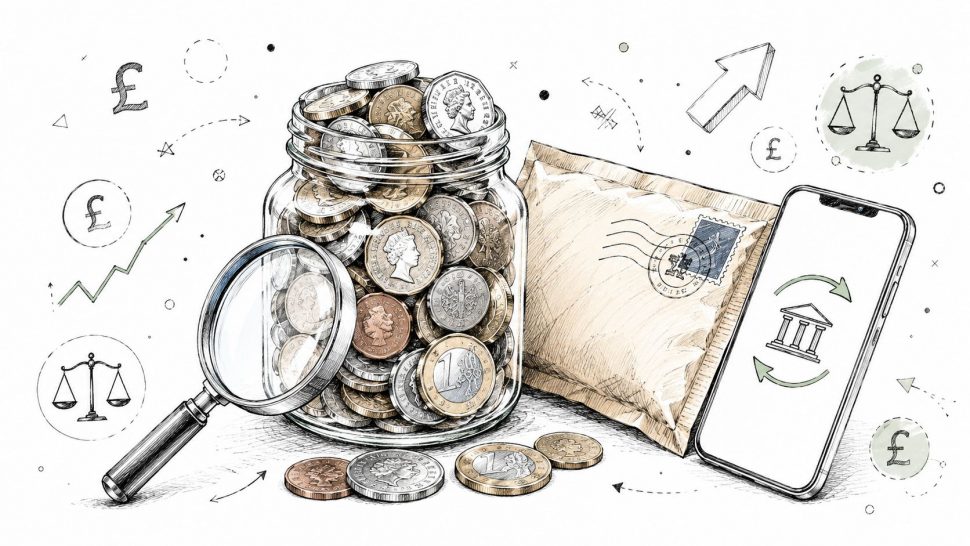
That Jar of Old Coins Could Be Your Next Payout
You empty a kitchen drawer or lift down an old biscuit tin and find the same kind of mix that turns up in thousands of UK homes. A few euros and cents, some old pound notes, pre-decimal coins, withdrawn foreign cash, and random change kept because it felt too wasteful to throw away. On its own, none of it looks important. Together, it can still be worth turning into cash.
Most households trying to sell old coins are dealing with mixed currency, not a neat collector's album. That distinction is important because the usual places people try first are built for current money, not leftovers from travel, inherited jars, charity collections, or years of accumulated odds and ends.
Quick Answer
The simplest way to sell old coins for cash in the UK is to use a specialist online currency exchange service that accepts coins, banknotes, and withdrawn currency together. The best option for most people is one that lets you send mixed, unsorted currency by post, gives you a clear quote upfront, and pays by bank transfer or PayPal after verification.
That approach saves time and cuts friction. Everyday sellers rarely want to sort every coin by country, check which notes are still legal tender, and work out whether anything should be treated as collectible. They want one practical route that handles the full pile and still leaves room to set aside anything unusual. If you are unsure what might deserve a second look, a quick guide to foreign coins that are worth money can help before you send anything off.
Why the usual options fall short
Banks can be useful for standard deposits. They are rarely useful for mixed foreign coins or obsolete currency. Travel money counters are narrower still. They usually want current notes in spendable condition, not a bag containing Croatian kuna, old Irish punts, Swiss coins, and a few damaged notes from long-forgotten trips.
A specialist service fits the job better because it is designed for the whole currency lifecycle, not just the collectible end of the market. That includes everyday foreign change, old notes that are no longer accepted in shops, pre-decimal money, and pieces with small individual value that only become worthwhile once everything is processed together.
For mixed collections, that usually means:
- Less sorting at home: You do not need expert knowledge before getting started.
- Wider acceptance: Coins, notes, and withdrawn currency can go through one route.
- A better fit for real households: Families, charities, and small businesses often have the same problem, a mixed stash rather than a curated collection.
- Fewer dead ends: You avoid branch visits and counter enquiries that end with a polite refusal.
Old currency can still have cash value even when it no longer has spending power. That is the point many people miss. A coin does not need to be rare enough for auction to be worth something, and a note does not need to be usable abroad to be saleable. For a mixed stash, the practical win is finding a buyer that can deal with all of it in one process.
How to Identify Valuable Coins in Your Collection
Before you exchange foreign coins and notes, do a quick check for anything that might deserve separate treatment. You don't need to become a coin expert. You just need to spot the obvious signs that a coin could be worth more than bulk exchange value.

Check the date and metal first
Older UK coins can carry value because of their silver content alone. MoneySavingExpert notes that coins minted pre-1947 in the UK contain approximately 50% silver by weight, while pre-1920 coins are composed of sterling silver at 92.5% purity. That means some old shillings, florins, sixpences, and similar pieces may be worth more than face value even if they're worn.
Start with a simple sort:
- Pre-1920 UK silver coins: Set these aside.
- Pre-1947 UK silver coins: Put these in a second separate group.
- Modern circulating coins: Keep together unless something stands out.
- Foreign coins: Leave them in their own group for exchange unless they appear obviously unusual.
If you've got a broad mix, this quick pass is enough. You're not trying to grade every item. You're trying to avoid bundling a potentially valuable coin into a basic lot.
Look for rarity, proof finish, and condition
Some coins are valuable because they're scarce, not because of metal content. As one example, a circulated 1983 one-pound coin generally retains face value, while proof versions can be worth between £10 and £20, and a well-preserved 1901 penny in uncirculated condition can sell for anywhere between £50 and £100, with top-condition examples potentially fetching more according to this valuation overview.
A few practical clues help:
- Mirror-like surfaces or presentation packaging: often suggest a proof coin.
- Very low wear: can make a common old coin more attractive.
- Odd dates or short-lived designs: may justify a closer look.
- Tiny mintage figures: can matter a lot, especially for UK collectors.
The Royal Mint's mintage figures are useful for checking whether a circulating coin had an unusually low issue. If you want examples of pieces people often overlook, this guide to foreign coins that are worth money is a useful place to start.
Practical rule: If a coin looks silver, unusually old, proof-like, or exceptionally clean, pause before sending it with your bulk currency.
Know when specialist exchange is enough
Not every old coin needs an auction or dealer valuation. Most mixed household collections contain a few items worth checking and a larger amount that needs converting. The smart approach is to separate possible standouts, then move the rest through a service built to exchange leftover currency efficiently.
Comparing Your Options to Sell Old Coins
A jar of old coins often contains two very different jobs. One is spotting anything with collector value. The other is getting the rest turned into cash without wasting time on routes that were never designed for mixed currency.
You've usually got four realistic options: a specialist online service, a coin dealer, an auction house, or a bank and Post Office route. The best choice depends less on the age of the coins and more on what the collection contains. A few better pieces call for one approach. A bag of foreign change, old notes, and withdrawn currency calls for another.
Where each route works best
A specialist online service is usually the strongest fit for mixed, unsorted currency. It suits households that want to exchange foreign coins, notes, and obsolete money in one go, especially if sorting everything by country and denomination would take longer than the payout justifies. If you want a clearer picture of that process, this guide to the easy way to exchange foreign coins is a useful reference.
A high street coin dealer is more useful when you already know you have collectible material and want a face-to-face opinion. An auction house makes sense for coins with proven collector demand, where rarity and condition can justify seller fees and a longer wait for payment.
Banks and the Post Office are the least flexible option for this kind of job. Wise explains that the Bank of England only exchanges banknotes that it has issued itself and does not provide exchange services for foreign currency. For everyday sellers with overseas coins, old travel money, or withdrawn notes, that route often leads to delays, rejections, or both.
Where to Sell Old and Foreign Coins A Comparison
| Selling Option | Accepts Coins? | Accepts Old/Withdrawn Currency? | Typical Fees | Best For |
|---|---|---|---|---|
| Specialist Online Service | Yes | Yes, usually across coins, notes, and obsolete currency | Clear rates vary by provider | Mixed collections, leftover foreign currency, unsorted lots |
| High Street Coin Dealer | Yes, selectively | Sometimes, but mainly collectible items | Dealer margin applies | Better UK coins, silver coins, collectible items |
| Auction House | Yes, if suitable for sale | Only when there is collector demand | Seller charges and sale terms apply | Rare or high-value collector coins |
| Bank/Post Office | Often limited | Usually very limited | Depends on provider and account route | Standard banknotes, account deposits, not mixed coin lots |
What usually makes the decision easier
If you have a rare coin, a collector route can produce a better result.
If you have a mixed pile of foreign coins, old notes, obsolete currency, and leftover holiday cash, convenience starts to matter just as much as headline value. Time spent calling branches, checking eligibility, and separating low-value change can quickly wipe out the benefit of chasing the perfect route.
Dealers still have a clear role. Warwick & Warwick notes that coin shops and dealers typically offer 20 to 40% less than true market value for collectibles because they need room for resale profit. That can be fair for the service they provide, but it also explains why a dealer is often best for selected collectible pieces rather than an entire mixed currency lot.
For everyday sellers, the practical winner is usually the option that accepts the whole collection, explains the process plainly, and lets you convert ordinary foreign coins and notes as well as any better items you decide not to hold back.
How to Exchange Foreign Coins and Notes The Simple Way
When you want to exchange foreign coins and notes, simplicity matters more than novelty. The process should let you move from “drawer full of clutter” to “payment received” without specialist knowledge.

Step 1 Get a quote
Start with the provider's online quote system. If you've got mixed change, a weight-based wizard is often the easiest route because it lets you estimate value without sorting every coin by country and denomination.
This is especially useful for people holding:
- Leftover holiday money from several trips
- Foreign coins and notes mixed together
- Old withdrawn currency that isn't accepted in shops
- Charity collections or business till finds
A good quote process should be clear, not vague. You should know what's accepted, how it's valued, and what payment methods are available before you send anything.
Step 2 Pack and send securely
For smaller shipments, practical postage matters. Cash4Coins explains that in the UK, amounts under 5 kg can typically be sent via Royal Mail or a courier of your choice, while medium-sized shipments require tracked services like Royal Mail Tracked 24 or 48. The same guidance also advises against some couriers because of reliability concerns.
A few habits help:
- Use sturdy packaging: coins are heavy and can split weak envelopes.
- Keep notes flat and dry: a plastic sleeve or inner bag helps.
- Choose tracked post where appropriate: especially for medium-sized parcels.
- Don't overcomplicate sorting: if the service accepts mixed currency, let it.
If you're looking for an exchange leftover currency route that doesn't require careful separation of every coin, this type of process is exactly what makes specialist exchange practical.
Step 3 Verification and payment
Once your parcel arrives, the provider verifies the contents against the quote method and issues payment according to its stated terms. For a specialist service, speed and clarity are most important. You want straightforward confirmation, no hidden deductions, and a payment method that suits you.
The strongest services keep the model simple:
- Quote online.
- Post your currency.
- Receive verified payment.
If a process depends on you becoming your own bank teller, it's not a simple service.
Step 4 Use it for more than personal travel money
This same process works well for charities, community groups, shops, airports, and businesses that receive stray foreign cash. That's one reason specialist exchange has become the practical solution where ordinary consumer banking falls short.
Mistakes to Avoid and Tips for Maximising Your Return
People usually lose value in one of three ways. They assume old coins are worthless, they choose the wrong selling route, or they ignore fees until the payout arrives smaller than expected.

Common mistakes to avoid
The first mistake is throwing damaged or obsolete currency away. Even worn, odd, or discontinued pieces may still be accepted by specialist services, especially when they're part of a mixed batch.
The second is assuming every exchange provider works like a transparent buy-back service. Some don't. A discussion on UKPersonalFinance highlights that some exchange offices commonly charge a 25% commission plus additional postage costs for converting old £1 coins, with some quotes also including a separate 10.9% fee. That kind of fee structure can wipe out a large chunk of the return.
The third is treating all coins as either junk or treasure. Most household lots sit in the middle. They're not auction stars, but they're not worthless either.
Pro tips that actually help
Use a method that matches the collection you have, not the one you wish you had.
- Check obvious standouts first: Separate coins that look silver, proof-like, or unusually old.
- Send mixed currency together where allowed: Bulk exchange is easier when the provider is set up for it.
- Read the pricing model carefully: Transparent rates beat complicated commissions.
- Consider the charity option: If the payout is modest, donating foreign coins to charity can be easier than storing them for another decade.
A mixed bag of low-denomination coins often looks trivial until it's combined, weighed, and processed properly.
Real-world scenarios
A family clearing an attic usually does best with one parcel containing old notes, pre-euro coins, and leftover travel money. A charity collecting airport donations needs a service that can handle volume without manual sorting. A retailer that receives foreign coins in change needs a repeatable way to convert foreign coins and banknotes without sending staff on pointless branch visits.
That's why specialist services outperform traditional routes for everyday users. They solve the operational problem, not just the valuation problem.
Frequently Asked Questions About Selling Old Coins
Can you exchange foreign coins in the UK?
Yes, but usually not through ordinary banks or travel money counters. A specialist service is normally the most practical route when you need to exchange foreign coins rather than just current foreign notes.
Can you exchange foreign coins and notes together?
Yes, some specialist providers accept mixed parcels containing both. That's especially useful if you have leftover foreign currency from several trips and don't want to sort everything country by country.
Do banks accept foreign coins?
Usually not in any helpful way for casual sellers. Banks are designed for banking, not for processing bags of mixed travel coins, withdrawn overseas cash, or obsolete currency.
Why don't exchange bureaux want coins?
Coins are harder to handle, sort, verify, and resell than standard banknotes. Travel exchange counters usually focus on current, spendable notes that fit their retail model.
Does old or withdrawn currency still have value?
Often, yes. Some old notes and coins still carry exchange value through specialist services. Some older UK coins may also have collector or metal value, which is why a quick check before sending is worth doing.
Do I need to sort my coins before sending them?
Not always. Some services are built specifically to accept mixed and unsorted currency, which is the easiest option for households, charities, and businesses with varied collections.
What if my coins are damaged?
Damage doesn't always make a coin worthless. For ordinary exchange, some specialist providers still accept worn or damaged coins as part of a broader lot. For collectible coins, damage can reduce value, so it's best to separate anything that might be rare before sending.
Can I donate foreign coins to charity instead of cashing them in myself?
Yes. Some specialist currency services let you direct the proceeds to charity. That's a useful option for small collections, fundraising drives, airport donations, and businesses collecting overseas money from customers.
How long does payment usually take?
It depends on the provider's process. Good specialist services state their payment times clearly, usually after the parcel has been received and verified. Always check the provider's published terms before posting your currency.
What's the best option for a mixed jar of old coins and notes?
It's a specialist service that can exchange foreign coins and notes, accept old or withdrawn currency, and handle everything in one simple postal process. That's the easiest way to turn clutter into cash without spending your weekend comparing branch policies and coin dealer offers.
If you're ready to stop storing old money and start converting it, We Buy All Currency offers a straightforward way to exchange foreign coins, convert foreign coins and banknotes, or use a simple currency buy back process for leftover and withdrawn currency. It's built for real-life collections, not perfect coin albums, so you can turn mixed coins, notes, and obsolete money into cash without the usual hassle.