
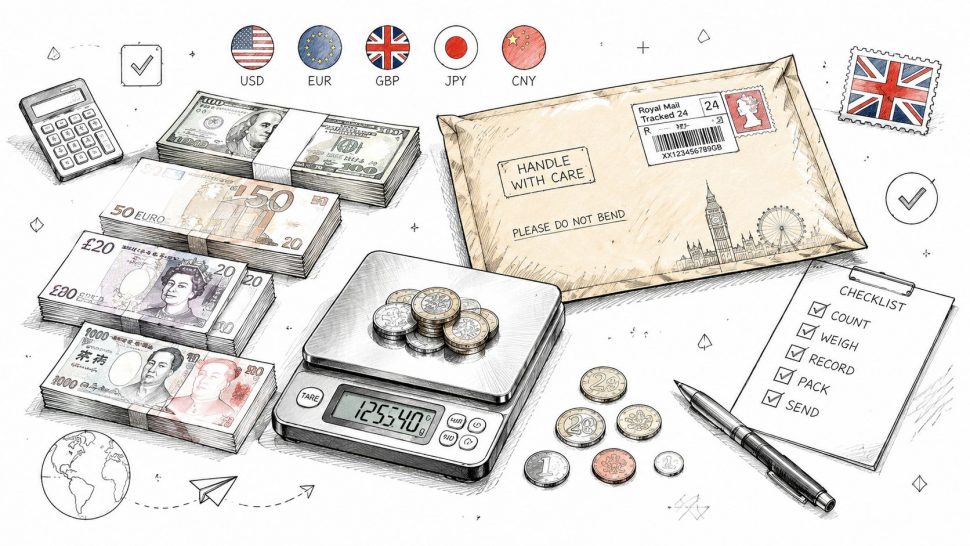
A lot of people searching for stacks of money UK aren't looking for luxury photos or bank vaults. They're looking at something far less glamorous: a jar of euros, a pouch of US coins, old holiday notes in a drawer, or foreign cash a bank has already refused.
That's a real problem, and it's more common than it looks. Leftover currency builds up after trips, charity collections, retail takings, and years of “I'll deal with that later”. The good news is that it usually isn't a dead end. If you understand which exchange routes work, and which ones don't, you can turn mixed coins and banknotes into usable pounds with far less hassle than is commonly expected.
Got Stacks of Old Coins? Here's What to Do
If you've got a bag, tin, or drawer full of foreign coins and notes, the quickest answer is simple.
Quick answer: If a bank or bureau de change won't take your foreign coins, mixed banknotes, or older withdrawn currency, the most practical route is a specialist online exchange service that accepts coins and notes by post, values mixed currency clearly, and lets you choose payment or charity donation.
That matters because the phrase stacks of money UK can sound abstract, but physical cash is still huge in real life. As of June 2025, the value of physical notes and coins in circulation in the UK was nearly £100 billion, according to UK notes and coin circulation data. So even in a card-heavy world, people still hold large amounts of physical money.
Your own pile of leftover travel money is a tiny part of that bigger picture. But the problem feels personal when it's your coins, your old notes, and your wasted value.
Why people get stuck
Commonly, three assumptions are made:
- The bank will sort it out: Often, it won't.
- Coins probably can't be exchanged at all: Some can, through specialist channels.
- Old or withdrawn notes are worthless: Sometimes they still have recoverable value.
That's why so many bags of currency sit untouched for years.
The practical next move
If your foreign cash is mixed, unsorted, or includes old issues, start by using a service built specifically for that situation rather than a high street option built for clean, current banknotes only. If you're dealing with older holiday change, this guide on what to do with old foreign coins is a useful place to begin.
A small pile on your kitchen table may not look like “stacks of money”. But if it can be converted, donated, or recovered, it's worth dealing with properly.
Why Traditional Exchange Options Fall Short
The frustrating part isn't finding foreign currency. It's finding someone willing to handle the awkward kind. Mixed coins, low-value notes, old issues, and withdrawn currency are exactly where traditional providers tend to step back.

A key reason is practical rather than mysterious. UK content around this topic rarely answers what to do with physical foreign coins and notes because banks and high-street bureaux often find them uneconomical to process, leaving specialist channels as the practical option for many people, as noted in this discussion of the gap in UK content around cash stacks and leftover currency.
Why banks say no
Banks are set up for mainstream banking. They usually prefer straightforward transactions, current notes, and larger, standardisable amounts. A bag of assorted holiday coins creates several problems:
- Counting takes time
- Coins are costly to handle
- Older foreign issues may be hard to repatriate
- Tiny values often aren't worth the processing effort
For the customer, it feels unreasonable. For the institution, it's a workflow issue.
Why bureaux de change aren't much better
Bureaux de change are designed mainly for buying and selling current travel money. That means they often focus on notes people are about to spend abroad, not loose change they've brought back.
They may accept some current foreign banknotes. But coins, obsolete issues, pre-euro currency, damaged notes, and mixed bags often fall outside what they want to handle.
Most exchange counters are built for speed at the till. They aren't built for sorting jars of holiday change or checking old withdrawn designs.
Comparing your UK currency exchange options
| Feature | High Street Bank | Bureau de Change | Specialist Service (Us) |
|---|---|---|---|
| Accepts foreign coins | Rarely | Sometimes, but often limited | Yes |
| Accepts mixed coins and notes | Usually not | Often limited | Yes |
| Accepts old or withdrawn currency | Usually not | Rarely | Yes |
| Suitable for small leftover amounts | Often no | Often poor fit | Yes |
| No sorting required | Usually not | Usually not | Yes |
| Can be used by charities and businesses | Sometimes, with limits | Sometimes | Yes |
| Postal option available | Not typically | Not typically | Yes |
The real issue is fit
This isn't about one route being “good” and another being “bad”. It's about using the right tool for the job.
A bank works well for normal banking. A bureau works well for standard travel exchange. Neither is ideal when you want to exchange foreign coins and notes that are mixed, old, or too awkward for the high street.
How to Exchange Foreign Coins and Notes The Easy Way
The easiest process is the one that doesn't force you to sort every coin by country at your dining table. Specialist currency recovery works best when it keeps the job simple from the start.

If you want a practical overview before sending anything, this guide on how to exchange foreign currency shows the basic journey clearly.
Estimate the value without overcomplicating it
Many people freeze at the first hurdle because they think they need to separate everything. In practice, specialist services often make this easier by using a structured system for mixed currency, including weight-based tools for unsorted coins.
That's useful if your collection includes:
- Holiday leftovers: euros, dollars, dirhams, kuna, francs
- Mixed family travel cash: several trips combined in one jar
- Old notes: previous designs or withdrawn issues
- Small coin balances: the kind no high street provider wants
If you know exactly what you've got, great. If you don't, that shouldn't stop you.
Practical rule: Don't spend an hour sorting low-value coins unless the service actually requires it. In many cases, mixed currency can be handled far more efficiently through a specialist process.
Pack it safely, not perfectly
Once you've decided to convert foreign coins and banknotes, secure packaging matters more than tidy presentation.
A few sensible habits help:
- Use a strong outer package: Padded envelopes or small boxes work better than thin paper packets.
- Keep heavy coins contained: Seal them in smaller bags inside the parcel so they don't tear through the packaging.
- Include notes flat if possible: This keeps the contents easier to process.
- Avoid loose contents: A parcel should survive handling without spilling or shifting too much.
There's a useful parallel from formal cash handling. Federal Reserve guidance for note processing says a full bundle is 1,000 notes, arranged as ten straps of 100, with notes aligned and secured for handling. The same guidance also distinguishes how to prepare partial groups, including 50 notes or fewer and 51 to 99 notes, to reduce recounts and damage, according to this cash-processing visual reference guide. Those sending holiday leftovers won't package money like a cash centre, but the principle is helpful: secure, organised packing reduces errors.
Send it, then choose what happens next
A specialist postal exchange usually follows a simple flow:
- Get your estimate or quote
- Pack the currency
- Post it securely
- It's checked and verified
- You receive payment or choose donation
The best systems also give you options. Some people want a bank transfer. Some prefer PayPal. Others would rather donate the value to charity instead of keeping a bag of unusable coins at home.
Where readers often get confused
A few points trip people up:
Current value isn't the same as face value
A foreign note might have a printed value but still be awkward to exchange in mainstream channels. Recovery value depends on whether the currency can still be processed.
Unsurtable doesn't mean worthless
Mixed coins and notes may still be exchangeable even when you can't list every item yourself.
Withdrawn doesn't always mean dead
Some old currencies still have recoverable worth through specialist routes, especially where standard retail exchange providers won't help.
The easiest route is the one designed for leftover foreign currency, not fresh travel cash.
Real-World Scenarios Who Uses This Service
People often think this kind of exchange is only for frequent travellers. It isn't. The users are much broader than that.

The family with a holiday money drawer
A family comes back from several trips with a familiar mix: euro coins, dollar notes, odd change from airport shops, and older notes they never got round to spending. None of it is neatly organised. Some of it may not even be current.
A specialist route suits them because it removes the admin. They don't need to separate every coin or guess which exchange counter might accept it. They just want the leftover cash out of the house and back into pounds.
The charity with tins of foreign change
Charities often receive travel coins in collection tins and donation points. That money has goodwill behind it, but not always an easy route to conversion.
For them, the issue isn't spending the currency. It's realising value from a mixed stream of donations. A service that accepts foreign coins and banknotes, including awkward or older issues, can turn otherwise stranded donations into funds that are usable.
For charities, foreign change is less a travel-money problem and more a cash recovery problem.
The small business that takes odd foreign cash
Tourist-facing businesses sometimes end up with foreign notes and coins accepted in error or taken informally from regular customers. Over time, that builds into a small pile behind the till or in the office safe.
The business owner doesn't want to visit multiple counters, argue over acceptability, or sort handfuls of coins after hours. They want a practical clean-up option that works by post and doesn't create more admin than the money is worth.
Why these users choose specialist exchange
The pattern is the same across households, charities, and businesses:
- They've got mixed physical currency
- Traditional routes don't fit
- They want a simple, low-friction process
- They may prefer payment or charity donation
That's why specialist exchange services are used by individuals, charities, and businesses alike. The need isn't niche. It just isn't handled well by standard providers.
Common Mistakes When You Exchange Leftover Currency
You empty a drawer, tip out a holiday jar, and end up staring at a small pile of foreign coins and notes from different trips. Some look current. Some look old. A few may even be from countries you barely remember visiting. The mistake starts when you treat that pile like ordinary travel money, because it is a different job entirely. It is a cash recovery job.

That shift in thinking matters. A travel counter is set up for tidy, current notes. A specialist service is built for the pile people have at home, mixed coins, notes, older issues, and small amounts that standard outlets often refuse.
Treating leftover currency like a normal holiday exchange
This is the most common wrong turn. People go to the same place they would use before a trip and expect the process to work in reverse.
Usually, it does not. Leftover currency is often unsorted, coin-heavy, and made up of amounts too small or too awkward for a retail exchange counter. If you have a jar of bits and pieces, you need a service designed for physical currency recovery, not routine holiday spending money.
Assuming coins are too small to bother with
A lot of households leave foreign coins untouched for years because each handful feels trivial. But a stack is built one coin at a time. The issue is not whether coins matter. The issue is whether you are using a provider willing to handle them.
Coins are the part banks and bureaux commonly reject first. That is exactly why specialist services exist.
Packing cash badly
This mistake is easy to avoid and worth getting right. Coins are heavy for their size, so weak packaging can split or tear in transit. Notes can also get bent, scattered, or mixed up if everything is shoved loosely into one envelope.
A safer approach is simple:
- Put coins in small bags inside the parcel
- Use strong outer packaging
- Keep notes flat where possible
- Stop the contents moving around
Good packaging protects the currency and makes the process easier when it arrives.
Writing off old or withdrawn money too early
People often assume older foreign notes or unfamiliar coins have no value because a local branch would not take them. That conclusion is often too quick.
Some withdrawn or obsolete currency still has recoverable value through a specialist route. The practical question is whether it can still be processed, not whether a standard counter refused it on the spot.
Sorting everything before you know the rules
This catches out organised people. They spend an evening making neat little piles by country, denomination, and issue, only to find the service would have accepted it mixed.
Sorting can help if a provider asks for it. If not, it is like alphabetising your recycling before checking what the collection needs. It feels productive, but it may just create extra work.
Forgetting there may be a donation option
Some people do not want the money back into their bank account. They want the foreign cash out of the house and put to good use.
That comes up a lot with family coin jars, school collections, charity tins, and business odds and ends from the till. In those cases, converting leftover currency into a donation can be the easiest answer.
Small stacks of money often look useless on the kitchen table. With the right process, they become recoverable value instead of clutter.
Your Foreign Currency Questions Answered
A lot of people reach this point with the same problem. There is a jar in the kitchen, a drawer full of travel change, or a pile of notes from old trips, and none of it seems usable in the UK.
The good news is that foreign cash is not limited to the options on the high street. If banks and bureaux have already said no, that usually means their service is limited, not that your money has no value.
Can I really exchange foreign coins in the UK
Yes. The practical route is usually a specialist currency exchange service rather than a bank branch or airport counter.
That matters because foreign coins are the part traditional exchange providers often avoid. A specialist service is set up for the awkward real-world mix people have at home, including small coins, mixed bags, and currency from more than one country.
Do banks accept foreign coins and notes
Banks may accept some foreign notes in some situations, but foreign coins are commonly refused. Older notes, unfamiliar denominations, and withdrawn currency also fall outside what many standard counters handle.
It helps to separate two questions. One is, "Will my local branch take this today?" The other is, "Can a specialist still process it?" Those are not the same thing.
Can I exchange foreign coins and notes together
Often, yes.
That is one of the biggest advantages of using a specialist service. Instead of splitting everything into neat piles and trying to work out what belongs where, you can usually send coins and notes together if the provider allows mixed submissions.
Is old or withdrawn foreign currency worthless
No. Some obsolete or withdrawn notes and coins still have recoverable value.
People often assume a refusal from a bank means the currency is dead. In practice, it can mean the bank does not deal with that type of item. Specialist exchange works like taking a specialist appliance to the right repair shop instead of asking a supermarket checkout for help. The setting matters.
Do I need to sort my currency first
Not always. Many people are relieved to hear that, because sorting a jar of assorted coins by country and denomination can take far longer than expected.
If a provider accepts unsorted currency, let their process do the heavy lifting. That is especially helpful for inherited collections, family travel leftovers, charity tins, and business takings where everything has ended up mixed together.
Is it safe to send cash in the post
It can be, if you follow the provider's packing instructions carefully.
Keep coins contained so they do not move around in transit. Wrap notes so they stay flat and protected. Choose a postal method that matches the value you are sending, and keep any paperwork or reference details the provider asks for. A little preparation here prevents the common problems.
How is the value worked out for mixed coins
A specialist service will usually assess the contents using its own checking and valuation process. That is why this route is more practical for loose, unsorted foreign change than a standard exchange counter.
If you have ever wondered how a mixed bag can be turned into a clear result, the answer is simple. The provider is set up to identify, separate, and assess what general retail exchange services are not designed to handle.
What if I'm not happy with the valuation
Check the terms before you send anything.
Look for clear information on rates, handling, and what happens if you decide not to go ahead. A trustworthy service explains the process in plain English, so you know what to expect before your coins and notes leave your hands.
Can I donate foreign coins to charity instead of cashing them in
Yes, and many people prefer that option.
It is a practical answer for holiday leftovers, school collections, fundraising drives, and the kind of mixed change that sits in a tin for years. Instead of leaving it unused, you can turn it into something useful without having to sort it yourself.
Who typically uses this kind of service
Holidaymakers use it after trips. Families use it when old travel money builds up over time. Charities use it for donated coins and notes. Businesses use it when foreign cash appears in tills, cash boxes, or collection pots.
In other words, this is not only for people with tidy bundles of banknotes. It is often for people with the opposite problem: loose stacks, mixed coins, old notes, and no clear route to convert them.
If you have leftover travel cash, obsolete notes, or a jar of foreign coins that no bank wants, a specialist postal exchange service can give you a clear next step. You send the currency, it is assessed, and you can usually choose between payment and donation. That turns a frustrating pile of foreign cash into something useful, without the sorting, guesswork, or dead ends people often hit first.