
UK Coin Weight Your Complete Guide to Currency Value
Posted by: Ian Stainton • 15 Feb 2026
Ever wondered how much that jar of spare change is actually worth? Knowing the specific weight of each coin is the secret to getting a quick estimate without counting every single one. For instance, a modern £2 coin weighs 12.0g, a £1 coin is 8.75g, and a 50p coin comes in at 8.0g. These details are exactly what we use to turn that jumble of unsorted coins into cash, minus the hassle.
Your Quick Guide to Exchanging Coins by Weight
If you've got a heavy jar of mixed coins, some leftover currency from holidays, or even a stash of old, obsolete money, the thought of sorting it can be a real headache. This is where knowing the official UK coin weights comes in handy. It’s the foundation of our fast, easy, and hassle-free exchange service, allowing for a surprisingly accurate valuation of bulk currency.
Our whole process is designed to be completely effortless on your part. There's absolutely no need to sort coins. Just gather up all your currency—be it UK coins, leftover foreign currency, or even old banknotes—and we’ll take it from there. This unique, weight-based approach is trusted by major brands, including charities, supermarkets, airports, and police forces, who all rely on us to exchange foreign coins and notes efficiently.
This chart gives you a quick visual on how the UK's three heaviest coins stack up against each other.
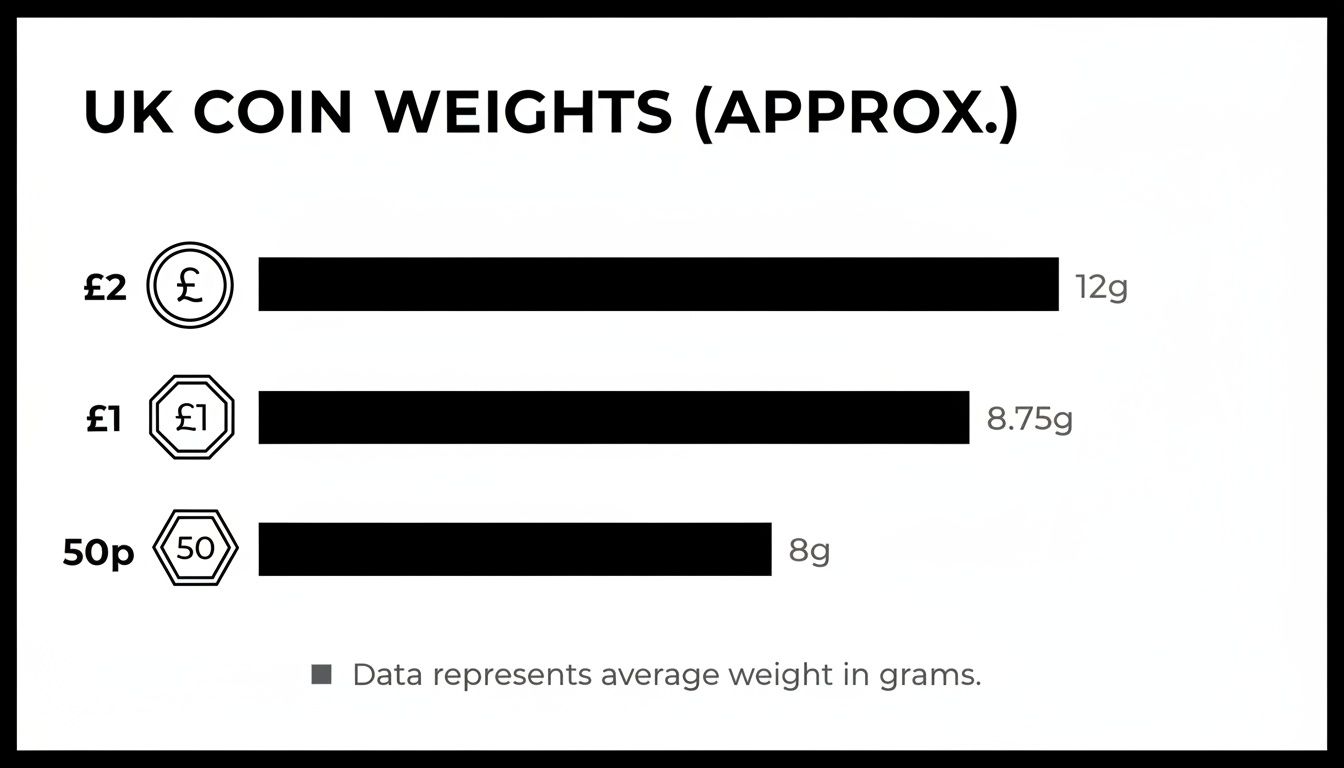
As you can see, the bimetallic £2 coin is a bit of a heavyweight compared to the others, and that difference is a key factor when we calculate value based on weight.
A Service Built on Trust and Simplicity
We’ve built our reputation on providing a fast, easy, and reliable way to exchange both foreign coins and notes. In fact, our service is 100% guaranteed, so you can feel completely confident with every transaction. Trusted by major brands like charities, supermarkets, airports, and police forces, our credibility is proven.
Whether you're looking to convert foreign cash from a trip abroad, donate foreign coins to charity, or just cash in a collection of old currency, we make the whole thing incredibly straightforward and hassle-free.
Ready to find out what your collection could be worth? Visit our homepage to get started.
A Detailed Breakdown of Current UK Coin Specifications
To get an accurate value for a big bag of mixed coins, you really need to know the official specifications for each one. It's not just about face value; weight, metal, and size all play a crucial part. Having a look at the unique details of each coin shows why sorting them can be such a headache.
This detailed breakdown covers every decimal coin you'll find in your pocket today, showing the kind of precision needed to value them correctly.
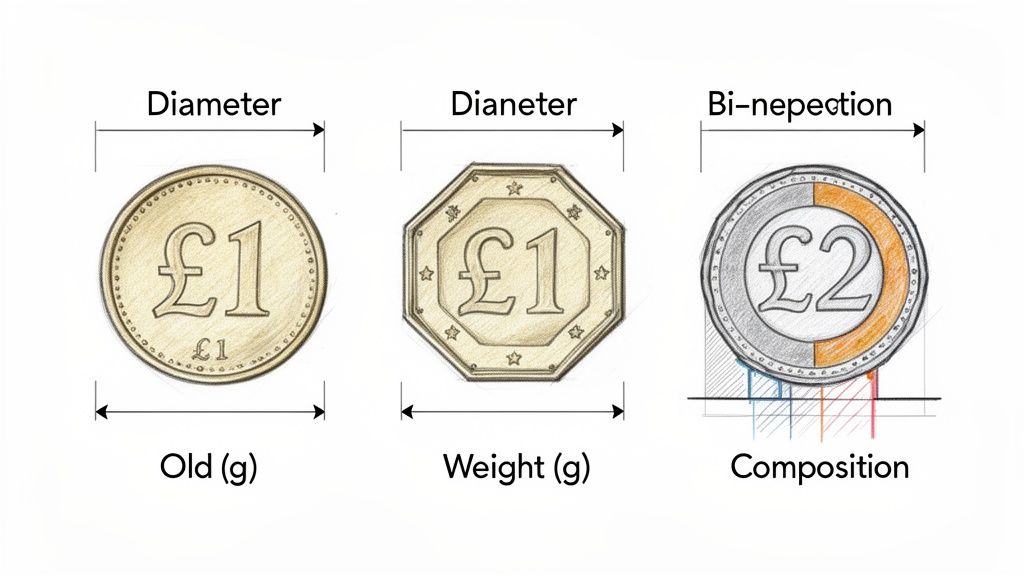
Of course, our service is designed to handle all this complexity for you. It’s a fast, simple, and hassle-free way to convert your leftover foreign currency and notes without lifting a finger to sort them. It's why we're the trusted choice for major UK brands, including charities, supermarkets, airports, and even police forces.
From Copper to Steel: The Lighter Coins
The UK’s smallest denomination coins, the one and two pence pieces, have seen some major changes over the years, which directly affects how much they weigh.
- 1p Coin: The humble one pence piece weighs in at 3.56g. It used to be made from bronze, but since 1992 it has been minted from cheaper copper-plated steel.
- 2p Coin: In the same vein, the two pence coin weighs 7.12g—exactly double the 1p. It also made the switch from bronze to copper-plated steel.
The five and ten pence coins also went on a diet. Back in 1990 and 1992, they were resized to be much smaller and lighter than their older counterparts.
- 5p Coin: The current small 5p coin is a featherweight at just 3.25g.
- 10p Coin: The modern 10p coin has a weight of 6.50g.
The Unique Heptagonal and Bi-Metallic Coins
The higher-value coins in circulation have more complex designs and materials, giving them very distinct specifications. The 20p and 50p pieces are instantly recognisable for their unusual seven-sided shape, known as an equilateral curve heptagon.
The specs for these coins are incredibly precise. For a deeper dive, our guide on the 20p coin weight explains it all.
The introduction of the 12-sided one pound coin in 2017 was a massive change for British currency, designed primarily to beat the counterfeiters.
- £1 Coin: This bi-metallic coin, with its nickel-brass outer ring and a nickel-plated alloy inner, weighs 8.75g.
- £2 Coin: The UK's heaviest circulating coin is the two pound piece. This bi-metallic giant weighs a solid 12.00g.
This sheer variety in weight, shape, and metal composition really highlights how difficult it is to manually sort and value a large amount of change. It’s exactly why our service is so valuable—we handle all the tricky identification and valuation for you, ensuring a fast, easy, and 100% guaranteed process every single time.
The Historical Importance of Weight in British Currency
Long before we had digital banking and paper notes, a coin's value was something you could feel in your hand: its weight. For centuries, the weight of the precious metal in a coin was its value. This simple, physical fact was the bedrock of trust in British currency, helping to build a reputation for reliability that lasted for generations.
This wasn't just a loose guideline; it was a strictly enforced standard. The very idea of 'sterling' silver, for instance, came from the consistent purity and weight of early English silver pennies. Because UK coin weight was so directly linked to its intrinsic value, the currency was trusted across borders, paving the way for international trade and commerce.
The Original Link Between Weight and Value
The story of the British penny is the perfect example of this deep connection. When King Offa of Mercia introduced the silver penny back in the 8th century, each one weighed about 1.5 grams (or 22.5 troy grains) of fine silver. This standard was revolutionary because it established the clear relationship between weight and value that would define British money for hundreds of years.
This weight-based system held firm until Edward III reduced the penny's weight to 18 grains, likely to fund his military campaigns in the Hundred Years' War. For collectors and for us here at We Buy All Currency, understanding these historical weights is absolutely crucial when evaluating pre-decimal coins, as the weight is a direct indicator of the silver content and its real value. You can explore more about the timeline of British currency to see how these changes happened over the years.
It’s this deep understanding of history that makes our service perfectly suited to handling old, obsolete, and pre-decimal coins. We know these aren't just bits of old metal; they are historical artefacts with a tangible, intrinsic worth.
Why This History Matters for Your Old Coins
Over time, monarchs and governments tweaked the composition and weight of coins, often because of economic pressures or the rising cost of metals. This left behind a complex timeline of different coin specifications, making it incredibly difficult for a non-expert to figure out what an old coin collection is actually worth. A coin that looks almost identical to another could have a completely different precious metal content and, therefore, a very different value.
This is exactly why a professional service is so important. We take all the guesswork and hassle out of the equation for you. Our expertise means we can accurately identify and value everything from ancient silver pennies to more recent obsolete currency.
Trying to sort through all this yourself would be a massive job. But with our fast, easy, and 100% guaranteed service, you don’t have to. We’re trusted by major brands, including charities, supermarkets, airports, and even police forces, to manage their unsorted currency because they know we have the expertise to get it right.
You can simply send us your collection of leftover foreign currency and old coins, and we'll handle the rest. Ready to turn that history into cash? Find out how easy it is on our homepage.
A Guide to Pre-Decimal Coin Weights
If you've ever stumbled upon a jar of old British coins, you'll know that figuring out what they are can be a real head-scratcher. Before Britain went decimal in 1971, the currency system was a world of shillings, florins, and farthings. Knowing the specific weight for these old UK coins is a key part of working out what they might be worth.
Trying to sort through them feels like a history lesson in itself. Each coin has its own unique specifications, and these often changed from one monarch's reign to the next. This can make valuing them yourself a slow and often frustrating task. That’s where our simple, hassle-free service comes in handy – instead of spending hours with scales and books, you can just send your mixed collection to us for a fast, professional, and 100% guaranteed valuation.
Common Pre-Decimal UK Coin Specifications
To give you an idea of the variety you might be dealing with, here's a quick reference for some of the most common pre-decimal coins. You'll notice right away how different their weights and metal makeups are compared to the coins in your pocket today.
Common Pre-Decimal UK Coin Specifications
| Denomination | Weight (grams) | Diameter (mm) | Composition | Years of Issue (Common) |
|---|---|---|---|---|
| Farthing | 2.83 g | 20.0 mm | Bronze | 1860–1956 |
| Halfpenny | 5.67 g | 25.5 mm | Bronze | 1860–1967 |
| Penny | 9.45 g | 30.8 mm | Bronze | 1860–1967 |
| Threepence | 1.41 g | 16.0 mm | Silver (pre-1947) | 1838–1944 |
| Sixpence | 2.83 g | 19.0 mm | Silver (pre-1947) | 1838–1967 |
| Shilling | 5.66 g | 23.5 mm | Silver (pre-1947) | 1838–1966 |
| Florin | 11.31 g | 28.5 mm | Silver (pre-1947) | 1849–1967 |
As you can see, many of these older coins were made with silver, which gives them a value based on the precious metal content alone, far beyond their original face value. If you'd like to dig deeper, you can learn more about pre-decimal coin values and how we assess them.
The Easy Solution for Your Old Coins
This sheer variety is exactly why trying to sort and value a mixed bag of coins is so tough. And it’s not just old British money; the same goes if you need to exchange foreign coins from all over the world or deal with piles of leftover foreign currency.
Our service is designed to take that headache away completely. We're trusted by major organisations, including national charities, supermarkets, airports, and even police forces, to handle their unsorted currency. They count on our expertise for a fast, fair, and incredibly simple valuation.
There's no need to sort your coins. Just gather up all your old coins, leftover holiday money, and even old banknotes. We do all the tricky identification and sorting for you. Our process is 100% guaranteed, which means you get a clear, accurate payment without any of the hard work. It's the simplest way to convert foreign coins and banknotes into cash you can actually use.
How Historic Reforms Standardised UK Coin Weights
For centuries, the link between a coin's weight and its value was a bit of a messy affair. It wasn't until a few key moments in history that the reliable, standardised UK coin weight system we know today took shape, building the trust and efficiency our currency relies on. Understanding these changes is crucial, especially when you’re dealing with older, obsolete coins.
Getting to grips with these historical nuances is vital for accurately valuing a mixed bag of currency. It’s why major UK names—from charities and supermarkets to airports and even police forces—trust us to sort through their collections. We know the ins and outs of historical coinage, making our fast, easy, and hassle-free service one they can rely on.
The Great Recoinage of 1817
One of the biggest turning points in British money history was the Great Recoinage of 1817. This was a massive overhaul that, for the first time, introduced a logical and systematic weight relationship between different silver coins. The change had a huge impact on trade across the entire British Empire.
Suddenly, all silver coins had precise measurements, creating a clear and simple hierarchy. A sixpence weighed exactly twice as much as a threepence, a shilling weighed double a sixpence, and a florin was double a shilling. This mathematical precision made commerce far more dependable for everyone. If you’re interested in the details, you can watch an explanation of the 1817 recoinage to see just how significant it was.
This standard stuck around for over 150 years, right up until decimalisation. For a service like ours, coins from this era are really important. Their consistent weights and high silver content make them valuable both as historical pieces and as bullion.
Why This Expertise Matters for You
This history isn't just a collection of interesting facts; it’s the very foundation of what we do. To properly assess a collection that includes old or pre-decimal currency, you need specialist knowledge. A coin's value can shift dramatically depending on the year it was minted and the specific metals used during that period.
Our ability to identify and value these historical coins is a core part of our 100% guarantee. We turn complex numismatic history into a fast, easy, and hassle-free process for you.
You don’t need to be a historian to cash in on old money. Whether you need to exchange foreign coins, clear out leftover foreign currency, or convert foreign coins and banknotes, we have the expertise to handle it all. We’ve designed our service to be incredibly simple: you just send us your unsorted collection, and we take care of the rest.
Ready to turn your old and foreign currency into cash with a service you can trust? Get a fast, free estimate on our homepage and see how simple it is.
How to Cash In Your Unsorted Coins by Weight
Got a heavy jar of old coins sitting around? Turning that jumble of leftover currency into actual cash doesn't have to be a headache. Our weight-based exchange service is designed to be fast, easy, and completely straightforward, making a tedious job feel rewarding.
Here’s your practical guide to getting it done.
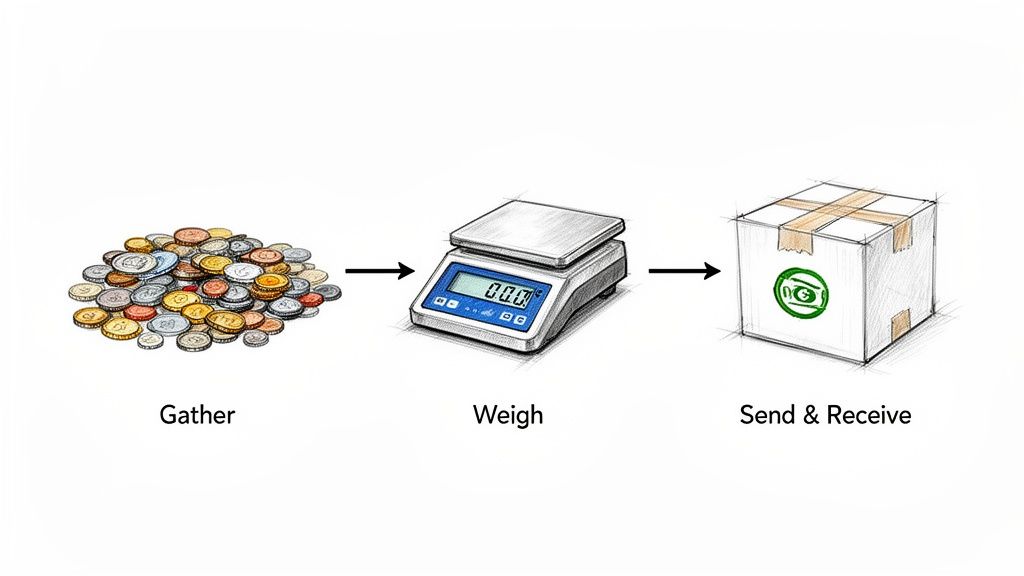
The best part? There is no need to sort coins. Honestly, just tip it all in a box. Our entire system is built on convenience, which is why we’re trusted by major UK charities, supermarkets, airports, and even police forces to handle their unsorted currency.
Step 1: Gather Everything Together
Your first job is the easiest one. Just collect all the currency you want to exchange. This can be anything from current UK coins and old, withdrawn pounds to leftover foreign currency from past holidays.
Don't worry about separating denominations, countries, or even coins from banknotes—just put it all into one container. This no-sort approach is at the heart of our hassle-free promise. We do all the tricky identification and valuation work, so you can exchange foreign coins and notes without any of the usual effort.
Step 2: Get a Quick and Easy Estimate
Once you have your collection, you’ll need to know its total weight. For an accurate reading, a decent set of digital scales is a must. If you're looking for specialist equipment, something like these Digi Scales will give you the accuracy needed for a proper valuation.
With the total weight in hand, you can head over to our simple online wizard for an instant estimate. This handy tool gives you a clear idea of what your collection might be worth before you even send it. If you're curious about how we handle the process, you can find more details in our guide on how we weigh coins in the UK.
We back our service with a 100% guarantee. We provide a transparent, fair valuation, and if you’re not satisfied for any reason, we’ll return your currency completely free of charge.
Step 3: Pack and Send for Fast Payment
All that's left is to securely package your currency and send it our way. Once your collection arrives, our expert team gets straight to work sorting, identifying, and verifying every single item. We then process your payment quickly, turning that forgotten stash into useful cash.
It’s the simplest way we know to convert foreign coins and banknotes. Our fast, easy, and guaranteed service takes all the work off your plate.
Got Questions? We've Got Answers
When you're dealing with a big bag of mixed-up coins, it’s only natural that a few questions pop up. We get it. To make things as clear as possible, we’ve put together answers to some of the queries we hear most often about valuing coins by weight and how our service works.
Our whole goal is to make turning your old and foreign currency into cash completely straightforward. That’s why we’ve designed our service to be fast, easy, and totally hassle-free, all backed by a 100% guarantee you can rely on.
Why Does the Weight of Coins Matter?
It might seem odd, but weighing coins is actually the quickest and smartest way to value a large, jumbled collection of currency. Instead of you having to sort through hundreds or thousands of coins one by one, we use their official weights to calculate a surprisingly accurate estimate for the whole lot.
This clever, weight-based method is the real secret behind our fast and fair service. It saves you a massive amount of time and effort, especially when you’ve got a heavy bag of leftover holiday money or old UK coins.
Can I Send You Damaged or Really Old UK Coins?
Yes, absolutely! In fact, that's what we specialise in. We're happy to take the kind of currency that high street banks and other services usually refuse, including damaged, obsolete, and even pre-decimal UK coins you might have thought were worthless.
Our team has the know-how to identify and value all of it, making sure you get a fair price for currency that would otherwise be gathering dust. It's a core part of our promise to our customers—we handle the tricky stuff so you don't have to.
What if I Have Foreign Coins Mixed in With UK Ones?
No problem at all. Our service is built for convenience, which means you don’t need to do any sorting yourself. Just pop your entire collection of UK and foreign currency—coins and banknotes included—into a package and send it over.
Once it arrives with us, our expert team gets to work, meticulously sorting and identifying every single item. This ensures you get paid the correct value for everything you sent. It’s genuinely the simplest way to exchange foreign coins and notes and finally clear out that drawer of leftover travel money.
Our professional and credible service is trusted by a whole host of major UK organisations. We work with well-known charities, supermarkets, airports, and even police forces, who all rely on us to handle their unsorted currency collections efficiently and securely.
How Can I Donate My Foreign Coins to Charity?
We make it incredibly easy to donate foreign coins to charity. We partner directly with many major UK charities, helping them turn their supporters' foreign coin donations into vital funds for their work.
You can use our service to send in your currency and simply choose to have the proceeds go to one of our partnered charities. It’s a fantastic way to make sure your leftover coins support a cause you care about, all handled by a service that charities themselves trust. It’s never been easier to turn small change into a big difference.
Ready to turn your old and foreign currency into cash? At We Buy All Currency, our fast, easy, and hassle-free service is 100% guaranteed. There's no need to sort your coins—just send them to us and get paid. Visit our homepage to get started today!