
What Currency in Slovakia: Your 2026 Travel Guide
Posted by: Ian Stainton • 22 May 2026
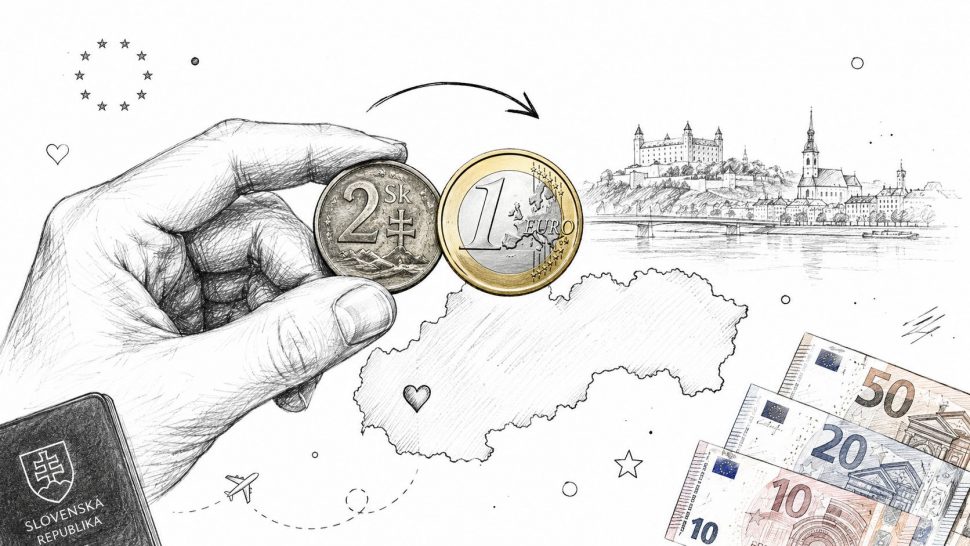
Slovakia's currency is the euro (€). It replaced the Slovak koruna (SKK) in 2009, so travellers use standard euro notes and coins for everyday spending.
That answers the simple part of what currency in Slovakia means today. The part that usually catches people out comes later, when they get home with a pocket of euro coins, a few notes they forgot to spend, or older Slovak money found in a drawer that no bank wants to handle.
That's where the practical difference matters. Current Slovak cash is just euro cash. Old Slovak koruna is a withdrawn currency, which means it isn't something you can spend in shops or usually swap at a normal UK travel money counter. If your goal is to exchange foreign coins, exchange foreign coins and notes, or sort out leftover foreign currency without wasting value, you need to treat those two situations differently.
Your Quick Guide to Currency in Slovakia
If you're heading to Bratislava, the Tatras, or anywhere else in Slovakia, you won't need a special local currency beyond the euro. That makes the spending side fairly easy. You can pay with the same euro banknotes and coins used across the euro area, and leftover Slovak euro cash is standard euros.
The more useful question for many UK readers is this: what should you do with money from Slovakia when you come home? That depends on what you have.
What most travellers have
Travelers often return with one of these:
- Leftover euros from a recent trip
- Mixed euro coins and notes from several eurozone holidays
- Old Slovak koruna notes or coins from trips taken before the euro switch
- Unsorted foreign change collected in jars, drawers, luggage pockets, or charity tins
If your money is in euros, it's current currency. If it's marked SKK or says koruna, it belongs to Slovakia's pre-euro era and needs specialist handling.
Practical rule: Check the currency code or the wording on the note before you assume it's spendable.
The short version
For day-to-day travel in Slovakia, think euro.
For old Slovak cash, think obsolete currency.
For leftover holiday money in the UK, especially coins, mixed notes, or older withdrawn issues, standard banks and bureaux often aren't the easiest route. That's why people look for ways to convert foreign coins and banknotes, arrange a currency buy back, or even donate foreign coins to charity instead of leaving them unused.
Slovakia's Currency Journey from the Koruna to the Euro
Before the euro arrived, Slovakia had its own national currency, the Slovak koruna. Slovakia introduced the koruna on 8 February 1993 after becoming an independent country, replacing the Czechoslovak koruna at par, and it remained in circulation until the euro changeover began on 1 January 2009, according to the National Bank of Slovakia's history of Slovak currency.

The key date that matters
Slovakia adopted the euro on 1 January 2009, replacing the Slovak koruna at the fixed rate of €1 = SKK 30.1260, and after the brief dual-circulation period ended on 16 January 2009, only euros remained legal tender for cash payments, as confirmed by the European Central Bank's Slovakia euro changeover page.
That single change explains why old Slovak notes and coins still turn up in UK homes. People travelled there, kept a few souvenirs, forgot about spare change, or stored notes away assuming they could always exchange them later.
Why old Slovak cash is different now
Old koruna isn't the same as current leftover euros. It's no longer active retail currency, so ordinary travel money desks treat it very differently. In practice, that usually means:
- You can't spend it in Slovakia
- Most UK banks won't treat it like normal foreign cash
- Coins are especially awkward
- You need to identify it correctly before valuing it
If you've found pre-euro Slovak money, the sensible first step is to separate it from current euro cash and check whether it belongs in an old Slovak koruna exchange process.
Old Slovak koruna can still have exchange value in the right channel, but it isn't everyday money anymore.
A Practical Guide to Using Euros in Slovakia
Once you know that Slovakia uses the euro, the next issue is spending it sensibly. The euro system includes seven banknotes (€5, €10, €20, €50, €100, €200, €500) and eight coins (1, 2, 5, 10, 20, 50 cent, €1, €2), all of which are legal tender across the euro area, including Slovakia, as set out on the ECB's euro denominations page.
What you'll actually use
In real travel situations, you'll usually handle:
- Small coins for cafés, public transport, and quick purchases
- €5, €10 and €20 notes for ordinary day-to-day spending
- €50 notes for larger bills, hotels, or cash withdrawals
The larger euro denominations exist, but many travellers won't need them.
Cash or card in Slovakia
For most UK visitors, the better question isn't just what currency in Slovakia is. It's how to avoid paying too much while using it.
Cards are convenient, but they're not automatically the cheapest option. A UK card can still trigger foreign transaction fees, and some ATMs may add their own operator charge. You may also see Dynamic Currency Conversion, where a card terminal asks whether you want to pay in pounds instead of euros.
Always choose to pay in euros, not sterling, when you're in Slovakia.
That local-currency choice usually gives your own card provider the exchange job instead of the retailer's terminal. If you accept the sterling option, you may lock in a weaker rate and make the purchase more expensive than it needed to be.
A simple spending routine that works
Use this approach if you want fewer surprises:
- Carry a small amount of euro cash for minor purchases.
- Use a card that's suitable for overseas spending where possible.
- Decline sterling conversion prompts and pay in euros.
- Check ATM screens carefully before accepting any extra fee or conversion option.
- Keep leftover notes together before you fly home so they don't disappear into bags and coat pockets.
That final point matters more than people think. Most “leftover holiday money” problems start with loose coins and notes getting split up and forgotten.
Comparing Your UK Currency Exchange Options
You usually get reasonable choice before you travel. The bottleneck appears when you come home with a mix of euro notes, euro coins, and perhaps old Slovak koruna found in a drawer or inherited from a relative. That is where the differences between exchange options become obvious.

What each route is good at
High street banks work best for current banknotes in mainstream currencies. If you walk in with clean euro notes, you may get a straightforward result. If you walk in with coins, mixed foreign cash, or obsolete Slovak koruna, the answer is often no.
Post Offices and travel money bureaux sit in a similar category. They can help with spendable currency, but they are not set up for awkward leftovers. Processing coins is labour-heavy, and withdrawn notes such as old SKK are outside the normal retail flow.
Specialist online buyers exist for exactly that gap. They are built for leftover holiday money, mixed batches, and older currencies that standard counters will not handle. If you need help with exchanging old foreign currency including coins and obsolete notes, that route usually makes more sense than trying three different branches and getting the same refusal.
Currency exchange options compared
| Currency Type | High Street Bank | Post Office / Bureau | Specialist Online Service |
|---|---|---|---|
| Current euro banknotes | Often possible | Usually possible | Possible |
| Euro coins | Often not accepted | Often limited or not accepted | Usually suitable |
| Old Slovak koruna banknotes | Usually not accepted | Usually not accepted | Designed for specialist handling |
| Old Slovak koruna coins | Rarely accepted | Rarely accepted | Designed for specialist handling |
| Mixed unsorted foreign currency | Poor fit | Poor fit | Strong fit |
| Leftover holiday change from multiple trips | Inconvenient | Inconvenient | Practical option |
Why banks and bureaux fall short
Their systems are built around current travel money that can be checked quickly and resold easily. Coins are bulky and costly to count. Old Slovak koruna cannot go back into ordinary circulation, so many mainstream providers will not touch them.
For UK travellers, that trade-off matters. A bank may suit your leftover euro notes, but it is rarely the answer for SKK coins, older koruna notes, or a mixed bundle from several trips. In practice, specialist services are usually the logical option for arranging to exchange both coins and notes, especially where some of the money is no longer current.
If your money is awkward, treat it as a specialist job from the start. It saves time, and it avoids the common mistake of assuming every exchange counter handles every type of foreign cash.
How to Exchange Old Slovak Koruna and Leftover Euros
When you've got current euros in one envelope and old Slovak koruna in another, the best process is the one that keeps both simple. The main thing is not to overcomplicate it. You don't need to become a currency historian. You just need to identify what you have and send it through the right route.

Step 1
Check whether your money is euro or Slovak koruna.
If it's euro cash, it's current money. If it's old Slovak currency, valuation starts from the official fixed benchmark of 30.1260 korunas to one euro, and that fixed rate is the correct starting point for old SKK valuation before any service fees or buy-back rate are applied, as explained by the National Bank of Slovakia's euro adoption guidance.
Step 2
Decide whether you're handling:
- Current leftover euros only
- Old Slovak koruna only
- A mixed batch of coins and notes from different trips
That matters because a standard retail currency counter may only be interested in the first of those. The other two usually need a specialist process.
Step 3
Get a quote from a service that accepts current and withdrawn money, including coins. For people in the UK who want to exchange old foreign currency, We Buy All Currency is one example of a postal service that handles coins, banknotes, and obsolete issues, lets customers send mixed currency, and pays by bank transfer or PayPal after verification.
Step 4
Pack the currency securely and send it as instructed. If the service uses a weight-based or unsorted system, you don't need to spend your evening stacking coins into little piles by denomination.
That no-sorting approach matters for households, charities, and businesses that collect mixed foreign change over time. It also helps with old jars of euro coins that would be too tedious to count one by one.
Real-world situations where this helps
- The recent traveller has a few euro notes and a heavy pocket of coins from Slovakia, Austria, and Spain.
- The family clear-out turns up old Slovak notes tucked inside a travel wallet from years ago.
- The charity collection tin includes current euros, old European legacy currencies, and random coins from multiple destinations.
- The business till receives foreign cash in error and wants a clean way to convert it rather than store it.
In all four cases, the winning move is the same. Separate current cash from obsolete cash, use the right quote process, and don't assume coins are worthless just because a bank doesn't want them.
Common Mistakes to Avoid When Handling Foreign Currency
People lose value on foreign currency in predictable ways. Not because the money has no value, but because they treat awkward currency as useless currency.

Mistakes that cost people money
Throwing coins into a drawer forever
Coins are the first thing people give up on. That's understandable, but it turns recoverable value into clutter.Assuming old Slovak money is automatically worthless
Withdrawn currency is harder to handle, not necessarily valueless. Specialist routes exist for obsolete notes and coins.Mixing current euros with old koruna
If you don't separate them, you can't judge the right exchange route.Paying in pounds while abroad
Many UK travellers face foreign card fees, some Slovak ATMs may add an operator fee, and merchants may offer Dynamic Currency Conversion at unfavourable rates, as noted in MoneySavingExpert's travel money guidance.
Better habits that work
Treat foreign cash the way you'd treat any other spare asset. Bag it. Label it. Deal with it while you still remember where it came from.
A mixed pile of holiday money looks messy, but it's still money. The right service turns it back into something usable.
If you'd rather not cash it out personally, another sensible route is to donate foreign coins to charity through a service that can process mixed overseas money.
Frequently Asked Questions About Foreign Currency Exchange
A common UK travel-money problem starts after the trip, not before. You come home with a few euro coins, a note or two, and sometimes an older stash of Slovak koruna from years back. The euro is easy enough to recognise. The harder question is what any outlet will accept.
Can I use pounds in Slovakia?
No. Slovakia uses the euro, and shops, hotels, restaurants, and transport providers expect payment in euros.
Can I exchange Slovak koruna at a normal UK bank?
Usually not. The Slovak koruna is obsolete, so high-street banks and standard travel-money counters generally do not handle it. That is where travellers get stuck. They assume "foreign currency" and "withdrawn currency" are treated the same way, but they are not.
Are Slovak koruna coins worth anything?
Sometimes, yes. They are no longer spendable in Slovakia, but they may still hold exchange value through a specialist buyer, and some pieces may interest collectors. Coins are the hardest part to place through ordinary exchange channels, which is why they often end up forgotten in jars and drawers.
Can I exchange foreign coins in the UK?
Yes, but you usually need a specialist service. Traditional bureaux focus on current banknotes they can resell easily. Mixed coins, small denominations, and obsolete currency are a different job.
What about leftover euros from Slovakia?
Leftover euros are still current money. You can save them for another eurozone trip, spend them elsewhere in the euro area, or sell them back if you would rather turn them into pounds now.
Do I need to sort my coins before sending them?
Not always. Some services accept mixed foreign coins and notes, which saves time if you have cash from several holidays in one bag. Even so, separating euros from old koruna helps you choose the right route and understand what you are sending.
Can businesses and charities use this kind of service too?
Yes. Charities, retailers, airports, schools, travel companies, and other organisations often build up foreign cash through collections, tills, or customer hand-ins. A specialist service makes more sense than asking staff to sort and identify every coin manually.
How long does payment take?
That depends on the provider's process. Postal exchange services usually pay after the currency has been received, checked, and valued. Before sending anything, check how payment works, how long inspection takes, and what happens if an item cannot be accepted.