
What determines currency exchange rates: Clear explanations for FX
Posted by: Ian Stainton • 9 Dec 2025
At its heart, what determines a currency's exchange rate is simple supply and demand. Think of it like any other item you might buy, from concert tickets to fresh strawberries. When everyone wants something and there isn't much to go around, the price shoots up. If nobody wants it and there's a huge supply, the price plummets.
The Core Forces of Supply and Demand
Every time you hear that a currency’s value has shifted, it’s because this delicate balance of supply and demand has been nudged one way or the other. This core principle applies to everything from the mighty US Dollar to the Euro, and it even trickles down to the value of those old foreign coins rattling in your drawer at home.
Getting your head around this fundamental concept is the first real step to making sense of the seemingly complicated world of foreign exchange.
This global marketplace is bustling with different players, each making moves that influence the supply and demand equation. You’ve got the big hitters like central banks managing national economies, massive corporations trading goods across borders, and investors hunting for the next big opportunity.
But it’s not just them. The market also includes tourists buying souvenirs, online shoppers grabbing a bargain from another country, and even people like you looking to exchange leftover foreign currency. Every single transaction plays a part.
Who Are The Main Players?
The actions of all these participants create constant movement in the currency market. For example:
- Investors and speculators who think a currency is about to rise will buy it up, increasing demand.
- Importers need to sell their home currency to buy foreign currency for the goods they're bringing in, which increases the supply of their local money.
- Tourists heading abroad create demand for the currency of the country they’re visiting.
This simple diagram below brings it all together, showing how rates are influenced by demand, supply, and the various market players involved.
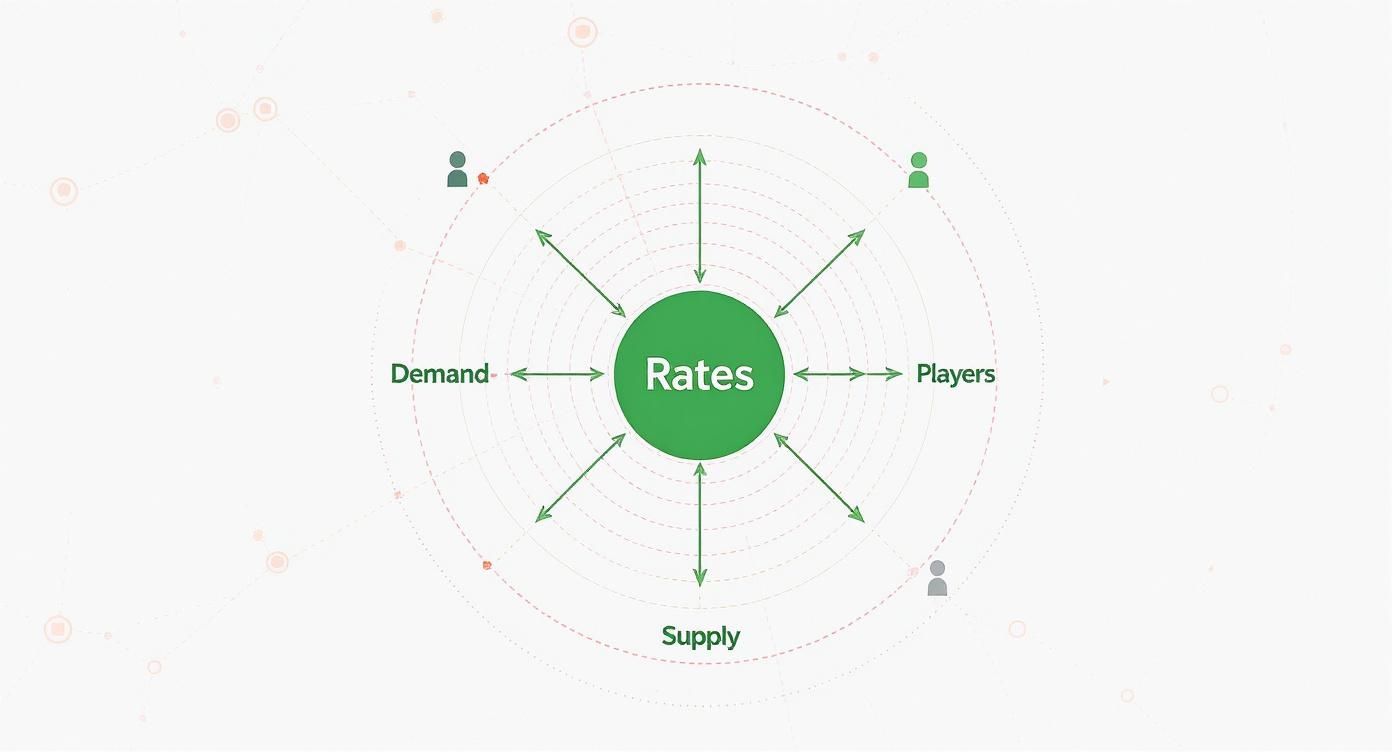
As you can see, there’s a direct relationship between these three elements. It really drives home the point that every transaction, no matter how big or small, contributes to a currency's final value. If you're curious about how specific events can influence currency pairs, you can find great explanations of things like what drives the USD buying rate today in South Africa.
One classic economic theory is that a tariff will cause the domestic currency to appreciate. By making imports more expensive, tariffs reduce the demand for foreign currency, which can, over time, strengthen the home currency's value.
Ultimately, all these factors mix together to create the exchange rate you see advertised. If you want to check how these rates affect the value of your own leftover cash, it's worth learning how to compare currency exchange rates in the UK to make sure you're getting the best deal. Whether you want to exchange foreign coins, convert old banknotes, or even donate foreign coins to charity, knowing the basics really helps.
For a fast, easy, and completely hassle-free way to exchange your currency, our 100% guaranteed service is the perfect solution. We’re trusted by major UK brands including charities, supermarkets, airports, and even police forces, making it simple to convert your foreign coins and notes without any need to sort them first.
How Interest Rates and Inflation Affect Your Money
Beyond the day-to-day push and pull of supply and demand, there are two huge economic forces quietly shaping the value of your money: interest rates and inflation. Getting your head around these is the key to understanding why the leftover foreign currency in your drawer can be worth one thing today and something completely different tomorrow.
Interest Rates: A Magnet for Global Money
Think of a country's interest rate as a global savings account. When a central bank, like our own Bank of England, raises its interest rates, it's essentially offering a better return on any money held in that country's currency. This simple move grabs the attention of international investors who are always hunting for the best possible return on their cash.
Before they can invest, they need to swap their home currency for the one with the better rate. This rush to buy drives up demand and, you guessed it, its value goes up.
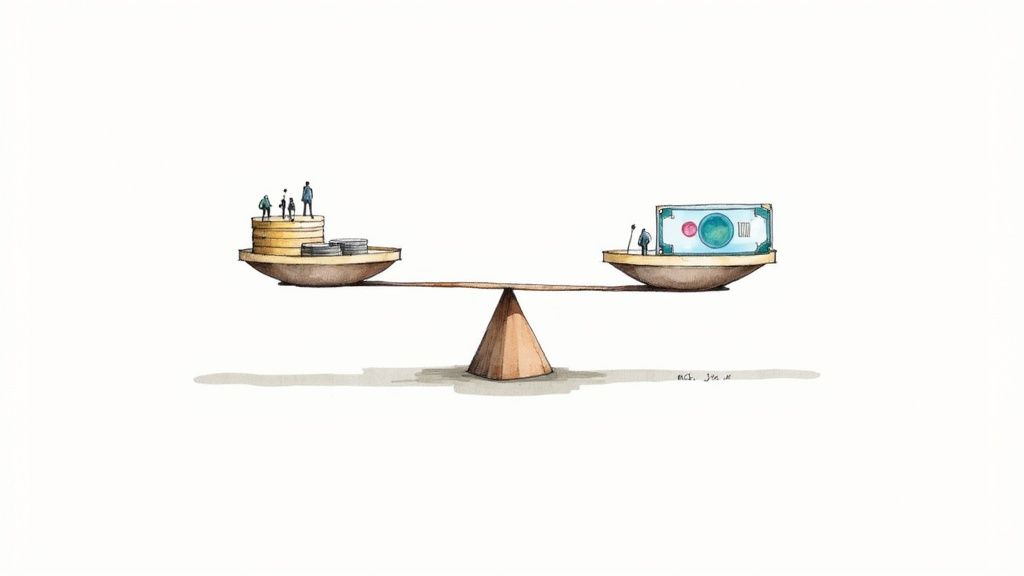
This isn't just theory; it’s a massive factor for the British pound. When the Bank of England’s Monetary Policy Committee decides to set higher interest rates than other major economies, foreign investment floods in, and demand for sterling shoots up.
We saw this happen in the early 2020s. The Bank of England hiked rates from historic lows near 0.1% up towards 4-5%. This made the pound far more attractive to investors and put serious upward pressure on its value. You can discover more insights on how these financial mechanics work over on HSBC's website.
Inflation: The Slow Puncture in Your Currency's Value
If interest rates are a magnet, think of inflation as a slow leak in a tyre. It gradually whittles away the purchasing power of a currency. Put simply, your money buys less today than it did yesterday.
A country with stubbornly high inflation will find its currency becomes less and less appealing on the world stage. Nobody wants to hold onto something that’s constantly losing value.
Because of this, investors start selling that currency off, flooding the market with it and pushing its exchange rate down.
It really boils down to this:
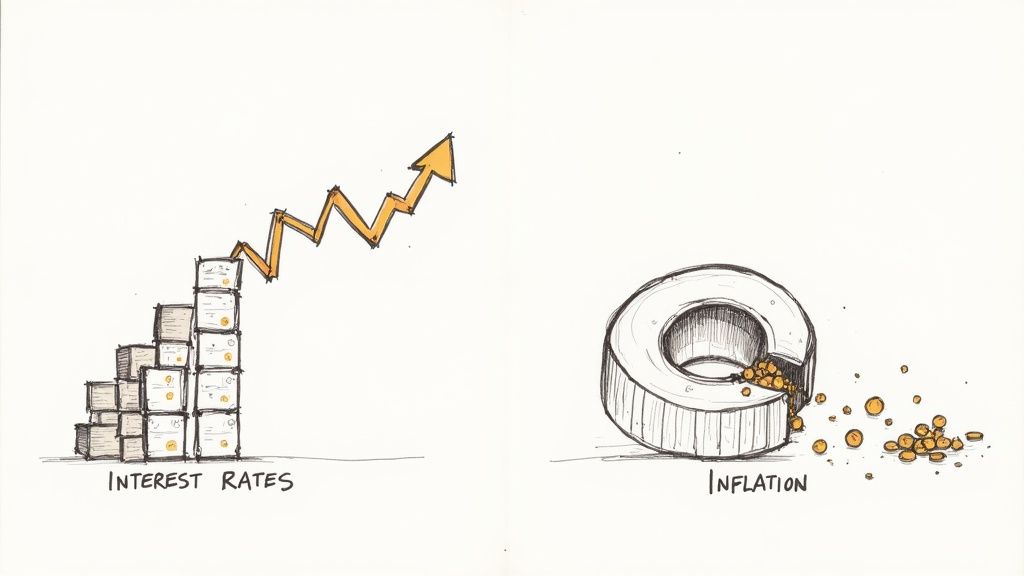
- Higher Interest Rates usually lead to a stronger currency.
- Higher Inflation usually leads to a weaker currency.
Of course, these two are often locked in a delicate dance. Central banks frequently raise interest rates specifically to fight rising inflation, creating a complex balancing act that keeps currency markets on their toes.
For anyone with a jar of leftover holiday cash, these big-picture shifts are exactly why its value is never fixed. The euros or dollars you brought back last year could be worth more—or less—today, all thanks to these powerful economic tides.
But you don’t need to be a market analyst to get value back from them.
Our service makes it incredibly fast and easy to exchange foreign coins and notes, no matter what’s happening in the global economy. We offer a 100% guaranteed, hassle-free process that’s trusted by everyone from major UK supermarkets to police forces.
You don't even need to sort your coins. Just send them to us, and we'll handle everything, turning that forgotten foreign currency back into real money.
Why a Country's Economic Health Matters
Think of a country's currency like a company's share price. If the business is booming, people want to buy its shares. In the same way, a country's currency often mirrors the strength of its economy. International investors are always watching, looking at a nation's economic data like a 'national report card' to decide where to invest their money. A strong, growing economy is a powerful magnet for global capital.
Key figures like Gross Domestic Product (GDP) growth and employment rates are the big headlines on this report card. When a country's GDP is climbing and unemployment is low, it's a clear signal of a healthy, productive economy. This gives investors confidence, encouraging them to buy that country's currency to invest in its businesses and assets. Naturally, this increased demand drives up the exchange rate.
This direct link between economic health and currency value is one of the main reasons what determines currency exchange rates is always changing. It's why the value of that holiday money you have tucked away has probably changed since your visit – the country's economic fortunes have shifted.
The Critical Role of Trade Balance
One of the clearest indicators of a country's economic performance is its balance of trade. This simply compares how much a country sells to the world (exports) versus how much it buys (imports).
Picture a local shop that sells far more than it needs to buy for stock. Its profits grow, and it becomes financially stronger. A country is no different:
- Trade Surplus: If a country exports more than it imports, foreign buyers must purchase its currency to pay for those goods. This high demand makes the currency stronger.
- Trade Deficit: On the other hand, if a country buys more than it sells, it has to sell its own currency to buy foreign currency for those imports. This floods the market, weakening its value.
A consistent trade surplus is usually seen as a sign of a competitive, robust economy, making its currency an attractive one for investors to hold. A persistent deficit, however, can make investors nervous about the country's long-term stability.
Keeping up with these economic shifts can be tricky, which is why managing financial exposure is so crucial for businesses. To see how companies protect themselves from these constant changes, you can explore the fundamentals of foreign exchange risk management.
For those of us with leftover foreign cash, these fluctuations can be baffling. But you don't need to be an economist to get some value back from your old coins and notes. Our service is designed to be fast, easy, and completely hassle-free, turning your obsolete or leftover currency into cash. Trusted by everyone from major UK supermarkets to police forces, we offer a 100% guaranteed way to convert foreign coins and banknotes. Just send it all to us – no sorting required – and we’ll take care of the rest.
The Influence of Political Stability and Government Debt
It's not just about cold, hard economic data. The political mood of a country plays a huge part in how its currency is valued on the world stage. Think of it this way: investors are a cautious bunch. They prize stability above almost anything else, looking to put their money where the rules are clear, the government is predictable, and the future feels secure. A stable political environment is like a safe harbour in a storm, attracting foreign cash and, in turn, pushing up demand for the local currency.
On the flip side, political uncertainty is a massive red flag. Things like messy elections, surprise policy U-turns, or diplomatic spats can make investors incredibly nervous. When they fear their investments could suddenly lose value, they often vote with their feet, pulling their money out by selling off the local currency. That sudden sell-off can cause its value to plummet.
Real-World Examples of Political Impact
You don't have to look far for a perfect example. Right here in the UK, political events have been a key driver of the British pound's exchange rate for years, especially Brexit. After the government announced the EU membership referendum back in 2015, the pound began a long slide against the US dollar.
It tumbled from around $1.50 in early 2016 to a low of $1.20 by October of that year, just after the vote. That’s a staggering drop of nearly 20%. This was almost entirely down to market jitters about the UK's future trade deals and economic prospects. You can read a deeper analysis of the factors driving the pound's rate if you're curious.
Government Debt and Investor Confidence
Tied closely to political stability is the size of a country's government debt. A nation that's constantly borrowing huge sums of money can make investors twitchy. If the debt balloons to a massive size compared to the country's economic output (its GDP), it raises a very simple question: can the government actually afford to pay it all back?
A high and rising national debt can be seen as a sign of poor financial management. This can chip away at international confidence, leading investors to sell off the country's currency and bonds, which pushes its value down.
A government with a track record of responsible borrowing, however, is seen as a much safer bet. This inspires confidence and helps keep a currency strong and stable.
Understanding these political and financial pressures helps explain why the value of your leftover foreign currency is always on the move. The headlines you see on the news directly influence the pounds and pence you get back when you exchange foreign coins and notes.
Trying to navigate all this can feel complicated, but our service is designed so you don't have to worry. We are a credible and trusted partner—relied upon by organisations like police forces, major airports, and charities—to provide a fast, easy, and hassle-free currency exchange. Our process is 100% guaranteed, and you don't even need to sort your coins, making it simple and secure to convert foreign coins and banknotes.
The Central Bank’s Starring Role
While a country’s economic health and political stability set the scene, it’s often the central bank that steps into the spotlight. Institutions like the Bank of England are the powerful guardians of a nation's monetary policy, and their actions can have a direct and immediate impact on what determines currency exchange rates.
Central banks can step in to cool down an overheating economy or give a sluggish one a much-needed boost. Their decisions don’t just affect the local high street; they send ripples across the entire globe.
They have a few powerful tools to make this happen. We’ve already touched on adjusting interest rates, but they can also jump directly into the foreign exchange market. It's surprisingly straightforward.
Getting Hands-On: Direct Market Intervention
Think about a company that wants to increase its share price. A classic move is to buy back its own stock, which reduces the supply out there and signals confidence to investors. Central banks can do something very similar with their own currency.
If the Bank of England decided the pound was getting too weak, it could start buying up pounds on the open market using its stash of foreign currencies like US dollars or euros. This sudden surge in demand for sterling would help push its price back up.
On the flip side, if the pound was so strong that it was hurting British exporters (making their goods too expensive abroad), the bank could sell pounds. This increases the supply and brings the value down a notch.
This isn't just theory; it's a huge part of UK financial history. Under the Bretton Woods system, which ran from the late 1940s to the early 1970s, the Bank of England was constantly in the market, buying and selling sterling to keep it pegged to the US dollar. You can discover more about this fascinating history on Cambridge.org.
The Power of Quantitative Easing
Another major tool, though a bit more complex, is quantitative easing (QE). Put simply, this is when a central bank creates new digital money to buy things like government bonds. The idea is to flood the financial system with cash to encourage lending and investment, especially when interest rates are already near zero.
By injecting more of its own currency into the system, a central bank massively increases the supply. Just like with anything else, when supply goes up but demand stays the same, the price—or in this case, the value—tends to fall.
While these global financial gears are always turning, you don’t need to be a market analyst to sort out your leftover holiday money. Our whole service is designed to make it incredibly simple to exchange foreign coins and notes.
We offer a fast, easy, and hassle-free way to convert foreign coins and banknotes, and we back it with a 100% guarantee. We’re trusted by major UK brands including charities, supermarkets, airports, and even police forces to take the complexity out of currency exchange. You don't even need to sort your coins; just send us your collection, and we’ll handle everything.
Turn Your Leftover Currency into Cash the Easy Way
It's fascinating to see how interest rates, central bank decisions, and global trade balances make the currency markets tick. But what does all that mean for the jar of foreign coins sitting on your shelf? While those global forces decide what exchange rates are doing minute-by-minute, you don't need to be a market expert to get real value back from your leftover holiday money.
Now that you've seen the bigger picture, it's time for some practical action. Those old pesetas, obsolete francs, and mixed foreign coins don't have to gather dust. Our service is designed to be a straightforward solution, turning that forgotten currency back into useful cash.
A Simple Process You Can Trust
We’ve built our service to be fast, easy, and completely hassle-free. We're proud to be a trusted partner for major UK organisations, including well-known charities, supermarkets, airports, and even police forces. They rely on us because we keep the process simple and credible.
Our 100% guaranteed service means you can send us your currency with complete confidence. Here’s why it’s so easy:
- No Sorting Needed: Let's be honest, the biggest headache is trying to separate dozens of different coins. With us, you don't have to. Just pop all your foreign coins and notes together and send them over.
- All Currency Accepted: We convert foreign coins and banknotes of all kinds, including old, obsolete, and pre-euro currencies that are no longer in circulation.
- Clear and Simple Steps: Our online process guides you through everything you need to do, making it incredibly easy to get started.
While new solutions like platforms offering local payouts in numerous currencies are emerging for digital transactions, dealing with physical leftover cash still needs a dedicated, expert service.
Practical Tips for Gathering Your Currency
Before you start, here are a few handy tips to make sure you get the most out of our service. Take a moment to check all the usual places where foreign money ends up:
Check old travel bags, coat pockets, car glove compartments, and that 'bits and bobs' drawer everyone seems to have. You'll often find more than you expect, from a few leftover US dollars to a handful of old European coins.
Once you have your collection, you’re ready to go. The process to exchange foreign coins is designed to be as smooth as possible. You can learn more about the specifics in our detailed guide on how to exchange foreign currency.
Whether you want to put some extra cash in your pocket or donate foreign coins to charity, we provide a reliable path to do just that. Stop wondering what to do with that leftover currency and let us turn it into something valuable for you today.
Ready to convert your collection of foreign coins and notes into cash? At We Buy All Currency, our fast, easy, and 100% guaranteed service is the perfect solution. Visit our homepage to get started.