
What Is the Currency of Gibraltar? Guide to GBP
Posted by: Ian Stainton • 26 Apr 2026
You get home from Gibraltar, empty your pockets, and find a familiar mess: a few Bank of England notes, some Gibraltar coins with local designs, and maybe a note that looks like a pound but won’t work at your local shop. That’s where most travel guides stop being useful.
If you’re asking what is the currency of Gibraltar, the short answer is simple. The practical answer matters more, especially once you’re back in the UK with leftover cash.
Introduction What is the Currency of Gibraltar
Quick answer
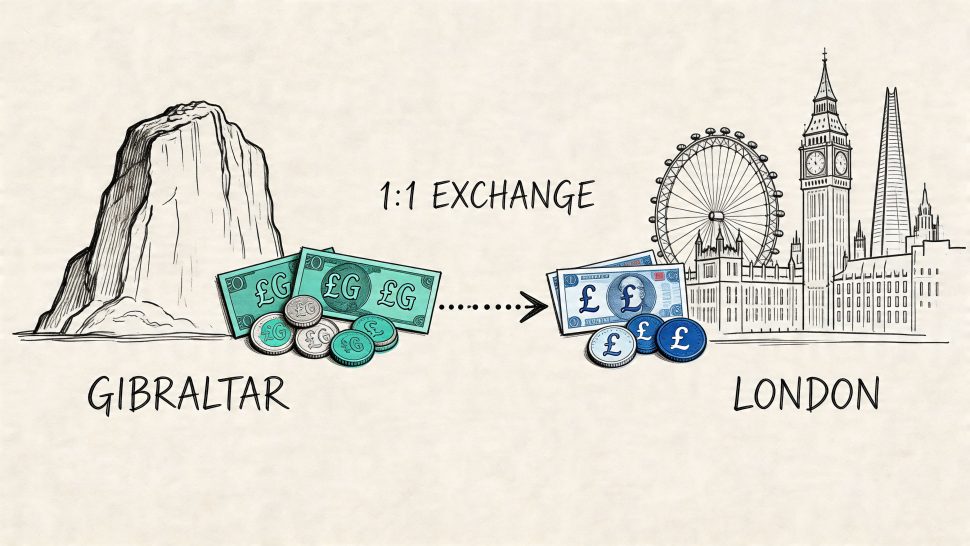
The currency of Gibraltar is the Gibraltar Pound (GIP). It is pegged at a fixed 1:1 value with the British Pound Sterling (GBP), so 1 GIP = 1 GBP. Gibraltar issues its own money, but Gibraltar notes and coins are not legal tender in the UK mainland, which is why travellers often struggle to spend or exchange leftovers once they return home.
That difference catches people out. In Gibraltar, British money and Gibraltar money often circulate side by side, so everything feels straightforward. Back in the UK, it isn’t.
For a traveller, the key point isn’t just the name of the currency. It’s what you can do with it. Gibraltar pounds hold pound-for-pound value, but Gibraltar-specific notes and coins can become awkward the moment your trip ends.
Understanding the Gibraltar Pound and Its Link to Sterling
The Gibraltar Pound, usually written as GIP, is Gibraltar’s official currency. It has been pegged at a fixed 1:1 par value with the British Pound Sterling since 1825, and the Government of Gibraltar issues its own coins and banknotes under the Currency Notes Act 2011. Gibraltar began producing its own banknotes in 1927, according to the Gibraltar pound reference.

What the 1 to 1 peg actually means
A lot of travellers hear “same value as sterling” and assume that means “same usability everywhere”. It doesn’t.
The easiest way to think about it is this. Value and acceptance are not the same thing. A Gibraltar pound is set at the same value as a British pound, but it is still a separate local issue. That’s why a shop in Gibraltar may happily accept both, while a shop in Manchester won’t take a Gibraltar note over the counter.
Why Gibraltar has its own money
Gibraltar is a British Overseas Territory, but it issues distinct local currency. That gives it a local monetary identity while staying tied closely to sterling for day-to-day stability.
Practical rule: If you’re travelling from the UK to Gibraltar, treat GIP as sterling in value but not in spending range.
That distinction matters most on the way home. It’s also why travellers who rely less on cash during the trip often avoid the usual end-of-holiday problem.
Gibraltar Banknotes and Coins in Circulation
Gibraltar’s money looks familiar if you use UK cash, but the designs are different and the acceptance rules are different too. Gibraltar’s currency decimalised alongside the UK in 1971, it has issued its own banknotes since 1927 and its own distinct coins since 1988, with denominations mirroring UK standards up to a £5 coin and banknotes up to £100, according to this Gibraltar pound overview.
What you’re likely to see in your wallet
For most visitors, the day-to-day denominations are the same ones they already know from the UK. The difference is in the issuing authority and the local imagery.
| Denomination | Type | Common Gibraltar Design Feature | Accepted in UK? |
|---|---|---|---|
| 1p | Coin | Gibraltar-specific local design | No, not as UK legal tender |
| 2p | Coin | Gibraltar-specific local design | No, not as UK legal tender |
| 5p | Coin | Gibraltar-specific local design | No, not as UK legal tender |
| 10p | Coin | Gibraltar-specific local design | No, not as UK legal tender |
| 20p | Coin | Gibraltar-specific local design | No, not as UK legal tender |
| 50p | Coin | Gibraltar-specific local design | No, not as UK legal tender |
| £1 | Coin | Gibraltar-specific local design | No, not as UK legal tender |
| £2 | Coin | Gibraltar-specific local design | No, not as UK legal tender |
| £5 | Coin | Gibraltar-specific local design | No, not as UK legal tender |
| £5 | Banknote | Often features Gibraltar imagery | No, not as UK legal tender |
| £10 | Banknote | Often features Gibraltar imagery | No, not as UK legal tender |
| £20 | Banknote | Often features Gibraltar imagery | No, not as UK legal tender |
| £50 | Banknote | Often features Gibraltar imagery | No, not as UK legal tender |
How to spot a Gibraltar issue quickly
Look for local themes rather than standard Bank of England styling. Gibraltar notes and coins often feature imagery linked to the territory itself, such as the Rock or local wildlife.
If you’ve found an older coin in a drawer and want to compare it with a known issue, this Gibraltar one pound coin guide is a useful example of what a Gibraltar-specific piece looks like.
Many people don’t realise they’re holding Gibraltar currency until a UK self-checkout, shop, or bank counter refuses it.
Practical Travel Tips for Using Money in Gibraltar
The most sensible way to handle money in Gibraltar is to keep things simple. Use cards for most spending, use any cash you already have in sterling where it’s accepted, and avoid ending the trip with a pocket full of Gibraltar coins.
What usually works on the ground
A typical visitor arrives, pays for a coffee, takes a taxi or bus, buys a few souvenirs, and maybe withdraws some cash. In those situations, cards are widely practical and help you avoid building up awkward loose change.
If you do use cash, British pounds are commonly accepted in Gibraltar, which makes life easier for UK travellers. The issue tends to come from receiving local change back.
Where euros fit in and where they don’t
Euros are unofficially accepted in most retail and tourist establishments in Gibraltar, but government offices and the Royal Gibraltar Post Office do not accept them, and change from euro payments is almost always given in Gibraltar pounds, according to the Gibraltar territory overview.
That leads to a common mistake. Travellers cross in from Spain, pay in euros for convenience, then end up holding Gibraltar change they didn’t want in the first place.
Sensible spending habits in Gibraltar
- Use cards for routine purchases so you don’t build up low-value coins.
- Spend British notes first if you already have them with you.
- Be careful paying in euros because the change often comes back in Gibraltar pounds.
- Use up local coins before departure for snacks, coffee, parking, or small purchases.
If you want the least hassle later, the goal isn’t just getting a fair price during the trip. It’s avoiding leftover local cash that becomes awkward after it.
The Problem with Leftover Gibraltar Pounds in the UK
This is often discovered only after returning home. Gibraltar notes and coins are not legal tender in the UK mainland.
That doesn’t mean they’re worthless. It means ordinary spending channels often won’t accept them. A supermarket till won’t treat a Gibraltar £10 note like a Bank of England £10 note. A vending machine won’t recognise Gibraltar coins. Many high street exchange points are focused on mainstream notes, not territorial coins, mixed change, or older issues.

Why this catches UK travellers out
In Gibraltar itself, the money feels close enough to sterling that people assume it will work the same way at home. It won’t.
That’s especially true for coins. Coins are where most travellers get stuck because they’re low value individually, easy to accumulate, and often ignored by standard exchange services.
What usually does not work
- Trying to spend GIP in UK shops. Staff may recognise it, but that doesn’t mean they can accept it.
- Holding onto it for the next holiday. Small amounts tend to sit in drawers for years.
- Assuming your bank will want the coins. Many people find that banks and basic exchange counters are selective about what they handle.
If you’ve got leftover GIP, the practical choice is to convert it while it still has a clear purpose, rather than letting it become dead money.
How to Exchange Gibraltar Currency Including Coins and Notes
The main challenge with Gibraltar currency isn’t value. It’s format. Notes can be awkward. Coins are usually more awkward. Mixed holiday money is awkwardest of all.
That’s why specialist exchange services exist. According to the Remitly Gibraltar pound guide, the 1 GIP = 1 GBP peg is supported by Gibraltar’s UK ties, Bank of England notes are estimated to make up over 70% of local cash flow, and Gibraltar-issued notes and coins require a specialist exchange service for conversion on the UK mainland because they lack UK legal tender status.

A practical way to deal with leftover GIP
If you want to exchange foreign coins and notes without arguing with a bank counter or sorting through mixed change yourself, the process is straightforward.
Check the quote online
Start with a rate calculator so you know what your Gibraltar notes, coins, or mixed foreign currency are worth before sending anything.Pack and post the currency
This is useful when you’ve got a mixture of coins, banknotes, older issues, or leftover holiday money that standard bureaux tend to reject.Receive payment
Once the currency is checked, payment is sent by the method offered by the provider.
For a clear walkthrough, this guide on how to exchange foreign currency explains the process.
What works better than banks and bureaux
Specialist services are usually the common-sense option when you need to:
- convert foreign coins and banknotes
- exchange leftover currency from several trips at once
- deal with withdrawn or older notes
- donate foreign coins to charity instead of leaving them unused
The big advantage is convenience. You don’t need perfect, bank-friendly currency in neat bundles. You need a service that handles the kind of money travellers actually bring home.
Real-world scenarios
A family comes back from Gibraltar with a few local coins, one or two notes, and some euros from Spain. That mix is too small and too messy for most traditional routes, but it’s exactly the kind of leftover foreign currency specialist services are built for.
A business, charity, airport collection point, or retailer can face the same issue on a larger scale. Foreign coins, territorial notes, and odd cash received in error all need a route that doesn’t depend on high street acceptance.
Frequently Asked Questions About Gibraltar Currency
Can I spend Gibraltar pounds in the UK
No, not in the normal everyday sense. Gibraltar notes and coins aren’t legal tender on the UK mainland, so shops, machines, and many standard cash handling points won’t accept them.
Some people assume a one-to-one value means universal acceptance. It doesn’t.
Is Gibraltar currency the same as British pounds
Not exactly. It has the same fixed face value against sterling, but it is a distinct local currency issue. That’s the practical difference that matters once you leave Gibraltar.
Do UK banks exchange Gibraltar pounds
Sometimes travellers assume a bank will sort it out automatically. In practice, banks are often limited in what they handle, especially with coins, mixed change, territorial issues, or older currency.
That’s why specialist services tend to be the route people use when they want to exchange foreign coins and notes rather than just mainstream banknotes.
What should I do with leftover Gibraltar coins
Spend them before you leave if you can. If you’re already back in the UK, the sensible route is to use a specialist service that accepts coins as well as notes.
Coins are the part that are not easily exchanged through normal channels.
Can I exchange old or withdrawn Gibraltar currency
In many cases, yes. Older and withdrawn currency can still have exchange or collector value depending on the issue. That matters if you’ve found pre-decimal items, older notes, or coins that are no longer circulating.
What doesn’t work is assuming old money has no value just because it isn’t current in a shop.
Can I donate Gibraltar currency to charity
Yes. If you have a small amount and don’t need the cash yourself, donating it can be a practical alternative. This is especially useful for low-value mixed coins that would otherwise sit in a jar.
Are euros used in Gibraltar
They are often accepted informally in tourist-facing places, but that doesn’t make them the best option. You may receive change in Gibraltar pounds, which creates another currency to deal with after the trip.
For official payments, euro acceptance is more limited.
What’s the best way to avoid leftover Gibraltar currency in the first place
The best approach is simple:
- Pay by card where practical
- Use sterling notes you already have before withdrawing local cash
- Avoid paying in euros unless necessary
- Use up Gibraltar coins before you travel home
How do specialist exchange services help
They fill the gap left by banks and standard bureaux. If you want to exchange foreign coins, convert foreign coins and banknotes, or exchange leftover currency that isn’t easy to spend locally, that specialist route is usually the smoothest one.
Conclusion Turn Your Leftover Currency into Cash
If you were wondering what is the currency of Gibraltar, the answer is the Gibraltar Pound. For UK travellers, the more important answer is what happens after the trip. Gibraltar money may match sterling in value, but it doesn’t behave like normal UK cash once you’re home.
So don’t leave it in a drawer. Exchange leftover currency, convert foreign coins and banknotes, or turn small amounts into something useful while it still has value.
If you’ve got Gibraltar notes, coins, or mixed holiday money sitting unused, We Buy All Currency gives you a straightforward way to turn it into cash. It’s designed for everyday leftover currency banks and bureaux often don’t want, including coins, notes, and withdrawn currency, with a simple postal process and no need to sort everything by hand.