
What to Do with Foreign Coins: 7 Smart Options for 2026
Posted by: Ian Stainton • 23 Apr 2026
That jar of leftover coins? It’s time to realize its value.
You’re back from a brilliant holiday, unpacking your bags, and there it is. A handful of foreign coins, a few leftover notes, maybe some euros from last summer, US dollars from a city break, and older currencies you’ve kept for years because you weren’t sure what to do with them. They often get dropped into a drawer, a travel pouch, or the classic kitchen jar and forgotten.
The problem is simple. High-street banks and exchange bureaus often won’t take foreign coins, and they’re usually even less interested in old or withdrawn currency. That leaves many travellers assuming the money is worthless when it often isn’t. In the UK, returned travellers commonly end up with unused foreign change, and many are still holding onto it rather than converting it.
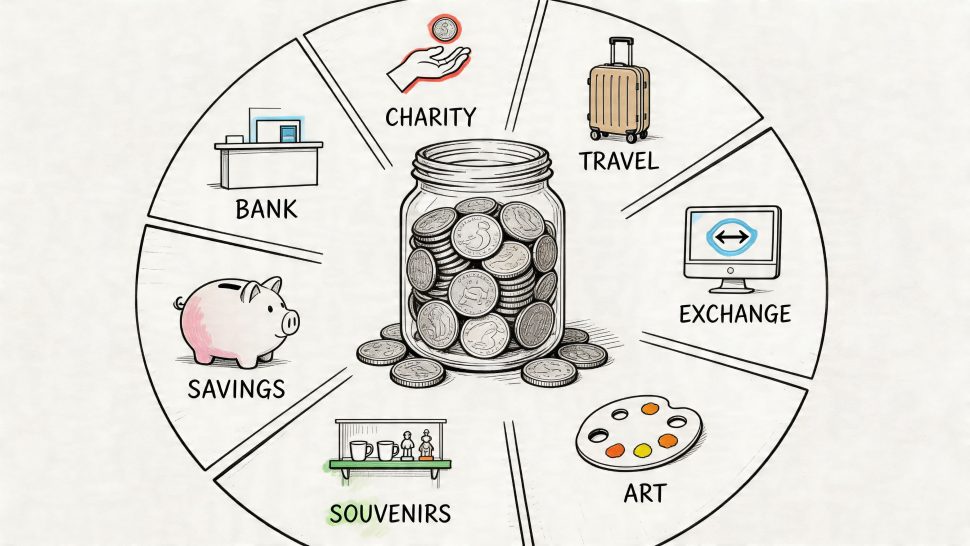
The good news is that you’ve got several practical options. You can exchange foreign coins and notes through a specialist, donate them to charity, separate out collectible pieces, or organise bulk conversion if you run a business or charity that receives mixed currencies. Some routes give you cash back. Others are better if your priority is convenience or fundraising.
If you want the quick answer, use a specialist online service. It’s usually the most straightforward route for people who want to exchange leftover currency, including coins, notes, and withdrawn money that banks won’t handle.
Quick answer
If you’re wondering what to do with foreign coins, a specialist service that can exchange foreign coins and notes, including old and withdrawn currency, is typically the best option in the UK. Banks and bureaux de change usually focus on current banknotes and often refuse coins. Charity bins are simple and useful if you’re happy to donate the value instead of receiving cash. Rare or unusual coins may be worth checking separately before you exchange them at face value.
1. Online Currency Exchange Platforms
You get home, empty your pockets, and end up with the usual mix. A few euro coins, some US change, an old note from a country that no longer uses that currency, and a handful of pieces you are not even sure are still valid. This is exactly the kind of pile that high-street options often refuse, while specialist online services are built to handle it.

For practical day-to-day use, online specialists are usually the strongest option if you want cash back rather than a donation or a keepsake. The key advantage is range. Banks and bureaux de change usually want current banknotes in larger currencies. Specialist services are more likely to accept foreign coins, mixed currency lots, pre-euro money, obsolete notes, and older UK coinage that falls outside normal exchange channels.
A service such as We Buy All Currency is set up around that gap in the market. You request a quote online, post the currency, the contents are checked, and payment follows by bank transfer or PayPal. That is a better fit for the average household jar of leftovers than visiting multiple branches and finding out, one by one, what they will not take.
How the process usually works
The steps are straightforward:
- Check what the service accepts: Look for coins, notes, obsolete currency, and any minimum value rules.
- Get an online quote: This gives you a working estimate before you post anything.
- Package the money carefully: Separate fragile notes, use secure packaging, and keep the contents list.
- Send it with tracking: Proof of postage matters if you are mailing anything valuable.
- Wait for verification and payment: The final amount is normally confirmed after the currency is counted and checked.
The trade-off is simple. Posting takes a little more effort than dropping notes at a bank counter, but specialist services often cover far more types of currency, especially coins and withdrawn money. For many people, that wider acceptance is what makes the option worthwhile.
This route is also useful for larger or repeat collections. Charities, schools, travel businesses, and retailers often end up with mixed foreign coins that are awkward to process through standard banking channels. An online specialist gives them one repeatable method instead of a box of unbankable change sitting in storage.
There is another point people often miss. Not every coin should be exchanged at face value. Some older foreign pieces, unusual designs, silver content coins, and withdrawn issues can carry collector demand. Before sending a mixed batch, it is worth checking whether any foreign coins are worth money beyond their exchange value.
When it’s the right choice
Use a specialist online service if:
- You have coins as well as notes: High-street exchange options typically become limited in this situation.
- You have old or withdrawn currency: Specialist firms are far more likely to assess it.
- You want payment back, not just convenience: The aim is to recover value, not merely clear a drawer.
- You have a mixed collection from different trips: One postal process is usually easier than trying several in-person options.
A common example is the family travel jar that builds up over years. Euros from Spain, dollars from Florida, a few Swiss francs, then older coins found during a clear-out. In practice, specialist online exchange is often the fastest way to turn that untidy mix into usable money.
2. Charitable Donation Programs
You get home, empty your pockets, and find a handful of coins from three countries plus a few low-value notes. For small leftovers like that, donation is often the cleanest option.
This route works well when the amount is too modest to justify sorting, listing, or posting for your own return. It is also one of the few practical choices for mixed foreign coins, which high-street banks and exchange counters often will not take at all. Airport collection bins and charity schemes solve the convenience problem fast, but the trade-off is simple. You give up the value instead of cashing it in.

A well-known example is Heathrow’s Change for Good partnership with UNICEF. As noted earlier in the article, airport donation schemes have raised substantial sums by accepting the coins and notes travellers cannot easily exchange elsewhere. That is the core strength of donation programs. They turn awkward, low-value currency into something useful without asking you to do much more than drop it in a box.
When donation makes sense
Choose donation if your priority is convenience or supporting a cause, not getting money back.
It is usually the right fit when:
- You have very small amounts: The return would be limited even if you found a buyer.
- You have mixed coins from several trips: Donation avoids sorting and checking each currency.
- You are still in transit: Airport collection points are quick and easy to use.
- You are clearing out family travel leftovers: A charity bin is often simpler than storing or researching the pile.
For personal finances, the decision is straightforward. If the leftover currency has meaningful value, recovering cash through a specialist service usually makes more sense. If the amount is minor, donation saves time and still puts the money to use.
That comparison matters because high-street options and donation bins serve different goals. A bank or bureau may help with current notes in larger amounts. A charity bin helps you dispose of low-value coins quickly. A specialist service sits between those two, especially if you want to check whether any pieces in the mix have exchange or collector value before giving them away. It is smart to review whether any foreign coins are worth more than face value before donating a whole batch.
A useful option for businesses too
Donation programs are not only for holidaymakers. Attractions, airlines, retailers, and charities often place collection points where international visitors naturally end up with spare change they cannot spend again.
The appeal for organisations is practical. Staff do not need to sort every coin at the counter, and visitors get an easy way to dispose of leftover currency. If you are setting up a scheme, use a recognised charity partner, make the collection point clearly visible, and explain what kinds of coins and notes are accepted. Clear handling rules matter, especially when the money is mixed, foreign, or partly obsolete.
If your main aim is raising funds, donation is a strong option. If your main aim is recovering the highest possible value from coins and old currency, specialist exchange will usually be the better route.
3. Numismatic Collection and Selling
A jar of leftover holiday coins can contain two very different things. One part is ordinary change that is only worth processing in bulk. The other is the small subset that may sell better as collectible material.
That distinction matters because high-street routes rarely help here. Banks and post offices usually have little interest in foreign coins, especially older or withdrawn ones, and they do not assess collector value. A specialist currency buyer may be the faster option for the bulk of the pile, but it still makes sense to pull out anything that looks potentially numismatic before you send it off.
What deserves a closer look
Set a few coins aside for inspection if you notice any of the following:
- Withdrawn or obsolete currencies: Older national coins, including pre-euro issues, can attract collector interest.
- Commemorative or unusual designs: Special reverses, anniversaries, and limited circulation themes often sell differently from standard coins.
- Higher-grade condition: Sharp detail, minimal wear, and original lustre can make a common coin more saleable.
- Less familiar countries or denominations: Some pieces from smaller markets are harder to replace and attract niche demand.
- Older sets or grouped runs: A complete or near-complete run can be easier to sell than loose singles.
Condition is often the deciding factor. A worn coin with an interesting design may still be worth very little, while a cleaner example of the same type can justify the effort of listing it properly.
A practical rule works well here. If a coin looks old, unusual, commemorative, or far better preserved than the rest, do not mix it straight into a bulk exchange bag.
Where to sell, and when it is not worth the effort
There are three main routes, and each has a trade-off.
- Specialist coin dealers suit coins that appear to be collectible and where you want a quick expert view.
- Auction houses make more sense for better individual items, complete sets, or larger collections.
- Online marketplaces can produce a stronger price, but only if the coin is desirable enough to justify photography, descriptions, postage, fees, and buyer questions.
People often lose time when dealing with foreign coins. Listing low-value foreign coins one by one sounds sensible, but the return is frequently poor once fees and effort are factored in. For ordinary mixed change, specialist currency services are usually more efficient than trying to become a part-time coin seller.
A simple sorting process helps:
- Pull out anything commemorative, old, or in notably strong condition.
- Group coins by country and denomination.
- Check whether any pieces appear to be part of a set or older withdrawn series.
- Send the obvious bulk remainder through a specialist exchange route.
- Only list or seek a dealer opinion on the small group that appears distinct.
In practice, that is the best balance for most households. You protect the upside on the few coins that may deserve collector pricing, and you still clear the rest without wasting hours on low-value listings.
4. Bulk Currency Collection for Organizations
A charity shop manager empties a donation tin and finds euros, US cents, old notes, and a handful of coins nobody on the team can identify. An airport retailer or hotel front desk sees the same pattern on a larger scale. The issue is not whether that money has value. The issue is having a repeatable way to turn mixed currency into usable funds.
For organisations, foreign currency collection is an operations problem first and a finance problem second. If the process is unclear, bags of coins sit in cupboards, staff make ad hoc decisions, and part of the value is lost through delay, mis-sorting, or simple lack of follow-through. In practice, high-street routes rarely solve this well, especially where coins or obsolete currency are involved. Specialist collection services usually do a better job because they are built for mixed, awkward, low-priority holdings that ordinary banking channels tend to reject.
Why bulk collection needs a proper process
The organisations that handle this well treat it like any other cash-handling workflow. They set collection points, assign responsibility, and choose one conversion route in advance.
That usually means:
- Clear collection points: Donation tins, front-desk drop boxes, or staff collection points in obvious locations.
- Simple handling rules: Staff need basic instructions on what to accept, where to store it, and what not to separate.
- Regular consolidation: Currency should be moved and logged on a schedule, not left to accumulate indefinitely.
- One specialist processor: A dedicated service is often the most efficient option for foreign coins, mixed notes, and withdrawn currency that banks and many high-street providers will not handle.
I see the same trade-off repeatedly. Internal sorting sounds cost-conscious, but it often burns staff time for very little gain unless the organisation has large volumes of a few major currencies. If the intake is messy and mixed, a specialist partner is usually the cheaper route once labour and admin are counted properly.
What works in day-to-day operations
Keep the system boring. That is usually the sign it will work.
Use labelled containers. Decide who empties them and how often. Keep foreign currency donations separate from operational cash takings. Record handovers, especially if collections are going through multiple sites. If you run several locations, centralising dispatch to one processor is often easier than letting each branch improvise its own method.
A good example is a visitor attraction collecting travel money for a charity partner. The tills are busy, the donation boxes fill up with mixed coins, and the finance team does not want staff spending hours sorting low-value change by country. A specialist bulk service solves the main friction point because it can accept the mix as collected, including coins and older currency that high-street options often refuse.
Compliance and reporting
Larger collections need cleaner records. Charities should also check the tax treatment of any donated foreign currency, especially where values are material or where sales and fundraising activity overlap. HMRC’s guidance on VAT and donations is set out in its manual at https://www.gov.uk/hmrc-internal-manuals/vat-finance-manual/vatfin3240.
This is not a reason to avoid collecting foreign money. It is a reason to document the process properly.
For airports, airlines, hotels, retailers, schools, museums, and local charities, the practical answer is usually the same. Use visible collection points, assign ownership, and send the bulk through a specialist service rather than hoping a bank counter will deal with mixed coins later. That approach is faster, easier to manage, and far more likely to recover value from the currencies other channels ignore.
5. Currency Conversion at Banks and Post Offices
You get back from a trip with €40 in notes, a pile of coins, and maybe a few older notes from years ago. The bank or Post Office feels like the obvious place to go. For some of that money, it is. For the rest, it usually is not.
High-street exchange counters are built for simple, current note exchange. They can work well if you have standard banknotes in a major currency and want to sort it out in person. They are much less useful for coins, small leftover amounts, and withdrawn currency. That is the trade-off people often only discover at the counter.
Where banks and Post Offices can work
These services are worth checking if your situation is straightforward:
- You have current banknotes only: Notes are far more likely to be accepted than coins.
- The currency is widely traded: Euros, US dollars, and other common currencies are easier to process.
- You prefer face-to-face service: A branch can feel simpler if you want immediate confirmation.
- You can meet the provider’s rules: Identification, account requirements, and minimum exchange amounts can apply.
Cost matters too. Banks, Post Office counters, and airport-style exchange desks often offer less favourable rates than specialist online services, especially on smaller transactions. Some also set conditions that make low-value exchanges poor value after fees and spread are taken into account.
Where they usually fall short
In practice, there are three recurring problems.
The first is coins. Many banks and exchange counters do not take foreign coins because they are expensive to count, store, and redistribute. The second is obsolete money. If the notes or coins are no longer in circulation, high-street providers often will not handle them at all. The third is mixed currency. A drawer full of travel leftovers from several countries is exactly the kind of collection that traditional counters are least set up to process efficiently.
I see this regularly with holiday money. Current euro notes may be accepted. The cent coins are usually useless through the same channel. Add in older currencies, commemorative coins, or a mix from several trips, and the bank route quickly stops being practical.
Banks and Post Offices are best for current banknotes in mainstream currencies. They are rarely the best option for coins, mixed collections, or older money.
That distinction matters if your goal is to recover as much value as possible, not just dispose of a few notes. A specialist online service will usually cover more of the problem in one go because it can assess coins, notes, and in some cases withdrawn currency together. High-street counters still have a place, but mainly for the narrow, easy cases. If you have anything more awkward than that, specialist processing is usually faster and more complete.
6. Travel Insurance and Travel Card Services
Travel cards and multi-currency accounts are excellent for preventing the problem. They’re much less useful once the problem already exists in coin form.
That distinction matters. If you mostly spend abroad using a travel card, app-based account, or digital wallet, you’ll often come home with less cash left over. That’s smart travel planning. But it doesn’t solve the coins already sitting in your drawer.
Where these services help
Travel-focused financial products are useful in two ways.
They reduce the amount of cash you need to take on holiday, and they make it easier to keep value in digital form for future trips instead of withdrawing too much. If you travel often, that can cut down the build-up of leftover foreign currency over time.
They’re especially practical for:
- Frequent travellers: You can reuse balances on future trips.
- People visiting multiple countries: Multi-currency features reduce repeated cash exchange.
- Those who dislike carrying cash: Card-first travel leaves fewer coins to deal with later.
There’s also a broader payments trend behind this. Institutional cross-border payment infrastructure is increasingly relying on stablecoin rails, with USDT and USDC accounting for approximately 99% of institutional cross-border payment volume, according to Chainalysis’s 2025 global crypto adoption analysis. For ordinary travellers, the takeaway is simpler than the technology. More cross-border money movement is becoming faster and more digital, while physical coins remain the awkward part of the system.
Where they don’t help
Travel cards won’t exchange your old coins. They won’t appraise withdrawn currency. They won’t process that bag of mixed pesetas, dollars, dirhams, and cents from ten different trips.
That’s why this option is best treated as prevention rather than cure.
A realistic example is the business traveller who uses a multi-currency card for hotels and meals but still accumulates coins from taxis, cafés, and tips. The card cuts the leftovers, but it doesn’t eliminate them. The coins still need a final route, whether that’s specialist exchange or donation.
If you travel regularly, use cards to reduce future leftovers. If you already have a pile of cash at home, this isn’t the option that resolves it.
7. Educational and Decorative Repurposing
Not every coin has to go back into the financial system.
Sometimes the best use is sentimental, educational, or creative. If a few coins remind you of a honeymoon, a family trip, or a round-the-world journey, keeping them for a display can make more sense than converting them. This is especially true when the financial value is modest but the personal value is obvious.

You’ll see this route used in schools, travel-themed homes, cafés, museums, and family memory projects. Coins can become framed displays, memory boxes, geography aids, or conversation pieces.
Good uses for coins you don’t want to cash in
This approach works well when the amount is small and the story matters more than the exchange value.
Ideas include:
- Travel memory frames: Pair coins with tickets, photos, or maps.
- School learning sets: Use mixed currency to teach geography and design.
- Shadow boxes: Create a display from a favourite trip or region.
- Themed collections: Group coins by continent, era, or design style.
A nice example is the family holiday display. A few coins from Italy, the US, and Japan won’t change your finances much, but arranged with travel photos, they become part of the memory. That can be a better outcome than chasing a small return.
The trade-off to keep in mind
Repurposing only makes sense when you’ve consciously chosen sentiment over value.
That’s important because a lot of people keep everything by default, not by choice. Years later, the drawer is full and nothing has been used. If that sounds familiar, it’s worth separating the coins that hold real meaning from the rest. Keep a handful. Exchange or donate the balance.
Keep the coins that tell a story. Convert the ones that are only taking up space.
This option also works nicely for community projects. Schools and charities sometimes use foreign coins in displays or educational fundraising activities, especially when the coins have visual appeal but limited practical exchange value.
7-Option Comparison: Handling Foreign Coins
| Method | Implementation complexity 🔄 | Resource requirements ⚡ | Expected outcomes 📊 | Ideal use cases ⭐ | Key advantages 💡 |
|---|---|---|---|---|---|
| Online Currency Exchange Platforms | Moderate, digital submission + postal handling | Low–Moderate, internet access, postage, provider fees | Fast cash conversion; accepts obsolete currencies; quoted pricing | Businesses or individuals with large/mixed collections or obsolete notes | Fast, transparent quotes; accepts currencies banks refuse; multiple payout methods |
| Charitable Donation Programs | Low, partner setup and donation handling | Low, collection points, admin for receipts | Converts coins into charitable impact and tax receipts (where applicable) | Attractions, airports, retailers seeking CSR and fundraising | Meaningful social impact; tax benefits; donor engagement |
| Numismatic Collection and Selling | High, research, grading, auctions required | High, expert appraisal, grading fees, secure storage, insurance | Potentially high returns but longer sale timelines and market risk | Owners of rare or historically significant coins and investors | Premium valuations; appreciation potential; access to collector markets |
| Bulk Currency Collection for Organizations | Moderate, setup, staff training, tracking systems | Moderate, branded containers, counting routines, storage/security | Regular accumulated value; lower per-transaction conversion costs | Hotels, museums, attractions, retailers with frequent international visitors | Low-cost setup; steady revenue or donations; CSR and marketing opportunities |
| Currency Conversion at Banks and Post Offices | Low, in-person transactions and authentication | Low, branch visit, ID; possible higher commissions | Immediate exchange for current currencies; limited obsolete acceptance | Travelers needing quick exchange of common currencies | Trusted face-to-face service; immediate payment; standard security |
| Travel Insurance and Travel Card Services | Low–Moderate, account/card setup and management | Low, card accounts, possible fees, pre-trip planning | Reduces leftover cash; digital multi-currency balances | Frequent travelers and businesses managing travel expenses | Competitive rates for cardholders; cashless convenience; multi-currency management |
| Educational and Decorative Repurposing | Low–Moderate, creative work or exhibit curation | Low, framing/materials, artisan or staff time | Non-monetary educational/aesthetic value; preserves cultural context | Schools, museums, craft projects, travel memory displays | Preserves history and memories; unique decor; educational uses |
Turn Your Leftover Currency into Real Cash Today
That forgotten jar of foreign coins and notes holds real value. The challenge isn’t whether the money matters. It’s choosing the right route for the type of currency you’ve got.
If you have current banknotes from major currencies, a bank or Post Office may still be worth checking. If you’ve got small amounts and want maximum convenience, donating foreign coins to charity is an easy and worthwhile option. If you suspect a coin may be collectible, it’s smart to separate it before you exchange anything at face value. And if you’re running a charity, business, airport, attraction, or retailer that receives foreign money in volume, a structured bulk process is far better than letting mixed coins pile up in storage.
The practical answer, however, is often a specialist online service. That’s because specialist platforms solve the exact problems that mainstream providers usually avoid. They can exchange foreign coins and notes together, handle leftover foreign currency from multiple trips, and process old or withdrawn money that a bank is unlikely to accept. They’re also easier to use from home. You get a quote, pack the currency, send it securely, and wait for payment after verification.
This approach is particularly useful if your money is unsorted, mixed, or old. It’s also the strongest option if you want cash back rather than just getting rid of the coins. A service built specifically for exchange foreign coins and notes gives you a route that’s fast, simple, and designed for exactly this kind of leftover travel money.
A good rule is to sort your currency into three groups. First, anything sentimental that you want to keep. Second, anything unusual that may deserve a collector check. Third, everything else. That third pile is usually where the value is stuck, and it’s the part often left untouched for years.
Don’t let your holiday money sit in a jar indefinitely. If you want to exchange leftover currency, convert foreign coins and banknotes, or turn old travel money into something useful, take the first step and get a quote. The process is straightforward, and it can finally clear out all those coins and notes that banks and exchange counters won’t handle.
Frequently asked questions
Can you exchange foreign coins in the UK
Yes, but usually not through ordinary banks or standard bureaux de change. Specialist services are the most practical route if you want to exchange foreign coins in the UK, especially if you also have old notes or withdrawn currency.
Do UK banks accept foreign coins
Often, no. Banks may accept some current foreign banknotes, but coins are commonly refused because they’re harder to process and resell. That’s one reason specialist services exist.
Can I exchange foreign coins and notes together
Yes. A specialist platform is usually the easiest way to exchange foreign coins and notes in one process, especially if the collection is mixed, unsorted, or includes older currencies.
What should I do with leftover foreign currency from a holiday
You’ve got four sensible options. Exchange it through a specialist, donate it to charity, separate out any collectible pieces, or keep a few sentimental coins and convert the rest. The best choice depends on whether you want cash back, convenience, or a donation outcome.
Is old or withdrawn currency still worth anything
Sometimes, yes. Some withdrawn currencies can still be exchanged through specialist services, while others may have collector value. If the money is unusual, old, or in strong condition, check before treating it as ordinary face-value currency.
How does a specialist online currency exchange work
You get a quote, choose your payment method, package the money, and send it by post. After the currency is checked, payment is issued. We Buy All Currency states that payment is made within five working days after verification.
Can I donate foreign coins to charity instead of exchanging them
Yes. Airports, airlines, attractions, and some businesses run donation schemes that accept foreign coins and notes. This is a good option if convenience matters more than receiving the money yourself.
What if I have mixed coins from lots of countries
That’s exactly the kind of situation specialist services are designed for. Mixed collections are awkward for banks but normal for dedicated foreign coin exchange providers.
Do I need to sort my coins before sending them
Not always. Some specialist services accept unsorted currency and use tools such as weight-based systems to simplify the process. It’s still helpful to separate obvious rarities or sentimental items first.
How long does payment take
For We Buy All Currency, payment is issued within five working days after verification, using bank transfer or PayPal.
If you want a simple way to turn leftover holiday money into something useful, We Buy All Currency offers a straightforward specialist service for coins, notes, and withdrawn currency. You can get a quote, send your currency by post, and receive payment after verification, with no hidden charges and free returns if you’re not happy with the quote.