
When Was the Pound Coin Introduced? A UK Currency Guide
Posted by: Ian Stainton • 4 Mar 2026
The modern UK £1 coin we all know first landed in our pockets on 21 April 1983. This date kick-started the beginning of the end for the familiar £1 banknote, but the switch wasn't just for looks. It was a common-sense solution to a real-world problem with paper money.
The Pound Coin Enters Circulation
Before 1983, the Bank of England's £1 note was the go-to for single-pound transactions. The problem? These notes wore out incredibly fast, often lasting just nine months before they were too tattered to use. This became a huge headache with the rise of vending machines in the 1970s and 80s, which were notoriously tough on flimsy paper notes. It was clear a tougher alternative was needed.
The Royal Mint’s answer was the brand-new round pound coin. Made from a nickel-brass alloy, its golden colour and reassuring weight were designed to feel substantial and trustworthy. For the UK Treasury, this was a smart, long-term move to save money, as the coin's durability was miles ahead of its paper counterpart. You can dive deeper into this currency changeover and the launch details on nextdaybullion.co.uk.
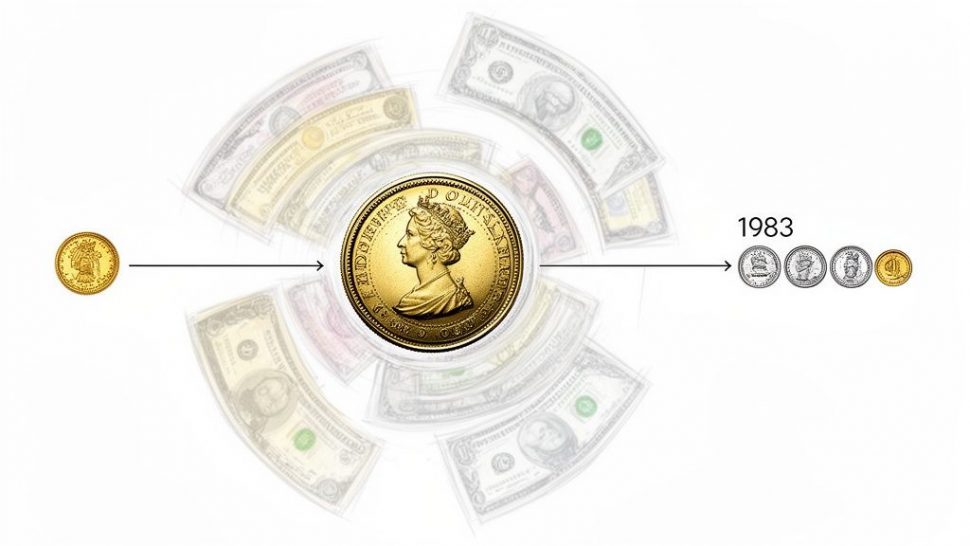
This simple timeline shows just how quickly things changed, from the coin's first appearance to the final withdrawal of the banknote it was designed to replace.

The old £1 note was taken out of circulation entirely just five years after the coin arrived, cementing the round pound's place in the nation’s pockets.
Below is a table that breaks down the key milestones for the original round pound, from its exciting debut to its eventual demonetisation.
Timeline of the Original Round Pound Coin
| Event | Date | Significance |
|---|---|---|
| Coin Introduced | 21 April 1983 | The new £1 coin enters circulation, beginning the transition away from paper. |
| Banknote Ceases Issue | 31 December 1984 | The Bank of England stops issuing new £1 notes. |
| Banknote Demonetised | 11 March 1988 | The £1 banknote is no longer legal tender, completing the switch. |
These dates mark the initial chapter of the coin's history, establishing it as the primary unit of currency for daily life in the UK for over three decades.
A Practical Solution for a Modern Economy
Bringing in the pound coin was more than a simple currency refresh; it was a necessary step for a changing economy. As automated services became more common, a solid, reliable coin was vital for everyday life.
- Durability: Coins simply last much longer than banknotes. This drastically cut down the recurring cost of printing and replacing worn-out money.
- Convenience: The coin worked perfectly in vending machines, parking meters, and other automated systems that were becoming popular.
- Security: While fakes would eventually become a problem, the coin's initial design was seen as more secure than the easily damaged paper note.
The decision to move from a banknote to a coin was really all about economics. With an estimated lifespan of at least 40 years, the £1 coin offered the government a much better return on investment than the constantly replaced paper notes. This first coin paved the way for decades of monetary change in the UK.
The Ancient History Behind the Pound
While most of us remember the modern pound coin appearing in 1983, its story actually goes back much further. To really get a feel for its origins, we have to look at its much older ancestor: the gold Sovereign. This impressive coin was first minted for King Henry VII way back in 1489, becoming the very first £1 denomination.
This wasn't just loose change; it was a powerful statement of Tudor wealth and influence. For hundreds of years, the Sovereign was the gold standard (literally) of British currency, fuelling the expansion of the British Empire. It held its top spot as the £1 coin until World War I, when gold shortages meant the country had to switch to cheaper £1 banknotes instead.
From Gold Sovereigns to Decimalisation
Even though it was replaced by paper money, the Sovereign's influence didn't just disappear. In fact, its legacy directly inspired the coin that would come decades later. The original round pound from 1983 was designed with a very similar diameter to the Sovereign—a deliberate nod to its famous predecessor, meant to build trust with a public used to paper notes.
Another huge step on the path to the modern pound coin was decimalisation. On 15 February 1971, the UK’s entire currency system was turned on its head.
This historic 'Decimal Day' simplified everything by fixing the pound's value at 100 "new pence." It got rid of the old, complicated system of pounds, shillings, and pence, creating a modern structure that made introducing a £1 coin much more practical.
This change made calculations far simpler and brought the UK in line with most other currencies around the world. If you're curious about the coins people used before this big shift, you can check out our guide on pre-decimal coin values.
The gold Sovereign’s journey is a fascinating one. It began as a coin equal to one pound of silver, with a lineage tracing back to the 240 silver pennies of King Offa in the 8th century, and was later reissued in 1817. You can dive deeper into this complete history on auronum.co.uk. By understanding this rich past, the answer to "when was the pound coin introduced?" becomes part of a much bigger and more interesting story.
Why the Round Pound Was Replaced
The classic round pound coin served us well for decades, but it had a growing, hidden problem that eventually spelled its doom: counterfeiting. By the mid-2010s, this wasn't just a minor issue; it had become a genuine threat to the UK's currency.
The numbers were quite shocking. The Royal Mint estimated that as many as one in every thirty round pound coins in circulation was a fake. These forgeries weren't just inconvenient, they were undermining public trust in the money we all used every single day. It was clear something had to be done.

The Great British Coin Hunt
To tackle the problem head-on, the Royal Mint kicked off a huge public campaign to get the old coins out of our hands and introduce its high-tech replacement. Known as "The Great British Coin Hunt," it encouraged everyone to check down the back of sofas, raid old piggy banks, and empty out their pockets.
The mission was simple: spend, bank, or exchange your round pounds before they were no longer accepted. This all happened during a six-month window in 2017 when both the old round coin and the new 12-sided version were in use together. With counterfeits making up nearly 3.1% of all £1 coins, the new, ultra-secure 12-sided coin was introduced on 28 March 2017. This move led to the old round pound being officially withdrawn from circulation later that year. You can read more about this massive currency switch on bullionbypost.co.uk.
On 15 October 2017, the original round pound officially lost its status as legal tender. From this day forward, shops were no longer required to accept them, marking a definitive end to the coin's 34-year reign and paving the way for a more secure currency future.
The Modern 12-Sided Pound Coin
By the mid-2010s, the old round pound was in serious trouble. Counterfeits were so common that some estimates suggested one in every 30 was a fake. To restore public trust, the Royal Mint went back to the drawing board and created what’s often called the world's most secure coin, launching it on 28 March 2017.

This new 12-sided coin wasn't just a cosmetic update; it was a high-tech answer to a growing problem. It was specifically designed to be incredibly difficult to copy, making it a game-changer for currency security in the UK.
Security Features That Outsmart Fakes
The real genius of the 12-sided pound coin lies in the clever security features packed into its small frame. These work together to make the coin both easy to recognise and exceptionally hard to forge.
- Bi-metallic Design: The coin has a distinctive two-tone look. It's made of a gold-coloured outer ring (nickel-brass) and a silver-coloured inner circle (nickel-plated alloy), a combination that’s tricky for forgers to get right.
- Holographic Image: If you look just below the Queen's head and tilt the coin, you'll see a hologram-like image that changes from a '£' symbol to the number '1'.
- Micro-lettering: You'll need sharp eyes for this one! Tiny letters are engraved on the lower inside rim of both sides. The 'heads' side says 'ONE POUND', while the 'tails' side shows the year it was minted.
- Hidden Security Feature: The coin also contains a secret high-security feature, built right into the metal itself, which allows for automatic verification by machines.
These changes had an immediate and dramatic effect, and the number of fakes in circulation plummeted. If you want to learn more about how to tell a real coin from a fake, our guide on spotting counterfeit pound coins has some great tips. This new coin didn’t just replace the old round pound; it set a completely new standard for secure coinage worldwide.
What to Do With Your Old Pound Coins
If you’ve found a stash of old round pound coins in a forgotten piggy bank, the back of a drawer, or an old coat pocket, you might think they’re now useless. After all, you can’t spend them in shops anymore.
But don’t be so quick to write them off! Those old coins absolutely still have value. Instead of asking "when was the pound coin introduced?" the better question is what you can do with your old ones.
Many people think their only option is a trip to the bank, but that can be a real hassle, and a lot of high street branches won’t even take them now. Thankfully, there’s a much easier, faster, and hassle-free way to exchange foreign coins and notes without any fuss.
A Fast, Easy, and 100% Guaranteed Exchange Service
We’ve created a service that makes turning your old UK money and leftover foreign currency into cash as simple as possible. We offer a fast, easy, and 100% guaranteed service to turn that clutter into cash, quickly and securely.
Best of all, there’s no need to sort through your coins. Just gather everything up—whether it's old round pounds, leftover foreign coins, or old banknotes—and send them over to us. Our hassle-free process means we do all the hard work for you.
Our credibility is everything. We are trusted by major UK brands, including national charities, supermarkets, airports, and even police forces, to handle their currency exchanges. This trust is built on our reliability and commitment to providing a secure and professional service every time.
Instead of letting those coins gather dust, our fast and easy process helps you get their value back.
For those who wish to support a good cause, we make it simple to donate foreign coins to charity. You can choose to have the value of your currency sent directly to one of our trusted charity partners.
Ready to finally cash in those old pounds? Visit our homepage to see just how easy it is to convert your foreign coins and banknotes today.
Exchange All Your Leftover Foreign Currency
While we've been talking about the old round pound coin, our fast and easy service isn't just limited to that. Chances are, if you have old pounds lying around, you probably have a drawer full of other leftover foreign currency too. Think of that mixed bag of coins from past holidays, or even old banknotes from decades ago.
We provide a simple and hassle-free way to exchange foreign coins and notes from all over the world. Instead of letting that money gather dust, you can turn it all into cash. The best part? There is no need to sort coins. Just gather everything up, and we'll take care of the rest.
A Service Built on Trust and Credibility
We know that trust is everything when sending currency. That’s why we’re the chosen currency exchange partner for some of the UK’s biggest brands, including national charities, major supermarkets, airports, and even police forces. Our process is 100% guaranteed, so you can convert foreign coins and banknotes with complete peace of mind.
If you'd prefer to help a good cause, we also offer a simple way to donate foreign coins to charity. You can have the full value of your currency sent directly to one of our trusted UK charity partners. It's a great way to turn that forgotten change into a really meaningful contribution.
Helpful Tip: When you get back from a holiday, put all your leftover foreign currency in one pot. Don't worry about mixing different currencies—our hassle-free service means you can send it all to us in one go, without sorting anything.
Ready to turn that clutter into cash or support a charity? You can find out more about what to do with your old money in our detailed article on the easy way to exchange old British coins and notes.
Frequently Asked Questions About Pound Coins
Got questions about your old pound coins? You're not alone. Here are the answers to a few we hear all the time, helping you figure out what to do with that old currency.
Can I Still Deposit Old Pound Coins At The Bank?
Unfortunately, most UK high street banks stopped accepting the old round pound coins a few years after they were taken out of circulation in 2017.
You might get lucky if you’re a customer at your local branch, but it's not a guarantee and often ends up being more trouble than it's worth. Using a dedicated currency exchange service is by far the most reliable, fast, and easy way to get value from them.
How Can I Tell If My Old Pound Coin Is Valuable?
The vast majority of round pounds are simply worth their face value for exchange. While a few specific designs are rarer—like the 2011 Edinburgh city coin—and might fetch more from a collector, most aren't considered rare.
Our service is perfect for cashing in your common coins without the need to spend hours sorting through them to find that one rare treasure. It's a hassle-free way to deal with your collection.
For a fast, easy, and hassle-free way to exchange foreign coins, old pounds, or any leftover foreign currency, our 100% guaranteed service is the ideal solution. You don’t need to sort anything; simply send us your collection for a secure and straightforward exchange.
At We Buy All Currency, we are trusted by major brands, including charities, supermarkets, airports, and police forces, to provide a fast, easy, and hassle-free currency exchange service. Ready to turn your old coins into cash? Start your exchange on our homepage today.