
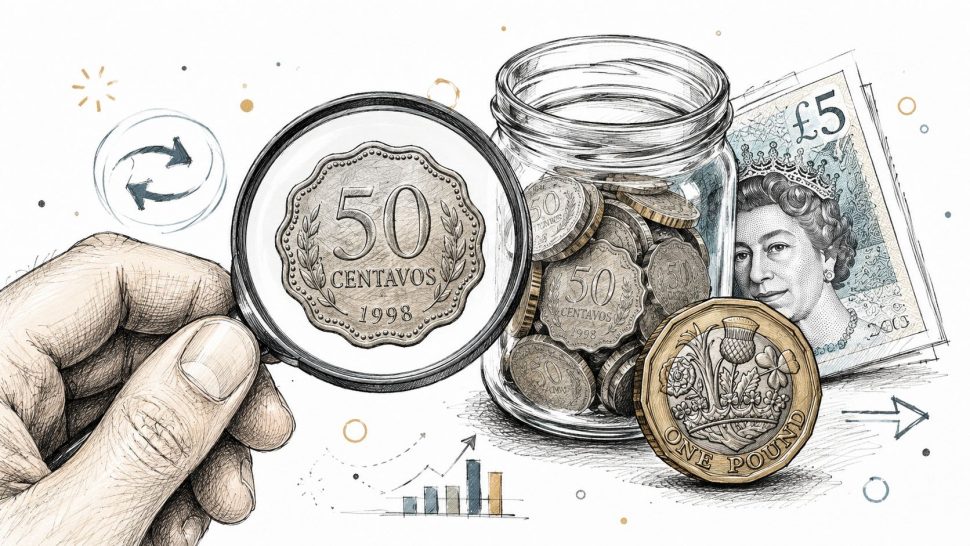
A 50 centavos coin is a foreign half-unit coin, not a UK denomination, and in Britain its exchange value is set by specialist currency buyers rather than by face value. If you've got a jar of mixed centavos coins, it's usually best treated as bulk leftover foreign currency rather than something to sort by hand one coin at a time.
You find one after a holiday, then realise they've got no clear idea whether it's Mexican, Philippine, Brazilian, or something else entirely. That confusion is normal, because “centavos” just means a small subdivision of a currency, so the same label appears across different countries and eras. The good news is that once you know what you're looking at, you can move from “what is this?” to “how do I turn it into pounds?” without a bank run or a sorting session.
What a 50 Centavos Coin Actually Is
A 50 centavos coin is usually the half-unit of a national currency, but the exact meaning depends on the country that issued it. In everyday UK use, it's a piece of leftover foreign currency, often found in drawers, travel wallets, or inherited coin mixes long after the holiday that brought it home.
Why the same name can mean different coins
That's where readers get tripped up. Centavos is the Spanish and Portuguese word for cents, so it appears across several currency systems, including Mexico, the Philippines, Brazil, and Colombia. A coin marked 50 centavos is not one single design or one single market value, it's a denomination label shared by different countries with very different histories.
For UK holders, that matters because these coins are rarely something to keep as a generic collectable unless they're unusually old, high-grade, or clearly scarce. A more practical first step is to treat them as foreign change and decide whether they belong in a specialist exchange batch, a charity donation pot, or a possible collector sort.
Practical rule: if the coin says 50 centavos but you can't confidently name the country, don't guess at rarity first, identify it first.
A helpful way to think about it is this, the label tells you the denomination, but the country tells you the story. That's why a Philippine piece from the 19th century, a modern Mexican coin, and a Brazilian circulation coin can all sit under the same umbrella while having very different value and usefulness in the UK.
For anyone sorting a mixed holiday jar, the smartest starting point is not coin collecting theory. It's a simple question, can this be exchanged, counted, or donated without wasting time? That's the route this guide follows.
Country by Country Variants Worth Knowing
A mixed jar of 50 centavos coins makes sense only after you split it by country, then by era. The label can look familiar from one coin to the next, yet the legal status, everyday usefulness, and collector interest can change a lot.
A simple comparison of the main versions
| Country | Denomination | Metal | Diameter | Status |
|---|---|---|---|---|
| Mexico | 0.50 MXN | Aluminium bronze | 22 mm | Current peso system, valid for transactions |
| Philippines | Fifty centavo | Data not available | Data not available | Minted from 1864 to 1994, demonetised in 1998 |
| Brazil | 0.50 BRL | Data not available | Data not available | Current circulation denomination |
| Colombia | 0.50 COP | Data not available | Data not available | Low-value circulation coin in many mixed lots |
Mexico is usually the easiest starting point because the current 50-centavo coin has a very clear modern specification. Banco de México states that it entered circulation in 1996 and is still valid for transactions. It is defined as 0.50 MXN, made of aluminium bronze, with a 22 mm diameter, 1.78 mm thickness, and a scalloped 12-notch shape Banco de México, Numista's Mexican 50-centavo catalogue entry. For anyone sorting foreign change in the UK, that gives you a clean reference point for size, colour, and form.
The Philippine fifty-centavo coin sits in a different historical category. It was minted from 1864 to 1994 and later demonetised in 1998, so it can still appear in inherited mixes even though it is no longer legal tender Philippine fifty-centavo coin history. That long life means the design and composition can vary by period, which is why older pieces and later circulation issues should be treated differently.
Brazil and Colombia add another layer of confusion for non-specialists. Their 50 centavos pieces belong to their own currency systems, so the denomination alone does not tell you whether a coin is current, withdrawn, or merely low value in the local market. For a practical Mexican example, the Mexico coin exchange guide shows why country identification comes first, since the same denomination label can lead you to very different handling decisions.
If you are holding a mixed bag of centavos, start with the country name on the coin. That single step does more for sorting than looking only at the number 50.
How to Identify Year, Denomination and Metal
Start with the country, then move to the date. That order saves time, because a coin that looks worn can still be a common late issue, while a bright-looking one may belong to a withdrawn series that is no longer used.
The four checks that matter
First, read the issuing country and the year on the coin's main side. On a Mexican piece, that usually gives you the clearest anchor. On a Philippine coin, the long date range already tells you that you are dealing with a much older historical period, and not the same kind of modern circulation coin you might find from Mexico or Brazil.
Second, confirm the denomination mark. Look for 50 centavos, ¢50, or the country's own equivalent notation. That stops you mistaking a half-unit coin for another low-value piece in the same jar, especially when several foreign coins have similar sizes or colours.
Third, judge the metal and feel. The modern Mexican coin is a useful benchmark because it is 4.39 g and 22 mm across Banco de México. If a coin is roughly that size and has the right colour for aluminium bronze, you are probably in the right family of issue.
Finally, notice the shape. The modern Mexican 50-centavo coin has a scalloped 12-notch shape, which is distinctive enough to separate it from plain round pieces Numista's Mexican 50-centavo catalogue entry.
Read the coin like a label first, a collectable second.
That simple order helps with every mixed lot. A modern Mexican piece, an older Philippine coin, and a Brazilian circulation coin may all say “50 centavos”, but they should not be judged by the same yardstick until you know exactly which one you have.
Approximate Values and What Really Drives Worth
Face value is the least helpful number on a 50 centavos coin. It tells you the denomination, not the practical worth in a UK exchange context, and the gap between the two can be huge depending on country and inflation history.
Face value versus real value
Numista catalogue data shows 50-centavo or 50-centavos denominations with face values ranging from 0.50 BRL to 0.50 COP, but their market equivalents are very different, about USD 0.08 for Brazil versus USD 0.00012 for Colombia Numista 50-centavo catalogue. That's the core lesson, the denomination label alone doesn't tell you much about what the coin is worth in practice.
For UK holders, three things matter most, the issuing country, the year and metal content, and the condition of the piece. A worn, common-date coin usually belongs with leftover foreign change. A sharply struck older issue may deserve a closer look. But most mixed jars are not full of sleeper rarities.

The practical UK takeaway is blunt. If you've got a handful of common Mexican or Brazilian 50 centavos pieces, they're usually better treated as bulk foreign coins than as a collection to price individually. That's especially true once you factor in handling time, sorting time, and the fact that banks and high-street bureaux often don't want small foreign coins at all.
Use this test: if the time you'd spend sorting is greater than the likely collector upside, it's exchange stock, not a numismatic project.
That's why specialist services matter. They're built for exchange foreign coins and notes, including awkward leftover pieces that don't fit neatly into cash desks or standard travel-money counters.
Rarity Indicators Without the Hype
Old does not automatically mean rare, and rare does not automatically mean valuable. Online coin chatter often blurs those lines, so a worn 50 centavos piece can get more attention than it deserves.
The signals that are actually worth checking
The Mexican 50-centavos series is a good reality check. A British-cited mint report recorded about $13,000 worth of 50-centavos coins, equal to 26,000 pieces, produced by active Mexican mints between 1 July 1887 and 30 June 1888 Mexican numismatic history on 50c minting. That is a hard production figure, and it shows why broad claims about “old Mexican centavos” being automatically scarce do not hold up.
The four rarity signals that matter are much narrower:
- Much lower mintage years, where a specific date was struck in smaller numbers than nearby issues.
- Mint-state condition, meaning the coin is uncirculated or very close to it.
- Verifiable mint errors, not just wear, dirt, or damage.
- Colonial-era or pre-decimal issues, such as older Philippine fifty-centavo pieces from a long production run, which makes some examples historically interesting even when a modern circulation coin is not.
That last point matters because age and value are not the same thing. A coin can be old enough to deserve a second look without being rare enough to sell for much, so the age itself should be treated as a prompt for checking the date, metal, and condition rather than as proof of scarcity.
If your coin is a common circulated piece, the smartest move is not to chase auction hype. Separate the unusual examples from the rest, then treat the common material as leftover foreign currency rather than a rare-coin project.

Practical filter: only pause for coins that are unusually old, unusually sharp, clearly mis-struck, or tied to a genuinely low-mintage year.
That keeps the decision-making sane. For everything else, a mixed lot is usually better handled through a specialist route that deals with leftover foreign coins and notes, such as exchange foreign coins.
Exchanging 50 Centavos Coins for Cash in the UK
If the coins are mixed, worn, or just taking up space, the simplest route is a specialist exchange service that accepts coins, banknotes, and withdrawn currency. That's where a platform like exchange foreign coins can make the process easier than a bank visit.
How the process usually works
You start online, create an account, and choose how you want to be paid, typically PayPal or bank transfer. Then you use a weight-based wizard to handle unsorted coins, so there's no need to separate Mexican pieces from Philippine or Brazilian ones first.
After that, you see a transparent quote before you send anything. If you're happy, you pack the coins securely and post them in. Once they're verified, payment is issued within five working days via the chosen method, and there are no hidden charges.
If the quote isn't right, the coins are returned free of charge under the happiness guarantee. There's also a charity option if you'd rather turn leftover coins into a donation instead of a payout.
The key advantage is fit. Banks and high-street bureaux often fall short on exchange leftover currency, especially coins, withdrawn notes, and old foreign money that no longer behaves like everyday cash. A specialist route is built for that exact problem.
- Create the account. Get the exchange started online.
- Choose the payout method. Pick bank transfer or PayPal.
- Enter the mixed coins. Use the weight-based wizard instead of sorting by country.
- Review the quote. Check the value before you post.
- Send the package. Pack the coins securely.
- Receive payment. Verification is followed by payment within five working days.
If you've got a drawer full of awkward foreign coins, the value is often in the batch, not in any single piece.
That's why this route works well for people trying to convert foreign coins and banknotes quickly, without turning the spare-room table into a sorting station.
Real-World Scenarios for Leftover Foreign Coins
A returned traveller lands in the UK with a jar that contains Mexican, Philippine, and Brazilian 50 centavos coins, plus a few notes from the same trip. A bank won't take the coins, and the pile is too mixed to sort with any confidence. A specialist exchange handles the lot as unsorted leftover currency, so the traveller doesn't have to identify every piece first.
A UK charity empties a donation tin from a supermarket collection point and finds a jumble of foreign coins, including centavos pieces from several countries. Staff don't have time to count or separate each one, and the coins aren't useful in branch tills. The charity sends the batch for exchange or uses the donation route, which turns loose change into a cleaner outcome for fundraising.
A small business receives foreign coins in error through a trading situation and wants them cleared off the books. The team needs a fast, simple answer, not a visit to several bureaux that may reject coins outright. The coins are packaged together, posted in, and dealt with as part of a broader currency lot.
These scenarios are why mixed centavos matter in the UK. The coin itself is rarely the story, the story is how quickly it can be turned into usable value without creating more admin.
Common Mistakes to Avoid and Quick FAQ
The most common mistake is assuming a stamped face value tells you the whole story. It doesn't, especially with foreign half-unit coins that vary sharply by country and age. Another is expecting UK banks to accept small foreign coins, which often isn't realistic for mixed leftovers.
Don't sort coin by coin before you know whether the lot is even worth individual attention. For the faster route, exchange foreign coins and notes as a batch, then only separate out obviously special pieces. And don't throw away withdrawn or old currency just because it isn't current, some of it can still be exchanged or donated.
A few quick answers usually clear up the rest:
- Can foreign coins be exchanged in the UK? Yes, specialist services are set up for that.
- Do banks accept foreign coins? Often not, especially small mixed coins.
- Do old or withdrawn coins still have value? Sometimes, either as exchange stock or collectable material.
- Do I need to sort them first? No, not when using an unsorted-coin exchange route.
- Can I donate foreign coins instead of cashing out? Yes, there's usually a charity option.
- How long does payment take? In the case of We Buy All Currency, payment is issued within five working days after verification.
- Can notes go in with coins? Yes, mixed currency batches are the whole point of the service.
- What if I'm unsure what I've got? Treat it as leftover foreign currency and let the exchange process handle the sort.
If you want a simple way to turn a jar of centavos into pounds, start with the homepage, choose the exchange route that fits your batch, and let a specialist handle the coins, notes, and withdrawn pieces together.
A CTA for We Buy All Currency.