
Conf Deratio Helvetica: Confederatio Helvetica
Posted by: Ian Stainton • 19 Jul 2026
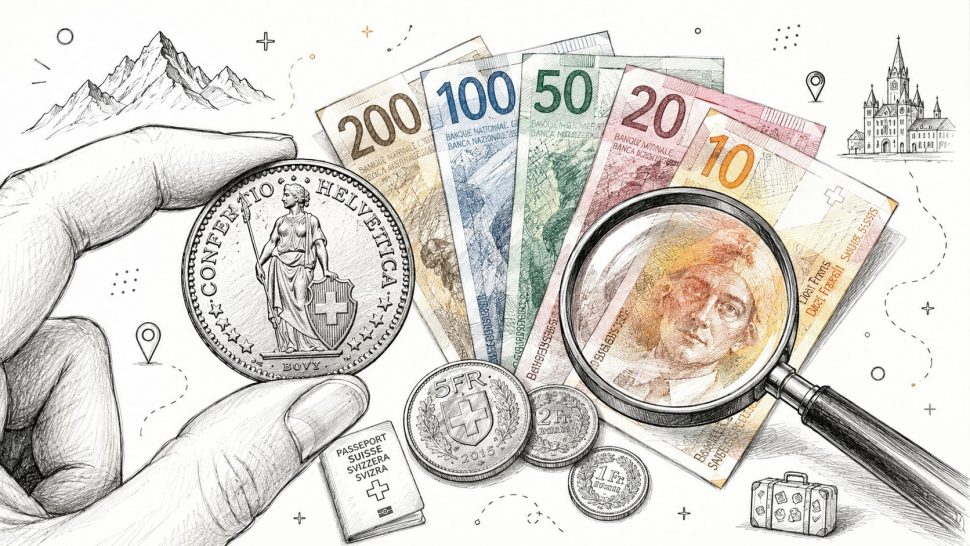
Confoederatio Helvetica is the official Latin name for Switzerland, formally adopted in 1848, and it appears on Swiss coins and banknotes so the country doesn't favour any of its four national languages. If you've found this phrase on leftover Swiss money, the simplest practical route is usually a specialist online service that can handle coins, notes, and even older or withdrawn currency.
That matters because a lot of travellers come home with Swiss francs and then hit a wall. The notes look official, the coins clearly have value, yet the local bank or airport desk often won't touch them, especially if you only have coins or mixed holiday change.
If you searched for Conf Deratio Helvetica, you're almost certainly looking at a misspelling or phonetic version of Confoederatio Helvetica. It still points to the same thing: Swiss currency, Swiss identity, and a very common question in the UK. What can you do with it?
Found Conf Deratio Helvetica on Your Coins
You open a drawer, tip out some travel change, and spot a coin marked Confoederatio Helvetica. If you haven't seen Latin on money before, it can look obscure. In practice, it's a sign that the coin is Swiss.

Swiss francs are a common type of leftover foreign currency in the UK. Data from the Office for National Statistics shows UK residents receive an average of £4.20 in leftover foreign currency per annual trip, with Swiss francs among the top 5 held but least converted because guidance on obsolete denominations is unclear, according to the ONS travel currency data.
What the phrase means on your money
If the wording looks odd, don't assume the coin is fake or commemorative. It's a normal marking used on Swiss money.
What usually confuses people is the gap between identification and exchange. Recognising that it's Swiss is easy. Knowing where to exchange foreign coins or exchange leftover currency is harder, especially when you have a mix of coins and notes from an old trip.
Practical rule: If your Swiss money is real but awkward to exchange, the problem usually isn't the currency. It's the exchange channel.
Why this matters for UK travellers
High-street services tend to focus on current banknotes in popular denominations. They're less helpful when you want to convert foreign coins and banknotes, send mixed currency by post, or deal with older Swiss issues.
That's why many people end up searching for coin-specific help such as coins of the Swiss franc. It's often the first sign that your spare travel money still has value, even if the usual exchange desk won't accept it.
The Meaning Behind Confoederatio Helvetica
The phrase sounds formal because it is. Confoederatio Helvetica is Switzerland's official Latin name, and it was formally adopted in 1848. Switzerland uses it on coins and banknotes because Latin doesn't favour German, French, Italian, or Romansh, the country's four national languages, as explained in Switzerland Facts on File.

Breaking the phrase into plain English
You don't need Latin to understand it.
- Confoederatio refers to a confederation or federation.
- Helvetica refers to Switzerland, drawing on the older name linked to the Helvetii.
- Together, the phrase means Swiss Confederation.
That choice is practical. A multilingual country needs a neutral label for official use. Latin works like common ground. Nobody gets linguistic preference, and the currency keeps a single national identity.
Why you see CH and CHF
Once you know the full phrase, a few common abbreviations make more sense:
- CH points back to Confoederatio Helvetica
- CHF is the international currency code for the Swiss franc
- Swiss coins and notes often use these short forms alongside national symbols
This is why someone may search for Conf Deratio Helvetica, CH currency, or CHF money and mean the same thing.
Think of Latin here as a neutral label on the front door. It tells you whose currency it is without choosing one local language over another.
Why it matters when you exchange money
Understanding the wording helps you identify your currency correctly before you send it anywhere. That matters if you're trying to exchange foreign coins and notes from several trips at once, or if you've found old Swiss francs mixed with euros and other holiday change.
It also explains why Swiss money can look unfamiliar even when it's genuine. The language on the coin isn't a warning sign. It's part of how Switzerland presents itself officially.
How to Exchange Your Swiss Francs in Three Simple Steps
Once you know your coins or notes are Swiss, the next question is practical. How do you turn them into pounds without sorting everything by hand or trekking from one counter to another?

Under the Price Indications (Bureaux de Change) Regulations 1992, UK foreign exchange providers must show rates and any commission clearly before the transaction, so customers can work out what they'll receive, as set out in the UK regulations on bureaux de change pricing. In plain terms, you should be able to see the pricing before you send your money.
Step 1 Get your quote
Start with the currency type and amount. If you're handling Swiss money, that means identifying whether you have coins, current banknotes, or older issues.
A specialist online exchange service is useful here because it's designed for the awkward stuff high-street counters often reject. That includes mixed bundles of holiday cash and cases where you want to exchange leftover currency without splitting every denomination into neat piles first.
Step 2 Send your currency
Pack the francs and send them by post using the provider's process. The practical advantage of a specialist service is that it can accept coins, banknotes, and withdrawn currency in one go, rather than forcing you to separate only the items a bank wants.
This matters if you have:
- Loose Swiss coins from a recent trip
- Old notes found in luggage or a drawer
- Mixed foreign currency from several holidays
- Charity collections or business takings that include overseas money
The easiest exchange process is the one that doesn't make you sort out the provider's limitations before you start.
Step 3 Get paid after verification
After the currency is checked, payment is sent using the provider's available methods. The key thing to look for is clarity. You want the rate shown up front, any deductions explained in advance, and a process that tells you what happens if your parcel contains a mix of accepted and older items.
If you're comparing options, ask three simple questions:
- Do they accept coins as well as notes?
- Do they handle withdrawn currency?
- Do they show the exact rate before you send?
That's the difference between a smooth transaction and a frustrating one.
Why Banks Wont Exchange Foreign Coins and Old Notes
Banks and airport bureaux aren't being awkward for the sake of it. Their systems are built for quick, standard transactions. Foreign coins, old notes, and mixed travel leftovers don't fit that model well.
Swiss francs are an interesting example because the currency itself is strong and liquid. The European Central Bank reference rate listed in the verified data is 0.9234 EUR/CHF, which supports the franc's reputation for stability, as noted in the CHF market reference information. Even so, a stable currency doesn't guarantee that every exchange counter wants to process every physical form of it.
Why high-street providers say no
The biggest issues are operational, not historical.
- Coins are bulky to handle and expensive to process relative to their face value.
- Old or withdrawn notes may require specialist verification.
- Mixed currency bags slow down a counter designed for current notes only.
- Small personal amounts often aren't worth the admin time for a bank branch.
That's why travellers often hear, “We only take notes,” or “We don't accept this series anymore.”
Comparing your Swiss currency exchange options
| Exchange Option | Accepts CHF Banknotes | Accepts CHF Coins | Accepts Old/Withdrawn Francs |
|---|---|---|---|
| Bank branch | Usually current notes only | Rarely | Rarely |
| Airport bureau | Usually current notes only | Usually no | Usually no |
| Specialist online currency buyer | Yes, typically broader acceptance | Yes | Yes, often including withdrawn currency |
The pattern is simple. General providers focus on easy-to-resell currency. Specialists are set up to exchange foreign coins and notes that don't fit the normal retail model.
Where specialist services fit
If you've got leftover holiday money, charity collections, or business takings in foreign cash, specialist services fill the gap banks leave behind. They're also more practical when you want to donate foreign coins to charity, because charities often receive mixed overseas money that ordinary banking channels won't process cleanly.
Common Mistakes to Avoid When Exchanging Currency
People lose value on foreign cash in predictable ways. Most of them are avoidable.
UK currency exchange firms must register as a Money Service Business with HMRC under the 2017 Money Laundering Regulations, which means anti-money laundering controls and identity checks are part of legal operation, according to this guide on HMRC registration for currency exchange businesses. For customers, the practical takeaway is straightforward. Use a regulated provider.
Mistakes that cost people money
- Using an unregulated service. If a business handles foreign exchange in the UK, regulation matters. Check that it operates within the proper framework before sending currency.
- Ignoring coins. Travellers often treat coins as worthless because banks usually refuse them. In reality, coins are often the part specialist services are built to handle.
- Assuming old currency has no value. A note that's been withdrawn from everyday circulation may still be exchangeable through the right channel.
- Sending money without checking the process. You want clear information on accepted currencies, rates, and payment method before you post anything.
- Forgetting mixed bundles. If you've got francs, euros, and other travel money together, choose a service that can process unsorted or mixed currency rather than one that only wants neat, current note bundles.
Sending foreign cash to the wrong place doesn't just waste time. It can leave perfectly exchangeable money sitting in a drawer for years.
A safer approach
Before you convert foreign coins and banknotes, check three basics: regulation, acceptance policy, and transparent pricing. If a provider can't explain those clearly, keep looking.
Frequently Asked Questions About Swiss Currency
Can I exchange foreign coins in the UK if they say Confoederatio Helvetica?
Yes. That wording identifies them as Swiss. The practical issue isn't whether they're real Swiss coins. It's whether the provider accepts coins at all. Specialist services usually do, while banks often don't.
Do UK banks accept Swiss franc coins?
Usually not. Banks generally prefer current banknotes because they're easier to handle and resell. Coins create more processing work, so they're often excluded.
Can I exchange old or withdrawn Swiss franc notes?
Often, yes, through a specialist service. High-street counters may reject older series, but a specialist buyer may still accept them as part of a broader foreign currency service.
What if I have coins and notes mixed together?
That's common with leftover foreign currency. A specialist service is usually the best fit because it can process a mixed bundle instead of asking you to separate only the easiest items.
Can I donate foreign coins to charity instead of cashing them in?
Yes. Some currency exchange services let you turn foreign coins and notes into a charity donation. That's especially useful for old holiday money that would otherwise sit unused.
Do I need to declare leftover holiday money when travelling with it?
For ordinary leftover travel amounts, people usually won't have an issue. If a person carries cash equivalent to €10,000 or more into or out of the UK, they must declare it to customs, as stated in the verified data from UK cash declaration guidance referenced here.
How long does payment take?
Payment timing depends on the provider's process. A specialist online exchange service will normally explain this before you send your currency and again once it has been verified.
Can businesses and charities exchange Swiss francs too?
Yes. This isn't only a traveller problem. Charities, retailers, airports, supermarkets, and even police forces can end up with foreign cash that normal banking channels don't handle well. Specialist exchange services are built for that kind of collection as well as personal travel money.
If you're ready to stop storing Swiss francs in a drawer, We Buy All Currency offers a practical way to exchange foreign coins, exchange leftover currency, or convert foreign coins and banknotes into cash. It accepts coins, banknotes, and withdrawn currency, keeps the process simple, and is built for the situations where banks and exchange bureaux fall short.