
100 Kenyan Shillings Banknote (1978)
£0.296940
1 KES = £0.002969
100 Shilingi / Shill Shilling (Issued 1978)
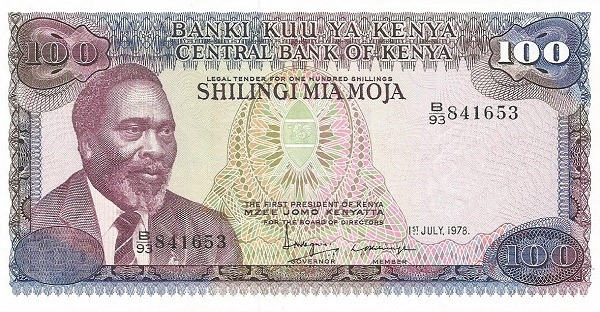
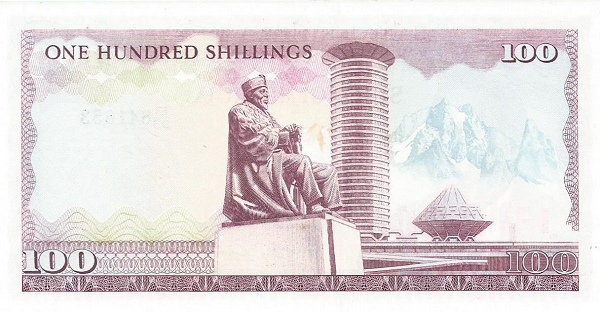
Kenya’s first decade of independence was defined by the towering presence of Mzee Jomo Kenyatta, the founding father who led the nation from colonial rule to sovereign statehood and whose image became inseparable from the Kenyan shilling itself. Issued on 1st July 1978 — Kenya’s fifteenth independence anniversary — this 100 shilling note carries both his portrait and his formal title, rendering it a document of national identity as much as a medium of exchange. The reverse depicts landmarks of Nairobi that symbolised Kenya’s post-independence ambitions: a modern capital rising against the backdrop of the country’s great mountain ranges. For Kenyans of that era, this banknote was a daily affirmation of nationhood and the promise of economic self-determination.
On the front, the dominant feature is a finely engraved portrait of Mzee Jomo Kenyatta, the First President of Kenya, positioned to the left of centre. He is depicted in a suit and appears in a calm, authoritative manner, the engraving rendered with careful tonal shading that gives depth to his facial features and clothing. To the right of the portrait sits a large decorative guilloché rosette or medallion, formed from intricate interlocking geometric patterns in shades of green and orange, providing both visual complexity and an anti-counterfeiting function. The background of the note carries subtle multicoloured geometric line work across the central field, with cross-hatched diamond patterns in mauve and lilac tones extending towards the right-hand margin. The top of the note bears the bilingual issuing authority inscription: “BANKI KUU YA KENYA” in the upper line and “CENTRAL BANK OF KENYA” directly beneath, both printed in dark ink. Centrally, the denomination is stated in Swahili as “SHILINGI MIA MOJA,” with the smaller text “LEGAL TENDER FOR ONE HUNDRED SHILLINGS” appearing above it. The numeral “100” appears prominently in the upper left and upper right corners in a bold serif typeface. Below the portrait, the serial number B/93 841653 appears twice — once to the lower left and once to the upper right of the portrait area — printed in dark ink. A text panel to the right of the portrait formally identifies the subject: “THE FIRST PRESIDENT OF KENYA MZEE JOMO KENYATTA.” Below this appear two facsimile signatures with the designations “GOVERNOR” and “MEMBER,” accompanied by the date “1ST JULY, 1978.” The borders of the note are framed with fine repeated ornamental patterns in mauve and brown tones, with a darker guilloché element visible in the lower right corner.
The reverse is dominated by a large engraved vignette rendered primarily in shades of mauve and purple. To the left stands a prominent bronze-style seated statue of Mzee Jomo Kenyatta, depicted on a tall plinth, the figure dressed in a long robe and cap with one hand resting on his knee. This is the well-known Kenyatta statue that stands outside the Kenyatta International Convention Centre in Nairobi. Behind and to the right of the statue rises the cylindrical tower of the Kenyatta International Conference Centre, its distinctive rounded form and vertical ribbing clearly identifiable. To the right of the tower, a lower domed structure — the plenary hall of the conference centre complex — is also visible. In the background, a mountain range with snow-capped peaks, representing the Kenyan highlands and Mount Kenya, recedes into a lightly printed sky. The top of the note reads “ONE HUNDRED SHILLINGS” in bold capitalised lettering, with the numeral “100” positioned to the upper right. The lower left carries a second “100” numeral. The border design of the reverse is composed of interlocking fine-line geometric patterns in green and mauve, consistent with guilloché security printing. The overall paper tone is cream, with some show-through from the front design visible near the centre of the note.
Sell foreign coins and banknotes the simple way: this 1978 Kenyan 100 shilling banknote can be exchanged through Webuyallcurrency.com together with other old or withdrawn Kenyan Shillings banknotes, all settled in a single transaction.
• Indicate the quantity of 100 Shilingi / Shill Shilling banknotes you want to exchange
• Click the ‘Add to your account’ button
• Your online account now shows the exchange value
Turn forgotten Kenyan Shillings banknotes into money: Webuyallcurrency.com lets you exchange foreign coins and notes — even withdrawn ones — as part of one clear transaction, no specialist knowledge required.
Other Kenyan Shillings you can exchange: 5, 10, 20, 50, 200, 500, 1000.
Fast turnaround
We send your money within 5 working days of receiving your currency.
We’ll send your money by bank transfer, PayPal or cheque. You can also donate your exchange to a charity of your choice.
Easy and convenient
Get paid quickly
After counting your leftover coins and banknotes we’ll pay you within 5 working days. Get your payment quickly via PayPal or bank transfer.
No hidden charges
We don’t have any hidden charges, you will see our rates before you send any notes or coins. You receive the full value of the calculated exchange.
Get rid of currency that’s no longer in circulation
We also exchange discontinued foreign money. You can cash in all pre-euro currency as well as most obsolete currencies from outside the Eurozone.
Benefit from the best exchange rates online
Exchange rates change daily, that’s why we stay on top of the rate fluctuations so we can offer you the best rates for foreign money.
Happiness guarantee
We check your foreign currency and produce a formal quote, if you’re not happy we guarantee to send your currency back to you, absolutely free of charge.
Help out a charity with your exchange
We partner with many of the UK’s amazing charities. If you’d like to turn your old foreign money into a charitable donation, we can help.