
200 Kenyan Shillings Banknote (2003)
£0.588000
1 KES = £0.002940
200 Shilingi / Shill Shilling (Issued 2003)
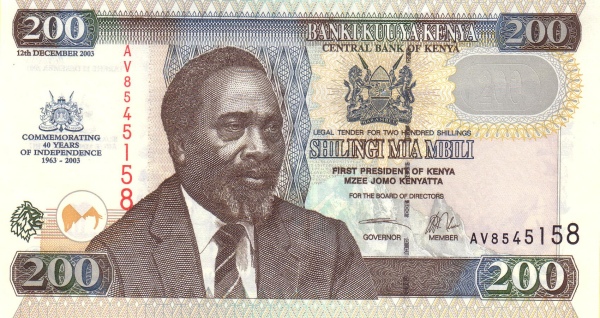
Kenya marked the 40th anniversary of its independence from British colonial rule on 12th December 2003, and the Central Bank of Kenya commemorated this milestone with a special issue of the 200 Shilling banknote. The note was released exactly four decades after Kenya gained independence in 1963, making it one of the most symbolically significant pieces of Kenyan currency produced in the modern era. Bearing commemorative inscriptions in both English and Swahili, it stands as a formal record of national celebration issued through the country’s central monetary authority. The date 12th December 2003 is prominently displayed on the note itself, anchoring it firmly to this historic occasion.
On the front, the note is dominated by a large, finely engraved portrait of Mzee Jomo Kenyatta, the first President of Kenya, positioned to the left of centre against a background of intricate guilloché patterning in tones of blue, purple, and gold. Kenyatta is depicted wearing a suit and tie, rendered with considerable detail in the intaglio engraving, capturing the texture of his clothing and the character of his features with precision. Directly beneath the portrait, the note carries the text “FIRST PRESIDENT OF KENYA MZEE JOMO KENYATTA”, clearly identifying the subject. To the upper left, the commemorative inscription reads “COMMEMORATING 40 YEARS OF INDEPENDENCE 1963 – 2003”, alongside the date “12th DECEMBER 2003” printed near the top left margin. The issuing authority is stated at the top in both Swahili and English: “BENKI KUU YA KENYA” and “CENTRAL BANK OF KENYA”. Centrally positioned to the right is the denomination text “LEGAL TENDER FOR TWO HUNDRED SHILLINGS” above the large stylised Swahili denomination “SHILINGI MIA MBILI”. The Kenyan national coat of arms, featuring two lions holding a shield and crossed spears, appears to the upper right of the portrait. A security thread is embedded vertically within the paper. The serial number AV8545158 appears twice, once vertically in red to the left of the portrait and once horizontally in black at the lower right. Signature lines below the central denomination text read “GOVERNOR” and “MEMBER” with a printed signature for the Governor on behalf of the Board of Directors. To the lower left, a small circular emblem featuring an orange and white motif is visible, likely representing a floral or civic symbol. A large oval watermark window is visible in the upper right area of the note. The denomination numeral 200 appears in each corner, with the lower numerals rendered in a larger, bolder typeface.
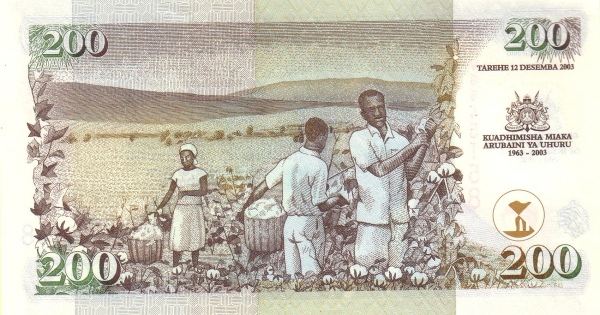
The reverse carries a richly detailed scenic illustration depicting three agricultural workers harvesting cotton in an open field, rendered in tones of green, olive, and pale gold. The central figure, a man, stands tall holding a branch of the cotton plant, whilst two other figures — one of whom appears to be a woman carrying a basket — work alongside him in the field. The cotton plants are depicted in considerable botanical detail, with bolls clearly visible throughout the lower portion of the image. Behind the workers, a gently undulating landscape of fields and low hills stretches to the horizon under a lightly shaded sky, conveying a sense of agricultural abundance and rural Kenya. To the upper right, the commemorative inscription reappears in Swahili: “KUADHIMISHA MIAKA ARUBAINI YA UHURU 1963 – 2003”, accompanied by the date “TAREHE 12 DESEMBA 2003” and the Kenyan coat of arms. A small circular emblem featuring what appears to be a stylised anvil or similar motif in orange and white is positioned below the coat of arms. The denomination numeral 200 appears in all four corners of the reverse in the same bold typeface used on the front. Faint guilloché underprinting in pale green and cream is visible across the background, adding texture and a security dimension to the overall design.
If you have a 200 Shilling banknote to exchange, Webuyallcurrency.com takes it as part of its leftover currency service, combining your Kenyan Shillings banknotes with other world coins and banknotes in one easy payout.
• Indicate the quantity of 200 Shilingi / Shill Shilling banknotes you want to exchange
• Click the ‘Add to your account’ button
• Your online account now shows the exchange value
Webuyallcurrency.com makes it easy to sell foreign coins and banknotes for cash, taking Kenyan Shillings banknotes along with modern and withdrawn currency so everything is converted in one step.
Other Kenyan Shillings you can exchange: 5, 10, 20, 50, 100, 500, 1000.
Fast turnaround
We send your money within 5 working days of receiving your currency.
We’ll send your money by bank transfer, PayPal or cheque. You can also donate your exchange to a charity of your choice.
Easy and convenient
Get paid quickly
After counting your leftover coins and banknotes we’ll pay you within 5 working days. Get your payment quickly via PayPal or bank transfer.
No hidden charges
We don’t have any hidden charges, you will see our rates before you send any notes or coins. You receive the full value of the calculated exchange.
Get rid of currency that’s no longer in circulation
We also exchange discontinued foreign money. You can cash in all pre-euro currency as well as most obsolete currencies from outside the Eurozone.
Benefit from the best exchange rates online
Exchange rates change daily, that’s why we stay on top of the rate fluctuations so we can offer you the best rates for foreign money.
Happiness guarantee
We check your foreign currency and produce a formal quote, if you’re not happy we guarantee to send your currency back to you, absolutely free of charge.
Help out a charity with your exchange
We partner with many of the UK’s amazing charities. If you’d like to turn your old foreign money into a charitable donation, we can help.