
10 Rupees Central Bank Of Ceylon Banknote (Fauna And Flora Series)
£0.013100
1 LKR = £0.001310
10 Rupees Rupee (Issued 1979)
Fine intaglio engraving and a naturalist illustration tradition define the design language of this 1979 Central Bank of Ceylon ten rupee note, placing it firmly within the mid-twentieth-century school of Commonwealth currency design that favoured botanical and zoological subjects rendered with scientific precision. The layout follows a horizontal format with a generous central vignette, flanked by typographic panels and decorative floral borders, reflecting the aesthetic conventions of engravers working in the post-independence period. Both faces are rich with layered colour printing, combining olive greens, warm ochres, and soft browns in a palette that evokes the tropical landscapes of Sri Lanka. The overall composition has a refined, encyclopaedic quality, closer in spirit to a natural history plate than to the purely heraldic imagery common on earlier colonial issues.
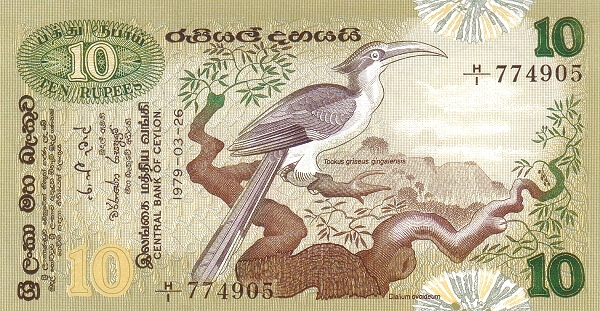
On the front, the dominant feature is a large, finely engraved central vignette depicting a Grey Hornbill perched on a gnarled tree branch, identified by a printed Latin caption reading “Tockus griseus ginginianus” positioned near the bird’s body. The hornbill is rendered in careful detail, showing the characteristic curved and ridged bill, the grey and white plumage of the breast, and the long tail feathers, with the branch extending across the centre of the note in warm brown tones. Behind and beneath the bird, a stylised rocky landscape and foliage in olive green create a naturalistic backdrop, while to the lower right a botanical label reads “Dalium ovoidum”, identifying an accompanying plant detail in the composition. To the far left, a bold green panel displays the numeral “10” set within a decorative circular guilloché frame, with the words “TEN RUPEES” printed in English beneath it, and flanking text in Sinhala script above and Tamil script below. The issuing authority is identified in the centre left area with the text “CENTRAL BANK OF CEYLON” printed in clear Roman type, accompanied by the date “1979-03-26” and signature lines rendered in a flowing script. Sinhala script text occupies a significant portion of the upper banner across the note, with Tamil script text appearing along the left vertical margin. The serial number “H/1 774905” appears twice, once at upper right and once at lower centre, printed in black. To the upper right and lower right corners, the numeral “10” is repeated in bold, and decorative starburst floral motifs in a pale cream-white fill the corners. The background security printing consists of fine guilloché latticework in pale olive, giving the note its characteristic warmth across the paper surface.
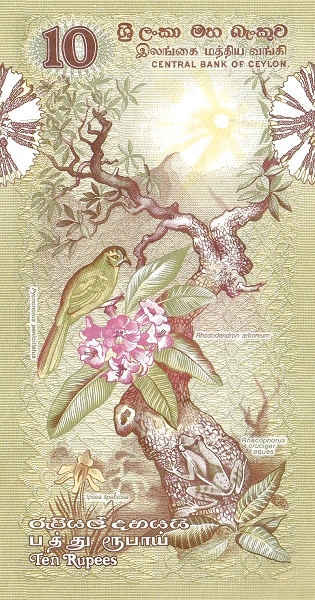
The reverse presents an equally detailed naturalist composition, dominated by a sweeping central scene of a tree with gnarled, textured branches rendered in brown intaglio engraving against a luminous pale background suggesting dappled sunlight filtering through the canopy. A small green bird — a Ceylon White-eye, labelled in Latin as “Zosterops palpebrosus” along the left margin — perches amongst the foliage, and a cluster of pink rhododendron blooms, identified by the caption “Rhododendron arboreum” to the upper right, adds vivid colour to the composition. In the lower portion of the scene, a lizard — identified as “Rhacophorus cruciger squos” in printed Latin text to the right — clings to the bark, its scaled texture engraved with fine precision. A small yellow flower with a botanical label reading “Exacum speciosa” appears in the lower left corner. The upper portion of the reverse carries the issuing bank name in Sinhala script followed by “CENTRAL BANK OF CEYLON” in Roman capitals. At the base of the note, the denomination is stated in Sinhala script, Tamil script, and in English as “Ten Rupees”, arranged in three clear lines. Decorative white floral border motifs, matching those on the front, frame the left and right edges, and the numeral “10” appears prominently in red at the upper left corner.
Looking to exchange leftover currency? Your 1979 Central Bank of Ceylon ten rupee banknote can be sold to Webuyallcurrency.com alongside other old or withdrawn Sri Lankan Rupees banknotes, turning spare money from a trip or collection into cash in one simple transaction.
• Indicate the quantity of 10 Rupees Rupee banknotes you want to exchange
• Click the ‘Add to your account’ button
• Your online account now shows the exchange value
Webuyallcurrency.com buys and exchanges foreign currency of every kind, so your Sri Lankan Rupees banknotes — withdrawn or current — can be sold for cash together with the rest of your leftover coins and notes.
Other Sri Lankan Rupees you can exchange: 0.1, 0.25, 0.5, 1, 2, 5, 20, 50, 100, 200.
Fast turnaround
We send your money within 5 working days of receiving your currency.
We’ll send your money by bank transfer, PayPal or cheque. You can also donate your exchange to a charity of your choice.
Easy and convenient
Get paid quickly
After counting your leftover coins and banknotes we’ll pay you within 5 working days. Get your payment quickly via PayPal or bank transfer.
No hidden charges
We don’t have any hidden charges, you will see our rates before you send any notes or coins. You receive the full value of the calculated exchange.
Get rid of currency that’s no longer in circulation
We also exchange discontinued foreign money. You can cash in all pre-euro currency as well as most obsolete currencies from outside the Eurozone.
Benefit from the best exchange rates online
Exchange rates change daily, that’s why we stay on top of the rate fluctuations so we can offer you the best rates for foreign money.
Happiness guarantee
We check your foreign currency and produce a formal quote, if you’re not happy we guarantee to send your currency back to you, absolutely free of charge.
Help out a charity with your exchange
We partner with many of the UK’s amazing charities. If you’d like to turn your old foreign money into a charitable donation, we can help.