
2 Rupees Banknote (Central Bank Of Ceylon Queen Elizabeth Ii)
£0.002620
1 LKR = £0.001310
2 Rupees Rupee (Issued 1952)
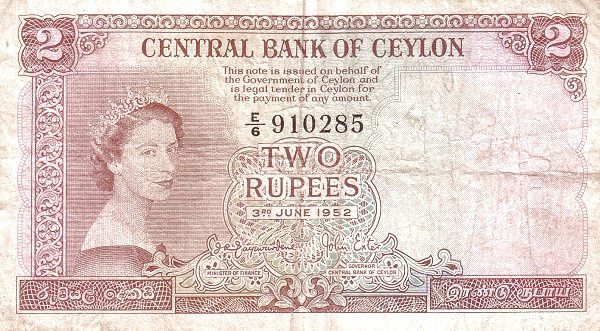
When the Central Bank of Ceylon was established in 1950, it marked a decisive step in the young nation’s journey towards full monetary sovereignty following independence from British rule in 1948. The Bank assumed responsibility for issuing currency, managing foreign reserves, and stabilising the financial system at a time when Ceylon was transitioning from a colonial monetary framework to one governed by its own institutions. The Two Rupees note dated 3rd June 1952 was among the earliest issues to carry the Central Bank’s authority, replacing earlier currency arrangements that had relied upon the Board of Commissioners of Currency. It represents a pivotal moment in which Ceylon’s banking infrastructure was being formally and visibly established in the hands of the Ceylonese state, even as the portrait of the reigning British monarch still graced its face.
On the front, the dominant feature is a portrait of Queen Elizabeth II, rendered in a delicate intaglio engraving style that captures her youthful likeness with fine cross-hatched shading, showing her wearing a tiara and pearl jewellery with her shoulders bare in a formal, elegant pose. The overall colour scheme of the note is a soft rose-mauve or dusky pink, applied across both the printed design and the underlying security paper. The issuing authority is printed prominently at the top in bold serif capitals reading “CENTRAL BANK OF CEYLON”, with the denomination stated clearly in the centre as “TWO RUPEES” in large lettering. The date “3RD JUNE 1952” appears below the denomination text. A legal tender declaration is printed to the right of the portrait in small serif text, stating that the note is issued on behalf of the Government of Ceylon and is legal tender for the payment of any amount. The serial number E/6 910285 appears in red beneath the legal tender clause. Two facsimile signatures appear across the lower central portion of the note, attributed to the Minister of Finance and the Central Bank of Ceylon respectively, with their titles printed in small text beneath each signature. The left and right borders feature ornate vertical panels of guilloché scrollwork and repeating floral motifs, creating a decorative frame around the central design. Along the very bottom of the note, a continuous band of Sinhala script text runs the full width, and a further band of Tamil script text appears directly above it, both providing the denomination and issuing authority in the respective languages. The numeral “2” appears in the upper left corner.
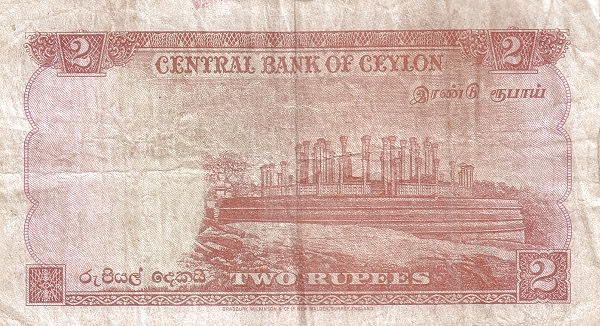
The reverse of the note is printed in the same rose-mauve palette and presents a detailed central vignette depicting an ancient stone temple complex, identifiable as the ruins of Polonnaruwa, showing rows of stone columns and ceremonial structures set against a landscape with rocks and low vegetation in the foreground. The engraving is executed with considerable precision, conveying the texture of the ancient stonework and the surrounding natural environment through fine line work. At the top of the reverse, “CENTRAL BANK OF CEYLON” is printed in the same bold serif capitals as the front, with Tamil script text appearing to the right of this heading. The numeral “2” appears in decorative cartouches in both the upper left and upper right corners of the reverse, framed by guilloché ornamental panels. Along the lower portion, a line of Sinhala script text stretches across the left and centre of the note, followed by the English text “TWO RUPEES” in bold lettering, with a further numeral “2” in a decorative frame at the lower right. The bottom margin carries a small printer’s imprint in English, attributable to Bradbury, Wilkinson and Company of New Malden, Surrey, England. The paper shows some show-through from the front portrait and serial number, and the surface bears the characteristic texture of the period’s security paper stock.
If you have a 2 Rupees Central Bank of Ceylon banknote to exchange, Webuyallcurrency.com takes it as part of its leftover currency service, combining your Sri Lankan Rupees banknotes with other world coins and banknotes in one easy payout.
• Indicate the quantity of 2 Rupees Rupee banknotes you want to exchange
• Click the ‘Add to your account’ button
• Your online account now shows the exchange value
Webuyallcurrency.com buys and exchanges foreign currency of every kind, so your Sri Lankan Rupees banknotes — withdrawn or current — can be sold for cash together with the rest of your leftover coins and notes.
Other Sri Lankan Rupees you can exchange: 0.1, 0.25, 0.5, 1, 5, 10, 20, 50, 100, 200.
Fast turnaround
We send your money within 5 working days of receiving your currency.
We’ll send your money by bank transfer, PayPal or cheque. You can also donate your exchange to a charity of your choice.
Easy and convenient
Get paid quickly
After counting your leftover coins and banknotes we’ll pay you within 5 working days. Get your payment quickly via PayPal or bank transfer.
No hidden charges
We don’t have any hidden charges, you will see our rates before you send any notes or coins. You receive the full value of the calculated exchange.
Get rid of currency that’s no longer in circulation
We also exchange discontinued foreign money. You can cash in all pre-euro currency as well as most obsolete currencies from outside the Eurozone.
Benefit from the best exchange rates online
Exchange rates change daily, that’s why we stay on top of the rate fluctuations so we can offer you the best rates for foreign money.
Happiness guarantee
We check your foreign currency and produce a formal quote, if you’re not happy we guarantee to send your currency back to you, absolutely free of charge.
Help out a charity with your exchange
We partner with many of the UK’s amazing charities. If you’d like to turn your old foreign money into a charitable donation, we can help.