
10 Rupees Central Bank Of Ceylon Banknote (King Parakramabahu I Statue)
£0.013231
1 LKR = £0.001323
10 Rupees Rupee (Issued 1968)
Ceylon’s 1968 ten-rupee note draws directly upon the island’s rich heritage of ancient sculpture and Buddhist-Hindu artistic tradition, placing indigenous art at the very heart of its monetary identity. Issued during a period when Ceylon was asserting a distinctly post-colonial cultural character, the note’s design choices reflect a conscious pride in South Asian civilisation rather than any legacy of British imperial imagery. The Sinhala script prominence across the face of the note further underscores the linguistic and cultural resurgence that defined this era of Ceylonese nationhood. Together, the sculptural and scriptural elements make this a quietly powerful statement of cultural self-determination pressed into everyday commerce.
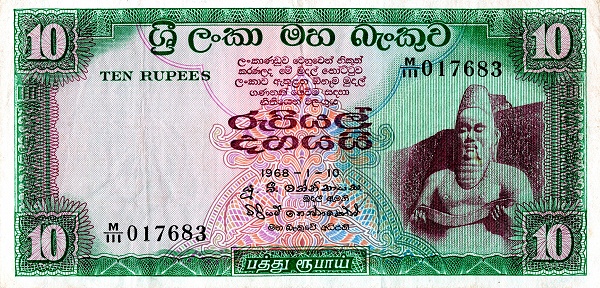
On the front, the note is dominated by a green and teal colour palette, with the numeral “10” appearing in each of the four corners rendered in bold, confident typography. The issuing authority is identified in Sinhala script at the top of the note as “ශ්රී ලංකා මහ බැංකුව” — the Central Bank of Ceylon — and the English denomination “TEN RUPEES” is printed clearly in the upper-left field. To the right-hand side of the note sits a finely engraved portrait of a seated stone figure, rendered in brown-grey tones; this is a depiction drawn from ancient Ceylonese sculpture, widely associated with the iconic seated figure of King Parakramabahu I, the great 12th-century monarch of the Polonnaruwa kingdom, whose image was taken from the celebrated rock sculpture at Potgul Vihara. The central field of the note carries a large overprinted denomination in Sinhala script — “රුපියල් දහයයි” — printed in a vivid red-pink tone that stands prominently against the lighter background. A block of Sinhala text occupies the upper-central area, likely comprising the legal tender declaration and issuing authority details. Below this text block, two signatures appear in Sinhala script alongside their printed designations. The serial number “M/M 017683” appears twice — once in the upper-right corner and once in the lower-left — printed in dark ink against the pale background. A date of “1968 – 1 – 10” is visible in the central lower area, confirming the issue date. The bottom edge of the note carries a further Sinhala script panel reading “පහතු රූපාය” within a framed border, and the overall design incorporates fine guilloché patterning across the background field in pale green, providing a decorative security ground. The border design features repeating geometric and foliate engraved motifs in a deeper green, framing the entire composition.
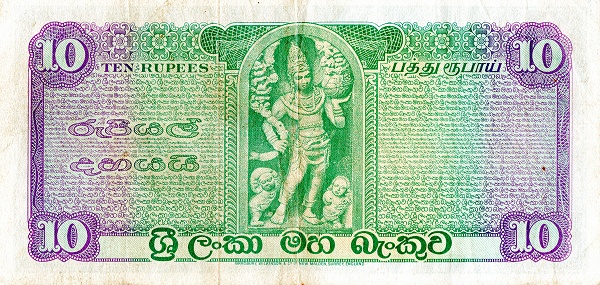
The reverse of the note is printed in a two-colour scheme of deep purple-violet and green, creating a striking tonal contrast. The central and dominant design element is a large, finely detailed engraving of a multi-armed standing deity rendered in green, occupying the full height of the central panel. This figure is consistent in style with representations of the Hindu deity Kataragama (Skanda/Murugan), a figure of profound religious significance in both the Hindu Tamil and Sinhala Buddhist traditions of Sri Lanka, shown in a dynamic posture with multiple arms extended and smaller figures at the base. The engraving is executed with considerable precision, conveying the texture and dimensionality of stone sculpture. Flanking this central image on both left and right are dense panels of repeated text in Sinhala and Tamil scripts, printed in purple-violet, which carry the legal tender declaration repeated across the full width of the note. The denomination “TEN RUPEES” appears in English at the top-left in the purple register, whilst “பத்து ரூபாய்” in Tamil script appears at the top-right. The Sinhala denomination “රුපියල් දහයයි” is printed in larger script in the left-central field. At the base of the reverse, the issuing authority name in Sinhala — “ශ්රී ලංකා මහ බැංකුව” — is rendered in bold lettering across the lower margin. The numeral “10” appears in the lower corners on both sides, and the border carries a continuous pattern of fine ornamental engraving in the purple tone, echoing the decorative framing seen on the front.
Webuyallcurrency.com makes it easy to exchange old coins and banknotes — a 1968 Ceylon Ten Rupees banknote from Sri Lanka is accepted with other old or withdrawn Sri Lankan Rupees banknotes and converted into cash in one go.
• Indicate the quantity of 10 Rupees Rupee banknotes you want to exchange
• Click the ‘Add to your account’ button
• Your online account now shows the exchange value
Got a mix of old coins and banknotes? Webuyallcurrency.com will exchange your Sri Lankan Rupees banknotes alongside other leftover and foreign currency, settling the whole lot in one straightforward transaction.
Other Sri Lankan Rupees you can exchange: 0.1, 0.25, 0.5, 1, 2, 5, 20, 50, 100, 200.
Fast turnaround
We send your money within 5 working days of receiving your currency.
We’ll send your money by bank transfer, PayPal or cheque. You can also donate your exchange to a charity of your choice.
Easy and convenient
Get paid quickly
After counting your leftover coins and banknotes we’ll pay you within 5 working days. Get your payment quickly via PayPal or bank transfer.
No hidden charges
We don’t have any hidden charges, you will see our rates before you send any notes or coins. You receive the full value of the calculated exchange.
Get rid of currency that’s no longer in circulation
We also exchange discontinued foreign money. You can cash in all pre-euro currency as well as most obsolete currencies from outside the Eurozone.
Benefit from the best exchange rates online
Exchange rates change daily, that’s why we stay on top of the rate fluctuations so we can offer you the best rates for foreign money.
Happiness guarantee
We check your foreign currency and produce a formal quote, if you’re not happy we guarantee to send your currency back to you, absolutely free of charge.
Help out a charity with your exchange
We partner with many of the UK’s amazing charities. If you’d like to turn your old foreign money into a charitable donation, we can help.