
1000 Zambian Kwacha Banknote (Paper)
£0.010050
1 ZMW = £0.000010
1,000 Kwacha Zambian Kwacha (Issued 1992-2003)
Zambia’s national identity — forged from its rich wildlife heritage, agricultural ambition, and sovereign pride — found vivid expression in the banknotes circulated during the economically turbulent years of the early 1990s. The One Thousand Kwacha note, issued under the authority of the Bank of Zambia, carried imagery drawn directly from the country’s natural world and its people’s daily working lives. Issued against a backdrop of significant inflation, these large-denomination notes became a defining artefact of a challenging economic era. The 1992 series marked a visual departure that set the tone for Zambian currency design throughout the decade.
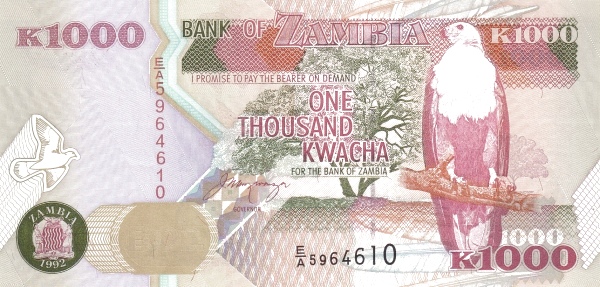
On the front, the note is dominated by a boldly engraved African Fish Eagle — Zambia’s national bird — rendered in deep maroon and reddish-brown tones, depicted perched in profile with its distinctive white head and chest feathers clearly visible, its powerful talons gripping a branch. Behind the eagle, a large spreading tree is illustrated in olive-green engraving, lending a naturalistic, almost pastoral depth to the composition. To the left of the central design, a small white dove appears in relief against a lightly patterned background. The serial number EA 5964610 appears twice — once vertically along the left-hand side and once horizontally across the lower-centre — printed in dark ink on the pale ground. A circular embossed seal in green and gold at the lower left bears the text “ZAMBIA” and the year “1992” surrounding a central motif of what appears to be a traditional woven basket or pot design. The issuing authority is proclaimed in bold serif lettering at the top: “BANK OF ZAMBIA”, flanked on either side by the denomination “K1000” in large characters. The promise clause “I PROMISE TO PAY THE BEARER ON DEMAND” is printed in smaller text across the upper-central field, with the written denomination “ONE THOUSAND KWACHA” in large, stacked serif lettering at the centre, followed by “FOR THE BANK OF ZAMBIA” in smaller type beneath. Two facsimile signatures of Bank of Zambia officials appear in cursive script across the lower-central area. The overall colour palette of the front is a warm combination of rose-pink, pale cream, and olive-green, with fine guilloché latticework visible across the background providing anti-counterfeiting texture. A vertical security thread is embedded within the paper, running parallel to the left serial number.
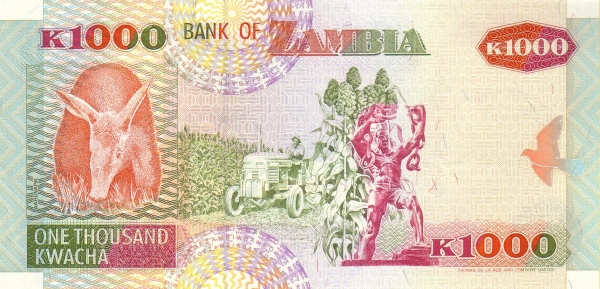
The reverse of the note is printed in a complementary palette of terracotta-orange, green, and pale yellow, and is rich with imagery celebrating Zambia’s agricultural landscape and wildlife. To the left, a large, detailed engraving of an aardvark is prominently displayed, the creature’s elongated snout and rounded ears rendered with fine intaglio precision in warm orange-brown tones against a lightly hatched background. The central panel depicts a rural agricultural scene showing a tractor at work in a field, printed in green tones, alongside a figure — appearing to be a farm worker — carrying a large bunch of crops or foliage above their head, engraved in deep reddish tones that suggest the vibrancy of Zambia’s agricultural productivity. The denomination “ONE THOUSAND KWACHA” is printed in bold serif lettering along the lower-left margin, while “K1000” appears at both the upper-left and lower-right of the reverse face. The heading “BANK OF ZAMBIA” is printed in bold capitals across the top, with the word “ZAMBIA” given particular visual emphasis through its larger scale. A small flying dove motif echoes the front design and appears near the right edge. Fine multicoloured guilloché rosette patterns and wave-form background printing cover the entire reverse field, with circular purple overprint security patterns visible across the design. The printer’s imprint — Thomas De La Rue and Company Limited — is noted in small text at the lower-right margin.
Whether it is a single 1,000 Kwacha banknote or a mix of leftover currency, Webuyallcurrency.com exchanges Zambian Kwacha banknotes and other foreign coins and notes for cash in one straightforward process.
• Indicate the quantity of 1,000 Kwacha Zambian Kwacha banknotes you want to exchange
• Click the ‘Add to your account’ button
• Your online account now shows the exchange value
If you have leftover currency to exchange, Webuyallcurrency.com accepts Zambian Kwacha banknotes and a wide range of other foreign coins and notes, paying out for the lot in a single straightforward transaction.
Other Zambian Kwacha you can exchange: 1, 2, 5, 10, 20, 50, 100, 200, 500, 5000.
Fast turnaround
We send your money within 5 working days of receiving your currency.
We’ll send your money by bank transfer, PayPal or cheque. You can also donate your exchange to a charity of your choice.
Easy and convenient
Get paid quickly
After counting your leftover coins and banknotes we’ll pay you within 5 working days. Get your payment quickly via PayPal or bank transfer.
No hidden charges
We don’t have any hidden charges, you will see our rates before you send any notes or coins. You receive the full value of the calculated exchange.
Get rid of currency that’s no longer in circulation
We also exchange discontinued foreign money. You can cash in all pre-euro currency as well as most obsolete currencies from outside the Eurozone.
Benefit from the best exchange rates online
Exchange rates change daily, that’s why we stay on top of the rate fluctuations so we can offer you the best rates for foreign money.
Happiness guarantee
We check your foreign currency and produce a formal quote, if you’re not happy we guarantee to send your currency back to you, absolutely free of charge.
Help out a charity with your exchange
We partner with many of the UK’s amazing charities. If you’d like to turn your old foreign money into a charitable donation, we can help.