
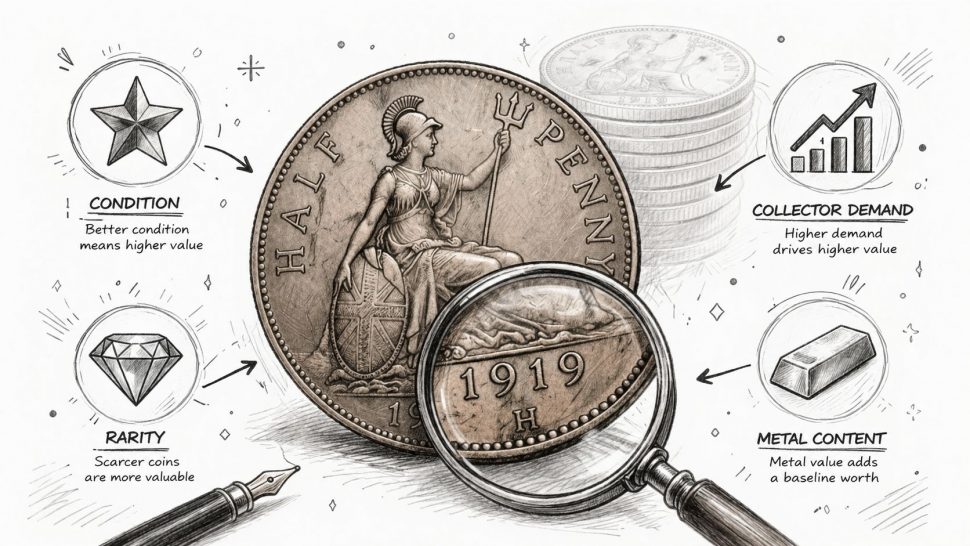
A pre-decimal halfpenny had a fixed face value of 1/2 of one penny, which was 1/24 of a shilling or 1/480 of a pound sterling. In collector markets, the same coin can be worth a few pence or hundreds of pounds, depending mainly on date, rarity, and condition, not the face value printed into its history.
You've probably got a jar, tin, or small pile of old halfpennies in front of you and you're trying to work out whether they're scrap, spendable cash, or something a collector would want. The answer starts with one key point, a half penny coin value is never just one number, because the old UK halfpenny lived in a very different money system and its worth today depends on what it is, when it was made, and how well it survived.
Your Guide to Old Half Penny Coin Values

A jar of old halfpennies can be deceptive. At a glance, they may all look similar, yet the value of each coin can vary a great deal depending on what it is and how it has survived.
Some pieces are common circulation coins with only modest collector interest. Others are the sort of halfpennies that collectors actively search for because they are scarcer, better struck, or in far stronger condition.
The first thing to separate is face value from collector value. The old UK pre-decimal halfpenny was withdrawn from legal tender on 31 July 1969, before decimalisation changed everyday money in Britain British pre-decimal halfpenny). That means many examples no longer have any spendable cash value, even though they may still have worth to collectors.
A common, worn coin often sits near the lower end of the market because there are many similar examples available. A scarcer date or a better-preserved piece can move into a very different price range, because collectors pay for condition, demand, and survival rate as much as for age.
People often expect “old” to mean “valuable”. That is where confusion starts. A coin can have no face value and still be collectible, or it can be historically interesting while remaining plentiful enough that the premium stays small.
The most useful way to judge a halfpenny is to ask two simple questions. What version do you have, and what shape is it in. Once those are clear, the value range becomes much easier to understand, and you can tell whether you are holding a collector's piece or one of the common coins that may still be worth exchanging rather than selling to a dealer.
How to Identify Your Half Penny Coin
A halfpenny jar can be misleading at first glance. Two coins may look similar in a drawer, yet belong to different money systems, and that difference changes how you identify them and how you think about value. The pre-decimal halfpenny and the decimal 1/2p are separate coins, and the decimal version is the one explained in the decimal halfpenny) reference.
Start with the date
The date is usually the fastest way in. A coin dated before 1971 is the old pre-decimal halfpenny. A coin dated 1971 or later is the decimal 1/2p, which was worth 1/200 of a pound and equated to 1.2 pre-decimal pence decimal halfpenny.
That split matters because mixed lots often contain both types. A dealer, collector, or exchange service will not treat them as the same coin, even if they sit in the same tin or envelope.
Check the portrait and wording
The monarch shown on the coin gives you another clear clue. Victorian, Edward VII, George V, and Elizabeth II halfpennies all come from different periods, and each period has its own collector interest and survival pattern. Even when the date is worn flat, the portrait style and lettering often still point you in the right direction.
The wording around the edge can help too. Small details in the legend, bust design, or reverse layout often separate one issue from another, especially when the date is not easy to read. For worn coins, that can be the difference between a common circulation piece and something worth a closer look.
Look at the material and finish
Older pre-decimal halfpennies were bronze in normal circulation issues, while the decimal 1/2p has its own design and specification. The metal is one clue, but it should never be used on its own. A quick magnet check, a clear photo, and a date chart usually sort out most mixed piles without much effort.
Condition matters here too. A coin that is dark, smooth, and heavily worn may still be identified correctly, but it will usually sit in the common end of the market. A sharper piece with cleaner detail is easier to place and is more likely to interest collectors, while the ordinary worn examples may still be suitable for exchange even if a dealer rejects them for resale.
The easiest way to remember it is simple. The date tells you which system the coin belongs to, the portrait tells you which reign it comes from, and the state of the coin tells you whether it is a collector piece or a common halfpenny that is better handled through exchange.

Key Factors That Determine Half Penny Value
A halfpenny's value usually rests on a few linked factors, not one single feature. A common date in poor condition may have little market appeal, while the same type in top-grade condition can sit in a much higher bracket UK halfpenny values. For a quick reality check, that same spread is why one worn coin may be best treated as an exchange piece, while a sharper survivor is worth setting aside for proper valuation.
Condition does most of the heavy lifting
Condition works like a report card for the coin. A heavily worn piece with flat details is not judged the same way as a bright, sharply struck example with original colour. UK price guides say worn common halfpennies are often worth only a few pence to a few pounds, while mint-state red bronze examples can reach £15–£50 UK halfpenny values.
That gap explains why two coins from the same tray can lead to very different outcomes. One may still have enough detail to interest collectors, while another is too worn for resale and is more likely to be handled through exchange instead of the collector market.
Rarity changes the ceiling
Rare dates matter because fewer examples survive for collectors to choose from. That is why some key Victorian and higher-grade Edwardian or George V coins are quoted at £80–£500 in UK-focused guides UK halfpenny values. The date alone does not set the price, but it can place a coin in a very different part of the market.
Rarity also works best when the coin is still attractive. A scarce halfpenny that is badly worn may remain interesting, but a scarce halfpenny with strong detail and a clean surface gives buyers far more reason to compete for it.
Collector demand can push prices higher
A coin does not gain value because it is old. Collectors need to want it, and demand often focuses on attractive types, hard-to-find dates, and especially crisp examples. BullionByPost notes that some historical halfpennies have sold for well over £300, with examples listed from £70 and £240 for rarer early issues BullionByPost.
That is why market interest matters as much as survival. A halfpenny with the right mix of eye appeal and scarcity can attract more attention than a coin that is older on paper but ordinary in hand.
Why two similar coins can price differently
Two coins can share a date and still end up far apart in value. One may be smooth, cleaned, or corroded, while the other keeps its detail and original finish. That is the practical reason a quick glance is not enough for serious valuation.
The easiest way to compare them is to ask a simple question. Does the coin still show sharp design detail, honest colour, and a surface collectors will want to hold? If the answer is yes, the value can move up quickly. If the answer is no, the coin may still have exchange value even when a dealer passes on it for resale.
| Factor | What it changes | What to look for |
|---|---|---|
| Condition | Wear level and visual appeal | Sharp detail, colour, no harsh cleaning |
| Rarity | How many collectors want it | Scarcer dates and survivals |
| Collector demand | Market interest | Popular types, strong competition |
| Coin system | Which halfpenny you have | Pre-decimal or decimal issue |
Notable High-Value Halfpennies to Look For

A few halfpennies deserve a second look because collector value often comes from scarcity, condition, and how attractive the coin still looks in hand. Older coins are not automatically valuable, yet the examples that survive with strong detail and clean surfaces are the ones that tend to draw attention from collectors. An artistic illustration featuring three different half penny coins labeled as Key Date, Gem, and Error.
Victorian pieces often get attention
Victorian halfpennies are a good place to start, especially if the coin still shows clear detail and has not been harshly cleaned. As noted in the key factors, UK price guides place some key Victorian examples in the £80–£500 range when date and grade line up well. That range helps explain why a careful sort is worth doing, even if the coin first looks ordinary.
A useful way to judge one is to ask whether the portrait, lettering, and reverse design still have sharpness that a collector would want to see. If they do, the coin may sit in a very different part of the market from a worn example of the same type.
George V and Edward VII can surprise people
George V and Edward VII halfpennies are easy to overlook because they are not the oldest coins in the tray. Their value can still rise when the coin survives in unusually strong condition, since collectors often pay more for quality than for age alone. As noted earlier, a coin with better preservation can move into a more attractive price bracket than a date that is old but tired in hand.
That is why two coins with the same monarch can feel very different to a collector. One may be a plain circulation piece, while the other keeps enough detail to stand out in a group of mixed coins.
Early and unusual issues deserve a closer look
Dealer guidance also shows that some historical halfpennies have sold for well over £300, with examples starting around £70 and reaching £240 for rarer early issues BullionByPost. That does not make every old halfpenny special, but it does mean an old tin, jar, or inherited mix should be checked before the coins are written off.
A practical approach is to separate anything that looks unusually crisp, unusually early, or noticeably different from the rest. Those are the pieces where collector interest is most likely to appear.
For a broader method that helps you sort what is collectible from what is exchangeable, a guide on how to value old coins is a useful starting point. That matters because many halfpennies are not rare enough for collectors, yet they can still have practical exchange value even when banks and dealers are not interested in buying them for resale.
Clean, sharp, original-looking coins tend to attract far more interest than polished or heavily worn pieces.
Getting an Accurate Valuation for Your Coins
The quickest way to avoid underpricing a halfpenny is to document it properly before you ask for a valuation. Start with the date, the monarch, the coin's condition, and whether it appears cleaned or damaged. A blurry photo can make a coin look much less interesting than it really is.
A simple home check goes a long way. Use a reputable price guide, compare the coin to known examples, and take photos in natural light from both sides. If the date is hard to read, shoot the edge and any lettering close up.
For a practical step-by-step approach, this guide on how to value old coins is a useful starting point. It's especially helpful if you're sorting mixed bags of old money and need to decide what's collectible, what's exchangeable, and what's only worth a small amount.
Professional grading can make sense for a coin that already looks scarce or unusually well preserved. It's less useful for common, heavily worn halfpennies, because the grading fee can outweigh the likely uplift in value. In other words, pay for expertise when the coin gives you a reason to believe the market will care.
A practical checklist
- Photograph both sides clearly so the portrait and date are readable.
- Group by date range to separate pre-decimal coins from decimal 1/2p pieces.
- Set aside standout pieces with strong detail or unusual wear patterns.
- Avoid cleaning the coin, because harsh cleaning can damage collector appeal.
- Compare with multiple listings before deciding whether a coin is special.
How to Sell or Exchange Your Halfpennies
There are three realistic routes for old halfpennies, and the right one depends on what you've got. A valuable coin may suit a collector market, while a mixed pile of common coins usually needs a more practical solution.
Pick the route that matches the coin
Auction houses and specialist dealers are best for the rarer pieces discussed above. They know how to place a coin in front of collectors who care about date, grade, and scarcity. That route can take more effort, but it suits coins with clear numismatic potential.
For common or mixed lots, the problem is different. Many banks and general exchange bureaux don't want to deal with old coins, especially when they're unsorted, damaged, or withdrawn. That leaves people with bags of currency they can't easily use, even if the items still have exchange value.
| Method | Best For | Effort Level | Payout |
|---|---|---|---|
| Collector dealer or auction | Scarce, high-grade halfpennies | Higher | Can be strong for rare coins |
| General bank branch | Modern everyday cash | Moderate | Often limited for old coins |
| Specialist exchange service | Mixed, unsorted old currency | Low | Fast and practical for bulk lots |
| Donate to charity | Coins with no collector focus | Low | Non-cash benefit |
For mixed old coin lots, a specialist exchange route is often the simplest answer. If you're also dealing with leftover holiday money, older notes, or foreign coins that banks won't take, it makes sense to look at a service designed for exchange foreign coins rather than trying to sort everything yourself.
Frequently Asked Questions About Half Penny Coins
A common halfpenny can raise two very different questions. One is whether a specific coin might interest collectors. The other is what to do with the many worn or mixed coins that still carry exchange value, even though banks and dealers may not want them at the counter.
Are halfpennies still legal tender
The old pre-decimal halfpenny was withdrawn from legal tender on 31 July 1969 British pre-decimal halfpenny. It is no longer spendable cash, but it can still matter to collectors if the date, condition, or variety stands out.
What is the value of a 1971 half penny
The 1971 coin is the decimal 1/2p, not the old pre-decimal halfpenny, and it was worth 1/200 of a pound or 1.2 pre-decimal pence decimal halfpenny. That difference matters because the same name can refer to two different coins from two different systems.
Its value today depends on condition and collectability, not just the denomination. A bright, well-preserved example can draw more interest than a worn one, even though both may look similar at first glance.
Can I exchange damaged or worn halfpennies
Yes. Worn coins usually have little collector appeal unless they are a rare date or a notable variety, but they may still be useful in an exchange service that accepts mixed old currency.
That is the practical side many people overlook. A coin can be too ordinary for a collector and still be worth sorting into a bulk exchange lot.
Do banks in the UK accept old halfpennies
Many banks focus on current circulation money and may not help with older or withdrawn coins. If your coins are unsorted, damaged, or out of circulation, a specialist route is often easier than a standard branch visit.
What is the difference between a pre-decimal and decimal halfpenny
As explained earlier, the pre-decimal coin belonged to the old system where 240 pence made a pound, while the decimal 1/2p sat in the newer 1/100 of a pound system. The two coins are related by name, but they belong to different monetary systems and should be checked separately.
That is why date matters so much. A halfpenny in an older jar may be a withdrawn coin from the pre-decimal era, while a later halfpenny is part of decimal currency and follows different value rules.
How can I exchange a large collection of mixed old coins easily
Sort only if you want to spot rare pieces. If your main goal is to turn mixed coins into usable money without a lot of effort, a specialist service for old and foreign currency is the most straightforward option.
This approach saves time when the pile is broad and uneven. You can separate obviously interesting coins for closer checking, then send the rest through a route designed for bulk exchange rather than collector grading.
Do old halfpennies still have value if they're common
Yes, but the value may be modest. As noted in the key factors, common worn examples often sit at the low end of the market, while better coins can be worth far more UK halfpenny values.
That is why condition matters so much. Two coins from the same year can lead to very different outcomes if one is heavily worn and the other still has clear detail.
Should I clean my halfpennies before selling
Usually not. Cleaning can reduce collector interest, especially if the coin is otherwise attractive.
Collectors often prefer original surfaces, even when a coin looks dull. A light film of age is usually less of a problem than scratches or a polished finish that changes the coin's natural appearance.
If you've got old UK coins, leftover holiday cash, or a mixed batch of withdrawn currency, We Buy All Currency offers a simple way to turn it into money without the hassle of sorting. Visit We Buy All Currency to exchange foreign coins and notes, compare your options, and get a fast, straightforward result for coins that banks and dealers often reject.