
New Zealand Coin Guide: Exchange, Value & History
Posted by: Ian Stainton • 26 Jun 2026
If you've got leftover New Zealand coins at home, the most practical route is a specialist online service, because banks and exchange bureaus usually won't take foreign coins. That matters whether you've got current change, mixed banknotes, or older withdrawn currency tucked away in a drawer.
A lot of people end up in the same spot. You come back from New Zealand with a few coins in your bag, or you're clearing a cupboard and find an old purse full of foreign change. It doesn't look like much, but it still feels wasteful to leave it sitting there.
That's where a bit of coin knowledge helps. Some New Zealand coins are everyday money best exchanged through a specialist. Others may be worth a closer look because collector demand can matter just as much as face value. The trick is knowing which is which, and knowing where to go when ordinary banks can't help.
Your Guide to New Zealand Coin Denominations and Designs
You've tipped out a small pile of coins on the table. Some are clearly modern. Some look older. Before you decide whether to exchange foreign coins, keep them, or set a few aside for further checking, it helps to identify what you have.

What coins are in everyday use
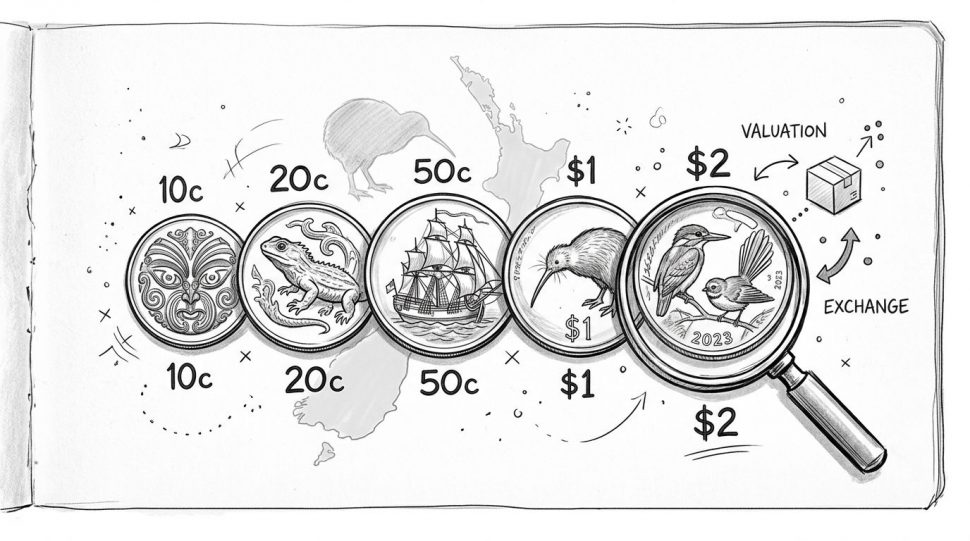
As of 2018, New Zealand's daily circulating coinage consists of five types: 10c, 20c, 50c, $1, and $2. They're all round and use medallic orientation, which helps with stacking and machine handling, as noted by this overview of New Zealand coin denominations.
For a traveller or someone sorting leftover foreign currency, this gives you a simple first check:
- 10c
- 20c
- 50c
- $1
- $2
If your coin fits into that modern set, it's usually everyday spendable money rather than an automatic collector's piece.
Practical rule: Start by separating modern circulating coins from anything that looks clearly older, unusual, or especially well preserved.
Why older coins look different
New Zealand changed its currency on 10 July 1967, replacing the pound with the dollar. The changeover happened at a fixed rate of one pound to two dollars, equivalent to 10 shillings to a dollar, according to the history of coins of the New Zealand dollar.
That date explains a lot of common confusion. If you find coins that don't match today's decimal system, they may come from before the dollar era. If you find very small decimal coins, those may be early dollar coins no longer used.
The same source notes that 1c and 2c coins were minted in large quantities, with 27,500,000 of the 1c and 36,250,000 of the 2c produced before both were withdrawn in 1990. In that same year, the $1 and $2 coins were introduced.
A simple sorting method
Use this quick desk-side method:
- Set aside current coins in the five modern denominations.
- Pull out tiny 1c and 2c pieces if you spot them, because they were withdrawn.
- Group anything pre-decimal separately if it refers to pounds, shillings, or pence.
- Keep unusual regional finds apart, especially if they resemble related Pacific issues such as the currency of the Cook Islands.
Individuals don't need to become coin experts. They just need a clear first pass so they don't accidentally treat a collectible coin the same way they treat common holiday change.
What Determines a New Zealand Coin's Value
A New Zealand coin has at least two possible values. One is its face value as money. The other is its collector value, which depends on what a buyer thinks it's worth.
That's why two coins with the same denomination can lead to very different outcomes. One goes into a standard exchange pile. The other deserves a closer inspection.
Condition matters more than people expect
Collectors often judge coins by condition in much the same way classic car buyers judge mileage, bodywork, and originality. A coin that has been heavily used, scratched, cleaned, or damaged usually attracts less interest than one with crisp detail and little wear.
Look closely at:
- Surface detail. Are the design features still sharp?
- Edges and rims. Heavy knocks can reduce desirability.
- Colour and finish. Unusual shine from cleaning can be a warning sign, not a bonus.
- Signs of circulation. Wear on raised parts often lowers collector appeal.
A circulated coin can still be interesting. It just shouldn't be assumed valuable solely because it's old.
Rarity and mintage are different from age
People often think old means rare. It doesn't. Plenty of old coins survive in large numbers, while some newer ones are much harder to find.
A useful concept here is mintage, meaning how many were made. In general terms, the fewer examples that survive and the more people want them, the more attention a coin gets from collectors.
A coin can be old and common, or modern and hard to find. Age alone doesn't settle value.
Metal content can change the picture
Some coins are sought after because of what they're made from, not just their face value. Historical New Zealand coins, especially pre-1966 proof and commemorative issues, were minted in .925 fine silver, matching UK sterling standards, as explained in this silver fineness guide for New Zealand coins.
That point matters because metal content creates a different kind of interest. A silver coin may appeal to collectors, silver buyers, or both. By contrast, ordinary modern circulating coins are usually valued for exchange convenience rather than intrinsic metal worth.
What to do before you exchange leftover currency
If you're sorting a mixed batch, don't ask “Is this old?” Ask these instead:
- Is it current or withdrawn?
- Does it look unusually scarce or unusual?
- Is it silver or a special issue?
- Is the condition notably better than average?
That approach helps you separate common pieces from coins worth a second look before you convert foreign coins and banknotes.
Rare and Collectible New Zealand Coins to Look For
You tip a handful of New Zealand coins onto the table after a trip or from an old drawer at home. Most are ordinary spending money. One or two may deserve a slower look before they join the rest.

Collectors usually pay attention for three reasons. A coin may have had a short run, a production issue, or a metal content that gives it interest beyond face value. For anyone sorting leftover currency, that distinction matters. You want to spot the few coins that may need specialist handling, then deal with the rest as exchangeable money.
The recalled 1997 two dollar coin
A well-known modern example is the 1997 New Zealand $2 coin. It was recalled after problems with vending machine acceptance, which gave it an unusual place in modern New Zealand coinage. Coins like this show how scarcity can come from a practical hiccup rather than great age.
That catches people out. Many assume the oldest coin in the pile will be the one to keep aside. In practice, a newer coin with a short and troubled release can be harder to find.
Older silver issues
Older New Zealand coins can also deserve a second look, especially if they come from a family collection or an envelope marked by date. Pre-decimal silver pieces are a good example. Their appeal may come from collectibility, silver content, or both.
A few clues suggest a coin should be separated before you cash in the rest:
- It appears to be pre-decimal
- It looks like a proof, commemorative, or presentation issue
- It has been stored in sleeves, folders, or cases
- It came as part of an organised collection, not loose change
Condition matters too. Two coins of the same type can be treated very differently if one is worn smooth and the other still shows crisp detail.
Separate the standout coin from the everyday currency
This is the practical split that helps most. A potentially collectible coin should be checked on its own. Common circulating coins, especially mixed foreign leftovers, are usually better treated as exchange currency rather than as auction material.
A coin collection works a bit like sorting jewellery from pocket change. One item may need appraisal. The rest may need converting into value you can use.
If one coin looks unusual, set it aside first. Then sort the remaining coins and notes as ordinary leftover currency.
Why Banks and Bureaus Wont Exchange Your Coins
People often assume a bank is the obvious place to convert foreign currency. That's sometimes true for current banknotes. It usually isn't true for coins, especially foreign ones.
The reason is practical. Coins are heavy, low in individual value, awkward to count, and expensive to process. A high street bureau has similar problems. It's much easier for them to deal with clean, current banknotes that can be priced and moved on quickly.
Why traditional providers say no
Banks and bureaux change money as a service, but they still have to manage handling costs and operational limits. Foreign coins create several headaches:
- Sorting issues. Mixed coins take time to identify and separate.
- Counting costs. Low-value items still require staff time.
- Storage and transport. Coins are bulky and costly to move.
- Limited resale routes. Older or withdrawn coins can be difficult for mainstream providers to place.
That's why people trying to exchange foreign coins and notes often find that notes are accepted while coins are refused.
Comparing Your Currency Exchange Options
| Currency Type | High Street Bank | Exchange Bureau | We Buy All Currency |
|---|---|---|---|
| Current foreign banknotes | Sometimes accepted | Often accepted | Accepted |
| Foreign coins | Usually not accepted | Usually not accepted | Accepted |
| Mixed coins and notes together | Rarely convenient | Not usually | Accepted |
| Old or withdrawn currency | Often not accepted | Often not accepted | Accepted |
| Unsorted leftover currency | Usually no | Usually no | Yes |
| Charity donation option | Not typical | Not typical | Yes |
Where specialist services fit in
A specialist service exists to solve the exact problems mainstream providers avoid. That includes leftover foreign currency from holidays, coin tubs collected by charities, and tills or donation points that end up with mixed international change.
That's also why these services are used by individuals, charities, and businesses, and trusted by major organisations including charities, supermarkets, airports, and police forces. The appeal isn't novelty. It's that they handle coins, notes, and withdrawn money in one place.
For anyone trying to exchange leftover currency without sorting every piece by hand, that difference is what turns an annoying dead end into a workable process.
How to Exchange Foreign Coins and Banknotes in 3 Simple Steps
Once you've pulled out anything you want to inspect more closely, the rest can usually be handled in one straightforward batch. You don't need a collector's album or a bank appointment. You need a process that accepts mixed currency and doesn't make you sort every coin.

Step 1 Get a quote
Use a specialist service that can handle exchange foreign coins online. The most useful systems let you enter what you have without needing to sort every mixed foreign coin first.
That matters if your New Zealand money is bundled with Euros, US Dollars, old travel leftovers, or withdrawn notes from other trips. A good quote process should feel simple and clear, not like a homework exercise.
Look for these features:
- Exact rates shown before sending
- Support for coins, notes, and withdrawn currency
- No need to separate every denomination
- A clear explanation of payment options
Step 2 Pack and send your currency
Once you accept the quote, package the currency securely and post it. Keep common-sense handling in mind:
- Use a sturdy envelope or small parcel.
- Stop coins moving around inside by wrapping or bagging them.
- Include any reference details the service asks for.
- Double-check that you've kept aside any coin you want independently assessed as a collectable.
This is the point where specialist services are much easier than local options. You're not asking a cashier to inspect a bag of mixed foreign change. You're using a process designed for exactly that.
Send common exchange currency together, but keep obviously collectible coins separate until you've decided whether to sell them as collectables or exchange them as money.
Step 3 Receive payment or donate the value
After verification, payment is issued within five working days by bank transfer or PayPal, based on the publisher information for the service. If you'd rather support a cause, you can also donate foreign coins to charity through the same type of specialist route instead of taking payment yourself.
That flexibility is useful for more than holidaymakers. Charities, airports, retailers, attractions, and businesses often receive mixed foreign currency in donation boxes or through day-to-day trading. A specialist exchange route helps turn that awkward pile into usable value without unnecessary admin.
If you're unhappy with the quote after verification, a strong service should also offer a clear return policy. That kind of reassurance is what makes the whole process feel fast, simple, and hassle-free.
Common Mistakes When Dealing with Leftover Currency
The biggest mistakes usually happen before anyone tries to exchange the money. They happen at the kitchen table, with good intentions and bad assumptions.
Cleaning coins
People often clean old coins to make them look better. That can reduce collector appeal. A bright scrubbed surface may look nicer to you, but it can remove the very signs collectors want to examine.
If a coin might be collectible, leave it as found. Store it safely and get advice before doing anything else.
Assuming old means worthless
Another mistake is throwing old or withdrawn currency into a junk drawer because it no longer circulates. Specialist exchange providers exist because old money can still be exchangeable even when banks won't touch it.
That's especially important with mixed foreign cash. A batch can include current notes, obsolete coins, and withdrawn issues all at once.
Confusing face value with collector value
Some rare New Zealand coins can be worth more than face value, but official redemption doesn't usually reflect that. The Royal Numismatic Society of New Zealand notes that the Reserve Bank in Wellington will redeem coins only at face value, not collector value, which is why specialist exchange services matter when numismatic value may be involved.
That single point catches out a lot of people. They assume an official institution will somehow price rarity. It won't.
Sending everything without checking for standouts
Before you exchange leftover currency, pause for a few minutes and inspect:
- Anything silver-looking and older
- Coins stored with collector paperwork
- Unusual dates or recalled issues
- Proof-style or commemorative pieces
You don't need to overthink every coin. You just don't want to miss the obvious outlier in a bag of ordinary change.
Frequently Asked Questions About Exchanging NZ Currency
A common travel clean-up problem looks like this. You empty a drawer, find a few New Zealand coins, one or two notes from another trip, and then realise your bank probably does not want any of it. That is where the difference between collectible value and exchange value matters most. Some pieces deserve a closer look. The rest can often still be turned into cash through a specialist service.
Can I exchange foreign coins for cash in the UK
Yes. For New Zealand coin and other leftover foreign currency, a specialist exchange service is usually the practical route because it can accept coins, banknotes, and in some cases withdrawn currency too.
Do UK banks accept New Zealand coins
Usually not. Banks sometimes handle selected foreign banknotes, but coins are a different job altogether. They are bulky, costly to count, and hard to send back into circulation, so many banks refuse them.
Can I exchange foreign coins and notes together
Yes. Many specialist services accept mixed batches, which helps if your leftover money is a blend of coins, notes, and currency from different trips. It works a bit like taking mixed recyclables to the right centre instead of trying to process each item at home.
What if my New Zealand currency is old or withdrawn
It may still be exchangeable. That is one of the main reasons specialist providers exist. High street counters often stop at current banknotes, while specialist services are set up to handle older and withdrawn issues as part of their normal process.
Is leftover foreign currency really worth bothering with
In many households, yes. Britons often leave foreign cash sitting unused at home, according to Yahoo Finance's report on unspent foreign currency in UK homes. New Zealand coins may not look like much on their own, but small amounts add up, especially if they have been sitting in a jar for years.
How long does payment take
With the publisher's service model described here, payment is made within five working days after verification, using bank transfer or PayPal. Check the provider's current terms before you send anything, because timelines and payment methods can change.
Do I need to sort coins before sending them
Not always. Some specialist services use a weight-based process for mixed and unsorted currency. That can save a lot of time if you want to cash in leftover travel money without counting every coin by hand.
Can I donate foreign coins to charity instead of cashing them in
Yes. That option suits travellers, schools, retailers, charities, and families who would rather turn awkward spare change into fundraising. If the provider offers a charity route, your foreign coins can still do something useful even if shops and banks will not accept them.
What if I'm not happy with the valuation
A reputable specialist should explain how its quote works and what happens if you decide not to proceed. The publisher information for this article states that unsatisfied customers can have their currency returned free of charge under a happiness guarantee.
Are old British coins different from old New Zealand coins
Yes. Older British coins can follow different metal-value rules from New Zealand issues. For example, MoneySavingExpert's guide to old UK and foreign currency explains that UK coins minted before 1947 contain about 50% silver by weight. That does not mean every old New Zealand coin has the same kind of built-in value, which is why it helps to separate possible collectibles from ordinary leftover currency before you exchange anything.
If you've got New Zealand coins, old banknotes, or a mixed pile of leftover holiday money, We Buy All Currency gives you a practical way to exchange foreign coins and notes, convert withdrawn currency, or turn spare change into a charity donation without the usual hassle. It's a straightforward option when banks and bureaux fall short, especially if you want a simple currency buy back process that works for coins as well as notes.