
Old Currency Converter: Exchange Foreign Cash & Notes
Posted by: Ian Stainton • 4 Jul 2026
You open a drawer looking for batteries and find a small pile of foreign coins, a few old notes, and a sealed bag from a house clearance. None of it is sorted. Some pieces are easy to recognise. Others are a mystery.
That is exactly the kind of collection an old currency converter is meant for.
The process is straightforward. Start with a specialist online tool, enter what you know, use a weight-based option if the coins are mixed or unsorted, then send the currency for valuation and payment. You do not need to identify every coin by hand, and you do not need to rely on a bank or high street bureau that only wants current notes in perfect condition.
Specialist services handle the awkward categories that usually get left behind. That includes mixed coin lots, withdrawn banknotes, pre-euro currency, and older British money that standard exchange counters often refuse.
A lot of UK households have some version of this stash at home. It might be leftover holiday change, notes kept “just in case”, or a box of unfamiliar currency found while clearing a relative's belongings.
The practical advantage is simple. Even if your collection is unsorted, you can still get a realistic valuation and a clear route to cashing it in. For mixed coin collections in particular, a modern converter that accepts weight-based estimates saves a lot of time and removes the usual guesswork.
That Jar of Old Coins Could Be Worth More Than You Think
You tip a jar onto the table and get the usual mix. Euros, a few old pesetas, copper coins you cannot place, and notes that may or may not still be valid. It looks messy, but that does not mean it has no value. It usually means the collection needs the right method.
The sticking point is rarely the amount. It is the sorting.
A bank counter or high street bureau tends to work well only when the currency is current, clearly identified, and in tidy denominations. Real household collections are rarely like that. House clearances, travel leftovers, and inherited tins of coins usually come as mixed batches, and that is where people put them aside for years.
Why forgotten currency matters
As noted earlier, large amounts of foreign cash remain unused in UK homes. A fair share of that total sits in exactly this form. Loose coins, older notes, and mixed collections that never got checked properly.
Three practical points make these collections worth a second look:
- Small amounts combine quickly: Ten different leftovers from ten trips can add up once they are assessed together.
- Older and withdrawn currency can still have value: Exchangeability depends on the currency, its status, and the route used.
- Unsorted coin lots are often mishandled: People try to identify everything one coin at a time, when a weight-based estimate is often the faster starting point.
Practical rule: Keep mixed old currency together until it has been checked by a specialist. Sorting too early often leads to mistakes, missed items, or coins being discarded.
A practical route for mixed collections
If your aim is to turn leftover foreign currency into cash without spending an evening classifying every coin, keep the process simple:
- Separate obvious notes from coins: That gives you a cleaner first pass.
- Group what you can recognise by country: Even rough sorting helps.
- Use a modern converter with a weight-based option for mixed coins: This is especially useful for jars, bags, and unsorted house-clearance lots.
- Send the collection to a specialist for valuation and payment: That route handles the awkward items standard outlets tend to refuse.
- Decide what to do with low-value leftovers: Some people take payment for the exchangeable items and donate the rest to charity.
The main advantage is time. A specialist service can assess a mixed collection in the form it exists, rather than expecting you to turn a biscuit tin of old coins into a perfectly sorted bank deposit first.
What Types of Old Currency Can You Exchange
The phrase “old currency” covers more than is commonly understood. It includes obvious leftovers from travel, but it also includes obsolete coins, withdrawn notes, and historical currencies that disappeared years ago.
The main categories that still matter
Specialist exchange services typically look at several broad groups.
- Current foreign coins and notes: These are still legal tender abroad but awkward to exchange in the UK, especially coins.
- Withdrawn foreign banknotes: Some notes are no longer in circulation but may still be redeemable or exchangeable through specialist channels.
- Pre-euro currencies: Old francs, marks, lira, pesetas, punts and similar legacy currencies often sit untouched for years.
- Pre-decimal British money: Old UK coins can still hold exchange or collector interest depending on what they are.
- Mixed unsorted collections: House clearances, charity donations, and business accumulations often include several currencies together.
Old British currency still causes confusion
Pre-decimal British currency is the classic example. The old £sd system had 20 shillings in a pound and 12 pence in a shilling, for 240 pence in one pound, and it stayed in use for over 700 years until decimalisation on 15 February 1971. Old coins such as the penny and threepenny were then demonetised by August 1971, although they can still hold value through specialist services, as explained in this overview of decimalisation in Britain.
That's why old shillings, florins, half crowns, pennies, and mixed pre-decimal lots keep turning up in exchange enquiries. They're obsolete in everyday spending terms, but not automatically worthless.
Why banks and exchange counters say no
Banks and standard exchange bureaus usually reject these items for practical reasons:
- Coins are expensive to handle: Low face value and manual processing make them unattractive.
- Withdrawn currency needs specialist knowledge: Staff need to know dates, issuers, and redemption status.
- Mixed collections slow everything down: A bag of random coins doesn't fit a quick counter service.
- Demand is narrow: High street outlets focus on fast-turnover travel money, not awkward holdings.
Here's the practical difference.
| Currency Type | High Street Bank | Post Office | Specialist Service (like ours) |
|---|---|---|---|
| Current foreign banknotes | Sometimes accepted | Sometimes accepted | Usually accepted |
| Foreign coins | Usually not accepted | Limited or not accepted for exchange | Accepted |
| Withdrawn foreign notes | Usually not accepted | Usually not accepted | Accepted |
| Pre-euro currency | Often refused | Often refused | Accepted |
| Old British pre-decimal coins | Usually not accepted | Not standard for exchange | Accepted |
| Mixed unsorted coin collections | Not suitable | Not suitable | Accepted, including weight-based valuation |
Most frustration comes from taking specialist currency to non-specialist outlets and expecting a standard counter service to handle it.
That's also why people searching for ways to exchange foreign coins or exchange foreign coins and notes usually end up needing a dedicated service rather than a bank branch.
How Our Old Currency Converter Works A Step-by-Step Guide
A typical job starts the same way. Someone tips out a jar, tin, or drawer full of mixed coins and old notes, then realises sorting it all by country and denomination would take longer than the exchange itself.
That is exactly why the process is built around practical identification first, not perfect preparation.
Start with what you have
Begin by separating obvious notes from coins and removing anything clearly damaged, counterfeit, or non-currency. After that, there is no need to arrange every coin into neat piles before you check value.
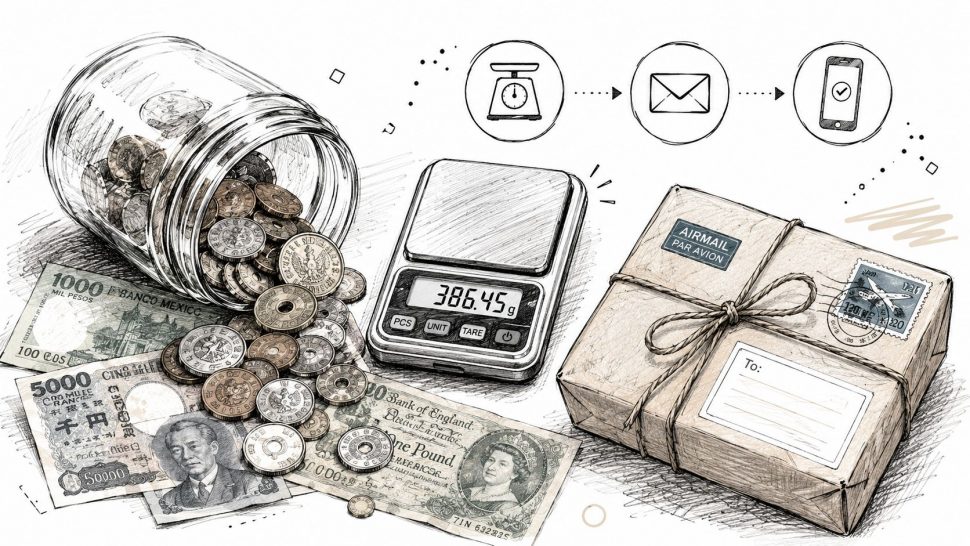
For straightforward banknotes, you can usually identify the currency by country, design, or face value and enter the amount directly. For mixed coin lots, the faster route is often a weight-based tool. It is designed for a real-world problem generic guides often skip. Old travel money and inherited collections are rarely sorted, and many people do not know every denomination in the bag.

Use the right route for the currency
There are usually two routes.
For notes or clearly identified coins, enter the currency and quantity to get a quoted rate.
For unsorted mixed coins, use the weight-based option. This saves a lot of time and usually reduces mistakes caused by guesswork. It is especially useful for:
- Leftover foreign coins from several trips
- Mixed family collections that include different countries and dates
- Charity donations gathered in tubs or collection boxes
- Inherited jars of coins where sorting every piece is not worth the effort
The trade-off is simple. A hand-counted, fully sorted submission can be precise, but it takes more time. A weight-based submission is faster and far more practical for bulk mixed lots.
Accept the quote and send the currency
Once you are happy with the quote, pack the currency securely, include the requested details, and post it to the specialist service. Keep mixed lots together unless the instructions ask you to separate them. In our experience, people lose time by over-sorting the wrong way, especially with pre-euro coins or older foreign denominations that look similar.
If you want a clear overview of the posting and payment stages, our guide to how the currency exchange process works shows each step.
Verification and payment
After the parcel arrives, the contents are checked against the submission. Payment is then issued by the selected method, such as bank transfer or PayPal. Some services also let you send the proceeds directly to charity.
The main benefit of using a specialist is not just convenience. It is that the process is built for awkward currency from the start, including mixed coins, obsolete notes, and collections that would be impractical to sort by hand.
Understanding the True Value of Your Old Currency
People usually ask a simple question. “What's this old money worth?” The answer is rarely one-dimensional.
Three different kinds of value
Old currency can carry value in three separate ways:
Exchange value
This is the practical conversion value based on whether the currency can still be redeemed or exchanged.Metal value
Some coins are worth more because of what they're made from, not just what was stamped on them.Collector value
Rare dates, unusual errors, strong condition, and specialist demand can push a coin into numismatic territory.

Why metal content matters
Many people miss important value because UK coins minted before 1947 contain approximately 50% silver by weight, which means their intrinsic metal value is often significantly higher than face value, as noted in this guide to getting paid for old UK and foreign currency.
That doesn't mean every old coin is a hidden treasure. Most aren't rare collector pieces. But it does mean you shouldn't assume face value tells the full story.
What a fair assessment looks like
A sound old currency converter should look at the full picture, not just one angle.
- Exchangeable status: Is the note or coin still redeemable through official or specialist channels?
- Material content: Does the coin contain silver or other metal that affects worth?
- Condition and rarity: Is it common circulation material, or something a collector may view differently?
Some old money is worth less than people hope. Some is worth more than they expect. The only reliable approach is proper identification and valuation.
That's also why general second-hand outlets can be a poor fit. One buyer may treat everything as scrap. Another may only care about collectables. A specialist old currency service tends to be more useful because it starts with the practical aim of converting what can be converted and flagging items with added value when relevant.
If you want a clearer idea of how these categories affect pricing, the guide on how much old currency is worth is a sensible place to start.
Common Mistakes and Real-World Success Stories
Most disappointment in old currency exchange comes from avoidable mistakes, not from the currency itself.
The mistakes that waste value
People often do one of four things.
- They bin the coins: This happens with low-denomination foreign change that looks too awkward to bother with.
- They spend hours sorting unnecessarily: Mixed collections can often be valued without hand-sorting every piece.
- They go straight to a bank: That usually works only for a narrow range of current notes.
- They assume old means worthless: Withdrawn or obsolete doesn't automatically mean valueless.

What successful exchanges look like in practice
A charity collection is a good example. Donation buckets and airport collections often contain a jumble of foreign coins, notes, and outdated currencies. A standard bank route won't handle that well. A specialist route can turn the pile into a usable donation without asking volunteers to become currency sorters.
House clearances are another common scenario. Someone finds envelopes of pre-euro notes, old Irish cash, and British coins tucked into drawers or books. The family usually wants a clean, fair way to deal with everything in one go, rather than piecing it out through multiple channels.
Businesses run into this too. Tourist attractions, retailers, airports, and charities often receive foreign cash in error or as donations. They don't want to hold unusable money on-site, and they definitely don't want staff spending time trying to identify every coin. A specialist exchange process is built for exactly that kind of backlog.
Why specialist handling changes the experience
The practical advantages are straightforward:
- No need to sort mixed coins by hand
- Coins, notes, and withdrawn currency can go through one route
- Individuals, charities, and businesses can all use the same basic process
- Payment or charity donation can be chosen at the end
That last point matters more than many people expect. Sometimes the right outcome isn't personal cash at all. It's turning forgotten foreign money into a simple donation.
Frequently Asked Questions About Old Currency Exchange
A typical enquiry starts the same way. Someone has a jar, tin, or drawer full of mixed coins and a few old notes, and they want to know whether any of it can still be turned into money. In many cases, yes. The key is using the right route for the type of currency you have, especially if it is unsorted.
Can you exchange foreign coins in the UK
Yes, but specialist services are usually the realistic option. Ordinary banks and travel money counters rarely handle foreign coins, especially low denominations or mixed batches. If the collection is unsorted, a service that can assess coins by weight is often the quickest way to get a usable valuation.
Do banks accept foreign coins and old notes
Usually not in any helpful way. High street banks tend to deal with current banknotes, and even that can depend on the branch and the account you hold. Foreign coins, pre-euro notes, withdrawn currency, and mixed old collections are much better suited to a specialist exchange.
Can old or withdrawn currency still have value
Yes. Some can still be exchanged through the original issuer. Some has value because of metal content or collector demand. Some has only modest exchange value, but that still makes it worth checking before it sits in storage for another few years.
What if my coins are all mixed together
That is common, and it is exactly why weight-based old currency tools are useful. Instead of asking you to separate every coin by country and denomination, the process can start with the collection as it is. That works well for inherited jars, charity collections, office coin tubs, and holiday change that has built up over time.
Can I exchange old Bank of England notes
Yes, in many cases. As noted earlier, old Bank of England notes can still be exchanged through the Bank of England, and some Post Office routes may also help depending on your circumstances. The practical point is simple. This applies to Bank of England notes only, not old foreign notes or obsolete coins.
Does the Bank of England take foreign currency too
No. It only deals with notes it issued itself. If you have old foreign notes, you usually need either the central bank or issuer in that country, or a specialist service that handles outdated foreign currency. Guidance on that process is outlined in Wise UK's article on what to do with old foreign currency.
How long does payment usually take
That depends on the service and on what you send in. With a specialist postal exchange, payment is normally made after receipt and verification. Mixed collections can take a little longer to assess than clearly sorted current notes, but the process is still much simpler than trying multiple banks, bureaux, or country-specific issuers yourself.
Can I donate foreign coins to charity instead of being paid
Yes. Many people prefer that option, especially for low-value mixed coins that are awkward to sort. It is also a practical fit for fundraising collections, memorial donations, and travel change that would otherwise be left unused.
Do I need to clean or polish old coins first
No. Leave them in the condition you found them. Cleaning can reduce collector value and can make proper assessment harder. Bag them securely and send them as they are unless the exchange service tells you to do something different.
Ready to Convert Your Leftover Currency
A jam jar of mixed coins, a few old notes from past trips, and some inherited change from countries you have never visited can look like a job for another day. In practice, it is usually much simpler than people expect once it goes through a specialist process built for old and unsorted currency.
The main advantage is straightforward. You do not need to guess what is still exchangeable, sort every coin by country, or waste time asking high street banks that often will not handle obsolete foreign money at all. A specialist service can assess mixed collections properly, and a modern weight-based converter gives you a practical starting point for bulk coin values when counting piece by piece would be slow and unreliable.
That matters most with the awkward collections. Holiday leftovers mixed across several currencies. Charity tins. Business takings. Family collections where notes, coins, and withdrawn issues have all ended up in one box. Those are exactly the cases where specialist handling saves time and usually recovers value that would otherwise sit unused.
If you are ready to turn old currency into cash or a charity donation, gather it as it is, bag it securely, and use the specialist route already outlined earlier. It is the simplest way to get an unsorted collection valued on realistic terms and converted without doing all the sorting work yourself.