
Size of a 2 Pound Coin: A UK Guide to Its Dimensions
Posted by: Ian Stainton • 30 Jun 2026
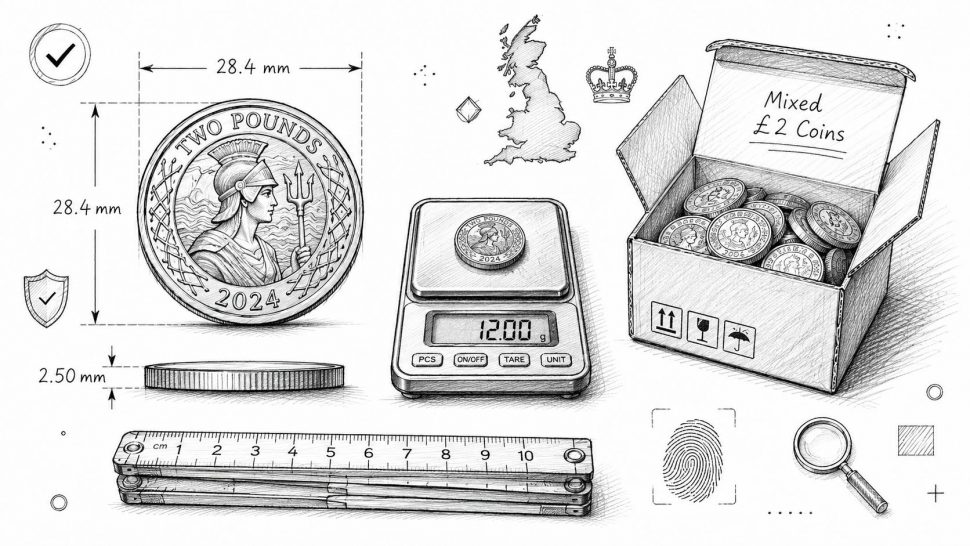
A modern UK £2 coin measures 28.4mm across, 2.5mm thick, and weighs exactly 12.0 grams. If you're checking a coin from an old jar, though, that answer only applies to the current bi-metallic version introduced in 1998, and that's where many people get caught out.
If you've just emptied a drawer, a holiday money pot, or a tin of mixed change, you're probably not only asking about the size of a 2 pound coin. You're also wondering whether the coin is current, older, unusual, or worth exchanging. That's a sensible question, because coins that look similar at a glance can belong to different issues, and that affects how you identify them and what you do with them next.
Your Guide to the UK Two Pound Coin
A £2 coin is one of the easiest UK coins to recognise. It's the highest-value coin in everyday UK circulation, while the pound sterling is divided into 100 pence and standard circulating coins include 1p, 2p, 5p, 10p, 20p, 50p, £1, and £2 according to this guide to British money.
That sounds simple enough until you find a mixed batch of coins and realise not every £2 coin is the same type. Some people check the width, see that it looks right, and assume that's all they need. It isn't.
Practical rule: When you're checking the size of a 2 pound coin, don't rely on diameter alone.
Quick Answer
The modern UK £2 coin has a diameter of 28.4mm, a thickness of 2.5mm, and weighs exactly 12.0 grams.
This is for the current bi-metallic coin introduced in 1998.
That distinction matters if you're sorting old UK money, collecting coins, or trying to exchange leftover currency alongside foreign coins and notes. The old and new £2 coins share one key measurement but differ in another important one, which is why people often misidentify them when valuing mixed change.
If you want a broader size comparison across UK denominations, this guide to the size of British coins is a useful companion.
The Two Pound Coin Explained A Detailed Look
The current circulating £2 coin has a very specific set of official measurements. According to the Royal Mint's two pound coin specifications, the modern coin was introduced in 1998 as a bi-metallic issue, has a diameter of 28.4 millimetres, weighs 12.00 grams, and has a thickness of 2.50 mm. The outer ring is Nickel Brass (76% copper, 20% zinc, 4% nickel) and the inner disc is Cupro-Nickel (75% copper, 25% nickel).
The detail most guides skip
A lot of search results answer the size question with the modern dimensions and stop there. That's fine for everyday use, but it leaves out a common source of confusion.
Before the current design, the UK issued single-metal £2 coins from 1986 to 1997. Those older coins had the same 28.40 mm diameter but were heavier at 15.98 grams, as explained in this guide to old pre-1997 two pound coins.
Here's the comparison that helps most:
| Specification | Single-Metal (1986-1997) | Bi-Metallic (1998-Present) |
|---|---|---|
| Diameter | 28.40 mm | 28.4 mm |
| Weight | 15.98 g | 12.00 g |
| Thickness | Not stated in the verified data | 2.50 mm |
| Composition | Nickel Brass | Outer ring: Nickel Brass. Inner disc: Cupro-Nickel |
| Appearance | Single-metal | Bi-metallic with contrasting centre and ring |
Why collectors notice this quickly
If you handle coins often, the difference is obvious. The older single-metal £2 feels more solid in the hand. The modern bi-metallic version feels lighter, and the two-tone design is easy to spot.
Collectors also pay attention to particular issues. Among circulating modern £2 coins, the 2002 Northern Ireland Commonwealth Games commemorative had a mintage of 485,500, making it the rarest circulating version listed in the verified data. For the older single-metal series, the 1989 Claim of Right £2 had a production of 381,400.
A coin can share the same width as another coin type and still be a different issue entirely.
That's why a search for the size of a 2 pound coin often leads to a bigger question. You're not just identifying a coin. You're deciding whether it belongs in current change, a collector's tray, or a pile of leftover currency to exchange.
Why Size and Weight Matter for Your Coins
People often treat coin dimensions as trivia. In practice, they're one of the fastest ways to check what you're holding.

Authentication starts with physical checks
The Royal Mint's modern £2 specification isn't broad or approximate. Genuine bi-metallic £2 coins must weigh within 12.00 g ± 0.05 g and measure 28.4 mm in diameter to meet the official standard, as set out by the Royal Mint in its published specifications already referenced above.
That matters for more than collecting. Coin-operated systems, counting processes, and manual checks all rely on consistent physical properties. A coin that looks right but feels too heavy or too light deserves a closer look.
The common mistake is relying on width alone
MyCoinage notes in its guide to £2 coin values in the UK that both the current bi-metallic £2 and the pre-1997 single-metal version share the same 28.4 mm diameter, but differ in weight. The modern coin is 12.0 g and the older one is 15.98 g.
If you only check diameter, you can misidentify the coin. That can lead to confusion during valuation searches, especially when someone is sorting mixed UK currency, old change, or coins gathered over many years.
For anyone handling unsorted bags of money, weight matters in a very practical way too. Specialist services that exchange foreign coins, convert foreign coins and banknotes, or process leftover foreign currency often deal with mixed batches rather than neatly sorted trays. In that context, accurate coin specs help separate current issues, older issues, and items that need extra review.
If you want a focused look at the weight side of the question, this page on how much a two pound coin weighs adds useful context.
Four practical reasons this matters
- Authentication: Accurate measurements help verify whether a coin matches official standards.
- Machines and counters: Coin handling systems depend on consistent size and weight.
- Valuation checks: Similar-looking coins can belong to different issues.
- Mixed currency exchange: Physical sorting becomes easier when coin types are clearly understood.
How to Exchange Leftover Coins and Notes Hassle-Free
A lot of people start with one UK coin question and end up facing a much bigger pile of money. There might be euros from a city break, dollars from a work trip, old kuna, pre-euro change, obsolete notes, and a few British coins mixed in for good measure. That's where ordinary exchange options often stop being helpful.
Banks and bureaux de change usually focus on current banknotes in major currencies. Coins are harder for them to handle. Older or withdrawn currency is even more awkward. Handling, counting, storage, and resale all take extra work, so many mainstream options refuse them.

A simple way to deal with mixed currency
If you want to exchange foreign coins and notes without turning your kitchen table into a sorting desk, specialist postal services are often the easiest route. They're designed for mixed collections, including coins, notes, and older withdrawn money that high street providers often won't accept.
That's especially useful for:
- Travellers: Leftover holiday money in several currencies.
- Families: Old drawers of notes and coins from years of trips.
- Charities: Donated foreign currency from supporters.
- Businesses: Coins and notes accepted in error through tills, collection points, or donation boxes.
You don't need to treat every coin like a collector's item to get value from it. Most people simply need a reliable route to exchange leftover currency without sorting every piece by hand.
How the process usually works
Check what you have
Gather your coins and notes. Include current money, leftover foreign currency, and older withdrawn issues that may still be exchangeable through a specialist service.Get a quote or rate confirmation
Good specialist services tell you the rate before you post. That helps you decide whether to proceed.Pack the currency securely
For UK post-based foreign currency exchange, packages under 5 kg can be sent via Royal Mail or a trusted courier, with tracked options such as Tracked 24 or 48 recommended for security according to Cash4Coins guidance on posting currency.Send without over-sorting
One of the biggest practical benefits is that you can often send mixed coins and banknotes together. That's ideal if you want to exchange foreign coins and notes without spending an evening organising them.Verification and payment
After receipt and checking, payment is issued using the method you choose. If you're comparing services, also look at whether they handle current notes only or offer a proper currency buy back route for coins and older money too.
Why specialists fill the gap
Banks can be useful for straightforward note exchange in a major live currency. They're less helpful when you want to exchange foreign coins, exchange leftover currency from multiple countries, or convert foreign coins and banknotes that are no longer current. Specialist services exist because this is a separate job.
They're also used by individuals, charities, and businesses, and they're the kind of service major organisations rely on when ordinary banking channels don't fit. That includes settings such as charity collections, retail environments, airports, supermarkets, and even police-held property processing.
Common Mistakes to Avoid When Handling Old Currency
Small mistakes can cost you money. Most don't happen because people are careless. They happen because old coins and notes look unimportant.

Mistake one, assuming old coins are worthless
That's often wrong. MoneySavingExpert notes in its guide to old UK and foreign currency that UK coins minted before 1947 contain approximately 50% silver by weight, while coins from before 1920 are sterling silver with 92.5% purity. That means some older UK coins can be worth far more than face value because of their metal content.
So if you inherit a tin of older British coins, don't spend them blindly and don't throw them away.
Mistake two, cleaning coins before checking them
This is a classic error. People polish coins because they want them to look nicer. For exchange or collector interest, cleaning can be unhelpful. Dirt and wear tell part of the coin's history. Harsh cleaning can damage surfaces and reduce appeal.
A better approach is simple:
- Handle gently: Hold coins by the edges where possible.
- Store dry: Keep them away from damp conditions.
- Separate unusual pieces: If a coin looks older, heavier, or different, keep it aside for a closer look.
Mistake three, taking everything to a bank first
That works for some current notes. It often fails for coins, obsolete currency, and mixed international change. Many people lose time by carrying bags of money from branch to branch only to be told the same thing repeatedly.
Real-world situations where people get stuck
- Holiday leftovers: A family returns with mixed euro coins, US cents, and a few notes that no local branch wants.
- Charity collections: Donation tins fill up with coins from many countries, plus old withdrawn notes.
- House clear-outs: A relative leaves behind old UK coins, pre-decimal items, and foreign cash from past travel.
In those situations, specialist exchange services or charity donation routes are usually far more practical than mainstream banking.
Frequently Asked Questions About Exchanging Currency
Can you exchange foreign coins in the UK?
Yes, but usually not through ordinary banks or standard travel money counters. Specialist services are often the best option if you want to exchange foreign coins, especially mixed or low-value denominations.
Do UK banks accept foreign coins?
Often, no. Banks are more likely to deal with selected current banknotes than foreign coins. Coins are bulky, costly to process, and difficult for many branches to handle.
Can I exchange foreign coins and notes together?
Yes. Specialist services can often exchange foreign coins and notes in one go, which is useful if you've got a pouch of mixed travel money rather than neatly separated currency.
Is old or withdrawn currency still worth anything?
Sometimes, yes. Some withdrawn currencies remain exchangeable through specialist channels. Some older UK coins also have value because of their metal content or collector interest.
Do I need to sort coins before sending them?
Not always. Some specialist services are designed for mixed, unsorted currency, which makes it much easier to exchange leftover currency from multiple trips or collections.
How long does payment usually take?
Payment for exchanged foreign currency and pre-decimal or withdrawn coins is typically issued within 5 working days after verification, with payment available by bank transfer, PayPal, or cheque, and rates confirmed before dispatch according to Leftover Currency's payment guidance.
Can I donate foreign coins to charity instead of cashing them in?
Yes. If you'd rather donate foreign coins to charity, some specialist services let you direct the value of your exchange to a partnered charitable cause.
What's the easiest option for leftover holiday money?
It is a specialist postal exchange service that accepts coins, banknotes, and older withdrawn currency in one process. That removes the hassle of trying several banks or bureaux de change that only take selected notes.
If you've got a jar of mixed change, old notes from past trips, or coins that banks won't take, We Buy All Currency gives you a simple way to convert them into cash. You can exchange foreign coins, convert foreign coins and banknotes, or turn leftover holiday money into a charity donation through one specialist service built for the currencies most high street providers refuse.