
Sovereign Coin Worth: Your 2026 Valuation Guide
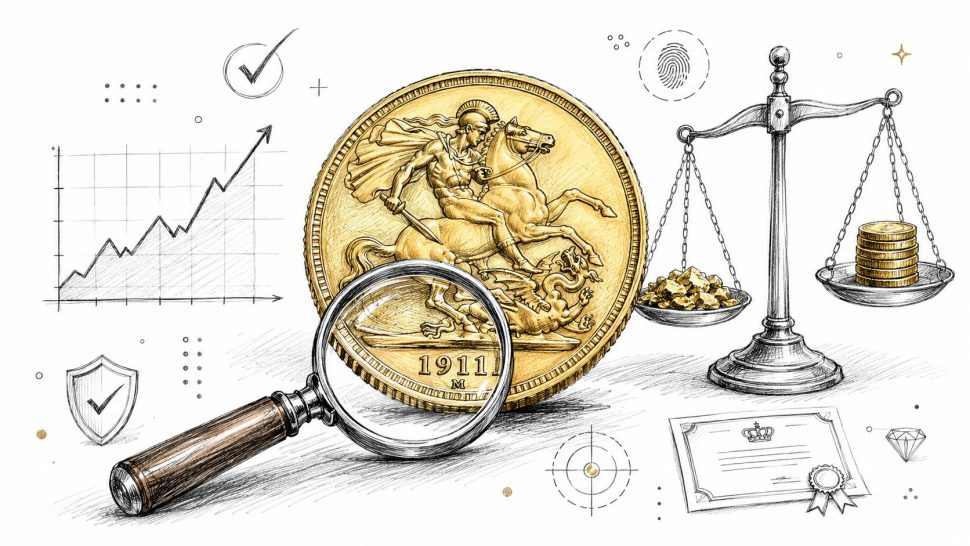
Posted by: Ian Stainton • 28 Jun 2026
A full gold sovereign is usually worth far more than its £1 face value because it contains 7.32 grams of pure gold, which gives it a bullion value of £475.80 when gold is £65 per gram. Some sovereigns are worth much more than bullion alone, because rarity, date, mint mark, and condition can add a strong collector premium.
That's why so many people get stuck when they find one in a drawer, inherit a small coin collection, or uncover an old tin with mixed coins and notes from different places. A sovereign looks small and simple, but its value can sit in two very different worlds at once. One is gold. The other is collectability.
If you've got a sovereign and a pile of other old money nearby, it helps to treat them separately. A gold coin needs proper identification before you sell it. Leftover holiday cash, foreign coins, withdrawn banknotes, and old change need a different route entirely. Banks and high street exchange counters often won't touch mixed coins, older notes, or obsolete currency, which is why people often need a specialist way to exchange foreign coins, convert foreign coins and banknotes, or deal with leftover foreign currency properly.
Your Guide to Understanding a Sovereign Coin's Worth
A sovereign often creates the same first reaction. You pick it up, see a monarch's portrait, notice the gold colour, and ask one question: what's this worth?
The practical answer is straightforward. A sovereign has a bullion value based on its fixed gold content, and it may also have a collector value if it's a scarcer date, a better condition example, or a sought-after type. Those two things aren't the same, and mixing them up is where people lose money.
The two values that matter
Bullion value is the floor. It comes from the gold in the coin.
Collector value is the premium. It comes from what a buyer wants beyond the metal itself.
Practical rule: Never assume a sovereign is “just worth scrap” until you've checked the date, portrait, reverse design, and any mint mark.
That matters because common sovereigns are often traded close to their gold value, while more interesting examples can sit in a completely different bracket. A novice owner doesn't need to become a coin expert overnight, but they do need a clear process.
What a sensible valuation looks like
A good valuation usually follows this order:
- Confirm it is a sovereign
- Read the date and design
- Check whether it looks like a standard bullion piece or a collector coin
- Work out the melt value
- Only then think about where to sell
That same logic helps when you're clearing out other money as well. A sovereign may need a coin-specific check, while the rest of the contents in the same drawer might be better suited to a service that can exchange foreign coins and notes, handle exchange leftover currency, and take mixed or withdrawn money without asking you to sort every item first.
First Identify Your Coin: Reading a Sovereign's Story
Before you put any value on a sovereign, read the coin itself. Most mistakes happen because people jump straight to price and skip identification.

What to look for on the coin
Start with the obvious physical clues:
- The monarch's portrait. The obverse usually shows the reigning monarch at the time the coin was struck. That gives you an immediate period.
- The date. This is one of the first things any buyer checks, because some years are much more common than others.
- The reverse design. Many sovereigns show St George and the Dragon, which is the classic design widely recognised.
- Any small letter or mark. A mint mark can indicate where the coin was struck, and that can affect scarcity.
- General wear. Heavy rubbing, edge knocks, or cleaning marks can all change how collectors view the coin.
If you're comparing your coin with examples of old European gold coins, focus on matching the portrait style, date placement, and reverse type first. Don't rely on colour alone.
Why the mint mark matters
Mint marks are small, but they can carry a lot of meaning. They tell you where the sovereign was produced. To a beginner, that can seem like a minor detail. To a collector, it can be one of the first clues to rarity.
A sovereign struck at a branch mint may attract different demand from one struck in London, especially when combined with a specific date and condition. That doesn't automatically make it rare, but it does mean the coin should be described accurately before anyone prices it.
Clean identification beats guesswork every time. A fuzzy description like “old gold coin” invites weak offers.
A simple identification checklist
Use this short checklist before asking anyone for a quote:
- Photograph both sides clearly
- Write down the full date
- Note the portrait and reverse design
- Look for a mint mark
- Avoid cleaning the coin
- Keep any box, case, or paperwork if it came with one
Many owners also discover that the sovereign isn't the only thing they've found. It's common to have a small group that includes foreign notes, odd coins from old trips, pre-euro money, and forgotten change. In those cases, it helps to separate the sovereign for specialist assessment, then deal with the rest as a broader currency exchange task.
What Is a Sovereign's Melt Value and How Is It Calculated
Once you know you're dealing with a sovereign, the next step is to calculate its base metal value. This is often called the melt value or bullion value.

The fixed gold content
A British gold sovereign has a nominal face value of £1, but it contains exactly 7.32 grams of pure gold within a total mass of 7.98 grams, struck in 22-carat gold (91.67% purity). At a live gold spot price of £65 per gram, the bullion value works out to £475.80, calculated as 7.32 × £65 according to this explanation of sovereign gold content and value.
That number matters because it gives you a practical floor. If your coin is genuine and is being valued as bullion, the starting point is the gold in it, not the £1 face value.
The formula in plain English
The working is simple:
| Part of the calculation | What it means |
|---|---|
| Pure gold content | 7.32 grams |
| Spot price per gram | Current live gold price |
| Melt value | 7.32 x spot price |
If the spot price rises, the melt value rises. If the spot price falls, the melt value falls. The coin's bullion value moves with the gold market.
Why this number helps
Melt value is useful for three reasons:
- It sets a baseline. You know the coin isn't being judged as an ordinary £1 coin.
- It helps you compare offers. If someone offers noticeably below a sensible bullion level, you can ask why.
- It separates bullion from numismatic value. Once the base is clear, any extra premium needs a reason.
A bullion price is not the same thing as a collector price. It's the starting point, not always the finish line.
What doesn't work
Two habits cause trouble here.
First, people search for “sovereign coin worth” and then compare their coin to a random listing price online. Asking prices are not the same as completed selling values.
Second, people assume every old sovereign must be rare because it looks historic. Age alone doesn't create a premium. Some older sovereigns are still mainly valued for their gold content, while others attract collector attention for much more specific reasons.
Beyond Bullion: Checking for Collector Value
Sovereign valuation reveals an interesting complexity. Most sovereigns trade as bullion first. Some move beyond bullion because collectors want that exact coin, not just its metal.

The gap between common and rare
A good example shows why full assessment matters. While many guides say a sovereign is worth its 7.32g gold weight, a rare George III Sovereign can fetch £186,000 at auction, which is far above the £450 to £500 range often seen for common bullion examples such as the Young Head Victoria, as noted in this discussion of full sovereign values and rarity.
That doesn't mean every inherited sovereign is a six-figure coin. It means the market splits sovereigns into two broad groups:
- Bullion-led coins, where gold content drives value
- Collector-led coins, where rarity and condition can dominate
What collectors actually pay for
Collectors don't pay premiums just because a coin is old. They usually pay for a mix of:
Scarcity
Some dates and types are harder to find than others.
Condition
Sharp detail, original surfaces, and limited wear can change buyer interest quickly.
Historical appeal
Certain reigns, portraits, and issues have stronger demand.
Specific varieties
A small design difference or a branch mint issue can matter.
Some sovereigns are bought like bullion bars. Others are bought like historical artefacts. The same word, “sovereign”, covers both.
Signs your coin may deserve extra attention
You should slow down and seek a more careful opinion if your coin has any of these features:
- An unusual early date
- A mint mark you don't recognise
- Very sharp detail with little visible wear
- A proof-like appearance
- An old family note that mentions it was collected, not just saved
The biggest error here is rushing to sell on weight alone. That's especially risky with family collections, where one standout coin can sit among ordinary pieces.
A practical example
Consider two owners.
One has a later, well-worn sovereign kept as a simple store of value. That coin is likely to be judged mainly on bullion content.
Another has an older sovereign with a scarcer date, stronger detail, and clear collector demand. That owner needs a valuation that looks beyond melt.
Both coins are sovereigns. Their selling strategy shouldn't be the same.
Common mistakes to avoid
- Cleaning the coin. Cleaning can damage surfaces and reduce collector appeal.
- Using only jewellery-style gold buyers. They may focus on melt and ignore numismatic value.
- Assuming every old coin is rare. That can lead to unrealistic expectations.
- Ignoring provenance. Old envelopes, tickets, or collector notes can help identify what you have.
If you suspect the coin may be special, treat it carefully and get it described properly before accepting a simple gold-price offer.
How to Sell Your Sovereign and Exchange Other Currency
Once you know whether your sovereign is mainly a bullion coin or something with collector potential, the next question is where to take it. The right answer depends on what else you have alongside it.
A single sovereign, a tray of old British silver, and a bag of leftover euros from holidays don't all belong in the same selling channel. That's where many people lose time. They take everything to one place and discover that the buyer only wants one category of item.
Comparison of selling options for your currency
| Selling Option | Best For | Pros | Cons |
|---|---|---|---|
| Local jeweller or gold buyer | Standard bullion-style sovereigns | Fast, convenient, simple for straightforward gold sales | May focus on metal value and overlook collector premium |
| Specialist coin dealer | Better sovereigns, rarer dates, collector pieces | Stronger knowledge of numismatic value, better for scarcer coins | Often not interested in mixed foreign change or everyday leftover currency |
| Online auction platform | Coins with proven collector demand | Can expose a better coin to specialist buyers | Requires listings, photos, fees, packing, and buyer management |
| Specialist currency exchange service | Mixed coins and notes, holiday money, withdrawn currency, unsorted collections | Handles the awkward items banks and bureaux often refuse, useful when you need to exchange foreign coins and notes without sorting everything | Not the route for a potentially high-end collectible sovereign that needs a coin specialist |
The tax point many sellers miss
British Gold Sovereigns are capital gains tax-free for UK residents, while foreign bullion coins such as the Krugerrand are taxed as foreign coins. The same source notes that Great Britain Gold Sovereign prices reached an all-time high of £455.96 in 2024, which makes that tax treatment an important part of the selling decision, as explained in this discussion of UK sovereign tax advantages.
For a UK seller, that means the headline price isn't the whole story. The type of coin you own can affect what you keep after the sale.
What works well in practice
If your sovereign looks ordinary and you want a simple bullion-led sale, a reputable gold or coin buyer can work well.
If it looks scarcer or better preserved, a specialist coin dealer is usually the safer route.
If you also have mixed travel money, obsolete notes, or jars of unsorted change, it makes sense to deal with those separately through a service built to sell my gold coins or to process broader currency exchange jobs depending on what you hold.
Why banks and bureaux often fall short
Banks and exchange counters usually prefer current, circulating notes in standard denominations. They often don't want:
- Foreign coins
- Withdrawn banknotes
- Pre-euro currency
- Obsolete issues
- Mixed, unsorted bags of small change
That's why people searching to exchange foreign coins, exchange foreign coins and notes, or convert foreign coins and banknotes often end up disappointed on the high street. Traditional channels are built for clean, current note exchange. They're not built for odd lots, old money, or mixed finds from drawers and lofts.
The easiest route for a sovereign isn't always the easiest route for the rest of your currency. Treat each category on its own merits.
How the process usually works for mixed currency
For everyday leftover money and older currency, the smoothest process is usually:
- Separate the sovereign from everything else
- Check whether the sovereign might have collector value
- Group the rest into notes, coins, and old or withdrawn currency
- Use a service that accepts unsorted or hard-to-place items
- Choose payment and send the currency securely
This matters for real-world situations such as:
- An inheritance box with one gold sovereign, old British coins, and foreign notes from past travel
- A charity collection tin containing mixed world coins and low-value notes
- A family holiday jar where nobody can use the coins abroad anymore
- A business till mix that has picked up foreign cash in error over time
In each case, the sovereign needs proper valuation. The rest needs a practical conversion route.
Frequently Asked Questions About Sovereign Coins
Are sovereign coins still legal tender in the UK
Yes. The sovereign remains legal tender in the UK, even though it is no longer in circulation, and its market value is driven by its gold content rather than its nominal denomination according to this overview of sovereign status and gold content).
Can you exchange foreign coins in the UK
Yes, but not usually through the places people try first. Banks and standard exchange bureaux often focus on current banknotes, not coins. If you need to exchange foreign coins or exchange foreign coins and notes, specialist services are usually more practical.
Do banks accept foreign coins
Often, they don't. Coins are harder to process, count, store, and repatriate than notes. That's why many people looking to exchange leftover currency find that banks accept current notes at best, while foreign coins and old money are refused.
What should I do with old British silver coins
Check the date before you spend or sell them casually. In the UK, pre-1947 British coins such as shillings and sixpences contain approximately 50% silver by weight, while pre-1920 coins are sterling silver at 92.5% purity, which means they can be worth more than face value because of their metal content, as explained in this guide to old UK and foreign currency values.
Can old withdrawn UK banknotes still be exchanged
Yes. The Bank of England exchanges all withdrawn UK £5, £10, £20 and £50 banknotes indefinitely, and 53 Post Office branches will swap these old notes even if the customer does not hold a bank account, according to the Bank of England guidance on exchanging old banknotes.
Can I donate foreign coins to charity instead of exchanging them
Yes. If the amount is small or the currency is awkward to convert, many people choose to donate foreign coins to charity instead. The charities explicitly noted in the available information include RNIB, Oxfam, The Royal British Legion, and UNICEF via airline donations, and there are also charity boxes at some airports and currency exchange locations, as listed in this roundup of options for foreign coins and notes in the UK.
How long does payment usually take when converting leftover foreign currency
Processing times depend on the provider. A specialist postal exchange service is often designed for speed, especially when it accepts mixed coins, banknotes, and withdrawn currency in one go. The main thing to check is whether the rate is shown clearly upfront and whether the provider accepts unsorted currency.
Do I need to sort coins before sending them for exchange
Not always. Some specialist services accept mixed and unsorted coins, which is much easier for people dealing with jars, tins, travel leftovers, or charity collections. That's especially useful when you want to convert foreign coins and banknotes without spending your evening separating every denomination.
What's the biggest mistake people make with sovereign coin worth
They either sell too quickly on gold weight alone, or they assume every old sovereign is rare. The best approach sits in the middle. Confirm the bullion base, check for collector clues, and then choose the right outlet for that specific coin.
If you've got a sovereign to value and a pile of other money to clear at the same time, We Buy All Currency gives you a simple way to turn foreign coins, banknotes, withdrawn currency, and leftover travel money into cash without the usual hassle. It's especially useful when banks and exchange bureaux won't help with mixed change, old notes, or unsorted collections. If you're ready to exchange foreign coins, exchange leftover currency, or convert foreign coins and banknotes, it's a straightforward place to start.