
Weight of 20p Coin: Official Grams & Exchange Uses
Posted by: Ian Stainton • 11 Jun 2026
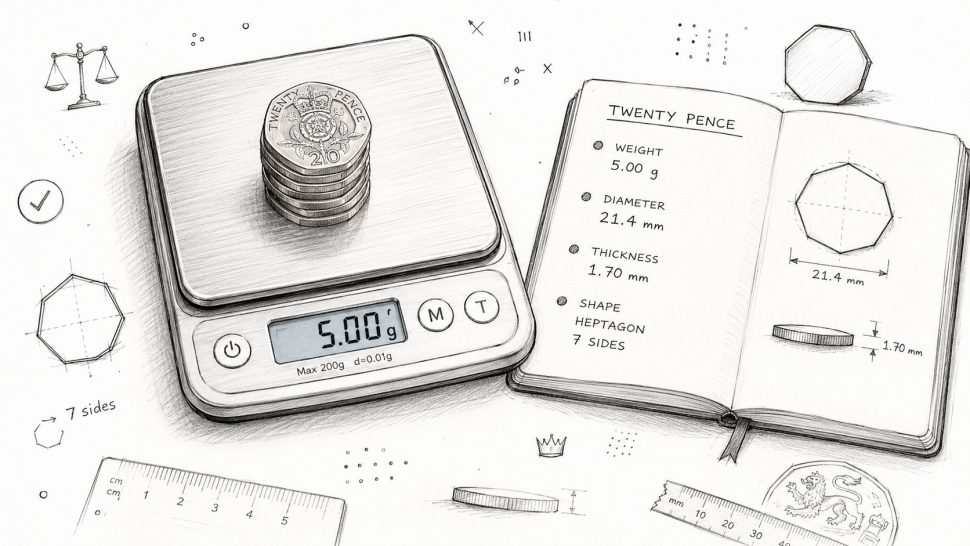
A 20p coin weighs 5.0 grams. That single figure matters because weight is one of the quickest ways specialist services handle bulk, unsorted coins and turn forgotten change into real money.
If you've got a jar on the kitchen shelf, a drawer full of old UK coins, or a mixed pile of leftover foreign currency from past trips, a simple coin spec proves practical. People often search for the weight of a 20p coin because they want to check a scale reading, sort loose change, or work out whether a bag of coins is worth sending in. That's exactly the point where weight stops being trivia and starts being useful.
The 20p coin entered circulation on 9 June 1982 to reduce the bulk and weight of cash in everyday use, and by March 2014 there were an estimated 2,765 million 20p coins in circulation in the UK according to the historical overview of the twenty pence coin). Small coins accumulate fast. Anyone who has emptied coat pockets or tip jars already knows that.
For people checking face value rather than collectable value, a practical next step is understanding how everyday 20ps are handled in bulk. If you want a straightforward reference for 20p coin values, the physical weight is the starting point.
Your Quick Guide to the 20p Coin and Cashing In
The weight of a 20p coin matters because it gives you a reliable reference when you're looking at bulk coins rather than one piece at a time. A single coin is easy to count. A jar, tray, till scoop, or mixed bag is different.
When people bring coins to a specialist exchange service, the usual problem isn't identifying one coin. It's dealing with volume, mixed denominations, old issues, and coins that banks often won't process in a simple way. That's why standardised coin weights are useful in practice.
Why this tiny detail matters
A 20p coin is one of the easier UK coins to use as a reference point because the official specification is fixed. If your scale is close to the official mass, you know you're working from something consistent. If your total is off, it can signal a mixed denomination batch, a weighing error, or the presence of non-currency items.
Practical rule: Weight helps with estimating. It doesn't replace proper verification when coins are mixed.
That distinction matters. If you're sorting a jar that also contains 1p, 2p, tokens, washers, or foreign coins, a simple weight total won't tell you the face value on its own. It only becomes useful when paired with a process that knows what's in the batch.
Where coin jars become exchangeable value
This is also why specialist services can handle awkward collections better than a bank counter. They're set up for leftover currency, mixed change, and coins people haven't touched in years. That includes customers who want to exchange foreign coins, exchange foreign coins and notes, or convert foreign coins and banknotes that would otherwise sit unused.
A lot of people aren't trying to become coin experts. They just want an easy route from loose change to cash, bank transfer, or even a charity donation. Weight-based handling helps get them there with less friction.
Official UK 20p Coin Specifications
The official specification is the reference point for anyone checking the weight of a 20p coin properly. According to Royal Mint 20p coin specifications, the UK 20p coin weighs 5.0 grams, has a 21.4 mm diameter, is 1.7 mm thick, and is made from cupro-nickel (84% copper, 16% nickel). The Royal Mint also states that it is legal tender for payments up to £10.

Royal Mint official 20p coin specifications
| Specification | Measurement |
|---|---|
| Weight | 5.0 grams |
| Diameter | 21.4 mm |
| Thickness | 1.7 mm |
| Composition | Cupro-nickel (84% copper, 16% nickel) |
| Legal tender limit | Up to £10 |
Why the specifications matter in the real world
These details aren't just for collectors. They matter because bulk coin handling depends on consistency. If a coin denomination has a known official mass and size, it becomes easier to identify, estimate, and separate from mixed lots.
The 20p is also physically distinctive, which helps people recognise it quickly when sorting by hand. Its shape is well known, and that helps when you're checking whether a pile really is mostly 20ps or a mixture of different coins.
When people estimate jars at home, the official spec is the reference. The real work is accounting for everything that doesn't match it.
That's also the point where collectable value and exchange value split apart. Some people ask about unusual 20ps, but a currency exchange service usually handles face value and exchangeability, not numismatic pricing. If a coin might be a collectible, it's worth separating it before sending a bulk lot.
Why Banks Wont Touch Coins But We Love Them
Banks and airport exchange desks are built around speed, notes, and standard transactions. Coins are slower. Mixed coins are slower again. Old or withdrawn currency creates even more admin, because someone has to identify it, count it, store it, and decide whether it can still be processed.
That's why people so often hit a dead end when they try to exchange leftover currency through ordinary channels. It isn't always that the money has no value. It's that the handling cost and effort can outweigh the convenience for a generalist provider.
The trade-off banks are managing
For a high street branch, bags of mixed coins create practical problems:
- Counting takes time: Staff need a method for checking quantity and denomination.
- Storage is awkward: Coins are heavy and take up space.
- Foreign coins are harder: They may have no routine path through the bank's normal systems.
- Older currency creates exceptions: Withdrawn notes and obsolete coins don't fit standard workflows.
That's also why many bureaux de change focus on notes only. Notes are easier to stack, verify, and resell. Coins are a specialist job.
Why weight-based handling works better
A useful question is whether coin weight is stable enough for bulk exchange. It's stable enough to be useful, but not so perfect that you should assume every lot is identical. As noted by Heads and Tails on UK coin weight calculations, the nominal weight of a 20p coin is 5.0g, but real-world wear, contamination, and variance can affect bulk measurements.
That's the key trade-off. Weight is excellent for efficient handling, but only when the service is set up to account for the messiness of real coin lots. Coins in jars pick up dirt. Some get worn. Some batches include the wrong items. A specialist process expects that and checks accordingly.
A general bank counter usually isn't designed for that kind of work. A specialist service is.
Comparing Your Currency Exchange Options
If you've got coins, old notes, or mixed leftover holiday money, your choice usually comes down to a local bank, an airport exchange desk, or a specialist mail-in service. The difference isn't just rate. It's what they'll accept.

Where to exchange leftover currency
| Service | Accepts Foreign Coins? | Accepts Withdrawn Notes? | Best For |
|---|---|---|---|
| High street bank | Usually limited or no | Often limited | Straightforward current banknote customers |
| Airport exchange | Generally not accepted | Rarely | Last-minute note exchange |
| Specialist service | Yes, typically includes coin handling | Yes, often includes older and withdrawn currency | Mixed leftover currency, coins, notes, obsolete money |
Which option suits which problem
A bank can be convenient if you have current notes in a major currency and an existing account. An airport desk is mostly about urgency, not flexibility. Neither is usually the right fit for a household jar of mixed coins, pre-euro notes, or leftover foreign currency from several trips.
That's where a dedicated provider becomes the practical option. If you need to exchange foreign coins and notes, the main advantage isn't hype. It's that the service is built for the awkward stuff other channels tend to refuse.
What matters more than rate alone
People often focus only on the headline exchange rate. In practice, these questions matter just as much:
- Will they take coins at all
- Can they accept old or withdrawn currency
- Do you need to sort everything first
- Can you do it from home
- What happens if your parcel contains a mixture
If your batch is messy, the most useful service is usually the one that can process the whole lot without turning it into a weekend sorting project.
How Our Weight-Based Exchange Process Works
For bulk coin handling, the basic principle is simple. A known denomination has a known mass, and that helps build a practical estimate before full verification. The UK cash-handling benchmark is a good example: 50 x 20p coins = £10 face value = 250g, as shown in the PTA cash weighing table.

Step by step
Gather the currency
Pull together your loose coins, notes, old holiday money, and any withdrawn currency you've still got tucked away. Specialist services, unlike banks, usually don't require you to create neat denomination piles first.Get an estimate
Use a tool built for bulk handling, such as a UK coin weight calculator, to get a practical starting point. This helps you judge whether a batch is worth sending and gives you a rough sense of what's in the container.Pack and send
Coins need secure packaging because weight can split weak envelopes quickly. Notes and coins should be packed so they arrive as sent, without loose movement inside the parcel.Verification and processing Specialist services prove their worth during this phase. The process checks what the batch contains, including mixed coins, notes, and older currency that won't fit a normal retail exchange model.
Payment or donation
Once the batch has been verified, the value can be paid out or directed to charity if that's what you prefer.
What works and what doesn't
What works is sending the whole usable batch through a service designed for mixed currency. What doesn't work is assuming a home weight estimate is the final figure for a mixed lot.
Home weighing is good for expectation-setting. Proper exchange still depends on verification.
That's especially true if the container includes both UK and foreign coins, or if you want to exchange foreign coins, exchange foreign coins and notes, or deal with older withdrawn money at the same time.
Common Mistakes When Weighing Coins at Home
Home weighing is useful, but small errors can throw off your estimate. The problem usually isn't the 20p specification. It's the setup.
The most common errors
- Using the wrong scale: Bathroom scales and older analogue kitchen scales often aren't precise enough for coin work. A digital kitchen scale is usually far more useful for a rough estimate.
- Forgetting the container weight: If you weigh a jar, bowl, or plastic tub without taring it first, your total includes the container as well as the coins.
- Leaving non-currency in the mix: Buttons, tokens, screws, washers, and foreign pieces can all distort the result.
The practical fix
A better home process is simple:
- Use a digital scale: Put it on a flat, stable surface.
- Zero the container first: Add the bowl or tray, then tare it before adding coins.
- Check the batch visually: Remove obvious non-coins and anything damaged beyond recognition.
- Treat the result as an estimate: Especially if the batch contains mixed denominations.
That last point saves a lot of confusion. People often assume that because the weight of a 20p coin is fixed, any total weight should produce an exact value. That only works if the whole tray consists of 20ps in clean, standard condition.
Why estimates and final valuations differ
Coin lots in circulation are rarely perfect. They've lived in pockets, drawers, cars, charity tins, and travel bags. Some are worn. Some are dirty. Some aren't the denomination you thought they were.
That's normal. It's also why a specialist check matters more than a home guess.
Who Uses Our Service Real World Examples
The people who use coin and note exchange services are rarely hobbyists with labelled coin flips. Most are dealing with money that has become inconvenient, mixed, or hard to place.
The family with travel leftovers
A family comes back from several trips with euros, dollars, and scattered change from airport purchases. Some notes are current. Some coins have been sitting in a drawer for years. A bank may only want selected notes, if any. A specialist service can handle the mixed batch in one go, which is exactly what people want when they need to exchange leftover currency without sorting every coin by country.
If that sounds familiar, a service built to exchange leftover currency is usually more practical than trying several different outlets.
The charity with donation tins
Charities often receive coins and banknotes that supporters can't spend easily. That includes foreign coins, small denominations, and older issues. Those donations still have value, but only if someone can process them efficiently.
This is one of the clearest examples of why specialist exchange exists at all. General banking routes often break down here because the money arrives in mixed small-value batches, not in tidy bankable packs.
The awkwardness is the point. If currency were already easy to bank, people wouldn't need a specialist route.
The business that receives the wrong money
Shops, visitor attractions, and small businesses regularly end up with the wrong coins in tills or collection boxes. Sometimes customers hand over foreign currency by mistake. Sometimes staff set aside odd notes or coins because nobody knows what to do with them.
A specialist service gives those organisations a clean way to recover value from money that would otherwise sit in a safe bag or office drawer. That's also why this type of service is used by individuals, charities, and businesses, and trusted by organisations such as charities, supermarkets, airports, and police forces.
Frequently Asked Questions About Currency Exchange

Can you exchange foreign coins in the UK
Yes, but usually not through the same places that handle ordinary holiday note exchange. That's why people often need a specialist provider when they want to exchange foreign coins rather than just current banknotes.
Do banks accept foreign coins
Often they don't, or they accept them only in very limited circumstances. Coins are bulky, low value per item, and inconvenient to process through standard branch systems. That's one reason specialist mail-in services exist.
Can you exchange foreign coins and notes together
Yes, specialist services are designed for that. This is often the easiest route if you've got mixed leftovers from several trips and don't want to separate every currency first.
What about old or withdrawn currency
Old or withdrawn currency can still have exchange value depending on the type of money and whether the service accepts it. This is another area where specialist providers usually go further than banks or airport counters.
Do I need to sort coins before sending them
Not always. Many specialist services are built around mixed batches, which is helpful if you want to convert foreign coins and banknotes without doing a full manual sort at home. It's still sensible to remove obvious rubbish, tokens, and non-currency items.
How quickly do you get paid
According to the publisher information provided for this service, payment is issued within five working days after verification via bank transfer or PayPal. That timing matters if you're comparing a mail-in service with a same-day in-person note exchange.
Is it safe to send currency by post
It can be, provided you pack it properly and follow the service instructions. Coins need stronger packaging than people expect. Notes should be kept flat and secure. The main risk usually comes from poor packaging rather than the idea of mailing currency itself.
Can I donate the value instead of taking payment
Yes. Some specialist services allow customers to direct the exchange value to charity. That can be useful if you've got leftover foreign currency that isn't worth the effort of spending but could still do some good.
Do you accept damaged or dirty coins
Acceptance depends on condition and whether the currency can still be identified and processed. Dirt, wear, and mixed-lot variance are common in real coin batches, which is why specialist handling matters. If a coin is heavily corroded or no longer recognisable, it may not be treated the same way as standard circulating pieces.
What if I'm unhappy with the valuation
That depends on the service terms. The publisher information for this article states that unsatisfied customers can have currency returned free of charge under a happiness guarantee. That's worth checking before you send anything, especially if your batch includes unusual or older items.
If you've got loose 20ps, old UK coins, holiday change, or a bundle of foreign notes that no bank wants to handle, We Buy All Currency offers a practical route to exchange foreign coins, notes, and withdrawn currency from home. It's a straightforward way to turn forgotten money into cash, or to donate the value if that suits you better.