
When Was the Two Pound Coin Introduced? a 2026 Guide
Posted by: Ian Stainton • 10 Jul 2026
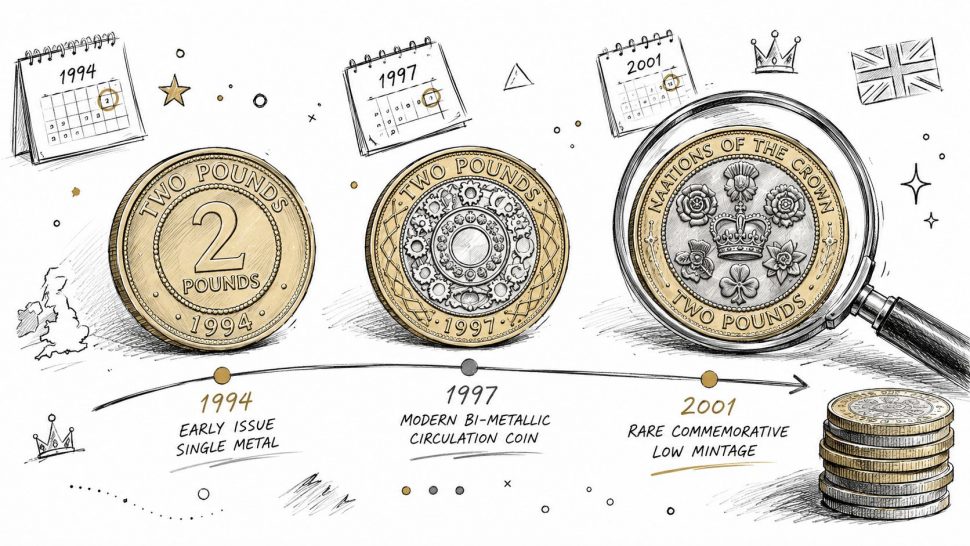
The modern bi-metallic £2 coin entered general circulation on 15 June 1998, but the first commemorative £2 coins appeared as early as 1986. That's why people often find an older two pound coin and wonder whether they've discovered an unusual collector piece, a withdrawn design, or a coin that shops and banks won't want.
If you've just found a £2 coin in a drawer, an old purse, or a mixed pot of leftover holiday money, the confusion is understandable. Some £2 coins look like the familiar two-colour coin still seen in change. Others are single-metal, older, and easy to mistake for something foreign or fake. Some may be collectable. Some are awkward to exchange through ordinary channels. Knowing the history makes the next step much easier.
The UK Two Pound Coin A Complete History
You empty a drawer, spot a £2 coin that does not look like the one you know from everyday change, and the first question comes quickly. When did this version appear?
Many readers asking about the two pound coin's introduction are really asking two separate questions. They want to know when the denomination first appeared as a UK coin, and when the familiar two-colour version began turning up in tills, pockets, and parking machines.
The answer has two dates. The first UK £2 coin was issued in 1986 as a commemorative piece for the Commonwealth Games in Edinburgh. The commonly recognised version, the bi-metallic circulating coin, arrived later, on 15 June 1998.

That gap matters because the £2 coin did not begin life in one fixed form. It developed in stages, much like a banknote series that changes design over time while keeping the same face value. If you have an older £2 coin, the date alone does not tell the full story. Its metal, design, and intended use all affect whether it was made for circulation, for commemoration, or for collectors.
Why the dates cause confusion
The confusion often stems from three common sources:
- Two valid starting dates: 1986 marks the first decimal UK £2 coin, while 1998 marks the start of the modern circulating format.
- Two different formats: Earlier £2 coins were single-metal. The modern version is bi-metallic, with two clearly different colours.
- Special issues within the same denomination: Some £2 coins were created to mark national events or anniversaries, so they do not always fit the pattern people expect from ordinary change.
A simple way to sort them is by appearance. A two-colour coin is usually part of the modern circulating series. A single-metal £2 coin often belongs to the earlier commemorative period. If you want a clearer point of comparison, this guide to the size and physical specifications of a £2 coin helps you check what should feel normal in the hand.
Why this matters beyond coin history
This is not only a collector's question. It is also a practical one.
People often find an older £2 coin, assume it should spend like any other £2, then discover that shops, self-service machines, or even bank counters are not interested. That is especially common with older commemorative issues, unusual condition coins, and money that falls outside what high street services handle every day.
Specialist exchange services fill that gap. They assess the coin for what it is, rather than treating it as awkward change, and they can help with older UK coins, withdrawn notes, and foreign currency that ordinary banks may refuse. For anyone trying to work out whether an unfamiliar £2 coin is spendable, collectable, or exchangeable, the history is the first step.
The Story Behind the Modern Bi-Metallic £2 Coin
The modern £2 coin wasn't introduced just to give the denomination a fresh look. It was a practical redesign.
The definitive bi-metallic two-pound coin was officially released into general circulation across the United Kingdom on 15 June 1998, and the move was driven by increasing counterfeiting risks. The design's distinct electromagnetic signature improved machine verification and helped deter forgery, as noted in Wikipedia's overview of the two pound coin.

What changed in 1998
The bi-metallic version established the format that people now recognise immediately. According to the Almost History Podcast's summary of the coin's specifications, the coin has:
- A diameter of 28.4mm
- A width of 2.5mm
- A weight of 12 grammes
- An outer ring of nickel-brass
- An inner core of cupro-nickel
That combination made the coin more distinctive in the hand and more reliable for cash-handling machines.
Why the design mattered
The redesign solved several practical problems at once. It made the coin easier for machines to identify, helped separate it from lower-value coins, and supported the wider move towards more secure modern coinage.
If you want a close look at the physical format, this guide to the size of a 2 pound coin is useful for checking what should feel normal in the hand.
A £2 coin isn't just a denomination. It's a piece of engineering built to work with tills, validators, banks, vending systems, and public trust.
The transition year that catches people out
Another point that often confuses collectors and casual finders alike is the date on the coin. Some bi-metallic pieces were struck earlier and dated 1997, even though the general circulation launch came later. That means a coin can carry a 1997 date and still belong to the transition into the modern system rather than a separate earlier everyday issue.
For anyone sorting old change, that detail matters. Date alone doesn't always tell the whole story. Format, colour, and intended use are just as important.
Older £2 Coins and Notable Commemorative Issues
You tip out a jar of old change and spot a £2 coin that looks wrong. It is one colour, heavier-looking, and nothing like the bi-metallic version you see in circulation today. That usually means you have found an older commemorative issue rather than an ordinary modern £2.
The first UK £2 coin appeared in 1986 to mark the Commonwealth Games in Edinburgh. It introduced the denomination, but not as an everyday coin for regular spending. That point matters because older £2 coins followed a different path from the modern pieces people recognise in shops, self-checkouts, and vending machines.
The early £2 story
Pre-1998 £2 coins were mainly produced to mark events, anniversaries, and national milestones. In other words, the denomination began life more like a special edition than a standard tool of day-to-day cash use.
That is why older £2 coins often catch people out. Someone finds a single-metal piece and assumes it must be foreign, fake, or obsolete. In reality, it may be a genuine UK commemorative coin from the period before the bi-metallic format became familiar.
If the coin looks unusual in a way that raises doubts, it helps to compare it with the warning signs in this guide to a fake £2 coin before deciding what you have.
A simple way to place an older £2 coin
The easiest way to sort the history is to separate purpose from appearance:
| Period | What the £2 coin was mainly used for | What it usually looked like |
|---|---|---|
| Earlier decimal issues | Commemorative or collector-focused use | Single-metal |
| Modern everyday issue | General circulation and commemorative designs | Bi-metallic |
That distinction works like the difference between a limited-edition print and a standard production run. Both are real. Both can be official. But they were made for different roles, and that affects how people should assess them today.
Why old commemoratives still matter
Older commemorative £2 coins matter for practical reasons, not just historical curiosity.
A single-metal £2 often falls outside what cashiers, banks, and coin machines expect to handle. That leaves many people unsure whether the coin can be spent, deposited, or exchanged. At that point, old British currency starts to overlap with the wider world of leftover foreign currency. Households often keep unusual UK coins in the same drawer as withdrawn notes and travel change because ordinary banking channels do not offer a clear route.
Collector interest is the second reason. Some commemorative issues attract attention because of their design, the event they mark, or lower mintages than standard circulating coins. Even if a coin is genuine and still has face value, spendability and exchangeability are not always the same thing. That is where a specialist exchange service becomes useful, especially for coins that high street banks may refuse to process or assess properly.
If a £2 coin does not look spendable, do not assume it is worthless. Its age, format, and commemorative status may be exactly what makes it worth checking.
How to Identify Valuable £2 Coins in Your Change
Most £2 coins are ordinary circulating pieces. A smaller number deserve a closer inspection because of scarcity, collectability, or unusual characteristics.
The strongest single example from the older series is the 1989 Claim of Right £2, described by the Britannia Coin Company as the rarest circulated two-pound coin in history, with 381,400 minted in its guide to old pre-1997 two pound coins.
Start with a simple checklist
When you inspect a £2 coin, focus on these points first:
- Check the format: Is it bi-metallic or single-metal?
- Read the date: Older dates can signal commemorative issues rather than standard circulation pieces.
- Inspect the condition: Heavy wear can affect collector appeal.
- Look for anything unusual: Missing details, odd inscriptions, or unexpected design features may justify further research.
If you're worried that a coin looks wrong rather than rare, it also helps to read about a fake 2 pound coin before assuming you've found something valuable.
Common vs Valuable £2 Coin Features
| Feature | Common Version | Potentially Valuable Version |
|---|---|---|
| Overall appearance | Familiar bi-metallic coin seen in everyday change | Older single-metal issue or less common commemorative design |
| Date context | Modern circulating period | Earlier commemorative period, especially unusual older dates |
| Collector interest | Face-value familiarity | Scarcity, event significance, or unusual issue history |
| Example to know | Standard modern £2 | 1989 Claim of Right £2, noted as the rarest circulated example with 381,400 minted |
What usually makes a coin stand out
Scarcity is one factor, but it isn't the only one. A coin can attract interest because it was tied to a notable event, belongs to an earlier format, or appears far less often than the standard modern version.
Don't jump straight from “old” to “valuable”, though. Many people make that leap too quickly. A coin may be interesting without being especially rare, and some collector value depends on demand as much as age.
Collector's note: The best first question isn't “How much is this worth?” It's “What exactly is this coin?”
A practical example
Say you find a single-metal £2 at the bottom of a tin of mixed change. It doesn't resemble the two-colour version you know from normal cash use. That alone tells you it belongs to an earlier chapter of the denomination's history. From there, the sensible move is to identify the issue before trying to spend, clean, or dismiss it.
That same approach works with foreign money too. Old form, unfamiliar appearance, and non-standard use are often signs that a specialist route is more useful than a high street one.
How to Exchange Old or Foreign Coins You Cannot Spend
Historical context can turn into a practical problem. Once a coin falls outside normal everyday use, many discover that spending it and exchanging it are two very different things.
Older and specialist currency often sits in a blind spot. High street banks usually focus on current, machine-friendly money. Exchange bureaux tend to prefer circulating banknotes from active travel destinations. Coins, older issues, withdrawn money, and mixed bags of holiday leftovers are where the friction starts.
The difficulty is especially clear with old single-metal £2 coins. Prior to 1998, the single-metal £2 coin weighed 15.98 grams, and its alloy composition made it susceptible to forgery and cumbersome for automated sorting systems, which is why banks don't accept them and specialist services are required, according to Coins of the UK.

Why banks and bureaux often say no
The issue usually comes down to processing. Coins are harder to handle than notes. Withdrawn currencies add another layer of complexity. Mixed collections create even more work, especially if the customer hasn't sorted them.
That's why people trying to exchange foreign coins, exchange foreign coins and notes, or deal with leftover foreign currency often hit a dead end with standard providers.
How the process usually works
A specialist service solves the problem by accepting categories ordinary channels avoid, including coins, banknotes, and withdrawn currency. The process is generally straightforward:
Choose what you're sending
This may include old British coins, foreign coins, current notes, obsolete notes, or mixed travel money.Get a quote before sending
Good specialist platforms show the rate clearly so you can decide before you part with the currency.Post the currency for verification
You don't usually need the kind of detailed branch sorting that frustrates people at the counter. Some platforms can handle unsorted mixtures by weight.Receive payment or donate the value
Depending on the service, you may be able to take payment or donate foreign coins to charity instead.
Real-world scenarios
People tend to use specialist exchange routes in a few familiar situations:
- After travel: You want to exchange leftover currency from several countries at once.
- After a house clear-out: You uncover old £2 coins, foreign notes, and odd bags of change together.
- For charity collections: A school, shop, airport, or fundraiser gathers mixed international currency donations.
- In business tills: Retailers sometimes receive foreign or older coins in error and need a practical way to convert them.
That's why specialist providers are used by individuals, charities, and businesses alike, and why organisations such as charities, supermarkets, airports, and police forces turn to this type of service when ordinary banks and bureaux fall short.
Common Mistakes to Avoid When Handling Old Currency
People don't usually lose value because their currency is worthless. They lose value because they make the wrong assumption too early.

Mistakes that cause the most trouble
Throwing it away too quickly
Old coins, commemorative pieces, and withdrawn notes may still have exchange or collector value. If you also have foreign money, it makes sense to assess the whole bundle together.Trying the bank first and stopping there
Many people assume a refusal from a bank means the currency has no value. Often it only means the bank doesn't process that category.Cleaning coins before checking them
Scrubbing, polishing, or chemical cleaning can damage collector appeal. Leave unusual coins as they are until you know what you have.Ignoring donation as an option
If the amount is small, or if sorting it feels like more trouble than it's worth, you may prefer to donate foreign coins to charity instead of storing them for years.
Don't mistake inconvenience for worthlessness. A coin can be awkward to use and still be worth exchanging properly.
A better approach
Handle old or foreign currency gently. Keep groups together if they were found together. Separate obvious current notes from coins if you want to, but don't assume you need to do detailed sorting before using a specialist service. The easiest route is usually the one designed for mixed, awkward, and otherwise rejected currency in the first place.
Frequently Asked Questions About Currency Exchange
A common situation is finding an old £2 coin in a drawer, then noticing it is sitting next to euros, dollars, and a few withdrawn notes your bank will not handle. That mix feels confusing because some items are still spendable, some are collectible, and some need a specialist exchange route. These questions clear up the difference.
Can foreign coins be exchanged in the UK
Yes, although ordinary banks and travel money counters usually focus on banknotes, not coins. Specialist services are often the practical choice if you want to convert foreign coins and banknotes, especially from mixed holiday leftovers.
Do banks accept foreign coins
Usually no. Banks often decline foreign coins, and they may also refuse older UK coins that sit outside current cash-processing systems. A refusal from a bank often reflects policy, not lack of value.
Can I exchange leftover holiday money that includes coins and notes
Yes. Mixed travel money is one of the most common cases handled by specialist providers. That suits people who want to exchange leftover currency from several trips without sorting every coin first.
Do old or withdrawn currencies still have value
Often, yes. Some can still be exchanged as obsolete currency. Others may carry collector interest, which is why an older non-bi-metallic £2 coin or commemorative piece should be checked before being treated as ordinary change.
What if I have old British coins as well as foreign money
That is very common. People often store old British commemoratives, withdrawn notes, and overseas change in the same jar or tin. A specialist service can assess the group as a whole, which is helpful when a high street branch will only deal with current notes and standard coins.
Do I need to sort everything before sending it
Not always. Some specialist exchange services are set up to handle unsorted currency, including mixed coins and notes. It works a bit like handing a mixed batch to a valuer rather than trying to identify every piece yourself first.
How long does payment take
Typically, specialist services issue payment within five working days after verification, with options such as PayPal or bank transfer. The exact timing depends on how quickly the currency is checked and approved.
What's the oldest two-pound coin in British history
The earliest British coin with a face value of two pounds for circulation was the 1823 Double Sovereign under King George IV. It was a gold coin from the pre-decimal period, so it sits outside the modern £2 story, but it helps explain why collectors and exchange specialists treat old two-pound pieces differently from current bi-metallic coins, as shown in this video on the first circulating two-pound coin in British history.
Can I donate old or foreign currency instead of exchanging it
Yes. If the amount is small, or you would rather turn it into fundraising, you can donate foreign coins to charity instead of exchanging them. That option suits leftover holiday change, mixed coin tubs, and collections that are more useful as donations than as spendable cash.
If you've got old £2 coins, leftover holiday money, withdrawn banknotes, or a mixed bag of coins your bank won't touch, We Buy All Currency offers a straightforward way to exchange foreign coins, exchange foreign coins and notes, or convert leftover currency without the usual hassle. You can check the rate in advance, send coins and notes together, and choose payment or charity donation, which makes it a practical option for older, unusual, and rejected currency.