
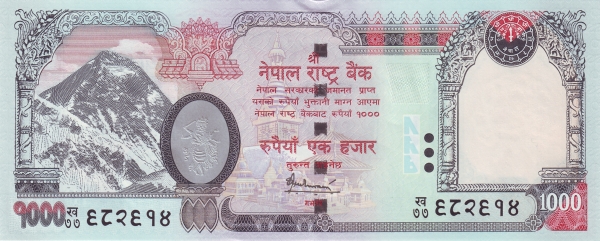
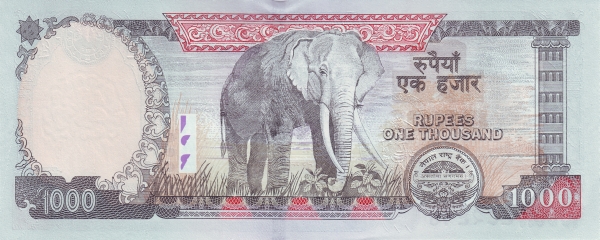
1000 Nepalese Rupees Banknote (Mount Everest)
£3.220000
1 NPR = £0.003220
1,000 Rupees Rupee (Issued 2010)
Surviving examples of the 2010-issued Nepalese 1,000 Rupee banknote from the Nepal Rastra Bank’s 2012–2016 series circulated widely across Nepal’s domestic economy, meaning notes in genuinely crisp, uncirculated condition are increasingly difficult to source outside the country. The denomination represented the highest value note in everyday circulation, making it subject to heavy use and a correspondingly high attrition rate among well-preserved specimens. Currency historians and those with an interest in Himalayan monetary design have paid particular attention to this issue for its distinctive combination of natural and cultural imagery. Those now holding examples in the United Kingdom are most likely to have brought them back from travel, making them a relatively common find among returned holiday currency.
On the front, the note is printed in a palette dominated by soft grey, pink, and muted green tones, with the dominant visual element being a large, finely engraved depiction of Mount Everest occupying the left-hand portion of the face. The mountain is rendered with impressive tonal detail, its snowfields and ridgelines captured through precise intaglio-style line work against a pale sky. To the upper left, decorative architectural motifs suggestive of a traditional Nepalese temple gateway or torana frame the composition, rendered in fine geometric detail. The issuing authority is named prominently in Devanagari script as नेपाल राष्ट्र बैंक, transliterated below as “Nepal Rastra Bank,” set in bold typography across the upper centre of the note. Beneath this, a block of Devanagari text carries the statutory promise text, followed by the denomination written in large Devanagari characters — रुपैयाँ एक हजार — meaning “One Thousand Rupees.” The numeral “1000” appears in bold red at the lower left and again in dark ink at the lower right, flanking the serial number which reads in both Devanagari and Western numerals. The serial number, rendered in red ink, appears twice across the lower register. A circular emblem or seal appears in the upper right area, alongside an ornate rectangular panel likely serving as the watermark window. A governor’s signature is visible in the lower central section of the note. A security thread is embedded vertically through the note, visible as a dark line running through the central field. The overall border is composed of intricate guilloché patterning in repeated geometric forms, typical of modern security printing.
The reverse of the note is printed in a warm combination of grey, olive, and terracotta tones and features as its central motif a large, naturalistically rendered Asian elephant standing in profile, facing left, with vegetation at its feet suggesting a jungle or grassland habitat. The elephant is depicted with considerable engraving detail — the texture of its skin, the curve of its tusks, and the musculature of its legs are all rendered with care through fine line work. To the upper right of the reverse, the denomination is repeated in Devanagari script — रुपैयाँ एक हजार — and beneath this in English the words “RUPEES ONE THOUSAND” appear in clear serif typography. The numeral “1000” is printed in bold dark ink at the lower right corner. To the lower right, a circular emblem depicting what appears to be the national seal or coat of arms of Nepal is visible, incorporating fine detail consistent with the country’s official insignia. The left side of the reverse carries a large blank oval watermark panel framed by ornate scrollwork and floral patterning. Additional decorative borders composed of repeating geometric and floral guilloché designs run along the upper and lower edges, with a column of small decorative squares — serving as EURion constellation or machine-readable elements — visible along the left margin in violet. The overall composition is balanced and detailed, consistent with the high-denomination status of the note within Nepal’s banknote series.
Webuyallcurrency.com buys foreign coins and banknotes for cash, including this 1,000 Rupees Nepal Rastra Bank banknote from Nepal. Send it in with any other Nepalese Rupees banknotes you have and we will handle the exchange in a single straightforward process.
• Indicate the quantity of 1,000 Rupees Rupee banknotes you want to exchange
• Click the ‘Add to your account’ button
• Your online account now shows the exchange value
Exchange foreign coins and banknotes the easy way — Webuyallcurrency.com buys Nepalese Rupees banknotes, current or discontinued, and combines them with the rest of your leftover currency for one simple payment.
Other Nepalese Rupees you can exchange: 5, 10, 20, 50, 100, 500.
Fast turnaround
We send your money within 5 working days of receiving your currency.
We’ll send your money by bank transfer, PayPal or cheque. You can also donate your exchange to a charity of your choice.
Easy and convenient
Get paid quickly
After counting your leftover coins and banknotes we’ll pay you within 5 working days. Get your payment quickly via PayPal or bank transfer.
No hidden charges
We don’t have any hidden charges, you will see our rates before you send any notes or coins. You receive the full value of the calculated exchange.
Get rid of currency that’s no longer in circulation
We also exchange discontinued foreign money. You can cash in all pre-euro currency as well as most obsolete currencies from outside the Eurozone.
Benefit from the best exchange rates online
Exchange rates change daily, that’s why we stay on top of the rate fluctuations so we can offer you the best rates for foreign money.
Happiness guarantee
We check your foreign currency and produce a formal quote, if you’re not happy we guarantee to send your currency back to you, absolutely free of charge.
Help out a charity with your exchange
We partner with many of the UK’s amazing charities. If you’d like to turn your old foreign money into a charitable donation, we can help.