
200 Nigerian Naira Banknote (Ahmadu Bello)
£0.010000
1 NGN = £0.000050
200 Naira (Issued 2000-2022)
The 200 Naira note was introduced by the Central Bank of Nigeria in 2000 as the country’s highest denomination at that time, entering circulation during a period of significant monetary reform and persistent inflationary pressure. Over the following two decades, the note underwent several redesigns to incorporate improved security features and updated design elements while retaining its fundamental composition. Inflation gradually eroded its purchasing power, prompting the Central Bank of Nigeria to introduce higher denominations, though the 200 Naira note itself remained legal tender throughout the 2000–2022 issue period. Its longevity across multiple print runs reflects both its practical utility in everyday Nigerian commerce and the central bank’s ongoing efforts to modernise the currency.
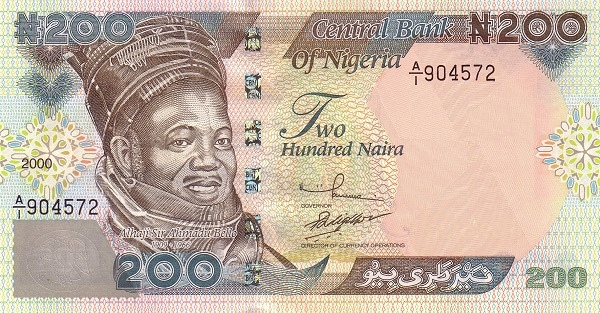
On the front, the note is dominated by a finely engraved portrait of Alhaji Sir Ahmadu Bello, the Sardauna of Sokoto and first Premier of Northern Nigeria, positioned to the left of centre against a warm brown and cream colour scheme. The portrait is rendered with considerable engraving detail, capturing Bello’s traditional attire and the characteristic wrapped headdress associated with northern Nigerian ceremonial dress, along with a beaded necklace visible at the collar. A printed caption beneath the portrait reads “Alhaji Sir Ahmadu Bello, 1909–1966,” confirming the identification. To the upper left and lower areas of the note, decorative rosette and snowflake-style guilloché patterns appear in pale blue and green, adding visual complexity to the background field. The denomination “₦200” appears prominently in the upper left corner and again in larger numerals in deep brown at the lower left, with the text “Two Hundred Naira” printed in stylised script across the centre-right of the note. The issuing authority is clearly stated as “Central Bank of Nigeria” across the upper right in bold serif lettering, accompanied by the serial number “A/1 904572” printed in dark ink. The year “2000” appears in small text at the left margin. Two facsimile signatures are present on the right-hand side, identified as the Governor and the Director of Currency Operations respectively. A large pale oval watermark area occupies the centre-right of the note, and text in Arabic script appears along the lower right edge, reflecting Nigeria’s multilingual heritage. A security strip is embedded within the paper, visible as a thin vertical thread running through the note’s body.
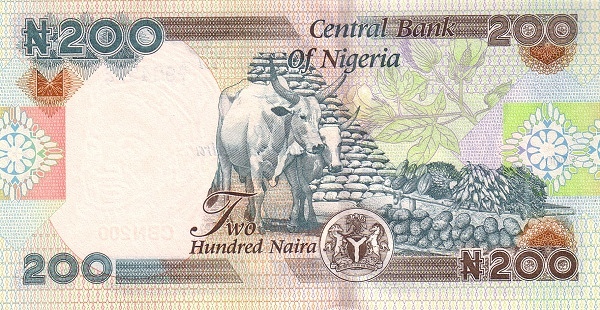
The reverse of the note is composed primarily in muted blue, green, grey, and brown tones, with the central design depicting a Zebu bull — a large-humped cattle breed common to West Africa — standing beside a collection of sacked goods arranged in a low mound, evoking themes of agriculture and trade central to the Nigerian northern economy. The scene is rendered in detailed intaglio engraving, with the bull’s musculature and the texture of the hessian sacks reproduced with considerable precision. To the right of the central vignette, leafy foliage and plant forms extend upward, rendered in green tones against a light background. Decorative guilloché rosettes in pale blue and green appear in the left and right margins, mirroring the front design. The text “Central Bank of Nigeria” is printed across the upper centre in clear serif type, with “₦200” appearing in the upper left and upper right corners. The denomination text “Two Hundred Naira” is written in the same stylised brown script as on the front, positioned beneath the central scene, and is accompanied by the Nigerian coat of arms rendered in small intaglio detail. The numeral “200” appears again in the lower left corner, and “₦200” is repeated at the lower right. A faint oval watermark zone is visible on the left side of the reverse, showing through from the front face of the note. Fine line pattern underprinting covers the background field throughout.
If you have a 200 Naira banknote to exchange, Webuyallcurrency.com takes it as part of its leftover currency service, combining your Nigerian Naira banknotes with other world coins and banknotes in one easy payout.
• Indicate the quantity of 200 Naira Naira banknotes you want to exchange
• Click the ‘Add to your account’ button
• Your online account now shows the exchange value
Webuyallcurrency.com makes it easy to sell foreign coins and banknotes for cash, taking Nigerian Naira banknotes along with modern and withdrawn currency so everything is converted in one step.
Other Nigerian Naira you can exchange: 5, 10, 20, 50, 100, 500, 1000.
Fast turnaround
We send your money within 5 working days of receiving your currency.
We’ll send your money by bank transfer, PayPal or cheque. You can also donate your exchange to a charity of your choice.
Easy and convenient
Get paid quickly
After counting your leftover coins and banknotes we’ll pay you within 5 working days. Get your payment quickly via PayPal or bank transfer.
No hidden charges
We don’t have any hidden charges, you will see our rates before you send any notes or coins. You receive the full value of the calculated exchange.
Get rid of currency that’s no longer in circulation
We also exchange discontinued foreign money. You can cash in all pre-euro currency as well as most obsolete currencies from outside the Eurozone.
Benefit from the best exchange rates online
Exchange rates change daily, that’s why we stay on top of the rate fluctuations so we can offer you the best rates for foreign money.
Happiness guarantee
We check your foreign currency and produce a formal quote, if you’re not happy we guarantee to send your currency back to you, absolutely free of charge.
Help out a charity with your exchange
We partner with many of the UK’s amazing charities. If you’d like to turn your old foreign money into a charitable donation, we can help.