
5 Nigerian Naira Banknote (Tafawa Balewa)
£0.000250
1 NGN = £0.000050
5 Naira Naira (Issued 2006-2008)
The 5 Naira banknote issued between 2006 and 2008 was withdrawn from legal tender status as part of Nigeria’s ongoing programme of currency modernisation, during which successive series of Naira notes were updated with improved security features and revised designs. This particular issue formed part of the broader Modern Naira series launched from 2005 onwards, which sought to standardise the visual identity of Nigerian currency while incorporating contemporary anti-counterfeiting measures. Its withdrawal reflected the Central Bank of Nigeria’s commitment to maintaining a secure and technologically current banknote supply rather than any catastrophic economic event. Holders of this note can no longer spend it within Nigeria, though it remains exchangeable through specialist currency services in the United Kingdom.
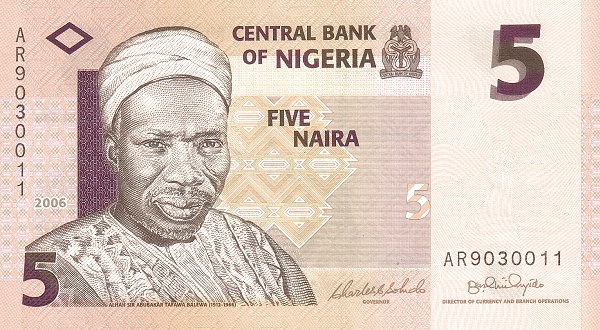
On the front, the dominant feature is a finely engraved portrait of Alhaji Sir Abubakar Tafawa Balewa (1912–1966), Nigeria’s first and only Federal Prime Minister, positioned to the left of centre against a pale background rendered in soft rose and cream tones. The portrait is executed with considerable engraving detail, capturing the distinctive white cap and traditional Northern Nigerian attire that Tafawa Balewa was widely associated with, along with the fine cross-hatching of the collar and garment folds. To the right of the portrait, a central geometric motif featuring a diamond and chevron pattern in cream and light gold tones provides an eye-catching guilloché-style decorative centrepiece. The words “CENTRAL BANK OF NIGERIA” are printed prominently in bold serif lettering across the upper portion of the note, with “FIVE NAIRA” displayed in slightly smaller text beneath in the central field. A large stylised numeral “5” appears in deep purple to the upper right, with a secondary “5” in the same colour positioned in the lower left corner. The serial number “AR9030011” appears twice — vertically along the left margin and horizontally in the lower right field — printed in a dark purple ink. The year “2006” is visible in the lower left area beneath the serial number. Two facsimile signatures appear along the lower portion of the note, labelled “GOVERNOR” and “DIRECTOR OF CURRENCY AND BRANCH OPERATIONS” respectively, printed in black. The overall colour palette of the front is dominated by muted purples, warm creams, and rose-pink tones, giving the note a restrained but dignified appearance consistent with its denomination.
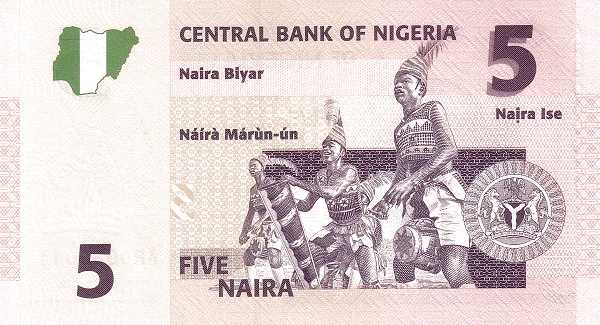
The reverse presents a vivid scene of traditional Nigerian cultural celebration, rendered in deep purple and brown engraving against a pale pink and cream ground. A group of traditionally dressed figures is depicted mid-performance, appearing to represent a cultural dance or ceremonial procession, with elaborate costumes including feathered headdresses, patterned garments, and staffs or ceremonial implements visible among the participants. The engraving work is detailed, capturing movement and texture in the figures’ attire. To the right of this central scene, a circular emblem resembling an official seal is clearly visible, featuring fine internal detail consistent with Nigerian heraldic imagery. In the upper left corner, a green and white map of Nigeria is prominently displayed, identifying the issuing nation’s geography with bold colour contrast. The words “CENTRAL BANK OF NIGERIA” appear in bold across the upper portion of the reverse, with “FIVE NAIRA” printed in the lower left in serif text. The numeral “5” appears in dark purple in the upper right corner. Two denomination inscriptions in Nigerian languages are printed on the left side of the note: “Naira Biyar” in Hausa appears in bold black text near the top, and “Náírà Márùn-ún” in Yoruba appears below it in italic lettering, reflecting Nigeria’s multilingual national identity. A second “5” in dark purple occupies the lower left corner of the reverse, maintaining visual balance across the design.
This 5 Naira banknote can be exchanged through Webuyallcurrency.com, where current Nigerian Naira banknotes are bought alongside other foreign currency — ideal for clearing a drawer of mixed coins and notes at once.
• Indicate the quantity of 5 Naira Naira banknotes you want to exchange
• Click the ‘Add to your account’ button
• Your online account now shows the exchange value
Got a mix of old coins and banknotes? Webuyallcurrency.com will exchange your Nigerian Naira banknotes alongside other leftover and foreign currency, settling the whole lot in one straightforward transaction.
Other Nigerian Naira you can exchange: 10, 20, 50, 100, 200, 500, 1000.
Fast turnaround
We send your money within 5 working days of receiving your currency.
We’ll send your money by bank transfer, PayPal or cheque. You can also donate your exchange to a charity of your choice.
Easy and convenient
Get paid quickly
After counting your leftover coins and banknotes we’ll pay you within 5 working days. Get your payment quickly via PayPal or bank transfer.
No hidden charges
We don’t have any hidden charges, you will see our rates before you send any notes or coins. You receive the full value of the calculated exchange.
Get rid of currency that’s no longer in circulation
We also exchange discontinued foreign money. You can cash in all pre-euro currency as well as most obsolete currencies from outside the Eurozone.
Benefit from the best exchange rates online
Exchange rates change daily, that’s why we stay on top of the rate fluctuations so we can offer you the best rates for foreign money.
Happiness guarantee
We check your foreign currency and produce a formal quote, if you’re not happy we guarantee to send your currency back to you, absolutely free of charge.
Help out a charity with your exchange
We partner with many of the UK’s amazing charities. If you’d like to turn your old foreign money into a charitable donation, we can help.