

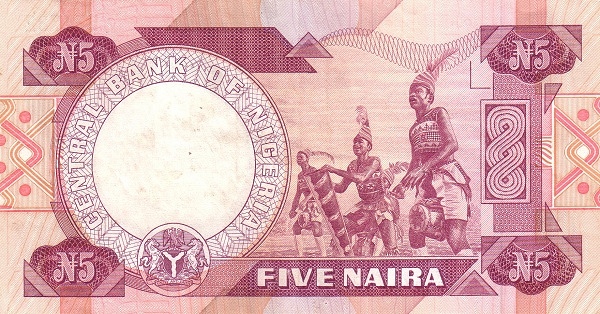
5 Nigerian Naira Paper Banknote (Tafawa Balewa Type 1984)
£0.000150
1 NGN = £0.000030
5 Naira Naira (Issued 1984-2000)
Nigeria’s five naira note from the Structural Adjustment Era carries a deeply patriotic message, honouring one of the nation’s founding political giants whilst celebrating the vibrancy of indigenous cultural expression. Issued during a period of significant economic restructuring under the Central Bank of Nigeria, this note reflects the government’s effort to anchor national identity in historical pride even as the naira faced mounting inflationary pressures. The warm rose and violet palette chosen for the note evokes both dignity and accessibility, qualities befitting a denomination that circulated widely in everyday Nigerian life. Across multiple redesigns between 1984 and 2000, the core iconography remained a statement of cultural continuity amid economic change.
On the front, the dominant figure is Alhaji Sir Abubakar Tafawa Balewa, Nigeria’s first and only Federal Prime Minister, whose name and dates 1912–1966 are inscribed beneath his portrait in fine serif lettering. The portrait is rendered in a detailed intaglio engraving style, set within a large circular frame positioned to the left of centre, and depicts Balewa wearing traditional northern Nigerian attire, his expression composed and statesmanlike. The background of the note is printed in soft rose and pink tones, overlaid with intricate guilloché rosette patterns that extend across the full width of the note, providing both visual complexity and a counterfeit deterrent. The issuing authority, “CENTRAL BANK OF NIGERIA,” is printed prominently in bold uppercase lettering along the top edge in deep violet, whilst “FIVE NAIRA” appears in a clear, authoritative typeface towards the upper centre. The Naira symbol with the numeral 5 — rendered as ₦5 — appears multiple times across the face of the note in varying sizes, including within decorative circular motifs at the left, centre-right, and far right of the design. A serial number, reading L/87 571782, is printed in violet in the upper right corner, with the prefix and number also repeated in smaller text to the lower left of centre. Two signatures appear at the lower portion of the note, one attributed to the Governor and the other to the Director of Domestic Operations, each accompanied by their respective titles in fine print. The lower central portion of the note features a band of Arabic-style script text, adding a further layer of cultural reference reflective of Nigeria’s diverse heritage.
The reverse of the note is printed predominantly in violet and rose tones, continuing the colour scheme established on the front. To the left, a large circular guilloché watermark zone frames the text “CENTRAL BANK OF NIGERIA” arranged in a circular arc, with the Nigerian coat of arms — featuring an eagle above a shield with a black band and wavy lines — printed at the base of this circle. The centrepiece of the reverse is a lively scene depicting traditional Nigerian dancers and musicians, rendered in fine engraved detail. The figures are shown in animated postures, wearing traditional costumes and headdresses, with one figure appearing to play a drum whilst others dance in ceremony around them, a vivid celebration of Nigeria’s rich cultural performance traditions. This scene is flanked on both sides by geometric and guilloché patterned panels. To the far right, a vertical rectangular panel features a bold interlocking spiral or serpentine pattern in deep violet. The denomination “FIVE NAIRA” is printed in clear bold uppercase lettering along the bottom centre of the reverse, and the ₦5 symbol appears in the upper left and lower right corners of the design. A wavy security thread or patterned band is visible running horizontally near the top of the note. The overall printing shows fine line detail consistent with the intaglio and offset lithographic techniques used by the Central Bank of Nigeria during this era.
Turn a 5 Naira banknote into money with Webuyallcurrency.com, which buys old or withdrawn Nigerian Naira banknotes along with a wide range of other foreign currency in a single, hassle-free transaction.
• Indicate the quantity of 5 Naira Naira banknotes you want to exchange
• Click the ‘Add to your account’ button
• Your online account now shows the exchange value
Whether you want to sell foreign coins and notes or exchange leftover currency from past trips, Webuyallcurrency.com accepts Nigerian Naira banknotes alongside modern money and settles everything in a single, easy transaction.
Other Nigerian Naira you can exchange: 10, 20, 50, 100, 200, 500, 1000.
Fast turnaround
We send your money within 5 working days of receiving your currency.
We’ll send your money by bank transfer, PayPal or cheque. You can also donate your exchange to a charity of your choice.
Easy and convenient
Get paid quickly
After counting your leftover coins and banknotes we’ll pay you within 5 working days. Get your payment quickly via PayPal or bank transfer.
No hidden charges
We don’t have any hidden charges, you will see our rates before you send any notes or coins. You receive the full value of the calculated exchange.
Get rid of currency that’s no longer in circulation
We also exchange discontinued foreign money. You can cash in all pre-euro currency as well as most obsolete currencies from outside the Eurozone.
Benefit from the best exchange rates online
Exchange rates change daily, that’s why we stay on top of the rate fluctuations so we can offer you the best rates for foreign money.
Happiness guarantee
We check your foreign currency and produce a formal quote, if you’re not happy we guarantee to send your currency back to you, absolutely free of charge.
Help out a charity with your exchange
We partner with many of the UK’s amazing charities. If you’d like to turn your old foreign money into a charitable donation, we can help.