
100 Rupees Central Bank Of Ceylon Banknote (Armorial Ensign Series)
£0.131000
1 LKR = £0.001310
100 Rupees Rupee (Issued 1956)
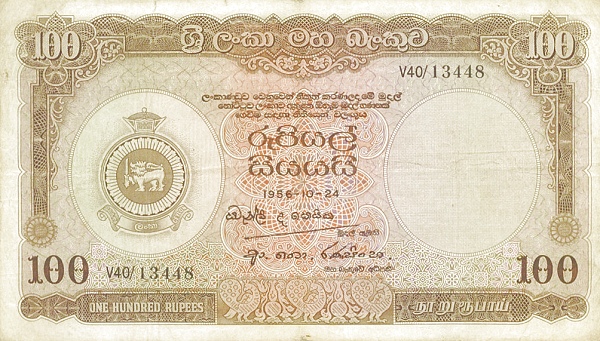
Issued just one year after Ceylon gained full membership of the Central Bank’s post-independence monetary framework, the 1956 one-hundred-rupee note represents a pivotal transitional moment in South Asian currency history — the country asserting a distinctly Ceylonese visual identity on its highest-denomination paper money while retaining the institutional gravitas of the Central Bank of Ceylon. A currency specialist examining this note would immediately notice the complete absence of any colonial portraiture, replaced instead by indigenous symbolism and script, marking a deliberate cultural and political statement in printed form. The date inscription of 1956-10-24 gives the note a precise historical anchor, placing it firmly within the era of S.W.R.D. Bandaranaike’s transformative premiership. The overall sepia and ochre tonal palette, combined with engraved guilloché work of considerable refinement, makes this an outstanding example of mid-twentieth-century South Asian intaglio printing.
On the front, the note is printed in warm sepia-brown tones across cream-toned paper, with a complex decorative border running the full perimeter consisting of fine repeated geometric and floral guilloché patterns that demonstrate a high level of engraving precision. In the upper centre, Sinhala script text forms the issuing authority name — the Central Bank of Ceylon — rendered in bold, stylised letterforms that dominate the upper register. Immediately below this, a dense block of text in Sinhala script occupies the central upper field, representing the legal tender promise of the bank. The serial number V40/13448 appears in the upper right field and is repeated again in the lower left, both printed in dark ink against the lighter background. To the left of centre sits a prominent circular emblem depicting the Sri Lanka state coat of arms — a lion passant holding a sword, enclosed within a decorative roundel with fine engraved cross-hatching providing tonal depth. The large denomination value in Sinhala script — reading as the equivalent of one hundred rupees — is printed in a bold, reddish-brown ink in the centre of the note, creating a strong visual focal point. The issue date 1956-10-24 is clearly printed below the central denomination text, followed by what appear to be two manuscript-style signatures in dark ink, each accompanied by printed Sinhala script titles denoting the signatories’ official positions within the bank. The numeral 100 appears in all four corners in standard Western numerals, printed in dark brown, while the lower border carries the English text ONE HUNDRED RUPEES in capital letters, flanked on the right by Tamil script denomination text. Decorative rosette motifs appear at the left and right edges of the lower section, adding further ornamentation to the overall design.
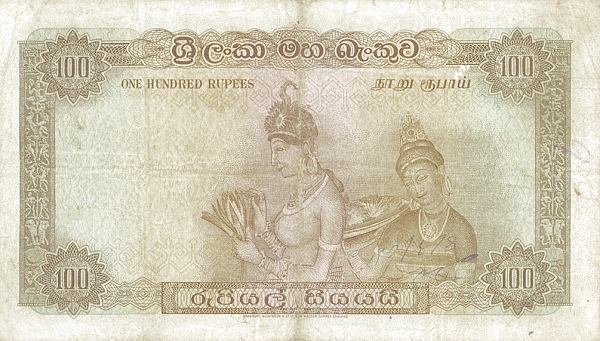
The reverse is printed in the same muted sepia-olive palette and features as its dominant central image a finely engraved scene of two female figures rendered in a classical Ceylonese artistic tradition, clearly derived from the style of the Sigiriya frescoes — the ancient cave paintings of Sri Lanka dating from the fifth century. The left-hand figure is depicted wearing an elaborate headdress adorned with a peacock feather motif, jewelled necklaces, armlets and bracelets, and holds a stylised floral offering in both hands. The right-hand figure wears a similarly ornate crown-like headdress and jewellery, and appears to be receiving or presenting flowers. Both figures are rendered with considerable engraving skill, their facial features, fabric folds, and jewellery details all articulated through fine line work and tonal graduation. Above this central scene, the issuing authority name appears again in Sinhala script at the top centre. To the left of the script name, the numeral 100 is printed, and to the right the English text ONE HUNDRED RUPEES appears in capitals, with Tamil script denomination text printed to the far right of the same line. The numeral 100 also appears in decorative star-burst roundels in all four corners of the reverse. A lower central panel carries further Sinhala script text in a decorative framed cartouche. The outer border mirrors the geometric guilloché patterning of the front, reinforcing the visual coherence of the design on both faces. The paper shows the characteristic texture and slight translucency of the period, with show-through visible from the front printing.
Have a 1956 Central Bank of Ceylon 100 Rupees banknote you no longer need? Webuyallcurrency.com lets you sell foreign coins and banknotes for cash, taking your Sri Lankan Rupees banknotes and other leftover currency in one simple exchange.
• Indicate the quantity of 100 Rupees Rupee banknotes you want to exchange
• Click the ‘Add to your account’ button
• Your online account now shows the exchange value
Got a mix of old coins and banknotes? Webuyallcurrency.com will exchange your Sri Lankan Rupees banknotes alongside other leftover and foreign currency, settling the whole lot in one straightforward transaction.
Other Sri Lankan Rupees you can exchange: 0.1, 0.25, 0.5, 1, 2, 5, 10, 20, 50, 200.
Fast turnaround
We send your money within 5 working days of receiving your currency.
We’ll send your money by bank transfer, PayPal or cheque. You can also donate your exchange to a charity of your choice.
Easy and convenient
Get paid quickly
After counting your leftover coins and banknotes we’ll pay you within 5 working days. Get your payment quickly via PayPal or bank transfer.
No hidden charges
We don’t have any hidden charges, you will see our rates before you send any notes or coins. You receive the full value of the calculated exchange.
Get rid of currency that’s no longer in circulation
We also exchange discontinued foreign money. You can cash in all pre-euro currency as well as most obsolete currencies from outside the Eurozone.
Benefit from the best exchange rates online
Exchange rates change daily, that’s why we stay on top of the rate fluctuations so we can offer you the best rates for foreign money.
Happiness guarantee
We check your foreign currency and produce a formal quote, if you’re not happy we guarantee to send your currency back to you, absolutely free of charge.
Help out a charity with your exchange
We partner with many of the UK’s amazing charities. If you’d like to turn your old foreign money into a charitable donation, we can help.