
100 Rupees Central Bank Of Ceylon Banknote (Swrd Bandaranaike Portrait Series)
£0.131000
1 LKR = £0.001310
100 Rupees Rupee (Issued 1963)
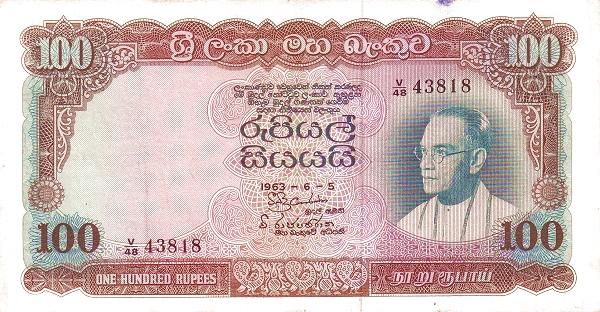
The 1963 one hundred rupee note belongs to the Central Bank of Ceylon’s post-independence series, a family of denominations that collectively marked Ceylon’s monetary identity following independence from British rule. Sharing design continuity with other denominations in the series through its use of Sinhala and Tamil script alongside English text, the one hundred rupee denomination stands apart as the highest-value note in the range, commanding a correspondingly elaborate and densely worked composition. The pairing of a prominent portrait on the front with classically inspired figurative imagery on the reverse gives this denomination a particularly ceremonial character. Together, these elements reflect the cultural and institutional confidence of the newly established Central Bank of Ceylon.
On the front, the note is dominated by a portrait positioned to the right of centre, depicting Dudley Senanayake, who served as Prime Minister of Ceylon during this period. The portrait is rendered in a fine intaglio engraving style, showing him in three-quarter profile, wearing spectacles and a collared jacket, with carefully detailed shading across the face and clothing that gives a strong sense of depth and texture. The overall colour scheme of the front is a warm combination of rose-red and dusky pink, offset by pale blue-green tones in the central panel. Across the top of the note, Sinhala script text identifies the Central Bank of Ceylon, and a matching inscription appears prominently as a header. A large denomination numeral “100” appears in the upper left and lower left corners in bold, dark lettering, while the lower border carries the English inscription “ONE HUNDRED RUPEES” in serif capitals, flanked by Tamil script text reading the equivalent denomination. Sinhala script in large characters occupies the central panel and denotes the rupee amount. The issue date 1963 is printed clearly in the central area alongside a hyphenated numerical date format. Two signature lines appear beneath the central text block, each accompanied by official titles rendered in both Sinhala and English. A serial number reading V/48 43818 appears in both the upper right and lower left areas of the note in dark numerals. The border design features an elaborate repetitive scalloped frame at the top and intricate geometric and floral guilloché patterning throughout, with additional ornamental corner devices incorporating stylised floral and lattice motifs. The paper carries a visible security watermark area to the left of the portrait.
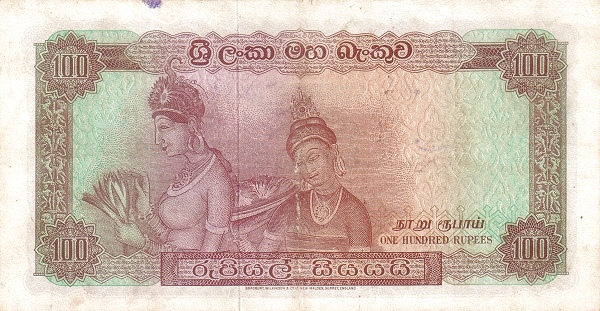
The reverse of the note is composed in a harmonious blend of green and dusky mauve-purple tones, with the central scene forming the visual focus. Two classically dressed female figures are depicted in a finely engraved, sculptural style inspired by traditional Sri Lankan iconography: the figure on the left is shown in profile holding a sheaf of foliage or lotus stems, adorned with elaborate jewellery including earrings and necklace, and wearing a decorative headdress; the figure to the right faces forward slightly, also richly ornamented with traditional jewellery and a tall, structured crown. Both figures are rendered with considerable engraving detail across fabric folds, jewellery, and facial features. To the lower right of the central scene, the denomination is stated in Tamil script above the English text “ONE HUNDRED RUPEES” in dark serif lettering. A rectangular banner at the lower centre carries Sinhala script text identifying the denomination. Across the top of the reverse, Sinhala script text again names the Central Bank of Ceylon, flanked by the numeral “100” in each upper corner. The border treatment mirrors the front with a scalloped upper edge and a geometric frame incorporating fine repetitive patterning. Small printer’s text appears along the very bottom edge of the reverse in English, identifying the security printer. The paper shows natural ageing consistent with a note of this period, with tonal variation across the surface.
Turn a 100 Rupees Central Bank of Ceylon banknote into money with Webuyallcurrency.com, which buys old or withdrawn Sri Lankan Rupees banknotes along with a wide range of other foreign currency in a single, hassle-free transaction.
• Indicate the quantity of 100 Rupees Rupee banknotes you want to exchange
• Click the ‘Add to your account’ button
• Your online account now shows the exchange value
Webuyallcurrency.com helps you exchange old coins and banknotes with no fuss, combining your Sri Lankan Rupees banknotes with other foreign currency into a single, hassle-free cash exchange.
Other Sri Lankan Rupees you can exchange: 0.1, 0.25, 0.5, 1, 2, 5, 10, 20, 50, 200.
Fast turnaround
We send your money within 5 working days of receiving your currency.
We’ll send your money by bank transfer, PayPal or cheque. You can also donate your exchange to a charity of your choice.
Easy and convenient
Get paid quickly
After counting your leftover coins and banknotes we’ll pay you within 5 working days. Get your payment quickly via PayPal or bank transfer.
No hidden charges
We don’t have any hidden charges, you will see our rates before you send any notes or coins. You receive the full value of the calculated exchange.
Get rid of currency that’s no longer in circulation
We also exchange discontinued foreign money. You can cash in all pre-euro currency as well as most obsolete currencies from outside the Eurozone.
Benefit from the best exchange rates online
Exchange rates change daily, that’s why we stay on top of the rate fluctuations so we can offer you the best rates for foreign money.
Happiness guarantee
We check your foreign currency and produce a formal quote, if you’re not happy we guarantee to send your currency back to you, absolutely free of charge.
Help out a charity with your exchange
We partner with many of the UK’s amazing charities. If you’d like to turn your old foreign money into a charitable donation, we can help.