
100 Rupees Central Bank Of Ceylon Banknote (Swrd Bandaranaike)
£0.131000
1 LKR = £0.001310
100 Rupees Rupee (Issued 1974)
The Central Bank of Ceylon, established in 1950, served as the sole monetary authority of Ceylon throughout the early 1970s, a period of considerable economic and political transformation on the island. By 1974, Ceylon had recently been renamed Sri Lanka under the 1972 republican constitution, yet the Central Bank continued to issue notes under the “Central Bank of Ceylon” name as the transitional currency framework remained in place. The 100 Rupees denomination represented the highest commonly circulating note of the era, used for significant commercial transactions and government payments. This series, spanning 1971 to 1975, bridges Ceylon’s colonial monetary legacy with the nascent institutions of the new republic.
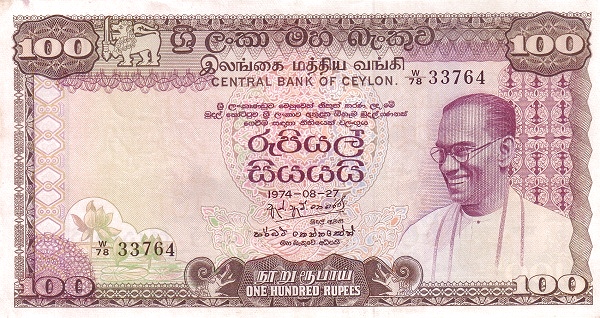
On the front, the note is printed predominantly in shades of mauve, rose, and lilac, with intricate guilloché patterning forming a decorative oval frame at the centre of the composition. To the right of centre sits a portrait of Dudley Senanayake, the prominent Ceylonese statesman and former Prime Minister, rendered in fine intaglio engraving; he is depicted wearing spectacles and a traditional Ceylonese national dress, smiling warmly, the engraving capturing subtle tonal depth in his features and clothing. At the top of the note, the issuing authority is identified in three scripts — Sinhala, Tamil, and English — with “CENTRAL BANK OF Ceylon” appearing in clear roman lettering across the upper register. The Sinhala and Tamil renderings of the bank’s name appear prominently above, alongside the denomination numeral “100” repeated in the upper left and upper right corners. A decorative lion emblem, the national symbol of Ceylon, is visible at the upper left within the header area. The central panel contains the denomination written in Sinhala script as රුපියල් සීයයදී, set within an ornamental cartouche surrounded by fine-line geometric border work. The issue date 1974-08-27 is printed clearly below the denomination text, accompanied by two facsimile signatures of authorising Central Bank officials, rendered in dark ink. The serial number W/8 33764 appears twice — once in the lower left and once in the upper right — printed in dark violet. A lotus flower motif is visible on the lower left, a recurring symbol in Ceylonese iconography. At the base of the note, the denomination is restated in both Sinhala script and English as “ONE HUNDRED RUPEES” within a dark ornamental band. The overall border of the note features repeated decorative floral and geometric patterns consistent with the engraving standards of the period.
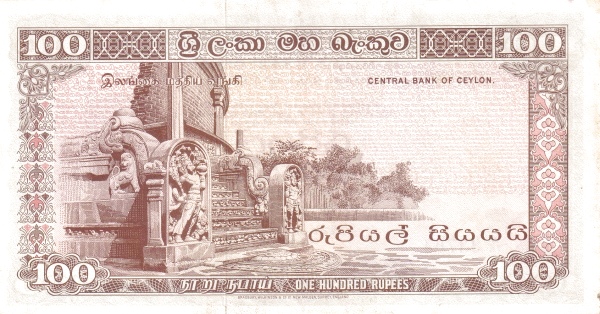
The reverse is printed in a warm reddish-brown and dusky rose palette, presenting an architectural scene of considerable historical significance. The central engraving depicts the moonstone and guardstone entrance of an ancient Ceylonese temple, identifiable as the style associated with the mediaeval ruins of Polonnaruwa or Anuradhapura, featuring a carved elephant guardstone to the left of a stone stairway, intricate relief carvings of figures ascending the steps, and a partial view of a traditional stupa or shrine structure rising behind the stonework. The engraving is executed with fine line work that conveys the texture of aged stone, the detail of carved figures, and the surrounding tropical foliage. To the upper left, the bank name appears again in Sinhala and Tamil script, while “CENTRAL BANK OF CEYLON.” is printed in English to the upper right. The denomination numeral “100” appears in the upper left and upper right corners, and the denomination is restated at the foot of the note in Sinhala script and as “ONE HUNDRED RUPEES” in English within a dark panel matching the front. The side borders of the reverse carry repeating ornamental patterns of interlocking geometric and floral motifs, framing the central architectural vignette symmetrically on both left and right edges.
Turn a 100 Rupees banknote into money with Webuyallcurrency.com, which buys old or withdrawn Sri Lankan Rupees banknotes along with a wide range of other foreign currency in a single, hassle-free transaction.
• Indicate the quantity of 100 Rupees Rupee banknotes you want to exchange
• Click the ‘Add to your account’ button
• Your online account now shows the exchange value
Webuyallcurrency.com is a simple way to exchange or sell foreign coins and banknotes for cash — current or withdrawn — turning your Sri Lankan Rupees banknotes and any other leftover currency into one straightforward payout.
Other Sri Lankan Rupees you can exchange: 0.1, 0.25, 0.5, 1, 2, 5, 10, 20, 50, 200.
Fast turnaround
We send your money within 5 working days of receiving your currency.
We’ll send your money by bank transfer, PayPal or cheque. You can also donate your exchange to a charity of your choice.
Easy and convenient
Get paid quickly
After counting your leftover coins and banknotes we’ll pay you within 5 working days. Get your payment quickly via PayPal or bank transfer.
No hidden charges
We don’t have any hidden charges, you will see our rates before you send any notes or coins. You receive the full value of the calculated exchange.
Get rid of currency that’s no longer in circulation
We also exchange discontinued foreign money. You can cash in all pre-euro currency as well as most obsolete currencies from outside the Eurozone.
Benefit from the best exchange rates online
Exchange rates change daily, that’s why we stay on top of the rate fluctuations so we can offer you the best rates for foreign money.
Happiness guarantee
We check your foreign currency and produce a formal quote, if you’re not happy we guarantee to send your currency back to you, absolutely free of charge.
Help out a charity with your exchange
We partner with many of the UK’s amazing charities. If you’d like to turn your old foreign money into a charitable donation, we can help.