

50 Rupees Central Bank Of Ceylon Banknote (Swrd Bandaranaike Portrait Series)
£0.065500
1 LKR = £0.001310
50 Rupees Rupee (Issued 1961-1965)
The 50 Rupees denomination sits at the upper end of the Central Bank of Ceylon’s post-independence series, sharing a consistent visual language with the lower denominations issued across the same period during the early 1960s. Across the series, a unified commitment to Sinhala and Tamil script lettering, engraved portraiture, and intricate guilloché patterning ties each value together as part of Ceylon’s first distinctly national currency identity following independence. The 50 Rupees note distinguishes itself through its commanding denomination figure, its choice of central portrait, and the architectural imagery selected for its reverse. The note was printed bearing the date 1963 and circulated within the 1961–1965 issue window.
On the front, the note is presented in a predominantly violet and lilac palette, with deeper purple tones concentrated around the border framework and the central engraved vignette. The numeral “50” appears prominently in the upper left and upper right corners, as well as repeated in the lower right, rendered in clear serif typography against the light background. At the top centre, Sinhala script text identifies the issuing authority — the Central Bank of Ceylon — displayed in a bold, stylised letterform. Below this, the English words “FIFTY RUPEES” appear in the left portion of the note in clear upper-case lettering, while Sinhala and Tamil script denomination texts are also present in the central and lower sections of the face. The serial number R/100 83736 is printed in two locations: the upper right and the lower left, in a dark blue-black ink. To the right of centre sits the engraved portrait of Solomon Bandaranaike, the prominent Ceylonese statesman who served as Prime Minister of Ceylon, depicted in a formal three-quarter pose, wearing traditional Ceylonese attire. The portrait is rendered with fine intaglio line work, capturing facial detail with precision. Centrally, an elaborate guilloché rosette and fine lathe-work pattern forms the security background, with delicate interlocking spirals and geometric mesh visible beneath the overprinted script text. Two manuscript signatures appear in the lower central area, attributed to the Governor and another senior official of the Central Bank of Ceylon, accompanied by small printed text designations in Sinhala script. The date 1963 is visible within the signature panel. A Sinhala script text panel runs vertically in the central section, presenting the denomination in native script alongside further Tamil script text near the lower margin. The border of the note is composed of a repeated fine-line frame with corner ornaments.
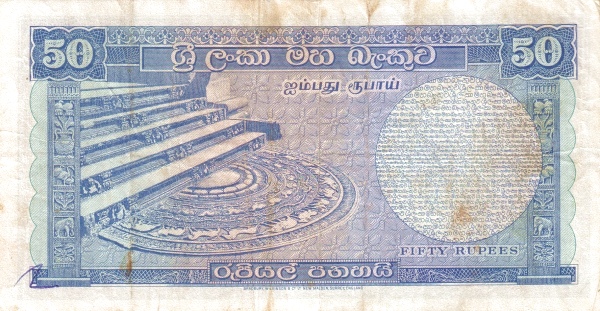
The reverse is rendered in a cooler, steel blue and pale indigo palette, with the same border framework of fine repeated geometric lines seen on the face. At the top centre, Sinhala script again identifies the Central Bank of Ceylon, flanked by the numeral “50” in the upper left and upper right corners. The dominant central design on the reverse features a detailed engraved depiction of the Vatadage — the ancient circular relic house — at Polonnaruwa, one of the most celebrated archaeological monuments in Sri Lanka. The image shows the broad stone staircase ascending to the circular platform, with the characteristic moonstone at the base of the steps rendered in careful engraving. The circular platform and its stone pillars are partially visible, conveying the grandeur of this sacred Buddhist architectural site. To the right of the Vatadage image sits a large circular guilloché medallion, densely packed with fine lathe-work text and geometric patterning, forming a watermark-style security rosette. Sinhala script text appears above this medallion area, and the English words “FIFTY RUPEES” are printed in the lower right portion of the note. Tamil and Sinhala script denomination text is also present along the lower margin. The side borders of the reverse carry decorative panel strips with repeating engraved motifs. The overall print shows signs of circulation wear consistent with a note that passed through regular use during its period of issue.
Whether it is a single 50 Rupees Central Bank of Ceylon banknote or a mix of leftover currency, Webuyallcurrency.com exchanges Sri Lankan Rupees banknotes and other foreign coins and notes for cash in one straightforward process.
• Indicate the quantity of 50 Rupees Rupee banknotes you want to exchange
• Click the ‘Add to your account’ button
• Your online account now shows the exchange value
Exchange foreign coins and banknotes the easy way — Webuyallcurrency.com buys Sri Lankan Rupees banknotes, current or discontinued, and combines them with the rest of your leftover currency for one simple payment.
Other Sri Lankan Rupees you can exchange: 0.1, 0.25, 0.5, 1, 2, 5, 10, 20, 100, 200.
Fast turnaround
We send your money within 5 working days of receiving your currency.
We’ll send your money by bank transfer, PayPal or cheque. You can also donate your exchange to a charity of your choice.
Easy and convenient
Get paid quickly
After counting your leftover coins and banknotes we’ll pay you within 5 working days. Get your payment quickly via PayPal or bank transfer.
No hidden charges
We don’t have any hidden charges, you will see our rates before you send any notes or coins. You receive the full value of the calculated exchange.
Get rid of currency that’s no longer in circulation
We also exchange discontinued foreign money. You can cash in all pre-euro currency as well as most obsolete currencies from outside the Eurozone.
Benefit from the best exchange rates online
Exchange rates change daily, that’s why we stay on top of the rate fluctuations so we can offer you the best rates for foreign money.
Happiness guarantee
We check your foreign currency and produce a formal quote, if you’re not happy we guarantee to send your currency back to you, absolutely free of charge.
Help out a charity with your exchange
We partner with many of the UK’s amazing charities. If you’d like to turn your old foreign money into a charitable donation, we can help.