
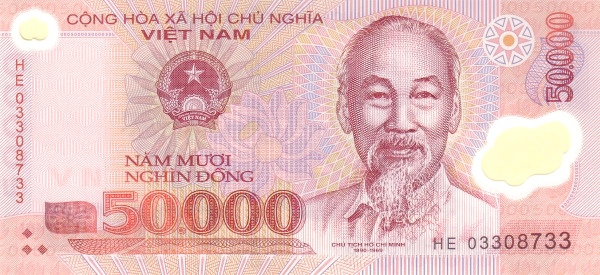
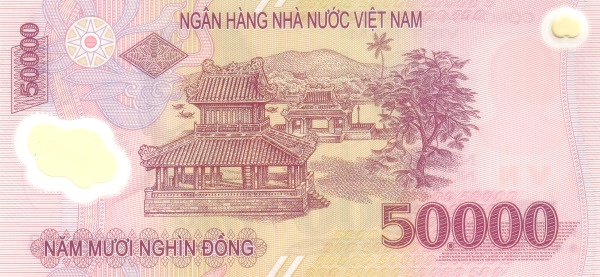
50,000 Vietnamese Dong banknote
£1.001000
1 VND = £0.000020
50,000 Ðồng Dong (Issued 2003-2025)
Polymer substrate technology has transformed banknote production since the early 2000s, and Vietnam’s 50,000 Dong stands as one of the earlier large-denomination polymer issues to demonstrate the format’s durability advantages over traditional cotton-paper notes. The transparent window elements and crisp intaglio printing that defined this note’s security architecture have since become standard expectations in contemporary polymer currency worldwide. What remains constant across both eras is the use of portraiture and architectural engraving as the twin pillars of national identity on circulating currency. This note strikes a balance between technological modernity and deep cultural symbolism that continues to feel deliberate rather than dated.
On the front, the dominant feature is a finely engraved portrait of Ho Chi Minh, the founding leader and first President of the Democratic Republic of Vietnam, positioned to the right of centre against a warm rose-pink and salmon background. The portrait is rendered with considerable detail, showing his characteristic thin beard and gentle expression, with fine crosshatched engraving giving depth and texture to his facial features. To the left of the portrait sits the national emblem of Vietnam — a circular device bearing a five-pointed yellow star at its centre, surrounded by stylised rice sheaves and a gear wheel at the base, printed in deep red tones. Below the emblem, the denomination text appears in Vietnamese as “NAM MUOI NGHIN DONG,” printed in bold dark lettering. The large numeral “50000” dominates the lower centre of the note in a strong serif typeface in deep red. The serial number “HE 03308733” appears in dark red at the lower right, with the vertical serial number “HE 03308733” also visible along the left edge. The issuing authority text “CONG HOA XA HOI CHU NGHIA VIET NAM” — rendered in Latin script — runs along the upper portion of the note. A caption below the portrait, also in Latin script, reads “CHU TICH HO CHI MINH” with date references, confirming the sitter’s identity. To the upper right, the denomination “50,000” is printed vertically in a contrasting panel. The note incorporates a transparent polymer window in the upper right area, characteristic of the polymer substrate, along with an embedded security element visible as a small star or geometric motif within that window. Guilloché rosette patterns and fine-line background printing in pale lilac and pink fill the field around the portrait, providing visual complexity that deters counterfeiting.
The reverse features a detailed intaglio engraving of a traditional Vietnamese architectural complex, identifiable as the Hue Imperial City — specifically a multi-tiered pavilion with curved, sweeping rooflines typical of Vietnamese imperial court architecture, set against a backdrop of hills and trees rendered in fine linear engraving. The scene is executed in deep red-brown tones over the same warm rose-pink polymer background, with considerable detail in the roof tiles, columns, and surrounding landscape vegetation. A tall palm tree rises to the right of the main structure, and the surrounding grounds include additional smaller buildings and walls consistent with the imperial citadel complex. To the upper left, a decorative geometric motif incorporating a compass-star or stylised floral medallion appears alongside fine guilloché patterning. The issuing authority name in Latin script, “NGAN HANG NHA NUOC VIET NAM,” is printed in dark lettering across the top of the note. The denomination “50000” appears in bold red numerals in the lower right, and the text “NAM MUOI NGHIN DONG” runs along the lower left in matching typography. A transparent polymer window is visible in the upper right corner on this side as well, consistent with the window placement on the obverse. The overall background is filled with fine-line security printing in soft pink and lilac tones that complement the engraved centrepiece.
Exchange foreign coins and notes with no fuss: Webuyallcurrency.com accepts this 50,000 Dong banknote and other current Vietnamese Dong banknotes, paying out for everything together in a single transaction.
• Indicate the quantity of 50,000 Ðồng Dong banknotes you want to exchange
• Click the ‘Add to your account’ button
• Your online account now shows the exchange value
Wondering who buys foreign coins and banknotes? Webuyallcurrency.com does — bring your Vietnamese Dong banknotes together with any other old or withdrawn currency and exchange it all for cash in one place.
Other Vietnamese Dong you can exchange: 10, 50, 100, 200, 500, 1000, 2000, 5000, 10000, 20000.
Fast turnaround
We send your money within 5 working days of receiving your currency.
We’ll send your money by bank transfer, PayPal or cheque. You can also donate your exchange to a charity of your choice.
Easy and convenient
Get paid quickly
After counting your leftover coins and banknotes we’ll pay you within 5 working days. Get your payment quickly via PayPal or bank transfer.
No hidden charges
We don’t have any hidden charges, you will see our rates before you send any notes or coins. You receive the full value of the calculated exchange.
Get rid of currency that’s no longer in circulation
We also exchange discontinued foreign money. You can cash in all pre-euro currency as well as most obsolete currencies from outside the Eurozone.
Benefit from the best exchange rates online
Exchange rates change daily, that’s why we stay on top of the rate fluctuations so we can offer you the best rates for foreign money.
Happiness guarantee
We check your foreign currency and produce a formal quote, if you’re not happy we guarantee to send your currency back to you, absolutely free of charge.
Help out a charity with your exchange
We partner with many of the UK’s amazing charities. If you’d like to turn your old foreign money into a charitable donation, we can help.