

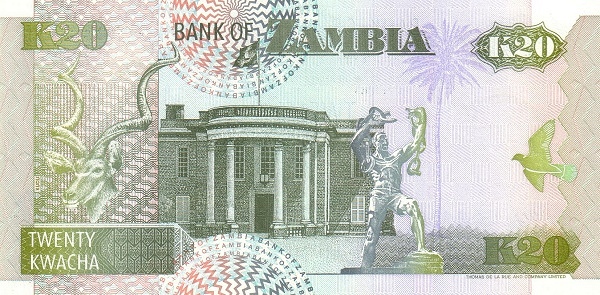
20 Zambian Kwacha Banknote (1992)
£0.000201
1 ZMW = £0.000010
20 Kwacha Zambian Kwacha (Issued 1992)
The 20 Kwacha note issued by the Bank of Zambia in 1992 was withdrawn from circulation as Zambia’s economy struggled through a prolonged period of severe inflation during the early 1990s, a era that ultimately necessitated a comprehensive redenomination of the national currency. The inflationary pressures of this period rendered lower-denomination notes increasingly impractical in everyday transactions, and successive issues were superseded by higher-value notes before the entire pre-redenomination Kwacha series was retired. Zambia eventually replaced the old Kwacha with a new Kwacha in 2013, at a conversion rate of 1,000 old Kwacha to one new Kwacha, bringing a definitive end to the legal tender status of notes such as this one. Today, this 1992 issue represents one of the surviving physical records of Zambia’s inflation era monetary history.
On the front, the design is dominated by a large, boldly rendered African fish eagle standing upright on a branch at the right-hand side of the note, depicted in detailed intaglio-style engraving with white plumage on its head and chest contrasting against darker green and brown tones on its wings and body. The bird is set against a background featuring a broad-canopied tree, rendered in warm orange and golden tones, which occupies much of the central and right-centre area of the note. To the left, a stylised flying dove is printed in pale green against a background of fine diagonal hatching and geometric guilloche patterning, which transitions across the note in shades of green, gold, and pale orange. The issuing authority is clearly identified by the text “BANK OF ZAMBIA” printed in bold capitals along the top of the note, while the denomination is stated prominently in two locations as “K20” in large stylised lettering in the upper left and upper right corners, as well as in full text reading “TWENTY KWACHA” in bold capitals at the centre. A serial number, printed in red as “AA 0702290”, appears twice — once vertically along the left margin and once horizontally in the lower centre of the note. A circular green seal reading “ZAMBIA 1992” is positioned in the lower left corner, incorporating what appears to be a decorative emblem at its centre. The promise to pay clause reads “I PROMISE TO PAY THE BEARER ON DEMAND” and “FOR THE BANK OF ZAMBIA” in small print, accompanied by a signature line attributed to the Governor. The overall colour palette of the front combines light greens, warm ambers, and pale cream tones, with fine microprinting and guilloche work providing visual depth across the background field.
The reverse of the note is printed in a palette of muted greens, olive tones, and purple-grey hues. At the centre is a detailed engraved depiction of a large, classically styled colonial-era building with a symmetrical façade featuring columns, a central portico, and regularly spaced windows — identifiable as the Bank of Zambia headquarters in Lusaka. To the right of the building stands a sculptural group depicting a human figure raising one arm aloft, rendered in fine engraving against a background that includes a tall palm tree. To the left of the building, two antelopes or similar wildlife animals are visible, rendered in a stylised engraved manner against further guilloche background patterning. A flying dove, echoing the motif from the front, appears to the far right in pale tones. The denomination text “TWENTY KWACHA” appears in bold lettering within a coloured panel at the lower left, and the “K20” denomination mark is repeated in the upper left and lower right corners. The issuing authority text “BANK OF ZAMBIA” runs along the top of the note in bold capitals, while a diagonal band of microprinted text reading “BANK OF ZAMBIA” repeats across the central background. The printer’s imprint, reading “THOMAS DE LA RUE AND COMPANY LIMITED”, is visible in small text at the lower right margin, confirming the note was produced by one of the world’s most established security printers.
Sell foreign coins and banknotes the simple way: this 20 Kwacha banknote can be exchanged through Webuyallcurrency.com together with other old or withdrawn Zambian Kwacha banknotes, all settled in a single transaction.
• Indicate the quantity of 20 Kwacha Zambian Kwacha banknotes you want to exchange
• Click the ‘Add to your account’ button
• Your online account now shows the exchange value
Wondering who buys foreign coins and banknotes? Webuyallcurrency.com does — bring your Zambian Kwacha banknotes together with any other old or withdrawn currency and exchange it all for cash in one place.
Other Zambian Kwacha you can exchange: 1, 2, 5, 10, 50, 100, 200, 500, 1000, 5000.
Fast turnaround
We send your money within 5 working days of receiving your currency.
We’ll send your money by bank transfer, PayPal or cheque. You can also donate your exchange to a charity of your choice.
Easy and convenient
Get paid quickly
After counting your leftover coins and banknotes we’ll pay you within 5 working days. Get your payment quickly via PayPal or bank transfer.
No hidden charges
We don’t have any hidden charges, you will see our rates before you send any notes or coins. You receive the full value of the calculated exchange.
Get rid of currency that’s no longer in circulation
We also exchange discontinued foreign money. You can cash in all pre-euro currency as well as most obsolete currencies from outside the Eurozone.
Benefit from the best exchange rates online
Exchange rates change daily, that’s why we stay on top of the rate fluctuations so we can offer you the best rates for foreign money.
Happiness guarantee
We check your foreign currency and produce a formal quote, if you’re not happy we guarantee to send your currency back to you, absolutely free of charge.
Help out a charity with your exchange
We partner with many of the UK’s amazing charities. If you’d like to turn your old foreign money into a charitable donation, we can help.