
5000 Zambian Kwacha Banknote (Lion Boz Type)
£0.050250
1 ZMW = £0.000010
5,000 Kwacha Zambian Kwacha (Issued 2003-2012)
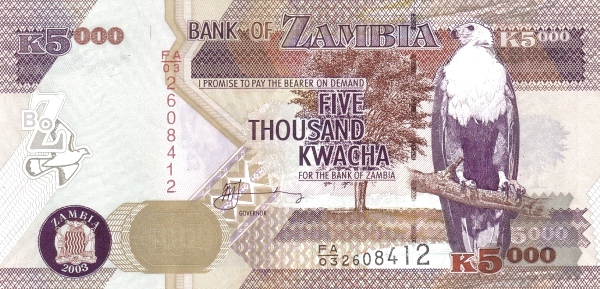
The African Fish Eagle, Zambia’s national bird and one of the most recognisable symbols of the nation, takes pride of place on the 5,000 Kwacha banknote issued by the Bank of Zambia between 2003 and 2012. Chosen as a powerful emblem of freedom and national identity, the eagle’s presence on this denomination reflects Zambia’s deep cultural and symbolic connection to this majestic raptor. The note forms part of the modernised series introduced by the Bank of Zambia in 2002, which brought a more contemporary visual language to the country’s circulating currency. Now withdrawn from circulation, this banknote represents a significant chapter in Zambia’s monetary history prior to the redenomination of the Kwacha in 2013.
On the front, the dominant central-right image is a finely engraved African Fish Eagle perched upon a branch, rendered in crisp intaglio detail with its characteristic white head, dark brown body plumage, and strong talons clearly depicted. Behind the eagle stands a large acacia-style tree, its canopy spreading across the central field of the note. The overall colour palette of the front is a blend of lilac, purple, and soft grey tones, accented with gold and olive highlights. To the upper left, the issuing authority name “BANK OF ZAMBIA” is printed in bold, prominent lettering, while the denomination appears both as “K5000” in the upper left corner and as the full text “FIVE THOUSAND KWACHA” in large, emboldened typeface across the central portion of the note. The promise text “I PROMISE TO PAY THE BEARER ON DEMAND” is printed in a smaller serif font above the denomination wording, followed by “FOR THE BANK OF ZAMBIA” beneath it. A vertical serial number “FA 032608412” appears on the left side of the note, printed in a deep intaglio ink, and the same serial number is repeated horizontally along the lower centre of the note. A circular purple seal bearing “ZAMBIA 2003” is positioned in the lower left corner, incorporating a fine guilloché design within its border. To the left of the eagle, an embossed silver holographic strip is integrated into the paper, bearing the Bank of Zambia “BoZ” monogram with a dove motif, providing a key security feature. A Governor’s signature appears in printed form beneath the central denomination text. The background of the front face is filled with intricate guilloché latticework in pale tones, providing anti-counterfeiting complexity across the entire field.
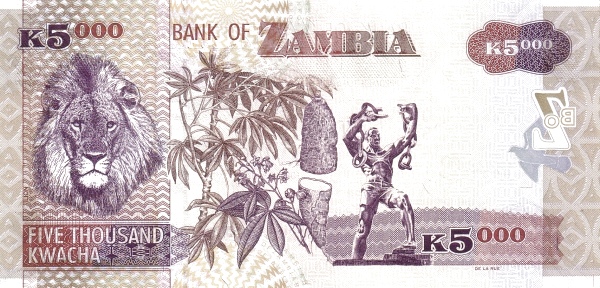
The reverse of the 5,000 Kwacha note is rich in symbolic imagery and national iconography. On the far left, a boldly engraved close-up portrait of an African lion’s head is rendered in fine intaglio lines, its mane and facial features depicted with considerable detail in warm brown and golden tones against a background of textured chevron and wave-pattern guilloché. Centrally positioned on the reverse is a detailed botanical illustration of a tropical plant — likely a cassava plant — its broad leaves and thick stem rendered in green and brown tones. To the right of the botanical image stands a figurative bronze-coloured statue of a man breaking chains, a powerful sculptural image evoking freedom and independence. The statue is depicted mid-motion, arms raised, and represents the spirit of Zambia’s liberation and sovereignty. The “BANK OF ZAMBIA” header appears across the top of the reverse, and the denomination “K5,000” is printed both in the upper right corner and again in a larger format in the lower right field. “FIVE THOUSAND KWACHA” is printed in bold text to the lower left, positioned beneath the lion’s portrait. On the far right, the “BoZ” holographic element and dove motif appear in mirror format, consistent with the front. The printer’s imprint “DE LA RUE” is visible in small text at the lower right corner, confirming the note’s production by the renowned British security printing firm. The reverse background continues the guilloché wave and hatching patterns seen on the front, maintaining a consistent anti-counterfeiting design language throughout the note.
Wondering who buys foreign coins and notes? Webuyallcurrency.com does — a 5,000 Kwacha banknote like this is accepted alongside other old or withdrawn Zambian Kwacha banknotes, so you can exchange the lot for cash at once.
• Indicate the quantity of 5,000 Kwacha Zambian Kwacha banknotes you want to exchange
• Click the ‘Add to your account’ button
• Your online account now shows the exchange value
Webuyallcurrency.com makes it easy to sell foreign coins and banknotes for cash, taking Zambian Kwacha banknotes along with modern and withdrawn currency so everything is converted in one step.
Other Zambian Kwacha you can exchange: 1, 2, 5, 10, 20, 50, 100, 200, 500, 1000.
Fast turnaround
We send your money within 5 working days of receiving your currency.
We’ll send your money by bank transfer, PayPal or cheque. You can also donate your exchange to a charity of your choice.
Easy and convenient
Get paid quickly
After counting your leftover coins and banknotes we’ll pay you within 5 working days. Get your payment quickly via PayPal or bank transfer.
No hidden charges
We don’t have any hidden charges, you will see our rates before you send any notes or coins. You receive the full value of the calculated exchange.
Get rid of currency that’s no longer in circulation
We also exchange discontinued foreign money. You can cash in all pre-euro currency as well as most obsolete currencies from outside the Eurozone.
Benefit from the best exchange rates online
Exchange rates change daily, that’s why we stay on top of the rate fluctuations so we can offer you the best rates for foreign money.
Happiness guarantee
We check your foreign currency and produce a formal quote, if you’re not happy we guarantee to send your currency back to you, absolutely free of charge.
Help out a charity with your exchange
We partner with many of the UK’s amazing charities. If you’d like to turn your old foreign money into a charitable donation, we can help.